




A private, multi-model, 100% local, full-featured alternative to Notebook LM
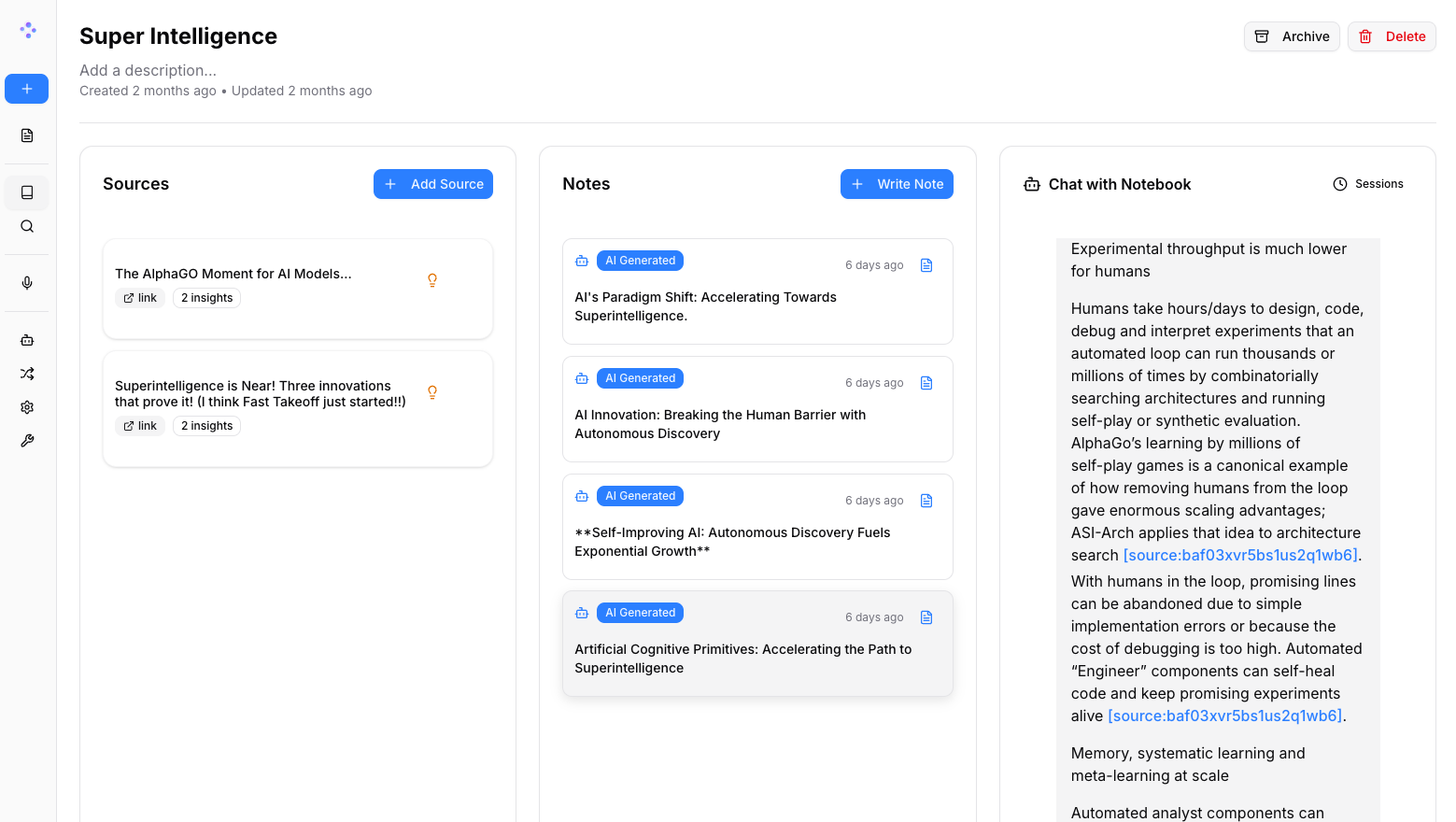
In a world dominated by Artificial Intelligence, having the ability to think 🧠 and acquire new knowledge 💡, is a skill that should not be a privilege for a few, nor restricted to a single provider.
Open Notebook empowers you to:
- 🔒 Control your data - Keep your research private and secure
- 🤖 Choose your AI models - 20+ providers including OpenAI, Anthropic, Google, Mistral, Ollama and any OpenAI-compatible server (LM Studio, vLLM)
- 📚 Organize multi-modal content - PDFs, videos, audio, web pages, and more
- 🎙️ Generate professional podcasts - Advanced multi-speaker podcast generation
- 🔍 Search intelligently - Full-text and vector search across all your content
- 💬 Chat with context - AI conversations powered by your research
- 🌐 Multi-language UI - English, Bengali, Catalan, Chinese (Simplified & Traditional), French, German, Italian, Japanese, Polish, Portuguese, Russian, Spanish and Turkish
Learn more about our project at https://www.open-notebook.ai
🆚 Open Notebook vs Google Notebook LM
| Feature |
Open Notebook |
Google Notebook LM |
Advantage |
| Privacy & Control |
Self-hosted, your data |
Google cloud only |
Complete data sovereignty |
| AI Provider Choice |
20+ providers, cloud or local (OpenAI, Anthropic, Google, Ollama, LM Studio, etc.) |
Google models only |
Flexibility and cost optimization |
| Podcast Speakers |
1-4 speakers with custom profiles |
2 speakers only |
Extreme flexibility |
| Content Transformations |
Custom and built-in |
Limited options |
Unlimited processing power |
| API Access |
Full REST API |
No API |
Complete automation |
| Deployment |
Docker, cloud, or local |
Google hosted only |
Deploy anywhere |
| Citations |
Answers cite the sources, notes and insights they used |
Comprehensive with sources |
Research integrity |
| Customization |
Open source, fully customizable |
Closed system |
Unlimited extensibility |
| Cost |
Pay only for AI usage |
Free tier + Monthly subscription |
Transparent and controllable |
Why Choose Open Notebook?
- 🔒 Privacy First: Your sensitive research stays completely private
- 💰 Cost Control: Choose cheaper AI providers or run locally with Ollama
- 🎙️ Better Podcasts: Full script control and multi-speaker flexibility vs limited 2-speaker deep-dive format
- 🔧 Unlimited Customization: Modify, extend, and integrate as needed
- 🌐 No Vendor Lock-in: Switch providers, deploy anywhere, own your data
Built With




🚀 Quick Start
Prerequisites
- Docker Desktop (macOS, Windows) or Docker Engine with the Compose plugin (Linux)
- An API key from an AI provider, or a local model server such as Ollama. You add it in the UI, not in config files.
Step 1: Download docker-compose.yml
mkdir open-notebook && cd open-notebook
curl -o docker-compose.yml https://raw.githubusercontent.com/lfnovo/open-notebook/main/docker-compose.yml
This is the official docker-compose.yml from this repository. It runs two services: surrealdb (the database) and open_notebook (UI, API and background worker).
Step 2: Set your encryption key
Edit docker-compose.yml and change this line:
- OPEN_NOTEBOOK_ENCRYPTION_KEY=change-me-to-a-secret-string
to a long random secret you generate yourself (for example with openssl rand -hex 32; other options). It encrypts the API keys you store; keep it.
Shared network or server? The UI (8502) and API (5055) are published on all network interfaces and there is no password by default. If other devices can reach this machine, change those two port lines to "127.0.0.1:8502:8502" and "127.0.0.1:5055:5055", or add - OPEN_NOTEBOOK_PASSWORD=your-password to the environment: block, before starting.
Step 3: Start services
docker compose up -d
Wait about 30 seconds, then open: http://localhost:8502
Step 4: Connect an AI provider
- In the sidebar, open Models (under Manage).
- Find your provider (OpenAI, Anthropic, Google, etc.) and click Add Configuration.
- Enter a name and your API key (local providers such as Ollama need a Base URL instead), then click Add Configuration.
- Click Test on the new configuration to check the connection.
- Click Models, choose a Model Type, tick the models to add and click Add. Add at least one Language model and one Embedding model.
- Under Default Model Assignments, click Auto-assign Defaults (or pick the models yourself).
Done! Create a notebook, add a source and start chatting. Full walkthrough: Connect a provider.
Need an API key? Get one from:
OpenAI · Anthropic · Google · Groq
Anthropic and Groq have no embedding models; pair them with a provider that does (see the matrix).
Want free local AI? See the Local Quick Start (Ollama in Docker).
📚 More Installation Options
📖 Need Help?
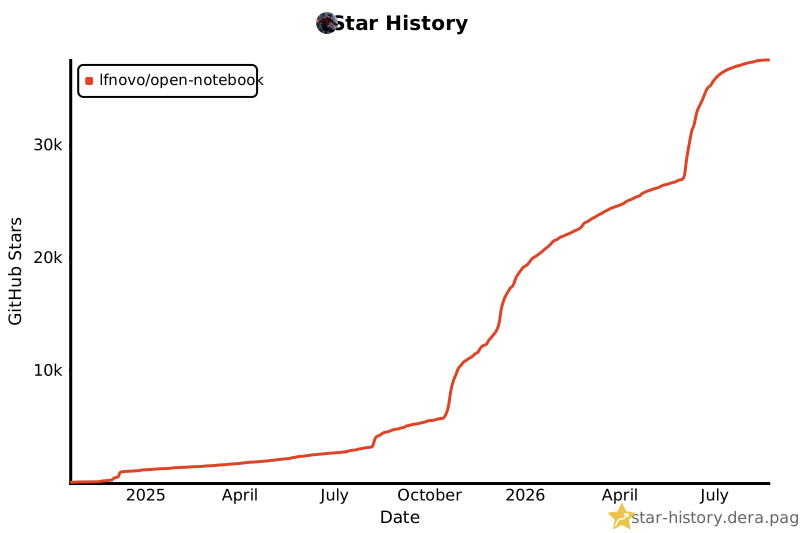
Star History
Provider Support Matrix
Thanks to the Esperanto library, we support these providers out of the box. The columns show the model types each provider offers; what you can use depends on your account.
| Provider |
LLM Support |
Embedding Support |
Speech-to-Text |
Text-to-Speech |
| OpenAI |
✅ |
✅ |
✅ |
✅ |
| Anthropic |
✅ |
❌ |
❌ |
❌ |
| Google (GenAI) |
✅ |
✅ |
✅ |
✅ |
| Groq |
✅ |
❌ |
✅ |
❌ |
| Mistral |
✅ |
✅ |
✅ |
✅ |
| DeepSeek |
✅ |
❌ |
❌ |
❌ |
| xAI |
✅ |
❌ |
❌ |
✅ |
| OpenRouter |
✅ |
✅ |
✅ |
✅ |
| DashScope (Qwen) |
✅ |
❌ |
❌ |
❌ |
| MiniMax |
✅ |
❌ |
❌ |
✅ |
| Novita |
✅ |
❌ |
❌ |
❌ |
| SiliconFlow |
✅ |
❌ |
❌ |
❌ |
| Z.ai |
✅ |
❌ |
❌ |
❌ |
| PayPerQ (PPQ) |
✅ |
✅ |
✅ |
✅ |
| Cohere |
✅ |
✅ |
❌ |
❌ |
| Voyage |
❌ |
✅ |
❌ |
❌ |
| ElevenLabs |
❌ |
❌ |
✅ |
✅ |
| Deepgram |
❌ |
❌ |
✅ |
✅ |
| Ollama |
✅ |
✅ |
❌ |
❌ |
| oMLX |
✅ |
✅ |
❌ |
❌ |
| Azure OpenAI |
✅ |
✅ |
✅ |
✅ |
| Vertex AI |
✅ |
✅ |
❌ |
✅ |
| OpenAI Compatible* |
✅ |
✅ |
✅ |
✅ |
| Anthropic Compatible |
✅ |
❌ |
❌ |
❌ |
*Supports LM Studio and any OpenAI-compatible endpoint. Prefer the native oMLX provider for oMLX (Apple Silicon); see docs/5-CONFIGURATION/omlx.md.
✨ Key Features
Core Capabilities
- 🔒 Privacy-First: Self-hosted; with local models nothing leaves your machine
- 🎯 Multi-Notebook Organization: Manage multiple research projects seamlessly
- 📚 Universal Content Support: PDFs, videos, audio, web pages, Office docs, and more
- 🤖 Multi-Model AI Support: 20+ providers including OpenAI, Anthropic, Ollama, Google, LM Studio, and more
- 🎙️ Professional Podcast Generation: Advanced multi-speaker podcasts with Episode Profiles
- 🔍 Intelligent Search: Full-text and vector search across all your content
- 💬 Context-Aware Chat: AI conversations powered by your research materials
- 📝 AI-Assisted Notes: Generate insights or write notes manually
Advanced Features
- ⚡ Reasoning Model Support: Full support for thinking models like DeepSeek-R1 and Qwen3
- 🔧 Content Transformations: Powerful customizable actions to summarize and extract insights
- 🌐 Comprehensive REST API: Full programmatic access for custom integrations

- 🔐 Optional Password Protection: Secure public deployments with authentication
- 📊 Fine-Grained Context Control: Choose exactly what to share with AI models
- 📎 Citations: Get answers with proper source citations
Podcast Feature

📚 Documentation
Getting Started
User Guide
Advanced Topics
(back to top)
🗺️ Where We're Going
Right now the focus is on making the core experience (sources, chat, search, notes, podcasts) solid across every provider and deployment, before adding new product surfaces. The bigger directions under consideration, such as multi-user support, new output formats and agents operating Open Notebook through MCP, are described in the Horizon section of VISION.md. They are directions, not dated promises.
Explore GitHub Discussions for proposed features and product ideas, and open Issues for known bugs and approved work. Recent changes are in the CHANGELOG.
(back to top)
📖 Need Help?
- 💬 Discord Server - Get help, share ideas, and connect with other users
- 𝕏 Follow @lfnovo on X - Project updates and news from the maintainer
- 💡 GitHub Discussions - Ask questions and shape features, product direction, design, and architecture
- 🐛 GitHub Issues - Report reproducible bugs and find approved work
- ⭐ Star this repo - Show your support and help others discover Open Notebook
Contributing
We welcome contributions! We're especially looking for help with:
- Frontend Development: Help improve our modern Next.js/React UI
- Testing & Bug Fixes: Make Open Notebook more robust
- Feature Development: Build the coolest research tool together
- Documentation: Improve guides and tutorials
Current Tech Stack: Python, FastAPI, Next.js, React, SurrealDB
See our Contributing Guide for detailed information on how to get started, including our guidelines for AI-assisted contributions. To understand what we're building (and what we'll say no to), read VISION.md.
(back to top)
📄 License
Open Notebook is MIT licensed. See the LICENSE file for details.
Community Support:
(back to top)


 Open Notebook 是一个可自托管的开源项目,是 Google Notebook LM 的替代品。它可以帮你整理研究资料、与文档对话,并使用你自行选择的 AI 服务商生成播客。