Orbit PI


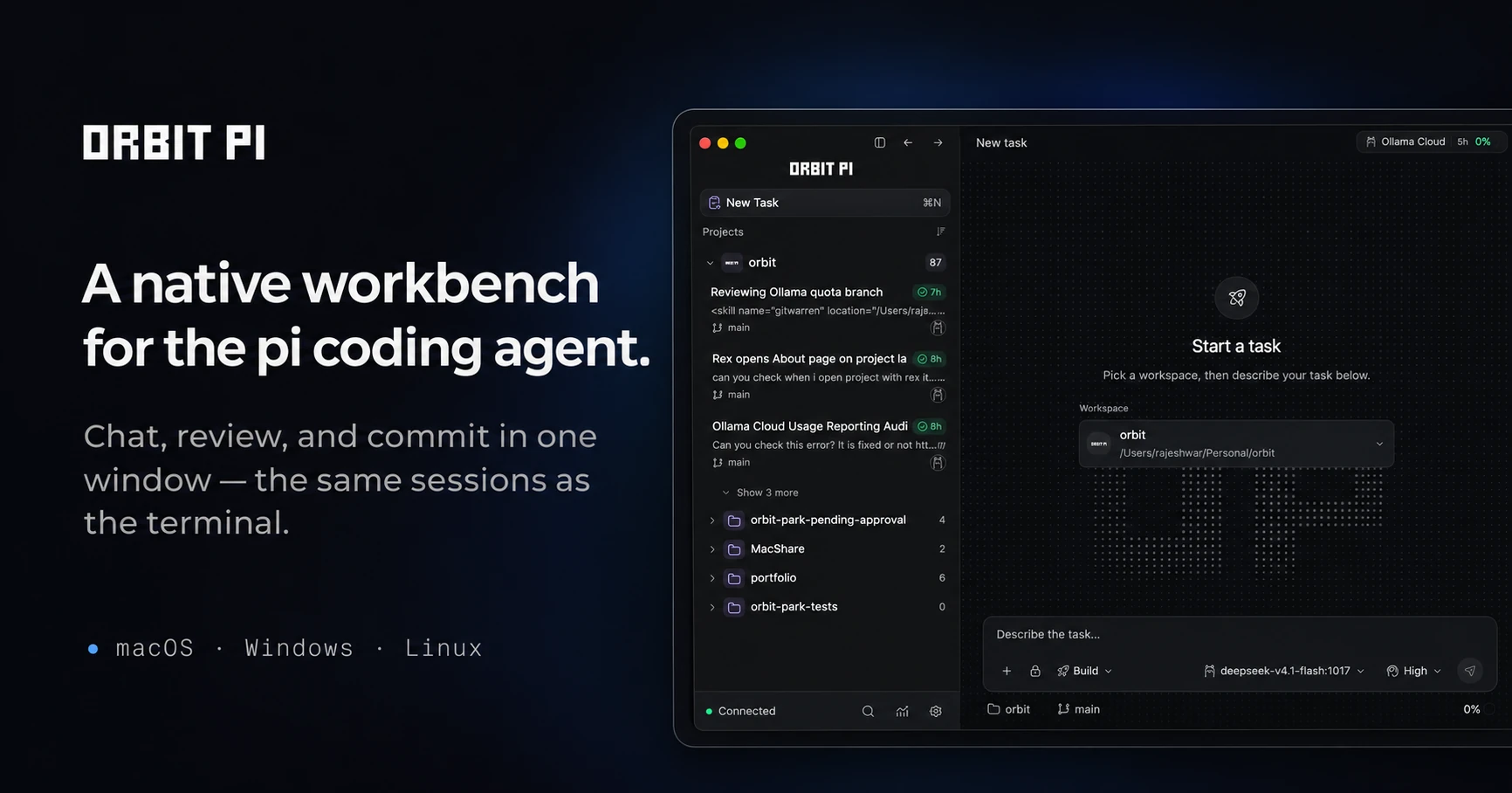
Orbit Pi is a native desktop workbench for the pi coding agent — a chat-style GUI rendered entirely in Rust on GPUI, the GPU-accelerated UI framework Zed is built on. It speaks the pi CLI's RPC protocol directly over stdio: no browser, no webview, no Node.
Sessions you create in Orbit and in the terminal are the same sessions (~/.pi/agent/sessions/), managed by pi's own session manager.
Screenshots
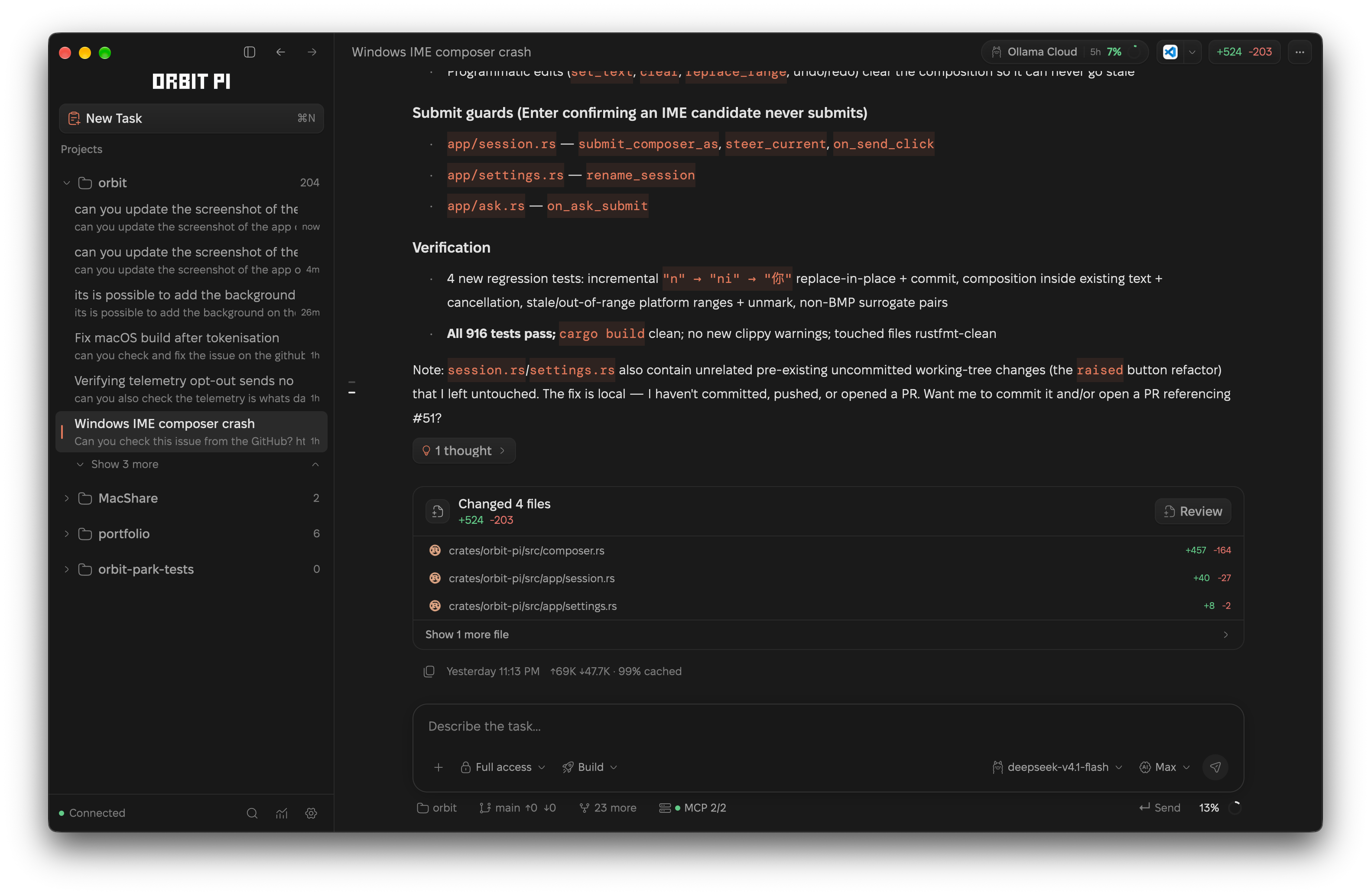
A live session — streaming transcript, tool rows, and the composer:
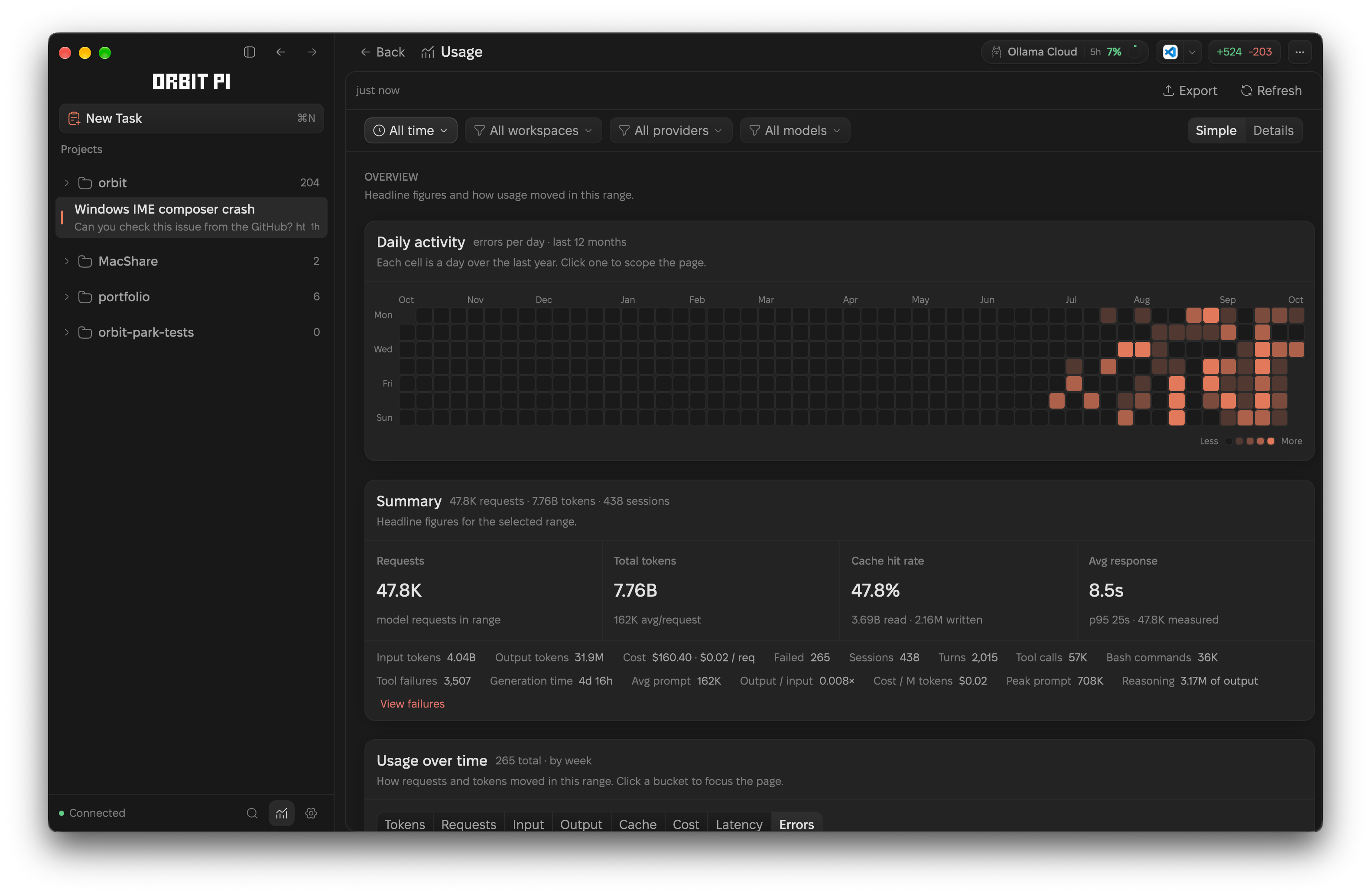
Usage — requests, tokens, cost, and cache, read from your own sessions; point at any
summary sparkline to read that day across the whole row:
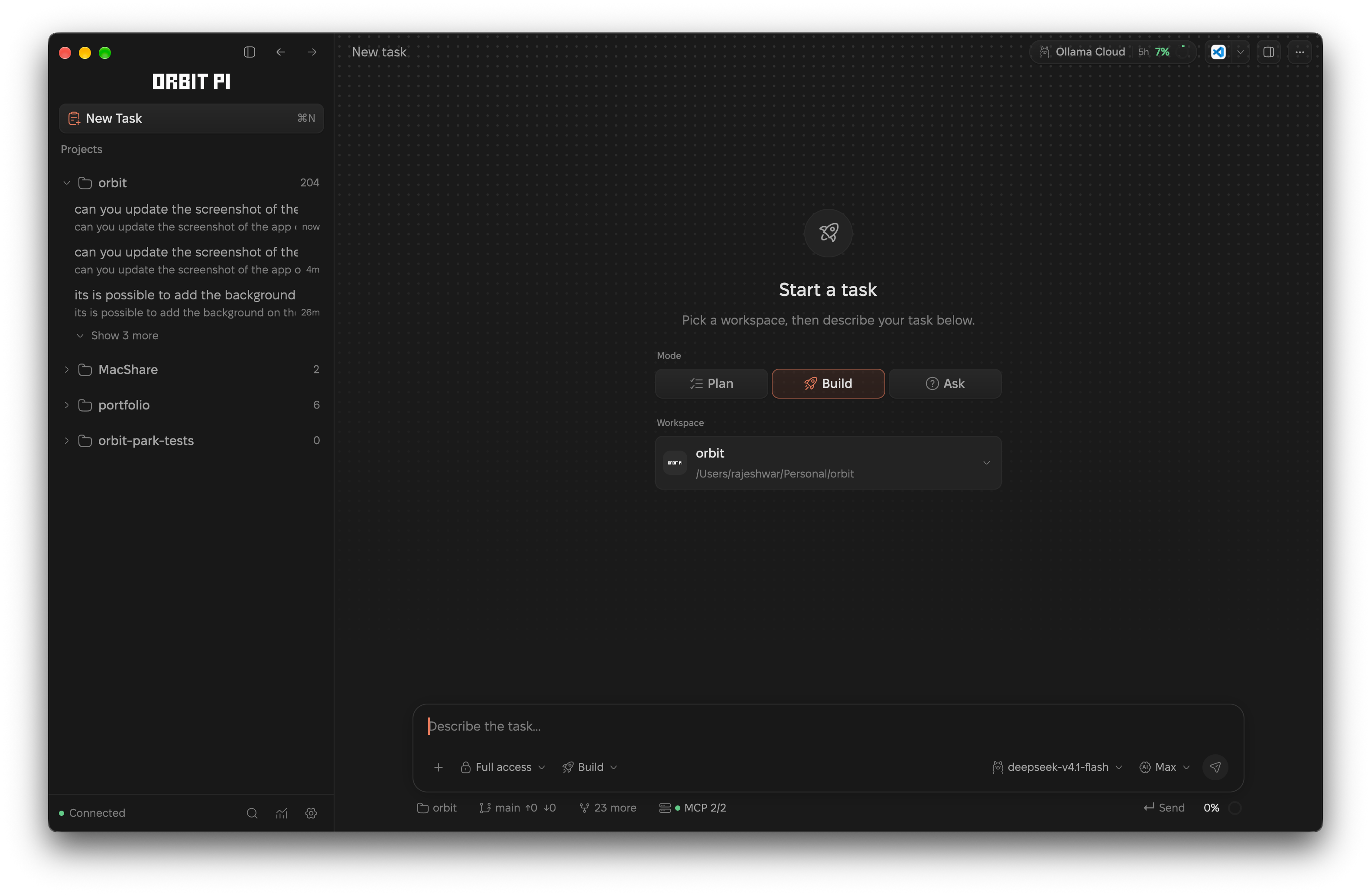
| New task |
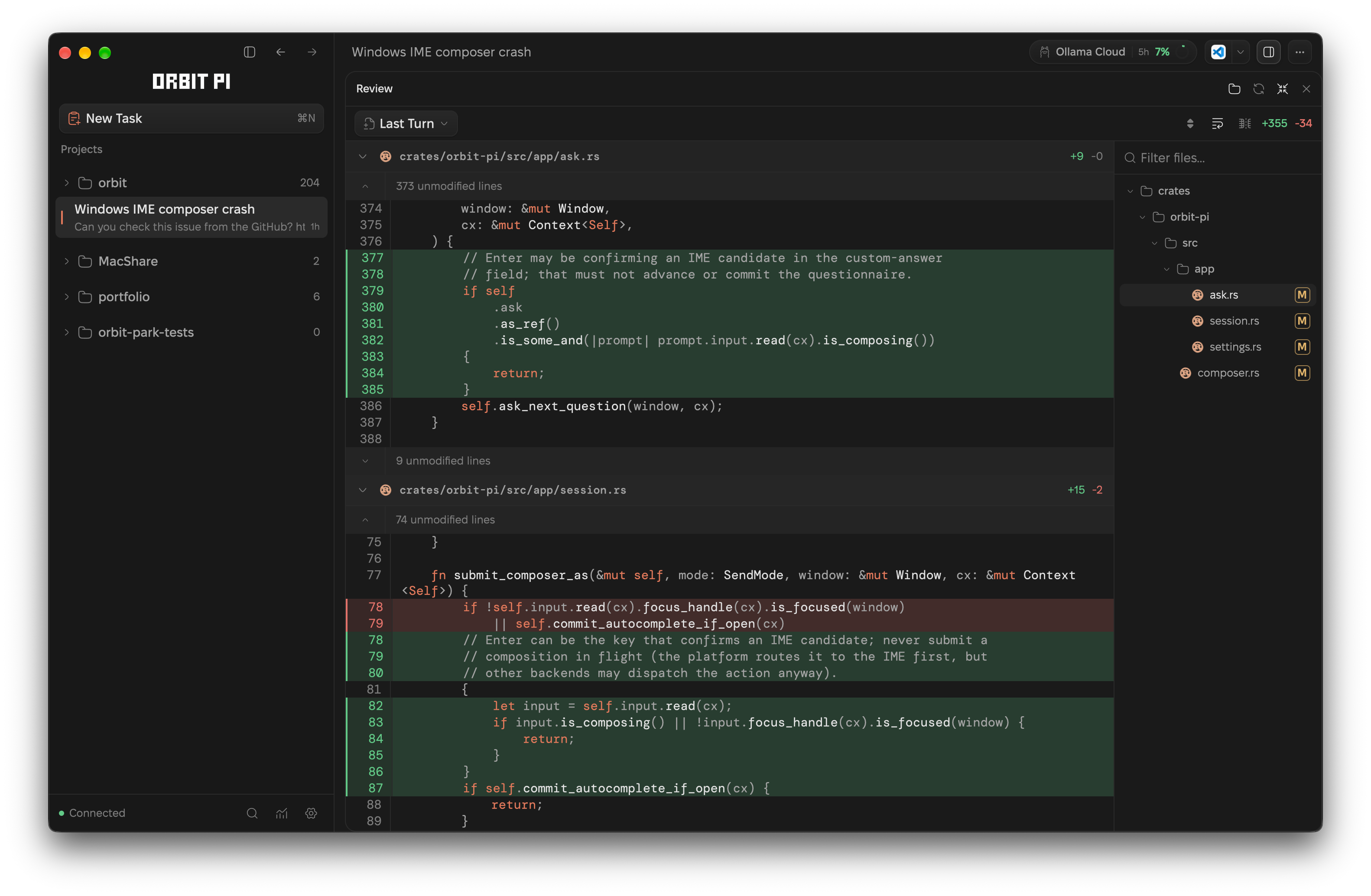
Review |
 |
 |
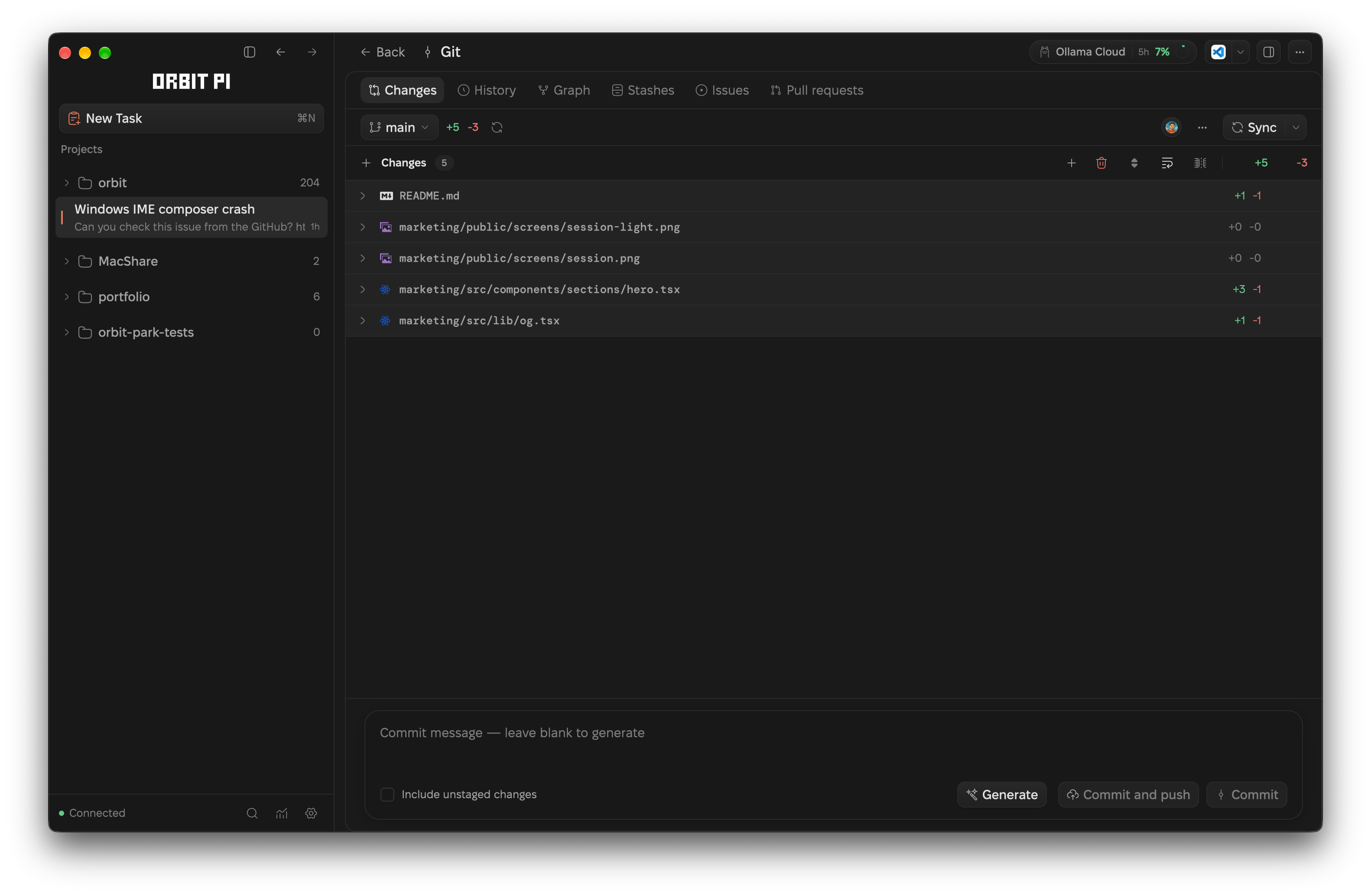
| Git |
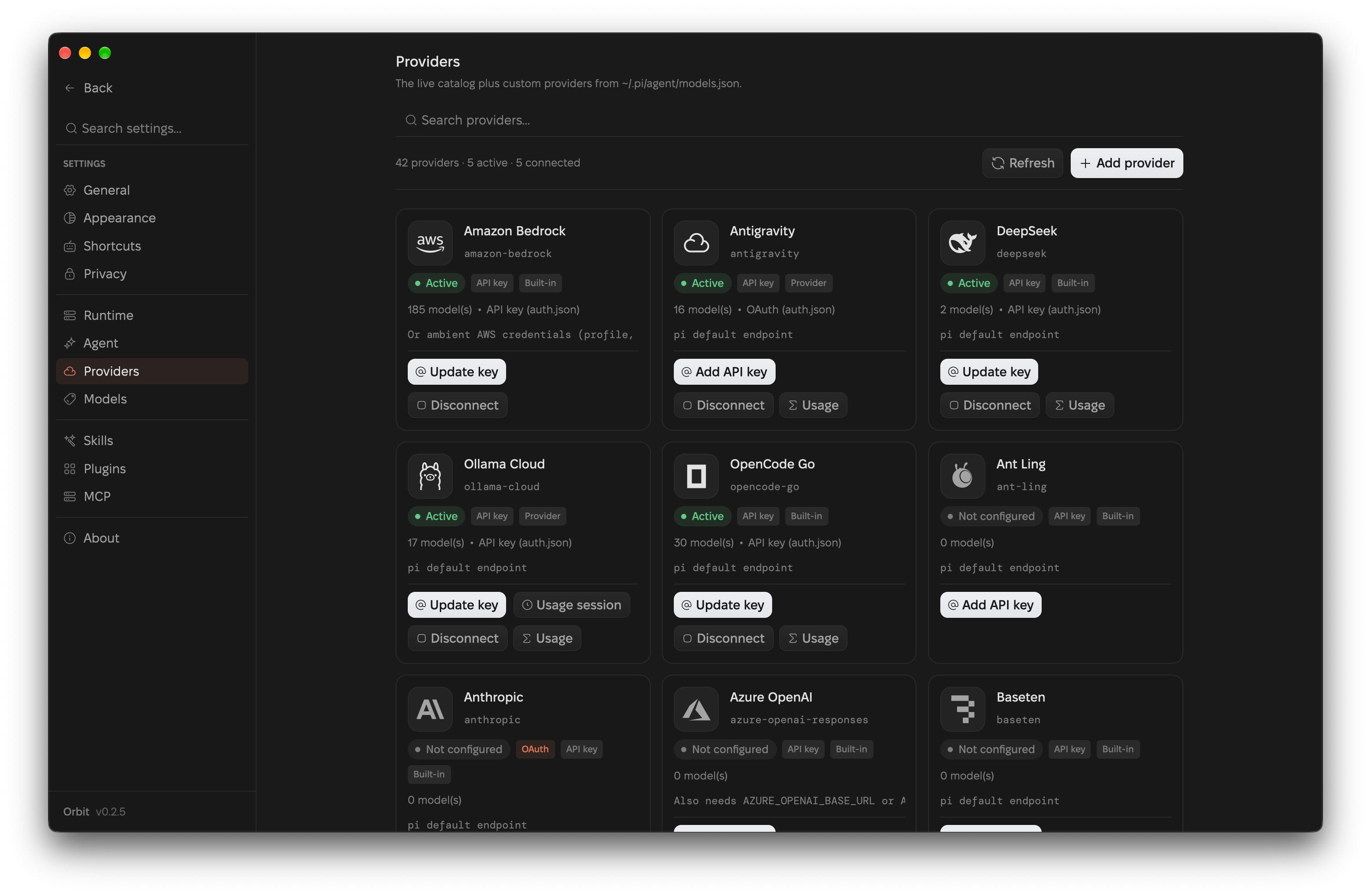
Providers |
 |
 |
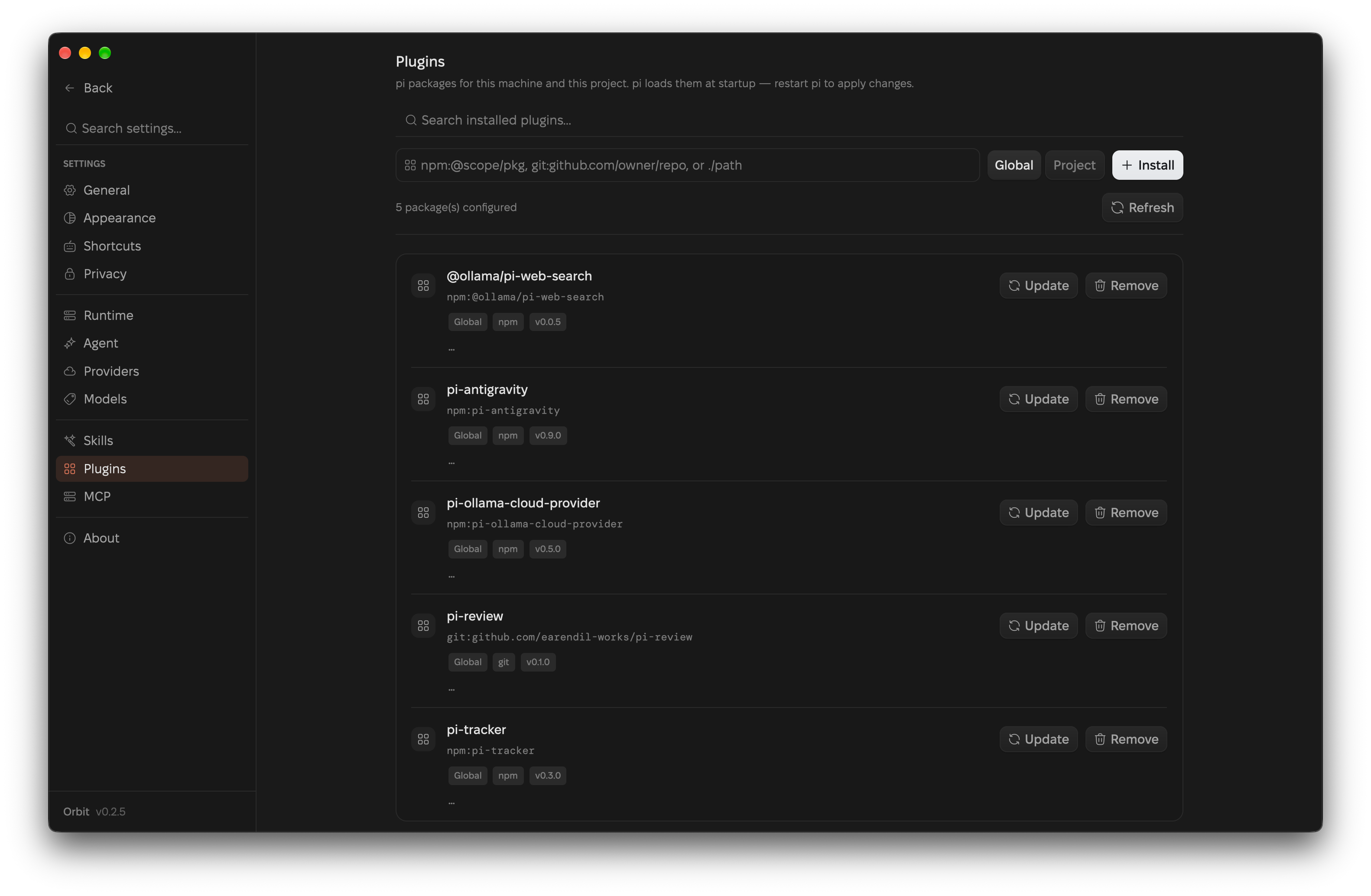
| Plugins |
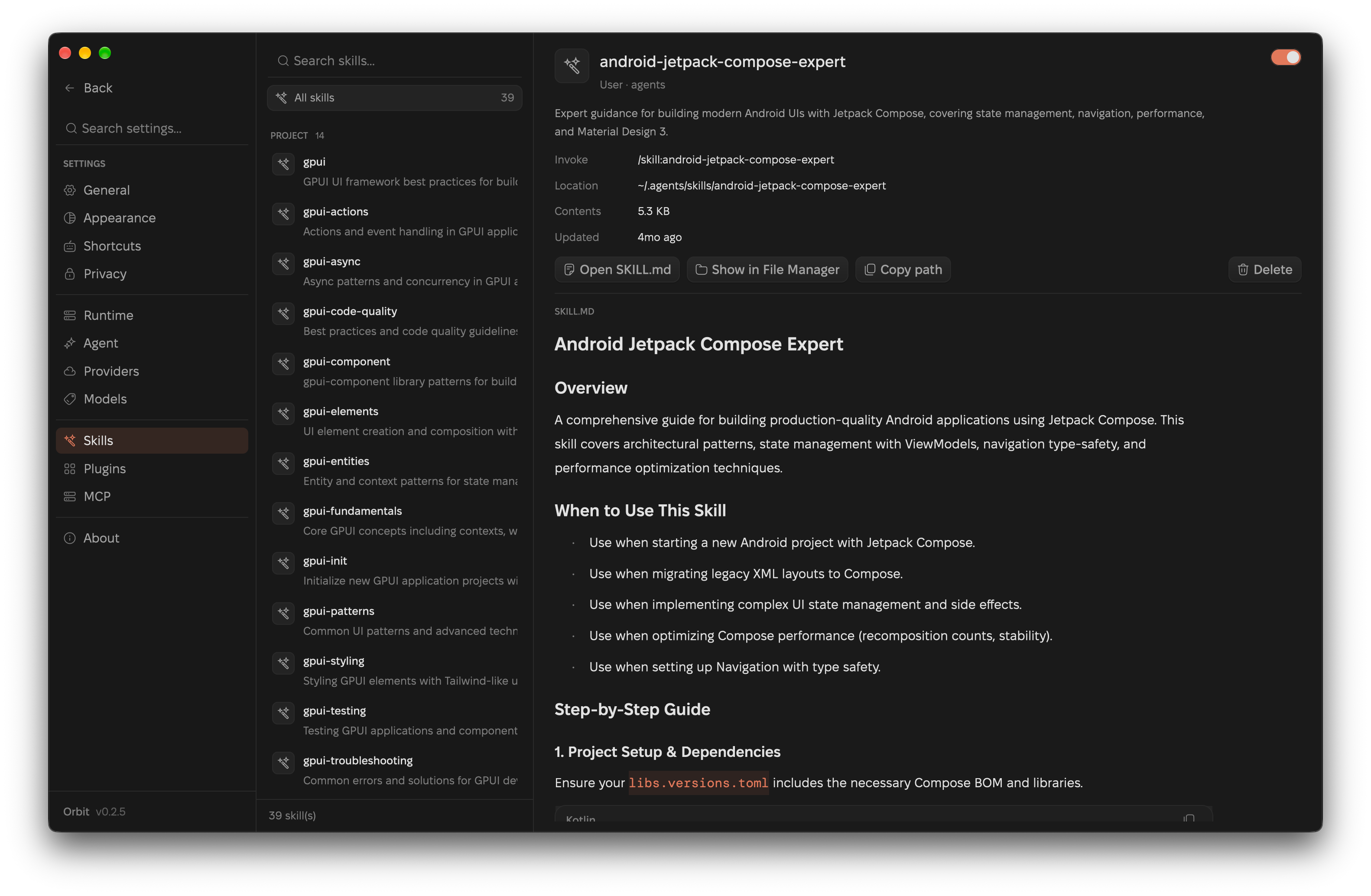
Skills |
 |
 |
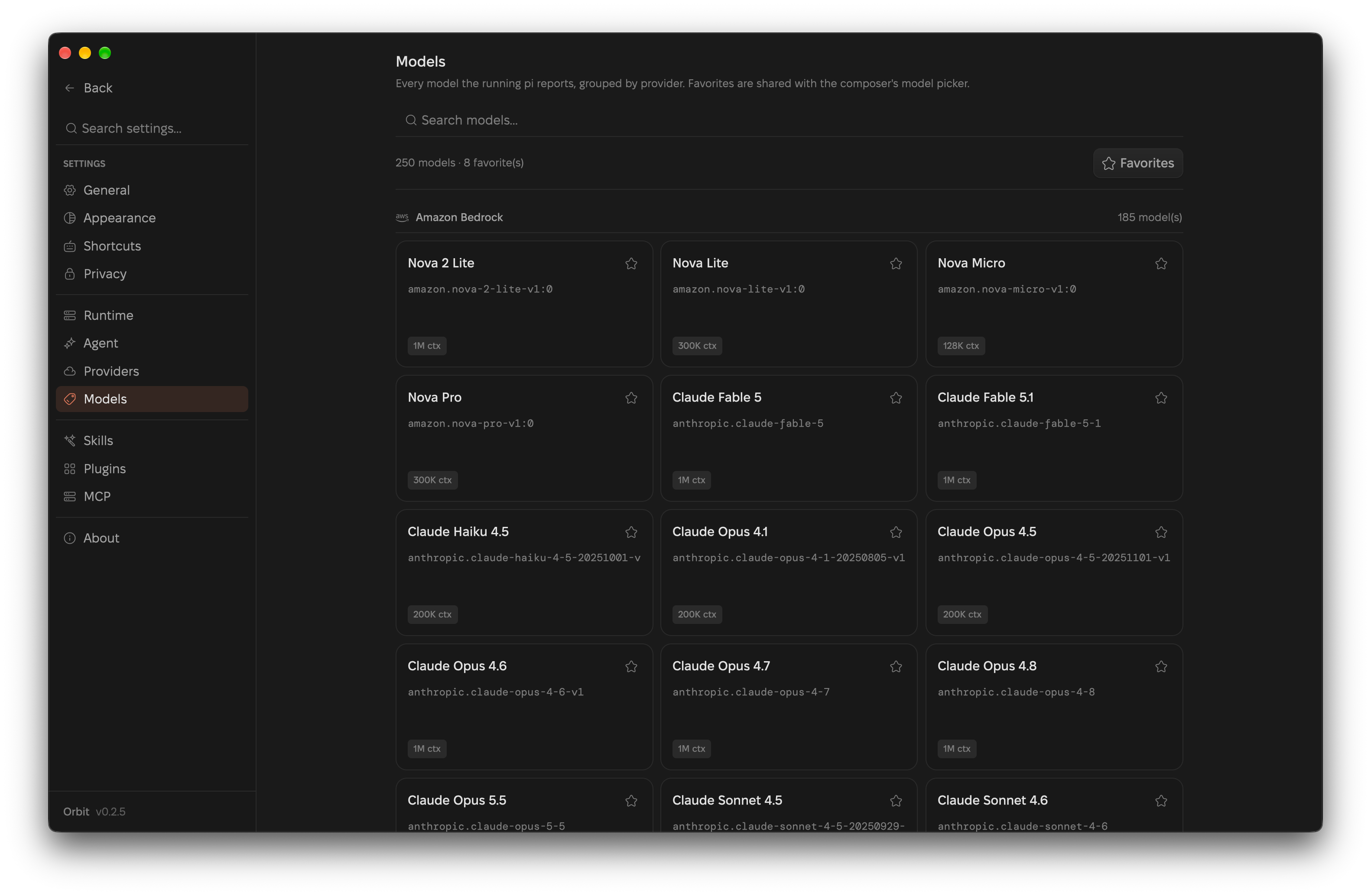
| Models |
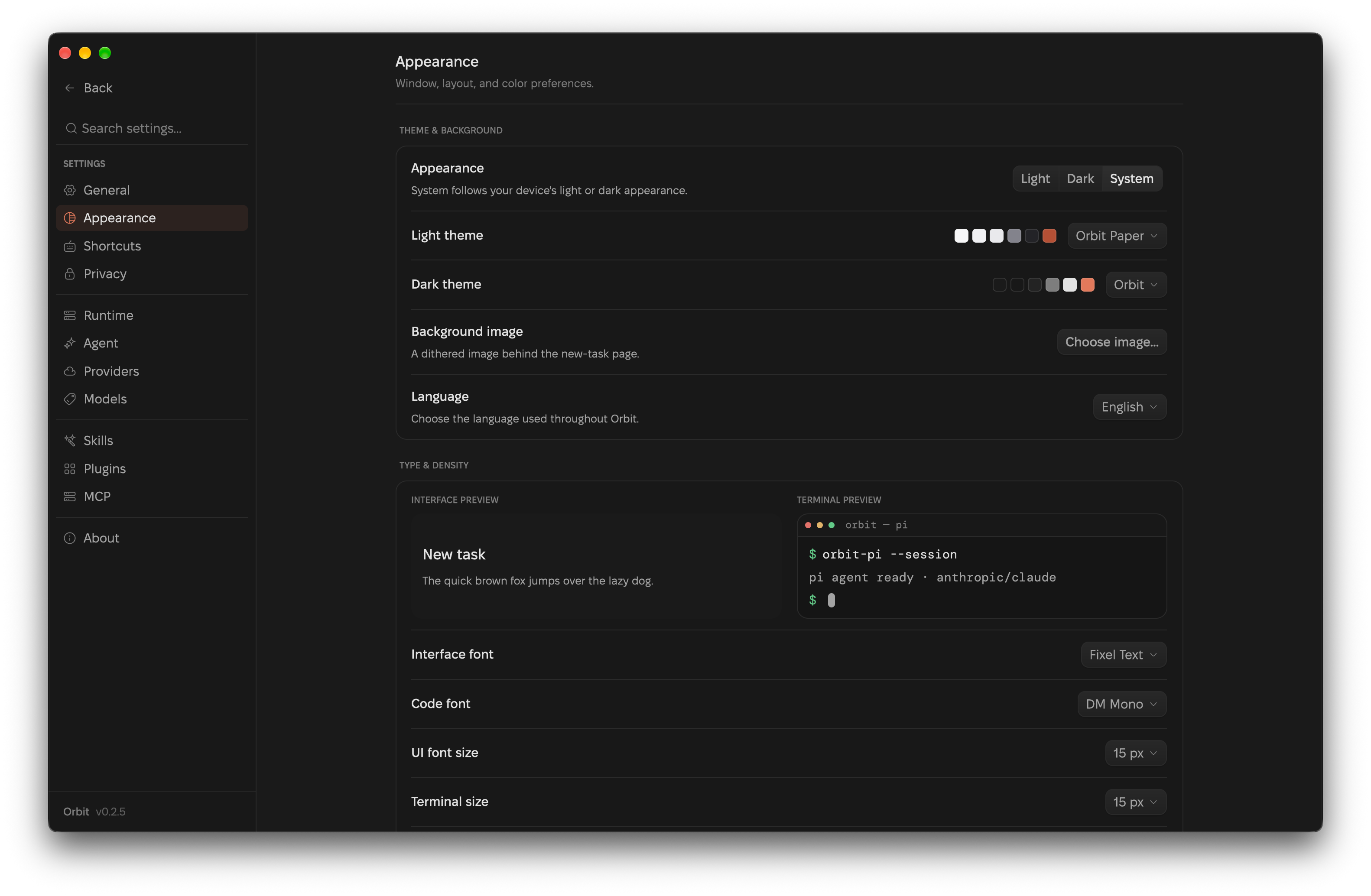
Appearance |
 |
 |
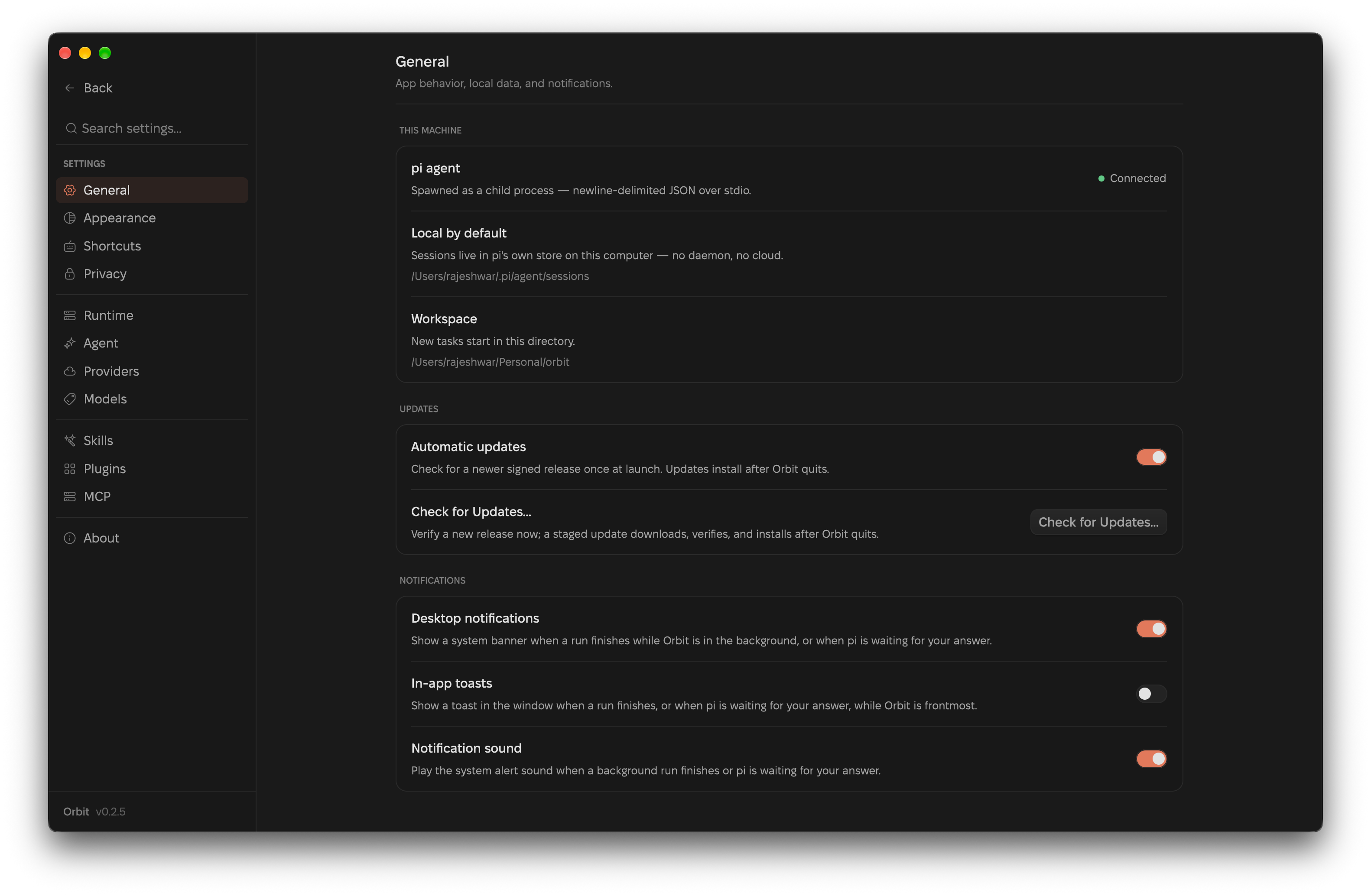
| General |
Agent |
 |
 |
Features
Chat and transcript
- Chat-style agent sessions — composer with model selection, thinking effort, follow-up queueing, mid-run steering, cancel, and streaming replies
- A send is in flight from the keystroke: pressing Enter flips the composer to Stop and starts the live “Working for…” row at the send, instead of waiting for pi’s first streamed token. A second Enter queues a follow-up rather than racing a second prompt, and a prompt pi rejects unwinds that state
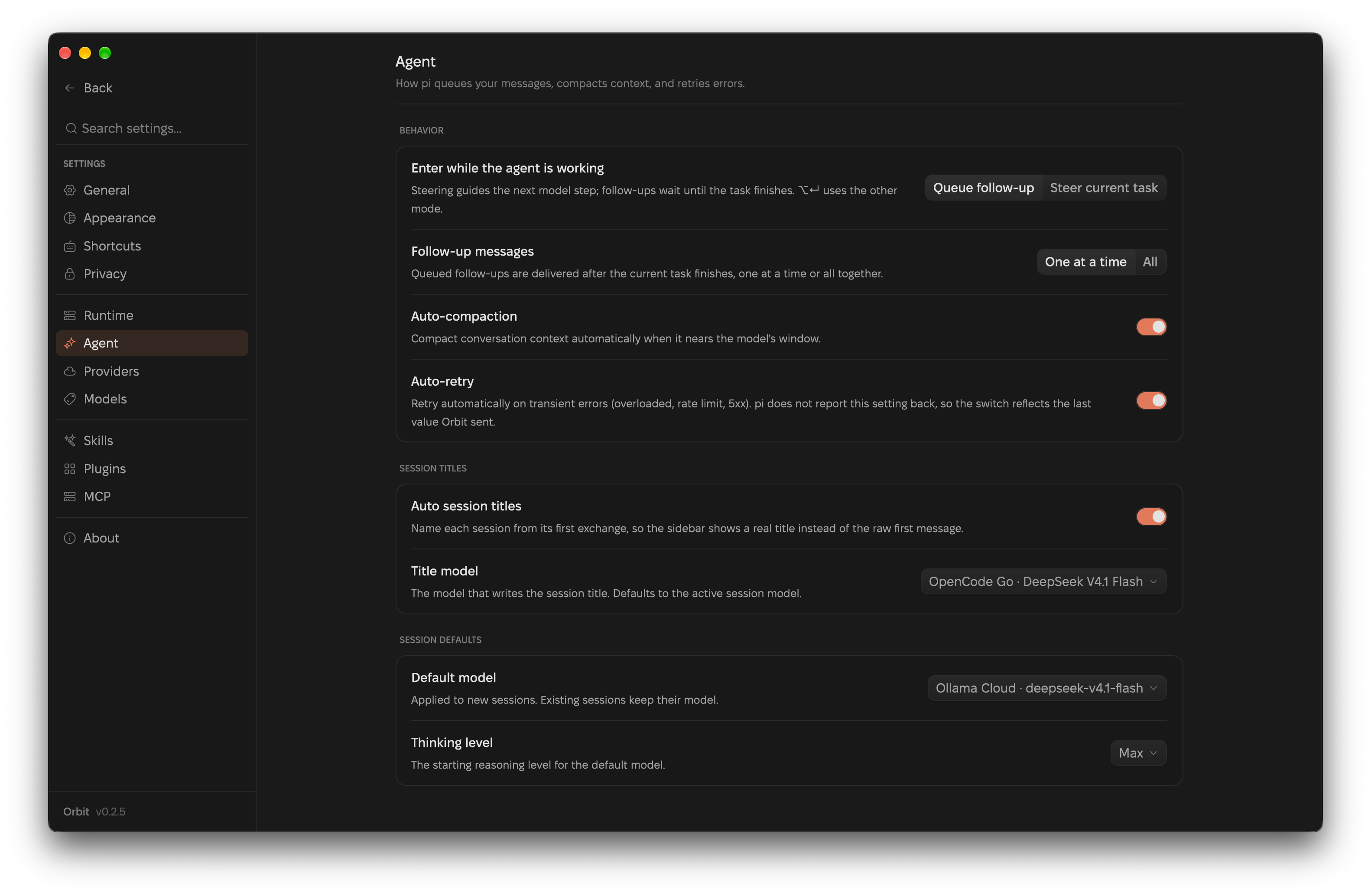
- Enter behavior — Settings → Agent → Behavior picks what Enter does: queue a follow-up (default) or steer the running task. Alt/Option+Enter uses the other mode, and ⌘⇧Enter / Ctrl+Shift+Enter always steers; the composer shows platform-aware keycap hints during a run
- Compact hints immediately left of the context-window indicator show both sending modes while the agent is working. Steering takes effect after the current response and tools finish; idle Enter sends normally, and Shift+Enter inserts a new line
- Edit queued messages, or send one now — the queue bar above the composer gives every pending steer and follow-up its own Edit (inline field, ⏎ saves, Esc cancels) and Send now, which moves that message to the front of the steering lane so pi delivers it before the next model call
- Workflow modes — scope a session to Plan, Build, or Ask: Plan and Ask are read-only (write tools disabled, bash gated), so you can explore and plan before switching to Build
- GPU-rendered transcript — virtualized so cost is independent of message count, with stick-to-latest streaming and coalesced commits
- GFM markdown and syntax-highlighted code; highlighting is paint-only so streaming code blocks never reflow
- Mermaid flowcharts drawn natively — a
flowchart/graph fence paints as a real diagram
(GPUI paths and text, no webview), subgraph groups included, with the copyable source one
click away; every other Mermaid diagram type keeps the honest source block instead of a fake
preview
- In-transcript find (⌘F) and a full-window image lightbox
- Save any settled response as Markdown from its footer, or export the visible transcript from the command palette. Both use a native save dialog and refuse to overwrite files. Exports omit thinking, tool output, and image data; the visible transcript may omit earlier history after compaction
- Compressed image attachments — images you attach or paste are downscaled and re-encoded at ingest (1400 px longest edge, 512 KiB base64, JPEG; transparency keeps lossless WebP), so a large screenshot no longer bloats the prompt or the session history; the status line reports the before/after size
- An attachment tray for images, files, and long pastes — every queued item is one chip above the input showing what it is (image thumbnail or file-type badge), its name, its size or line count, and its own remove button; two or more chips add a count header with Clear. Dropping or picking a non-image file, or pasting one copied in macOS Finder or Windows Explorer, queues it as a file chip instead of splicing a path into the sentence, and on send it folds into the prompt as an
@path mention the agent opens with its tools. The sent message shows those files as the same chips under the bubble (the path stays selectable), so a reloaded session looks like the live send. Pasting an image file copied in Finder or Windows Explorer attaches its contents rather than its file icon. On Linux, file URI lists exposed as clipboard text are supported; file-only clipboard offers are not yet supported. The + menu picks several images or files at once. All three kinds share one eight-item budget
- Tool activity — bash, edit, read, and thinking rows drawn natively, expanding into Arguments/Output cards with per-section copy
Sessions
- Grouped by project, persistent, reopenable, and cross-workspace
- Search sidebar sessions with ⌘⇧F (Ctrl+Shift+F); the empty input also shows the command palette shortcut ⌘P (Ctrl+P)
- Session rows keep titles, prompt previews, age/status, branches (with
↑n/↓n against upstream), and provider/model marks. Tinted project marks, semantic status badges, one title weight, and a neutral selection fill with a distinct focus outline make the list easier to scan; flat mode names each row's workspace and branch, and a grouped row adds that line only when its folder differs from the header's
- Show first message in the sidebar view menu toggles prompt previews in grouped and flat lists; off by default and remembered across restarts, without hiding other session metadata
- Orbit-owned project list — remove a workspace from the sidebar without deleting pi's sessions
- Sort projects by last activity, recently added, name, or session count
- Rename, pin, clone, or delete sessions, and copy a session id; pinned sessions sort first — right-click a row for its actions
- Address sessions by position — ⌘1…⌘9 (Ctrl+1…9) opens the Nth visible session; hold ⌘ (Ctrl on Windows/Linux) to reveal its shortcut in the sidebar. Ctrl+Tab / Ctrl+Shift+Tab cycle them
- Sessions written by the CLI or another window refresh the sidebar live
- Execution status for sessions observed during this app launch — Running, Waiting for approval/input, Retrying, Compacting, Completed, Failed, Stopped, Disconnected, or Idle. Open and background sessions use the same real pi events; outcomes remain after reading and switching. Historical or externally written sessions get no guessed status
- A turn that ends while you are elsewhere leaves a separate unread mark on its row (a green eye plus "Needs review", or a red cross with a corner dot when it failed) until you open it in the foreground. Reading spends the mark and leaves the Completed/Failed state behind; unread and waiting sessions remain visible under collapsed project groups
- Native approvals and input dialogs stay pending when you switch sessions, and return with their answers intact when you reopen the session
- Background turn notifications — a desktop banner and alert sound when the window isn't frontmost, an in-app toast otherwise, and a heads-up when a run is waiting on an extension dialog
Safeguards
- Access modes — Supervised, Auto-accept edits, or Full access, chosen from the composer
- Enforced by a bundled pi extension that hooks
tool_call and confirms mutating calls the mode does not auto-approve
- An inline bar above the composer offers Allow once / Always allow this tool / Deny (↑ ↓ ⏎ esc), with the allowlist recorded per mode
- Permissions — one row per tool family (commands, edits, reads, fetches, MCP, delegation, other) with
Inherit · Allow · Ask · Deny, the resolved value shown beside it, and pattern rules beneath (rm * → Deny). Switch the scope between every session, main sessions only, or one subagent. Full access still means full access: it is answered before the rules, so nothing asks and nothing is refused there. "bash may run, but rm asks" needs no mode change; a subagent has no approval window, so its rules are what let a worker use a command at all
- A confirmation guard, not a sandbox — pi ships no sandbox, and Orbit does not add one. Permission rules change when Orbit asks; they are not a shell parser, so a chained command is never auto-approved by an
allow rule
- Subagents — the model can delegate a scoped task to a child
pi process with its own context window and get back a short report plus its cost. Children inherit the session's access and workflow modes; a delegation the session mode cannot finish is refused before it spends anything
Review and Git
Settings → Git Accounts inspects local Git author settings, generic and host-scoped credential helpers, SSH agent fingerprints and conventional public-key file presence, remote hosts and the GitHub CLI version without managing credentials. Git author identity is not authentication; a helper or loaded SSH key does not prove that a valid credential exists or that a remote accepts it. Remote access is not tested. The page does not run gh auth status, since it can contact hosts and refresh credentials, so GitHub CLI authentication remains unknown. An optional Check for updates action anonymously checks the latest stable GitHub CLI release and shows manual update commands; ordinary status refresh stays offline and Orbit does not run the update. Public-key file detection checks conventional names without opening their contents on Unix; it is unavailable on Windows. Environment-variable indicators reflect only Orbit’s process environment, which may differ from your terminal. Resolve authentication problems manually with your existing tools; credentials may be expired or lack permissions.
- Review side pane with selectable sources — Last Turn (exactly what one agent turn changed, from per-turn checkpoints), Uncommitted, Unstaged, Staged, Committed, and Branch; changes arriving during a refresh trigger a follow-up read
- Diff view controls: collapse or expand each file, wrap or pan long lines, unified or side-by-side rows, docked / full page / minimized, a changed-file count with previous / next arrows and the reader's place among the files, and full keyboard operation (Tab focus stops, arrows,
n / p between files, [ / ] between hunks)
- Git page for Changes / History / Graph / Stashes: staging, commit (⌘↵), stash push/pop/apply/drop, sync, push (including force-with-lease), pull, fetch, merge, and rebase, with recovery actions for rejected pushes and conflicts
- The commit bar's Generate button has its own model picker — a searchable chip beside it — so commit messages can run on a different (or smaller, local) model than the chat session, with Active session model restoring the default
- Git page's Issues and Pull requests tabs through
gh: browse and filter, file issues and PRs, comment, apply labels, close/reopen, review, merge, and check out a PR's branch — with repository templates and an AI Generate action that drafts a title and body from the branch, its commits, optional notes, and the repo's own template
- Git worktrees as first-class workspaces — a Worktrees page lists and creates worktrees (
repo/.wt/113 → feature/issue-113), opens them as the active workspace so the Explorer, terminal, Git page, Review, and agent all run there, and supports rename / move / lock / remove / prune / repair
- In a repository, the status bar's Work in chip names where the next task runs:
Local, linked worktrees, recent folders, a new or existing worktree, a remote branch (as a local branch that tracks it), a clone, or another folder. The new-task picker offers the same choices; there, remote branches are selected in the create dialog. Outside a repository, the status bar uses a folder chip; the new-task picker still offers cloning
- An optional per-repository setup script runs asynchronously with
ORBIT_ROOT_PATH and ORBIT_WORKTREE_PATH
Explorer and Files
- Project panel (⌘⇧E) — a gitignore-aware workspace tree with expand/collapse, filter, hidden-files toggle, devicons,
M/A/D/R/U git badges, and keyboard navigation
- File operations from the tree: new file, new folder, rename, and delete to Trash, plus open / reveal / copy path actions
- Files page with a tab strip and an editor for the active workspace: syntax-highlighted editable buffers, Markdown Edit/Preview, images, debounced autosave (and ⌘S) with dirty/saving state, and honest read-only guards for binary, oversized, truncated, and non-UTF-8 files
Terminal
- Integrated terminal (⌘J) — a real login shell in a resizable bottom panel, built on
alacritty_terminal for PTY and VT/ANSI emulation and rendered natively by GPUI: scrollback, click-drag selection (⌘C/⌘V), bracketed paste, a blinking cursor, a per-theme ANSI palette, and restart; the shell follows the active workspace
- Terminal tabs — ⌘T opens another shell in the current workspace, ⌘W closes the active one (the panel closes with its last tab), and ⌘⇧] / ⌘⇧[ (Ctrl+Shift+] / Ctrl+Shift+[) step between tabs
- The tab chords are scoped to the terminal, so Ctrl+Tab still reaches the shell. On Windows and Linux, where Ctrl+T and Ctrl+W belong to the shell, the tab chords are Ctrl+Shift+T / Ctrl+Shift+W
- A background tab keeps its PTY alive, so a build left running in one tab keeps running while you work in another, and switching sessions no longer kills the shells
- Each tab carries its login shell’s mark (zsh, bash, fish), with the shell name and start directory on hover
Workbench
- Usage, skills, plugins, models, providers, MCP, appearance, and agent/runtime settings, backed by pi's on-disk data; Settings uses the shared UI type and control scale and keeps navigation scrollable in short windows
- MCP — manage pi's MCP servers (global and per project) in Settings → MCP: add / edit / validate, a
${NAME} secret store, live status and tool lists from pi mcp list --json, and applying changes by respawning pi with the session preserved
- Providers — pi's live catalog plus custom endpoints (
models.json), with API-key or OAuth sign-in and usage meters
- Plugins — install pi packages from npm, git, or a local path, global or per project; update checks and update/remove in place
- Models — read from pi's own runtime, with a default session model and thinking level (Settings → Agent) applied to every new session; the choice lives in Orbit's own store and leaves pi's global settings alone
- Auto session titles — a bundled pi extension names any session that has no title yet from its first exchange, with a model picker and an on/off toggle in Settings → Agent
- Report a bug — Settings → Report a bug takes an issue type (bug / feature / other) and the bug context, then Generate draft writes the title and description with the active session model or a separately selected model
- It files the issue against the project with your build details attached (Orbit version, app ID, OS and architecture, install kind, pi CLI, and
gh account): through the gh CLI when it is signed in, or as a prefilled GitHub new-issue page otherwise
- Screenshots attach too. They upload with
gh issue create --attach when permitted; otherwise, if the CLI cannot upload them before creating an issue, the web form and saved screenshot folder open so you can drag them in
- Privacy — Settings → Privacy archives or deletes idle
pi sessions on a schedule you choose. Nothing is uploaded
- Appearance — Light / Dark / System, a persisted Design system choice (Classic keeps the existing palette and geometry; Operational applies the near-black, lime-accented Restrained Operational Minimalism system), independent light and dark theme palettes, a customizable wallpaper (hero or full-window, with artwork effects, effect-intensity and pixel-size controls, and translucent surfaces), bundled interface fonts (including Onest), code fonts, sizes, spacing density, and interface language (English, 简体中文, 日本語, 한국어, Español, Français, Deutsch, Português do Brasil, Русский, Italiano, or the system language)
- System follows OS appearance changes live; new installations use System, while existing theme choices are preserved. Switching design systems is opt-in and does not modify the Classic palettes or their geometry
- With no wallpaper set, the new-task page carries a living ordered-dither field with the app monogram screened into it: it follows the palette, drifts slowly enough to breathe instead of strobe, and freezes under Reduce Motion
- No telemetry: no analytics client, no identifier, and no queue (see PRIVACY.md)
Native
- A command palette (⌘P / ⌘K) and a registry-driven shortcut layer: the keymap, palette chips, and the Settings → Shortcuts reference all read from one command table, with Tab focus traversal, context-aware keys (review tree, pickers, dialogs), custom macOS window chrome, native dialogs, and reduce-motion
- Zed-derived, Orbit-adapted design tokens in
theme/tokens.rs for spacing, type, controls, elevation and motion. Dynamic spacing follows UI font size and Spacing Density; other tokens use their own resolvers and preferences. Settings, usage, the sidebar, transcript chrome, pickers, modals, the Explorer, Git and terminal use the shared vocabulary.
- Open in — open the workspace in a detected editor or terminal right from the header, with each app's real icon
- macOS window handling — closing the window keeps the session, its pi process, and any running stream alive; clicking the Dock icon reopens that same session, and a run that settles with no window open still posts its notification
- A first-run dependency check for
pi, node, and git that reports anything missing with its install command
- Signed releases: macOS
.dmg (signed + notarized, universal) and .tar.gz, Windows .exe / .zip, Linux .deb / .tar.gz, with signed in-app updates on every platform
Linux updates
Extract the release tarball into its own orbit-pi or orbit-pi-* directory and run bin/orbit-pi there. Do not merge it into a shared prefix such as ~/.local or /usr. The in-app installer only replaces a dedicated directory with the known release layout and no extra files or symlinks; on unsupported layouts the updater is normally disabled, so update manually or through your package manager. ORBIT_FORCE_UPDATER=1 enables checking without installation for development. Existing tarball layouts remain supported. Keep personal files outside the install directory. Linux updates retain the old directory as a hidden .orbit-pi*.rollback-* sibling; after checking the new version, you may remove that backup yourself. Release packaging changes must update the updater's layout validation before adding files.
Structure
┌───────────────────────────────────────────┐
│  Orbit (Rust) — GPUI, Metal-rendered UI   │
│  crates/orbit-pi                          │
│  window, transcript, markdown, workbench  │
└──────────────┬────────────────────────────┘
               │ newline-delimited JSON RPC over stdio
┌──────────────▼────────────────────────────┐
│  pi CLI (child process, per open session) │
│  pi --mode rpc — sessions, models, tools  │
└──────────────┬────────────────────────────┘
               │
┌──────────────▼────────────────────────────┐
│  ~/.pi/agent/ — sessions, config, usage   │
│  (same data the pi CLI uses)              │
└───────────────────────────────────────────┘
Orbit spawns the pi CLI as a child process per open session and speaks its RPC protocol: JSON requests on stdin, JSON-line events on stdout (text/thinking deltas, tool calls, question dialogs, settle signals). Everything user-facing is painted by GPUI on Metal — no DOM, no CSS, no browser engine. The agent runtime stays pi itself, so the model catalog, thinking levels, and persistence remain pi's own.
Project layout
crates/orbit-pi/      The GPUI app — window, transcript, markdown, workbench
crates/orbit-rpc/     pi CLI RPC client (process lifecycle + JSONL protocol)
contrib/              Bundled pi extensions (access guard, auth/quota bridges)
scripts/make-dmg.sh   Build a signed .app + DMG (arm64 / universal)
assets/icons/         App icon (logo-icon.png source, icon.icns, icon.png)
marketing/            Next.js landing page
PRODUCT.md            Product definition, capabilities, constraints
INTENT.md             Architecture decisions + phase plan
AGENTS.md             Conventions for agents and humans working on this repo
PRIVACY.md            What Orbit does and does not send
Roadmap
Orbit is a workbench, not just a chat window. The confirmed direction lives in
PRODUCT.md, architecture decisions in INTENT.md, and
shipped work in CHANGELOG.md. Every unchecked item below is open
for a pull request — read CONTRIBUTING.md and claim the linked
issue before starting.
Planned features
| Feature |
Area |
Description |
Status |
Tracking |
| Workflow modes |
Composer |
Start a session scoped to Plan Mode, Build Mode, or Ask Mode instead of one undifferentiated chat. |
Shipped |
— |
| Follow-up on settle |
Transcript |
Show a queued follow-up inline once a run ends, not only in the compose queue. |
Planned |
— |
| Suggested follow-ups |
Transcript |
Propose 2–3 context-grounded next prompts as composer inserts after a run settles. |
Proposed |
#10 |
| GitHub client |
Workbench |
Browse and manage remote commits, graph, issues, and pull requests in-app. |
In progress — Issues and Pull requests ship with comments, reviews, merges, and branch checkouts; a remote-commits view remains open (#8 closed for the issues/PRs half) |
— |
| Pi extension support |
Workbench |
First-class list / install / enable / configure / debug of pi extensions, including community ones. |
In progress — Plugins installs, updates, and removes packages; a dedicated extensions surface with enable/configure/debug is still open |
#7 |
| Global default model |
Models |
Pin pi's global default model and thinking effort from within Orbit. |
Shipped — Settings → Agent sets the model and thinking level every new session starts on (Orbit's own store; pi's global settings are untouched) |
#9 |
| Voice dictation |
Composer |
Dictate prompts into the composer. |
Planned |
— |
| Diff review and terminal |
Workbench |
Inline diff review and an integrated terminal. |
Shipped — Review pane with per-turn checkpoints and view controls, plus a login-shell terminal (⌘J) |
— |
| Terminal tabs |
Terminal |
Run several shells in the bottom panel without losing the ones in the background. |
Shipped — ⌘T / ⌘W / ⌘⇧] / ⌘⇧[, each tab holding its own PTY |
— |
| Git worktrees |
Workbench |
List, create, open, move, lock, repair, and prune worktrees, and work in one as the active workspace. |
Shipped — Worktrees page, Work in on the status bar in a repository and on the new-task page, plus an optional per-repository setup script. Clone from URL is implemented, with the Windows job-object cancellation path covered on the Windows CI leg; manual GUI verification remains. |
— |
| Session retention |
Workbench |
Keep pi's session store from growing without bound. |
Shipped — Settings → Privacy archives or deletes idle sessions on a schedule, alongside Orbit and pi scratch-file cleanup |
— |
| Parallel sessions |
Sessions |
Run multiple agents / sessions side by side. |
Planned |
— |
| Explorer gaps |
Explorer |
Quick-open, sticky scroll, and directory folding in the file tree. |
Planned — expand/collapse, filter, hidden toggle, and git badges ship today |
— |
| Markdown export |
Transcript |
Save the visible transcript or an individual response as Markdown. |
In progress — response footer and transcript palette actions are implemented; GUI verification remains |
— |
| Conversation fork/rewind |
Sessions |
Branch and rewind a conversation. |
In progress — user-message rewind, response-footer fork picker, and a palette action create a new session and leave the old one in the sidebar. The response footer opens a chooser because pi forks before user messages; GUI verification remains |
— |
| Scroll-perf measurement |
Performance |
On-device measurement of transcript scroll performance. |
Planned |
— |
| Design-system unification |
Design |
One token layer (colour, geometry, state, motion) across every surface, with the interaction-state and motion contracts enforced by scripts. |
Done — see DESIGN.md and docs/design-system-audit.md |
— |
Contributor checklist
- Workflow modes — Plan Mode / Build Mode / Ask Mode
- Follow-up on settle — show a queued follow-up inline when a run ends
- Suggested follow-ups — context-grounded next prompts (#10)
- GitHub client — remote commits view (issues and PRs ship today)
- Pi extension support — a dedicated extensions surface; Plugins manages packages today (#7)
- Global default model — set the default model and thinking level for new sessions (#9)
- Voice dictation — dictate prompts into the composer
- Diff review and terminal — inline review plus an integrated terminal
- Terminal tabs — several shells in one panel, background PTYs kept alive
- Git worktrees — open a worktree as the active workspace
- Session retention — archive or delete idle sessions on a schedule
- Parallel sessions — multiple agents / sessions at once
- Explorer gaps — quick-open, sticky scroll, directory folding
- Conversation fork/rewind — branch and rewind a session
- Scroll-perf measurement — on-device transcript scroll benchmark
Credits
Orbit leans on a lot of other people's work. The full license texts ship in
NOTICE and beside each asset in the repo.
The agent
- pi by earendil-works. Orbit ships no
agent of its own: the CLI is a separate program, installed separately, and the
model catalog, thinking levels, tools, and session store are all pi's.
Framework and libraries
- GPUI by Zed Industries (Apache-2.0):
the GPU UI framework Orbit is built on, and where the spacing, type, elevation,
and motion tokens in
theme/tokens.rs come from.
- Waku by egoist (MIT): the review diff, turn
checkpoints, syntax highlighting, and localization patterns in
crates/orbit-pi follow its approach.
- alacritty_terminal (Apache-2.0): the
terminal's PTY, grid, and VT/ANSI parsing.
- rust-i18n (MIT): the lookup behind
the app's ten locales.
Icons
- HugeIcons (MIT): the interface icon set.
- Simple Icons (CC0-1.0): the zsh, bash, and fish
marks on terminal tabs.
- Nerd Fonts Symbols Only
(MIT, Ryan L McIntyre) and the devicons
crate (Apache-2.0): the file-type glyphs in the Explorer, composer
attachments, and tool rows.
Fonts
Every family in crates/orbit-pi/assets/fonts/bundled/ ships under the SIL Open
Font License 1.1: Anonymous Pro, Atkinson Hyperlegible, Cascadia Code, Commit
Mono, DM Mono, DM Sans, Fira Code, Fixel Text, Geist, Geist Mono, IBM Plex Mono,
Inconsolata, Inter, Iosevka, JetBrains Mono, Manrope, Martian Mono, Noto Sans,
Noto Sans Mono, Onest, Roboto, Roboto Mono, Source Code Pro, Source Sans 3, and Space
Mono. IBM Plex Sans and Lilex come from Zed's font set, also OFL 1.1.
Marketing site
Built with Next.js, React,
Tailwind CSS, Base UI,
HugeIcons for React, and
shadcn/ui patterns. Sora and Geist Mono are served
through next/font. The Apple mark in the download buttons follows
gilbarbara/logos (CC0), and the Tux mark
comes from tandpfun/skill-icons (MIT).
People
- Rajeshwar Kashyap (@imrj05), maintainer
- Dumitru Moloșnic, for transcript scrolling and table fixes, per-workspace
"Open in" preferences, and the configurable Enter behavior (#11,
#17, #33)
- Bougie (@bougieL), for reopening the window from
the macOS Dock (#63)
- Everyone who filed an issue, opened a pull request, or sent a report through
Settings → Report a bug
Something missing from this list is a bug. Open an issue and it gets fixed.
Setup, checks, and commit conventions live in CONTRIBUTING.md. Orbit is licensed under Apache-2.0; report vulnerabilities per SECURITY.md. Data handling is documented in PRIVACY.md.

 Orbit 是为 pi 编程智能体打造的原生桌面图形界面,完全用 Rust 在 GPUI 上渲染(GPUI 是 Zed 所基于的 GPU 加速框架)。它直接通过 stdio 使用 pi 命令行工具的 RPC 协议与之通信,因此界面中不涉及浏览器、网页视图或 Node 运行时。