
6.1K ·GitHub
What is this?
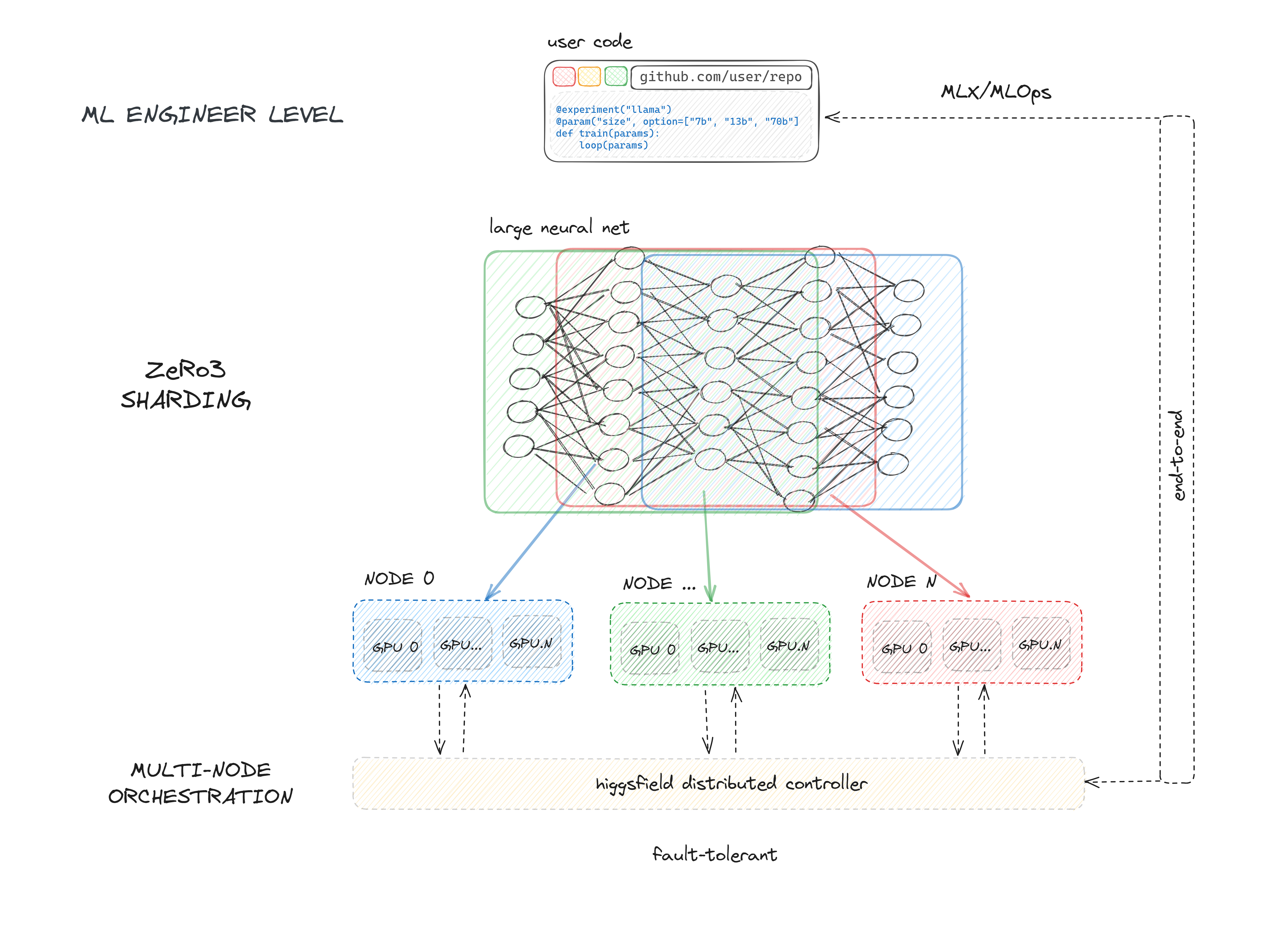
 Higgsfield is an open-source, fault-tolerant GPU orchestration system and machine learning framework for training huge models, from billions to trillions of parameters, such as LLMs.
Higgsfield is an open-source, fault-tolerant GPU orchestration system and machine learning framework for training huge models, from billions to trillions of parameters, such as LLMs.Is this a cluster scheduler, a training framework, or both?Both: it is a GPU workload manager that allocates compute to users and queues experiments, plus a PyTorch-based framework for launching, running, and monitoring distributed training jobs.
Both: it is a GPU workload manager that allocates compute to users and queues experiments, plus a PyTorch-based framework for launching, running, and monitoring distributed training jobs.How do I get a training job running?You install the higgsfield binary which sets up Docker, deploy keys, and tooling on your server, then it generates deploy and run GitHub workflows so pushing to GitHub automatically deploys your code to your nodes.
You install the higgsfield binary which sets up Docker, deploy keys, and tooling on your server, then it generates deploy and run GitHub workflows so pushing to GitHub automatically deploys your code to your nodes.What do my training nodes need to meet?Each node must run Ubuntu, be reachable over SSH, and have a non-root user with passwordless sudo privileges.
Each node must run Ubuntu, be reachable over SSH, and have a non-root user with passwordless sudo privileges.Which cloud providers actually work with it?It has only been tested on Azure, LambdaLabs, and FluidStack; other clouds may work but aren't guaranteed, and you're asked to open an issue if problems arise.
It has only been tested on Azure, LambdaLabs, and FluidStack; other clouds may work but aren't guaranteed, and you're asked to open an issue if problems arise.Does it support DeepSpeed or PyTorch FSDP sharding?Yes, Higgsfield supports the ZeRO-3 DeepSpeed API and PyTorch's fully sharded data parallel (FSDP) API for efficient sharding of trillion-parameter models.
Yes, Higgsfield supports the ZeRO-3 DeepSpeed API and PyTorch's fully sharded data parallel (FSDP) API for efficient sharding of trillion-parameter models.What problem is the experiment queue solving?It manages resource contention among users by keeping a queue for running experiments, so exclusive and non-exclusive node access can be allocated fairly.
It manages resource contention among users by keeping a queue for running experiments, so exclusive and non-exclusive node access can be allocated fairly.Why not just write raw PyTorch training scripts?Higgsfield exists to kill 'environment hell' and 'config hell': it standardizes dependency/driver versions across nodes and replaces sprawling YAML configs with a simple experiment interface.
Higgsfield exists to kill 'environment hell' and 'config hell': it standardizes dependency/driver versions across nodes and replaces sprawling YAML configs with a simple experiment interface.How does GitHub fit into the training workflow?GitHub Actions is used as the deployment backbone: once your experiment code lands in GitHub, workflows automatically deploy it to your nodes and let you watch runs and checkpoints through GitHub's UI.
GitHub Actions is used as the deployment backbone: once your experiment code lands in GitHub, workflows automatically deploy it to your nodes and let you watch runs and checkpoints through GitHub's UI.What are similar projects?metaflow, ray, ludwig, Meshy, skypilot, verl, train-llm-from-scratch, ColossalAI
metaflow, ray, ludwig, Meshy, skypilot, verl, train-llm-from-scratch, ColossalAIWhich topics is it in?cluster-management, llama2, model-training, distributed, distributed-training, mlops, azure, llama, training, ssh, neural-network, github-actions
cluster-management, llama2, model-training, distributed, distributed-training, mlops, azure, llama, training, ssh, neural-network, github-actions