


What is this?
 ESPectre turns a supported ESP32 into a private, local Wi-Fi motion sensor: it reads how movement changes the Wi-Fi signals in a room and reports motion in real time — no camera, microphone, wearable, or dedicated radar hardware needed.
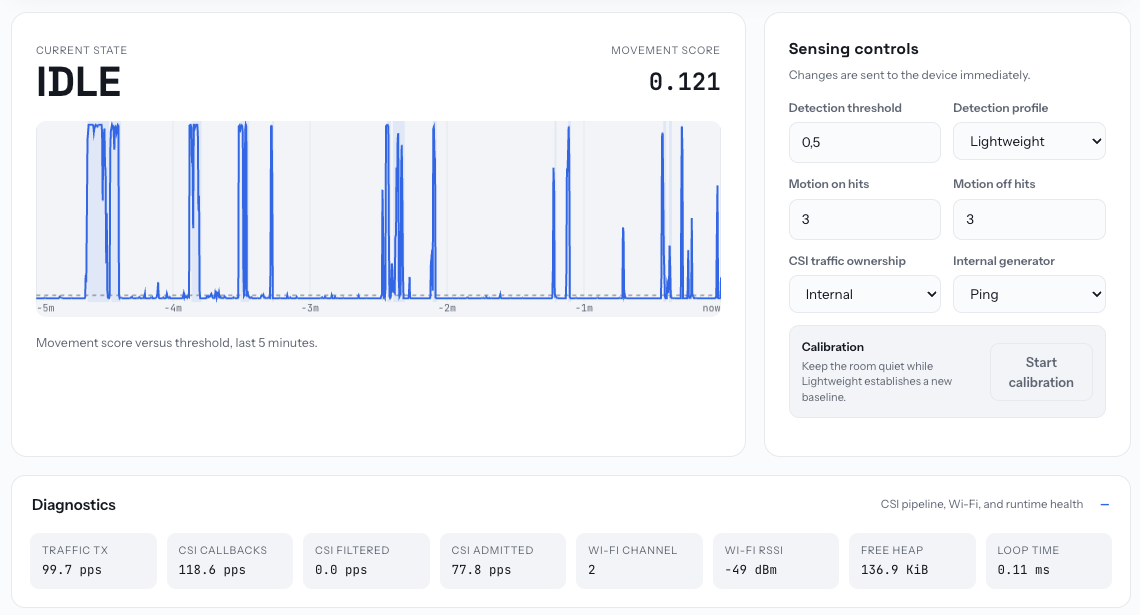
ESPectre turns a supported ESP32 into a private, local Wi-Fi motion sensor: it reads how movement changes the Wi-Fi signals in a room and reports motion in real time — no camera, microphone, wearable, or dedicated radar hardware needed.How does it detect motion without a camera or radar?It reads Wi-Fi CSI (Channel State Information): when someone moves through a room, they change how Wi-Fi signals travel, and the detector processes those changes right on the ESP32, outputting a motion state and a movement score.
It reads Wi-Fi CSI (Channel State Information): when someone moves through a room, they change how Wi-Fi signals travel, and the detector processes those changes right on the ESP32, outputting a motion state and a movement score.How do I set up my first sensor?Flash it from the browser: open Flash in desktop Chrome 151+, plug a supported ESP32 in over USB, pick a firmware and release channel, then finish the on-screen Wi-Fi provisioning. Local builds and CLI workflows start with SETUP.md.
Flash it from the browser: open Flash in desktop Chrome 151+, plug a supported ESP32 in over USB, pick a firmware and release channel, then finish the on-screen Wi-Fi provisioning. Local builds and CLI workflows start with SETUP.md.What hardware and network do I need?A supported ESP32 board (C6, C5, C3, S3, S2, or classic) and a normal Wi-Fi 4 (802.11n) network on 2.4 GHz. For the hosted browser workflow you want desktop Chrome 151+; Edge can flash too, but Device settings and Monitor compatibility is not guaranteed.
A supported ESP32 board (C6, C5, C3, S3, S2, or classic) and a normal Wi-Fi 4 (802.11n) network on 2.4 GHz. For the hosted browser workflow you want desktop Chrome 151+; Edge can flash too, but Device settings and Monitor compatibility is not guaranteed.What are its limits?One board covers one sensing area, so room-level coverage normally means one board per room. It detects changes in the radio environment only: it cannot identify or count people, prove a room is empty, or replace safety-certified security, medical, or emergency systems.
One board covers one sensing area, so room-level coverage normally means one board per room. It detects changes in the radio environment only: it cannot identify or count people, prove a room is empty, or replace safety-certified security, medical, or emergency systems.Where does the motion data go?Nowhere external by default: CSI is processed on the device, motion detection is local, and cloud connectivity is not required. Raw CSI collection is optional and intended for research and debugging needs.
Nowhere external by default: CSI is processed on the device, motion detection is local, and cloud connectivity is not required. Raw CSI collection is optional and intended for research and debugging needs.Can I use it in proprietary firmware?First-party code is GPLv3. To embed ESPectre in proprietary, closed-source firmware without source-disclosure obligations there is a separate commercial license (see LICENSING.md); note the ESPHome C++ frontend remains GPLv3-only.
First-party code is GPLv3. To embed ESPectre in proprietary, closed-source firmware without source-disclosure obligations there is a separate commercial license (see LICENSING.md); note the ESPHome C++ frontend remains GPLv3-only.Does it work with Home Assistant?Yes — through ESPHome for native Home Assistant entities, or via MQTT with Home Assistant MQTT Discovery. It also exposes a standard Matter occupancy sensor (controller validation is still limited) and a local Direct HTTP API for custom integrations.
Yes — through ESPHome for native Home Assistant entities, or via MQTT with Home Assistant MQTT Discovery. It also exposes a standard Matter occupancy sensor (controller validation is still limited) and a local Direct HTTP API for custom integrations.Which firmware paths can I choose from?Four: Native for standalone sensors and MQTT integrations, ESPHome for Home Assistant users who want native entities, Matter for Matter controllers, and Micro-ESPectre — a lightweight MicroPython build with local read-only HTTP monitoring.
Four: Native for standalone sensors and MQTT integrations, ESPHome for Home Assistant users who want native entities, Matter for Matter controllers, and Micro-ESPectre — a lightweight MicroPython build with local read-only HTTP monitoring.What comes with the project besides the firmware?An embeddable C++ SDK, a host CLI covering the full device lifecycle, browser tools (Flash, Device settings, Monitor), an open CSI dataset with recordings of empty rooms, static presence and motion, plus trained model weights and the full training and validation workflow.
An embeddable C++ SDK, a host CLI covering the full device lifecycle, browser tools (Flash, Device settings, Monitor), an open CSI dataset with recordings of empty rooms, static presence and motion, plus trained model weights and the full training and validation workflow.What can it actually automate?Anything motion-driven: turn on a display or lights when a room becomes active, adjust heating and cooling to room activity, or trigger an alarm or notification where movement should not occur — via Home Assistant, Matter, MQTT, or the HTTP API.
Anything motion-driven: turn on a display or lights when a room becomes active, adjust heating and cooling to room activity, or trigger an alarm or notification where movement should not occur — via Home Assistant, Matter, MQTT, or the HTTP API.What are similar projects?Tasmota, WLED, muse-gadget-sdk, EchoMuse, esp-sdr, ESP32Marauder, neonplan3d, Arduino
Tasmota, WLED, muse-gadget-sdk, EchoMuse, esp-sdr, ESP32Marauder, neonplan3d, ArduinoWhich topics is it in?sensors, smart-home, home-assistant, wifi, home-automation, microcontroller, firmware, iot, dataset, embedded, cpp, sdk
sensors, smart-home, home-assistant, wifi, home-automation, microcontroller, firmware, iot, dataset, embedded, cpp, sdk