





What is this?
 An open-source semantic layer: define metrics, dimensions, joins and access rules once in code, and it serves them through SQL, REST and GraphQL APIs to BI tools, custom apps and AI agents.
An open-source semantic layer: define metrics, dimensions, joins and access rules once in code, and it serves them through SQL, REST and GraphQL APIs to BI tools, custom apps and AI agents.Is it a library I add to my code, or a server I run?It's a standalone server you run next to your data, not a library. It's headless — no UI ships with it; you build your own analytics experience on top of its APIs.
It's a standalone server you run next to your data, not a library. It's headless — no UI ships with it; you build your own analytics experience on top of its APIs.How do I get it running?Install Docker, then in a new folder for your project run the Cube Core Docker command from the README and open the local URL in your browser to continue setup.
Install Docker, then in a new folder for your project run the Cube Core Docker command from the README and open the local URL in your browser to continue setup.Which data sources can it sit on top of?Any SQL data source: cloud warehouses like Snowflake, Databricks and BigQuery, query engines like Presto and Amazon Athena, and application databases like Postgres.
Any SQL data source: cloud warehouses like Snowflake, Databricks and BigQuery, query engines like Presto and Amazon Athena, and application databases like Postgres.Is it safe to put straight onto a public server?Not in development mode — it's an authentication bypass: JWT checks are switched off, the Playground is open, and without a SQL password the SQL API accepts any credentials. Local development only; never expose it to the internet.
Not in development mode — it's an authentication bypass: JWT checks are switched off, the Playground is open, and without a SQL password the SQL API accepts any credentials. Local development only; never expose it to the internet.Should I use Cube Core or the commercial Cube?Core if you want to own the stack — a custom BI experience, deeply integrated embedded analytics, or AI agents on a governed foundation. Cube if you want a managed, full-featured BI platform out of the box.
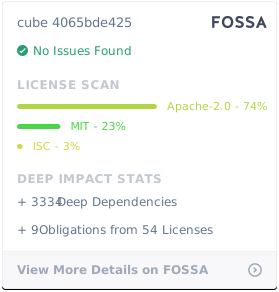
Core if you want to own the stack — a custom BI experience, deeply integrated embedded analytics, or AI agents on a governed foundation. Cube if you want a managed, full-featured BI platform out of the box.Is the whole thing open source?Yes, under a split license: Cube Client is MIT and Cube Backend is Apache 2.0 — both permissive, free to use commercially.
Yes, under a split license: Cube Client is MIT and Cube Backend is Apache 2.0 — both permissive, free to use commercially.How does it cope with lots of concurrent queries?It has a built-in relational caching engine designed to deliver sub-second latency and high concurrency for API requests.
It has a built-in relational caching engine designed to deliver sub-second latency and high concurrency for API requests.I'm building AI agents on top of a warehouse — is this useful for me?Yes, that's a first-class use case: agents consume the same governed metrics through the standard SQL, REST and GraphQL APIs, so metric logic isn't re-implemented in every agent or tool.
Yes, that's a first-class use case: agents consume the same governed metrics through the standard SQL, REST and GraphQL APIs, so metric logic isn't re-implemented in every agent or tool.If I later move to the paid Cube, is my work portable?Fully: the data model is compatible both ways, so a model you build in Cube Core runs unchanged in Cube, and vice versa.
Fully: the data model is compatible both ways, so a model you build in Cube Core runs unchanged in Cube, and vice versa.Which topics is it in?bi, databricks, snowflake, bigquery, data-warehouse, business-intelligence, headless, big-data, graphql, caching, analytics, mysql
bi, databricks, snowflake, bigquery, data-warehouse, business-intelligence, headless, big-data, graphql, caching, analytics, mysql