Apache Airflow
| Category |
Badges |
| License |
 |
| PyPI |
   |
| Containers |
   |
| Community |
    |
| Dev tools |
 |
| Version |
Build Status |
| Main |
  |
| 3.x |
  |

Apache Airflow (or simply Airflow) is a platform to programmatically author, schedule, and monitor workflows.
When workflows are defined as code, they become more maintainable, versionable, testable, and collaborative.
Use Airflow to author workflows (Dags) that orchestrate tasks. The Airflow scheduler executes your tasks on an array of workers while following the specified dependencies. Rich command line utilities make performing complex surgeries on Dags a snap. The rich user interface makes it easy to visualize pipelines running in production, monitor progress, and troubleshoot issues when needed.
Table of contents
Project Focus
Airflow works best with workflows that are mostly static and slowly changing. When the Dag structure is similar from one run to the next, it clarifies the unit of work and continuity. Other similar projects include Luigi, Oozie and Azkaban.
Beyond traditional data pipelines, Airflow is widely used to orchestrate machine learning workflows — training, retraining, evaluation, and deployment — and increasingly to orchestrate agentic and LLM-based workloads, coordinating the steps of an AI pipeline (data prep, tool calls, model invocation, evaluation) rather than acting as the agent itself. This isn't a new direction: teams have run ML and AI workloads on Airflow for years, and the ecosystem of providers supporting these use cases (see the AI & ML section of the Airflow registry) continues to grow.
Airflow is commonly used to process data, but has the opinion that tasks should ideally be idempotent (i.e., results of the task will be the same, and will not create duplicated data in a destination system), and should not pass large quantities of data from one task to the next (though tasks can pass metadata using Airflow's XCom feature). For high-volume, data-intensive tasks, a best practice is to delegate to external services specializing in that type of work.
Airflow is not a streaming solution, but it is often used to process real-time data, pulling data off streams in batches.
Principles
- Dynamic: Pipelines are defined in code, enabling dynamic dag generation and parameterization.
- Extensible: The Airflow framework includes a wide range of built-in operators and can be extended to fit your needs.
- Flexible: Airflow leverages the Jinja templating engine, allowing rich customizations.
Requirements
Apache Airflow is tested with:
|
Main version (dev) |
Stable version (3.3.0) |
Deprecate version (2.11.2) |
| Python |
3.10, 3.11, 3.12, 3.13, 3.14 |
3.10, 3.11, 3.12, 3.13, 3.14 |
3.10, 3.11, 3.12 |
| Platform |
AMD64/ARM64 |
AMD64/ARM64 |
AMD64/ARM64(*) |
| Kubernetes |
1.30, 1.31, 1.32, 1.33, 1.34, 1.35 |
1.30, 1.31, 1.32, 1.33, 1.34, 1.35 |
1.26, 1.27, 1.28, 1.29, 1.30 |
| PostgreSQL |
14, 15, 16, 17, 18 |
14, 15, 16, 17, 18 |
12, 13, 14, 15, 16 |
| MySQL |
8.0, 8.4, Innovation |
8.0, 8.4, Innovation |
8.0, Innovation |
| SQLite |
3.15.0+ |
3.15.0+ |
3.15.0+ |
* Experimental
Note: MariaDB is not tested/recommended.
Note: SQLite is used in Airflow tests. Do not use it in production. We recommend
using the latest stable version of SQLite for local development.
Note: Airflow currently can be run on POSIX-compliant Operating Systems. For development, it is regularly
tested on fairly modern Linux Distros and recent versions of macOS.
On Windows you can run it via WSL2 (Windows Subsystem for Linux 2) or via Linux Containers.
The work to add Windows support is tracked via #10388, but
it is not a high priority. You should only use Linux-based distros as "Production" execution environment
as this is the only environment that is supported. The only distro that is used in our CI tests and that
is used in the Community managed DockerHub image is
Debian Bookworm.
Getting started
Visit the official Airflow website documentation (latest stable release) for help with
installing Airflow,
getting started, or walking
through a more complete tutorial.
Note: If you're looking for documentation for the main branch (latest development branch): you can find it on s.apache.org/airflow-docs.
For more information on Airflow Improvement Proposals (AIPs), visit
the Airflow Wiki.
Documentation for dependent projects like provider distributions, Docker image, Helm Chart, you'll find it in the documentation index.
Installing from PyPI
We publish Apache Airflow as apache-airflow package in PyPI. Installing it however might be sometimes tricky
because Airflow is a bit of both a library and application. Libraries usually keep their dependencies open, and
applications usually pin them, but we should do neither and both simultaneously. We decided to keep
our dependencies as open as possible (in pyproject.toml) so users can install different versions of libraries
if needed. This means that pip install apache-airflow will not work from time to time or will
produce unusable Airflow installation.
To have repeatable installation, however, we keep a set of "known-to-be-working" constraint
files in the orphan constraints-main and constraints-2-0 branches. We keep those "known-to-be-working"
constraints files separately per major/minor Python version.
You can use them as constraint files when installing Airflow from PyPI. Note that you have to specify
correct Airflow tag/version/branch and Python versions in the URL.
- Installing just Airflow:
Note: Only pip and uv installation is currently officially supported.
While it is possible to install Airflow with tools like Poetry or
pip-tools, they do not share the same workflow as
pip - especially when it comes to constraint vs. requirements management.
Installing via Poetry or pip-tools is not currently supported.
If you wish to install Airflow using those tools, you should use the constraint files and convert
them to the appropriate format and workflow that your tool requires.
pip install 'apache-airflow==3.3.0' \
 --constraint "https://raw.githubusercontent.com/apache/airflow/constraints-3.3.0/constraints-3.10.txt"
- Installing with extras (i.e., postgres, google)
pip install 'apache-airflow[postgres,google]==3.3.0' \
 --constraint "https://raw.githubusercontent.com/apache/airflow/constraints-3.3.0/constraints-3.10.txt"
For information on installing provider distributions, check
providers.
Installation
For comprehensive instructions on setting up your local development environment and installing Apache Airflow, please refer to the INSTALLING.md file.
Official source code
Apache Airflow is an Apache Software Foundation (ASF) project,
and our official source code releases:
Following the ASF rules, the source packages released must be sufficient for a user to build and test the
release provided they have access to the appropriate platform and tools.
Convenience packages
There are other ways of installing and using Airflow. Those are "convenience" methods - they are
not "official releases" as stated by the ASF Release Policy, but they can be used by the users
who do not want to build the software themselves.
Those are - in the order of most common ways people install Airflow:
- PyPI releases to install Airflow using standard
pip tool
- Docker Images to install airflow via
docker tool, use them in Kubernetes, Helm Charts, docker-compose, docker swarm, etc. You can
read more about using, customizing, and extending the images in the
Latest docs, and
learn details on the internals in the images document.
- Tags in GitHub to retrieve the git project sources that
were used to generate official source packages via git
All those artifacts are not official releases, but they are prepared using officially released sources.
Some of those artifacts are "development" or "pre-release" ones, and they are clearly marked as such
following the ASF Policy.
User Interface
Dags: Overview of all Dags in your environment.
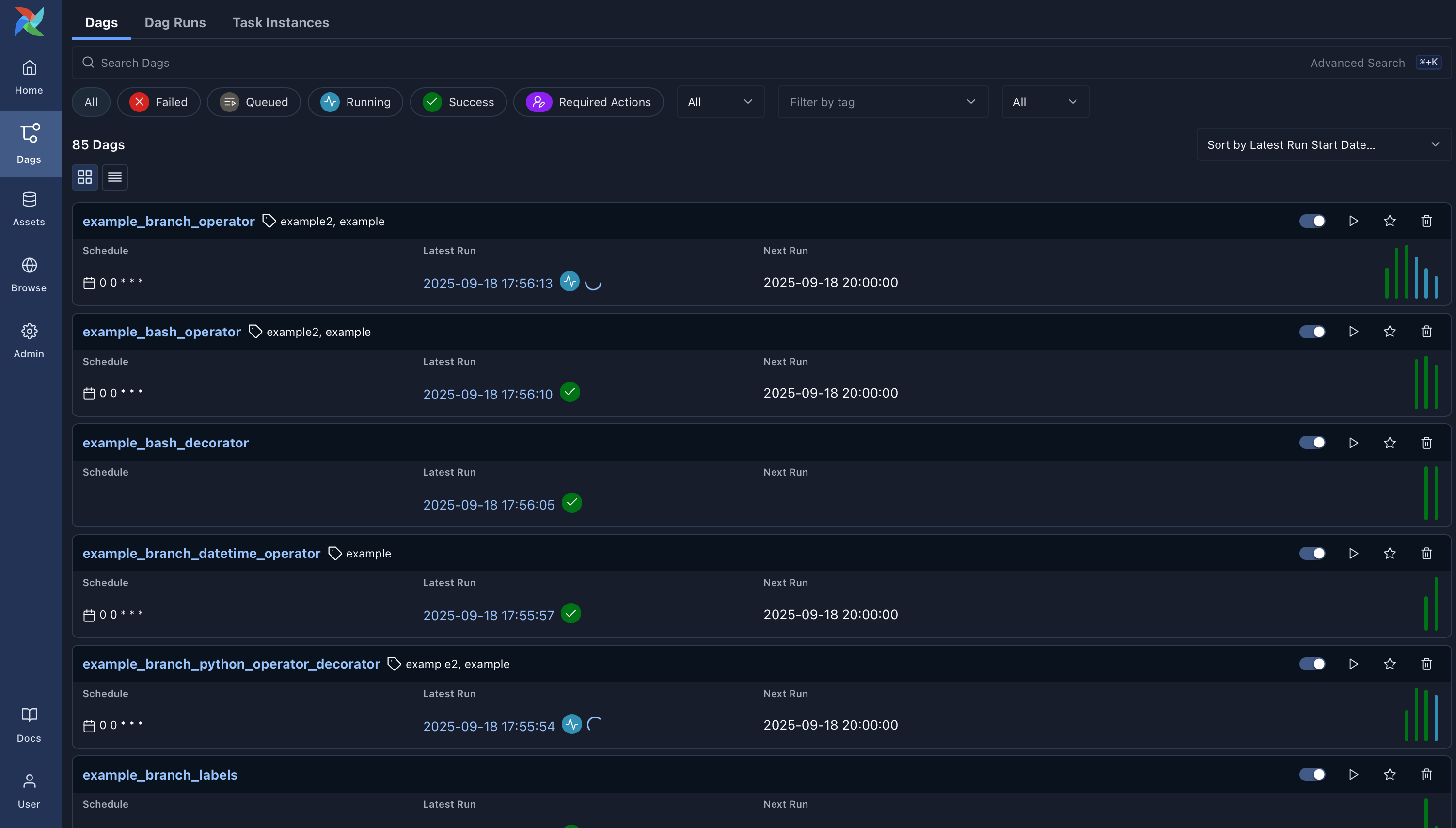
Assets: Overview of Assets with dependencies.
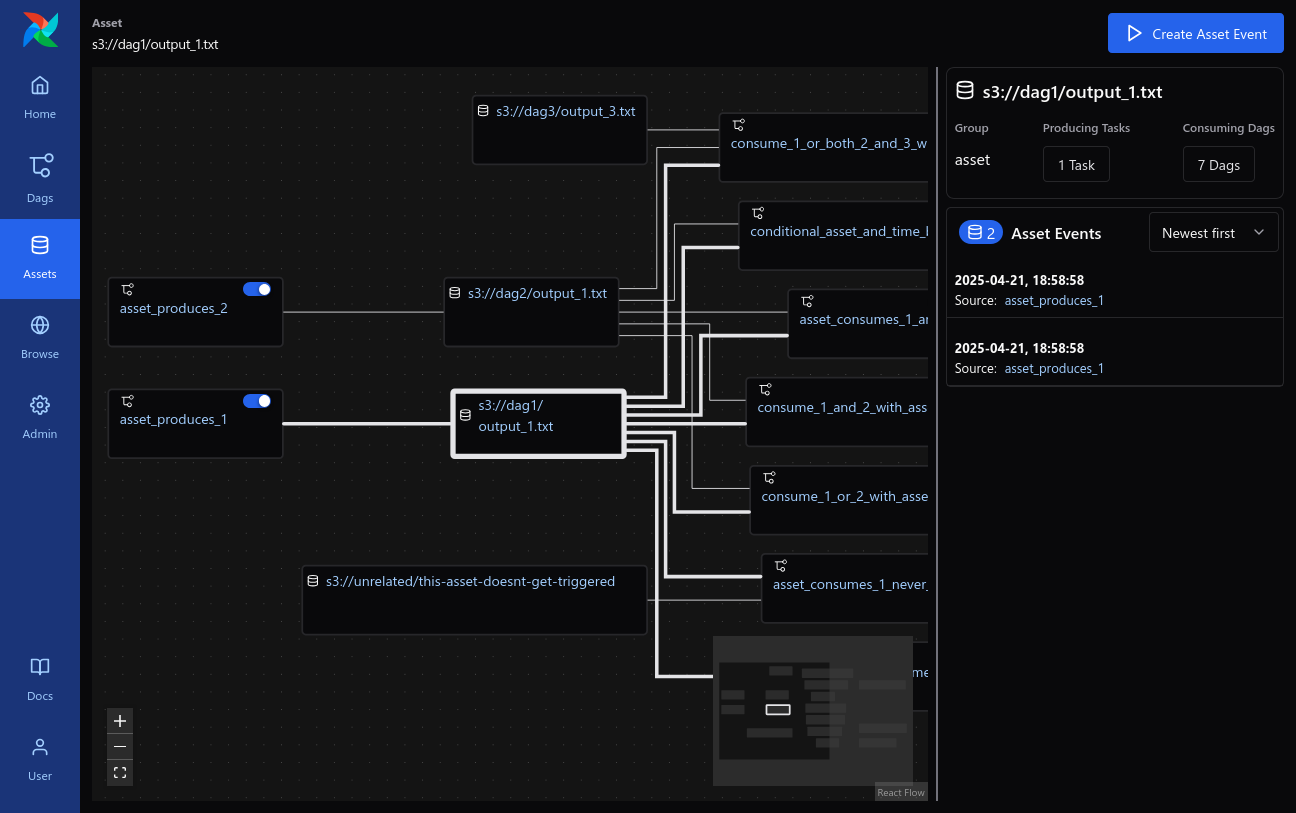
Grid: Grid representation of a Dag that spans across time.
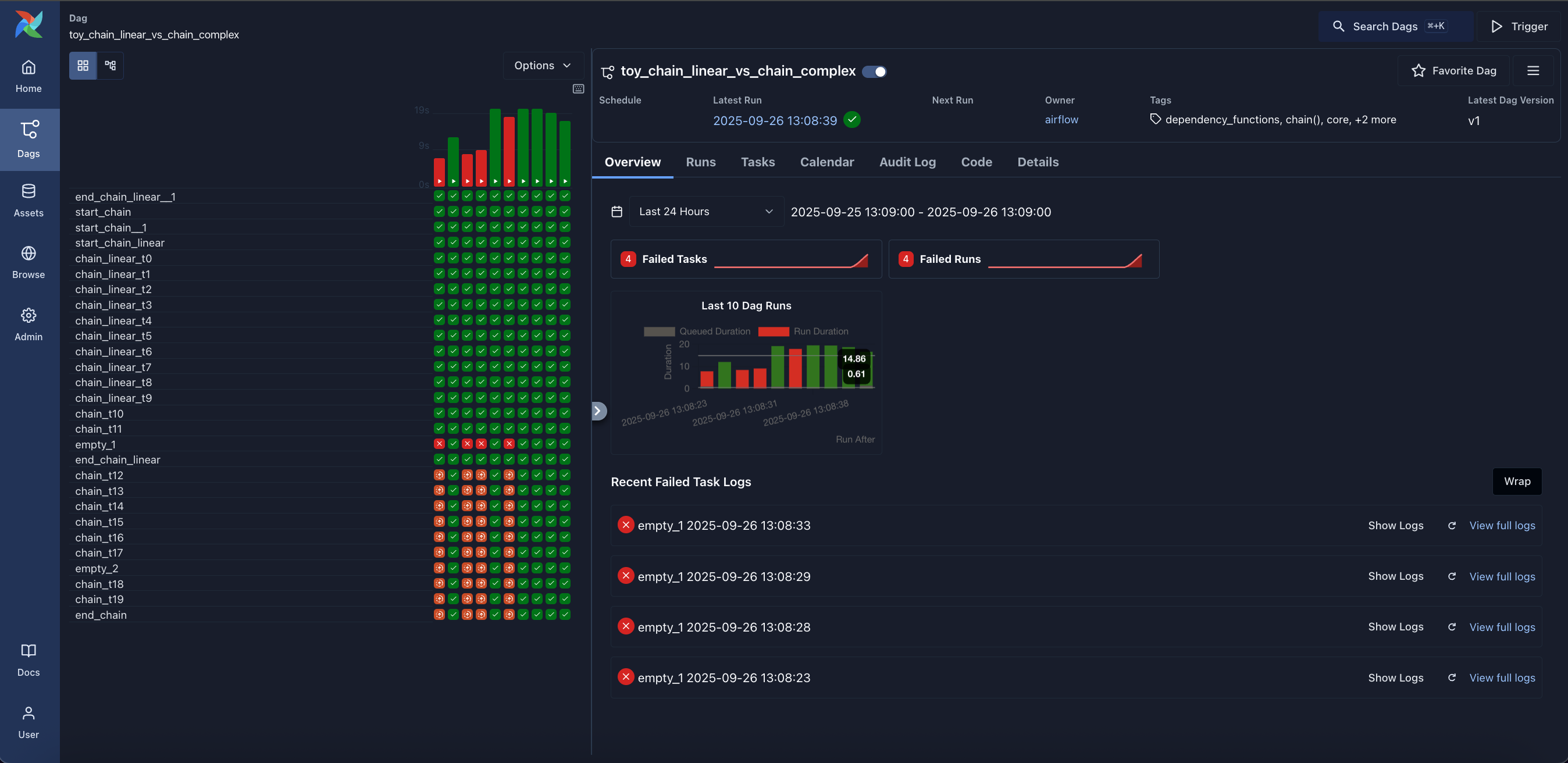
Graph: Visualization of a Dag's dependencies and their current status for a specific run.
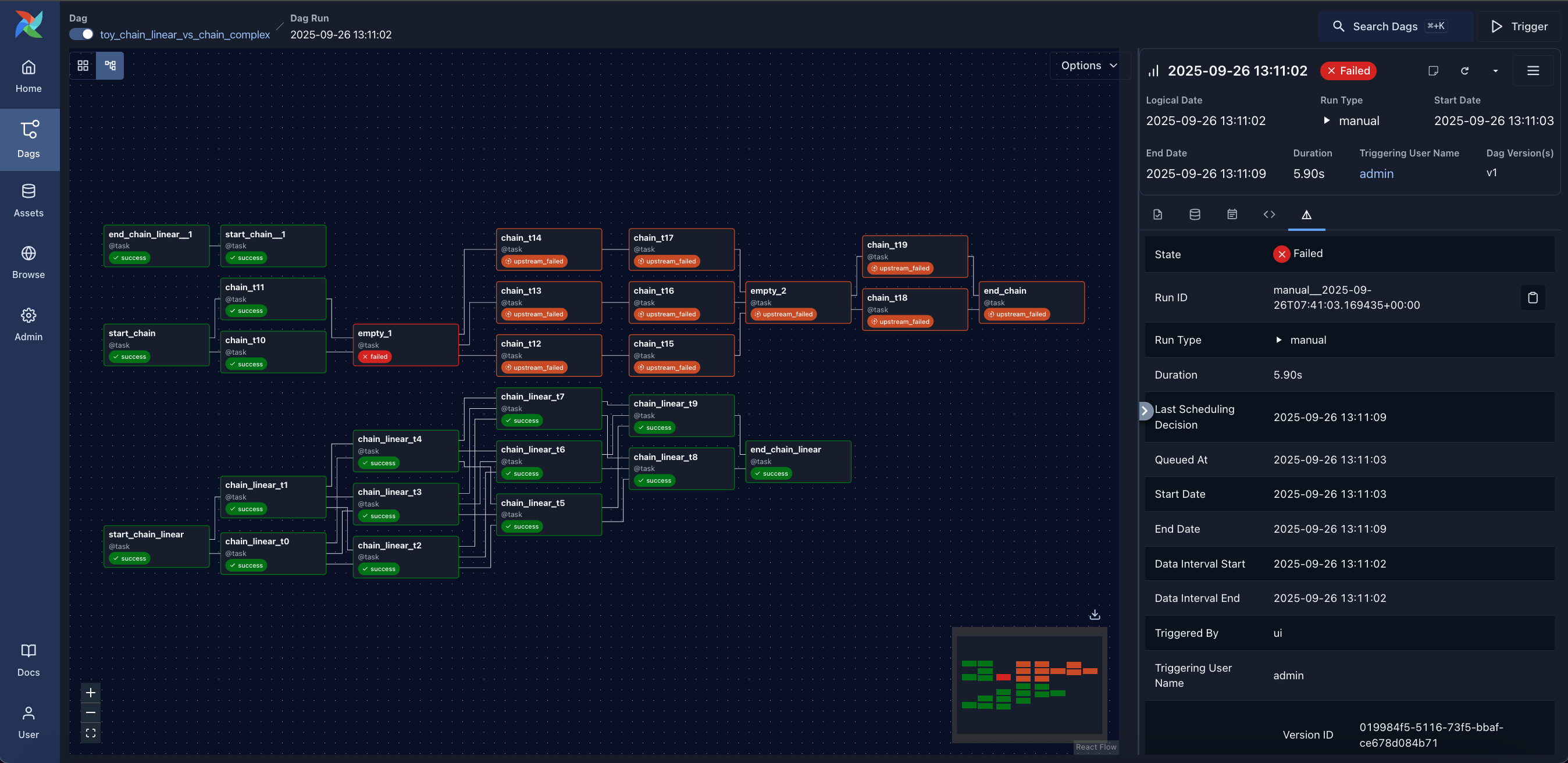
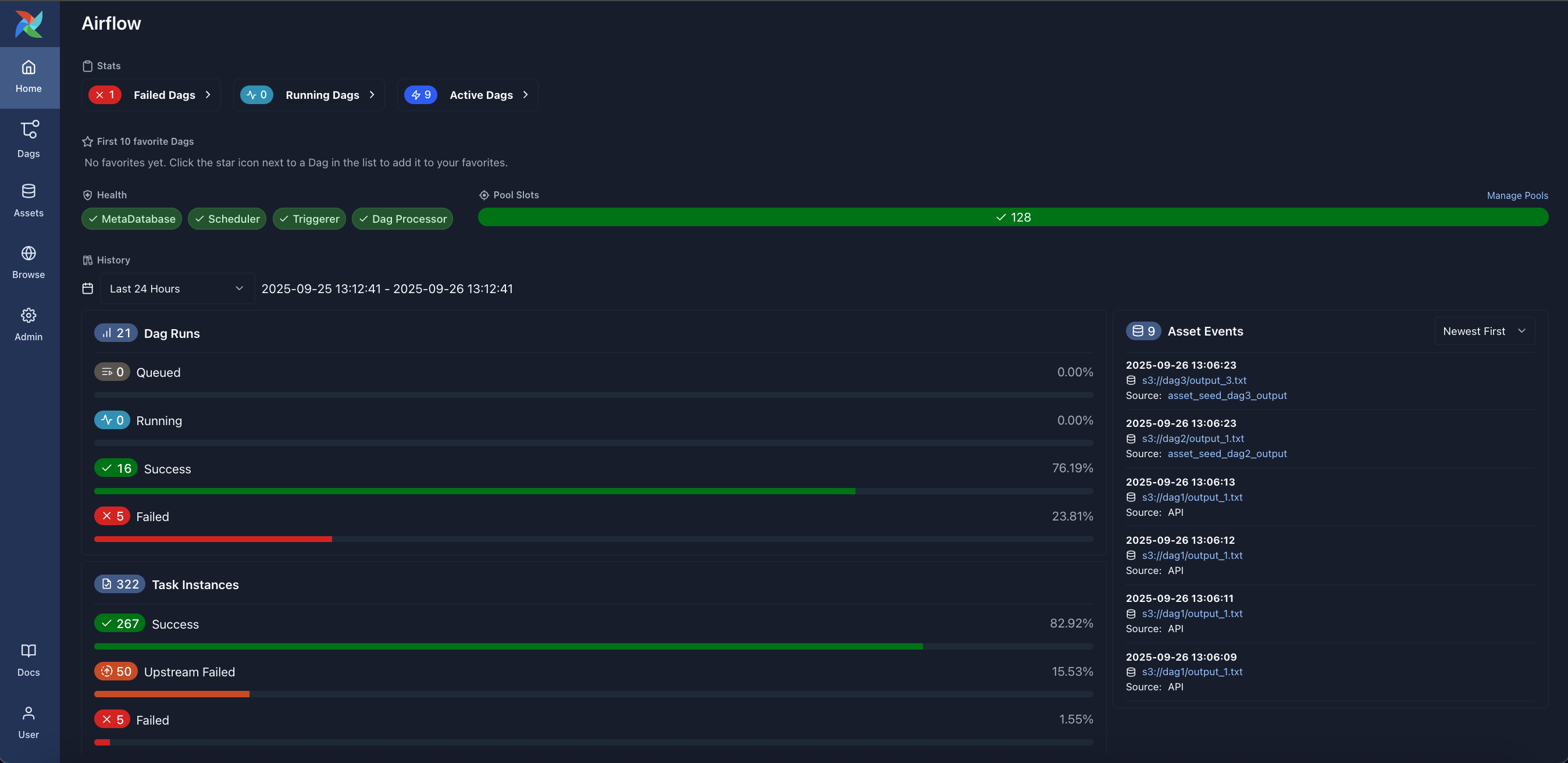
Home: Summary statistics of your Airflow environment.
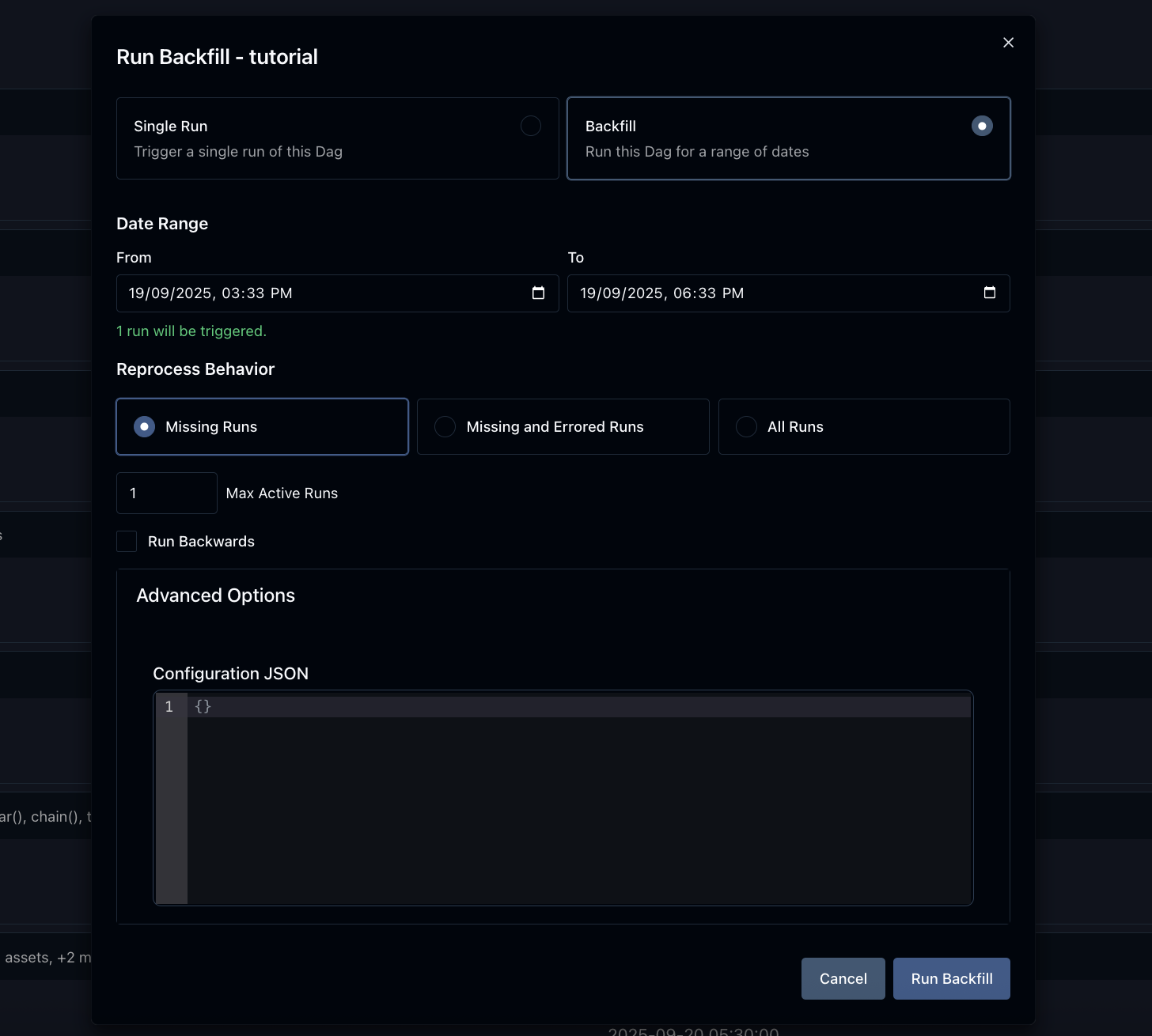
Backfill: Backfilling a Dag for a specific date range.
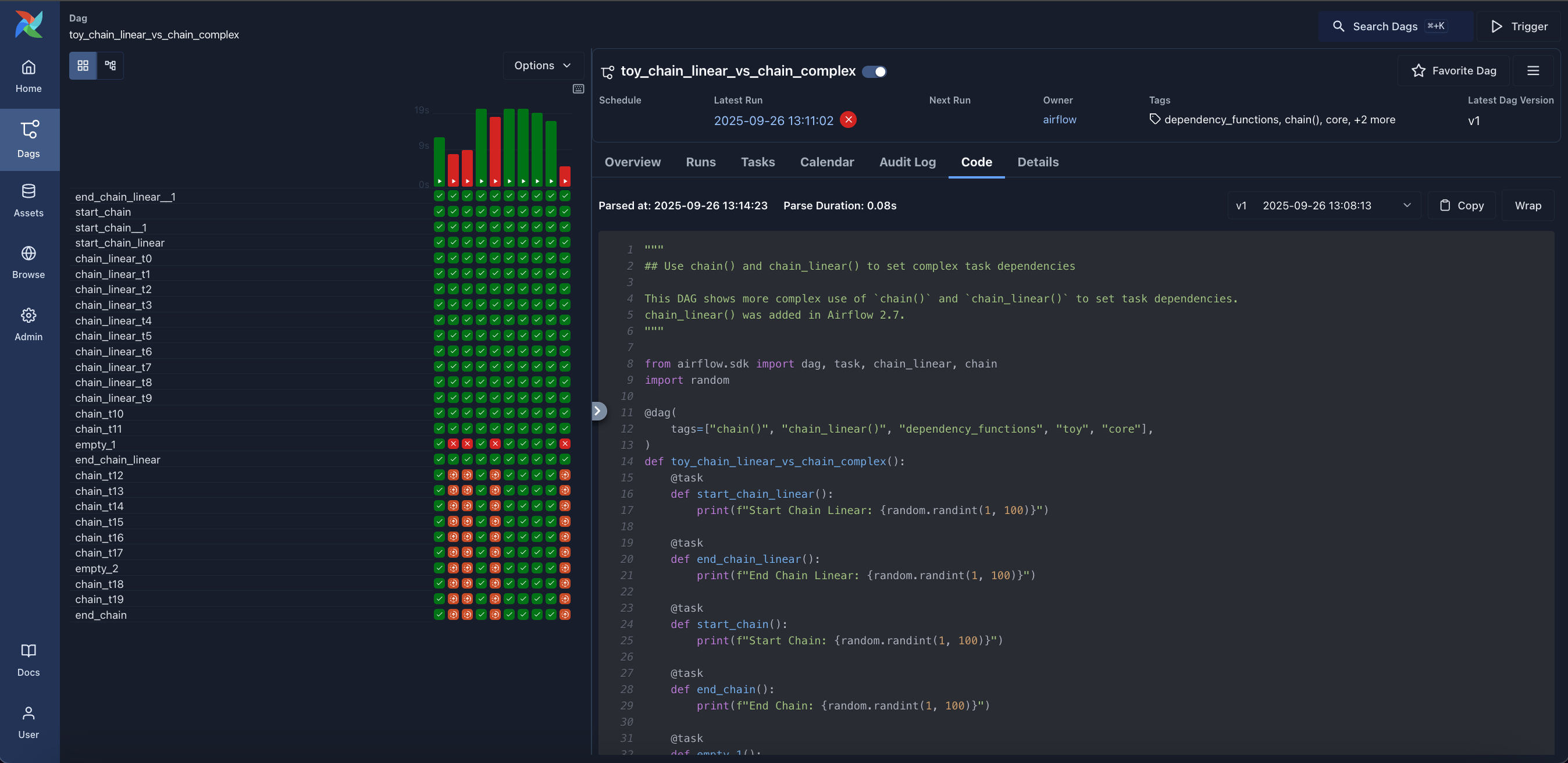
Code: Quick way to view source code of a Dag.
Semantic versioning
As of Airflow 2.0.0, we support a strict SemVer approach for all packages released.
There are few specific rules that we agreed to that define details of versioning of the different
packages:
- Airflow: SemVer rules apply to core airflow only (excludes any changes to providers).
Changing limits for versions of Airflow dependencies is not a breaking change on its own.
- Airflow Providers: SemVer rules apply to changes in the particular provider's code only.
SemVer MAJOR and MINOR versions for the packages are independent of the Airflow

 Apache Airflow 是一个平台,用于以代码方式编写、调度和监控工作流,工作流使用 Python 定义。