Lock Screen Explorer
A few lock screen designs for Omarchy 4 and a picker to preview and switch between them.
Colors and fonts come from your Omarchy theme.
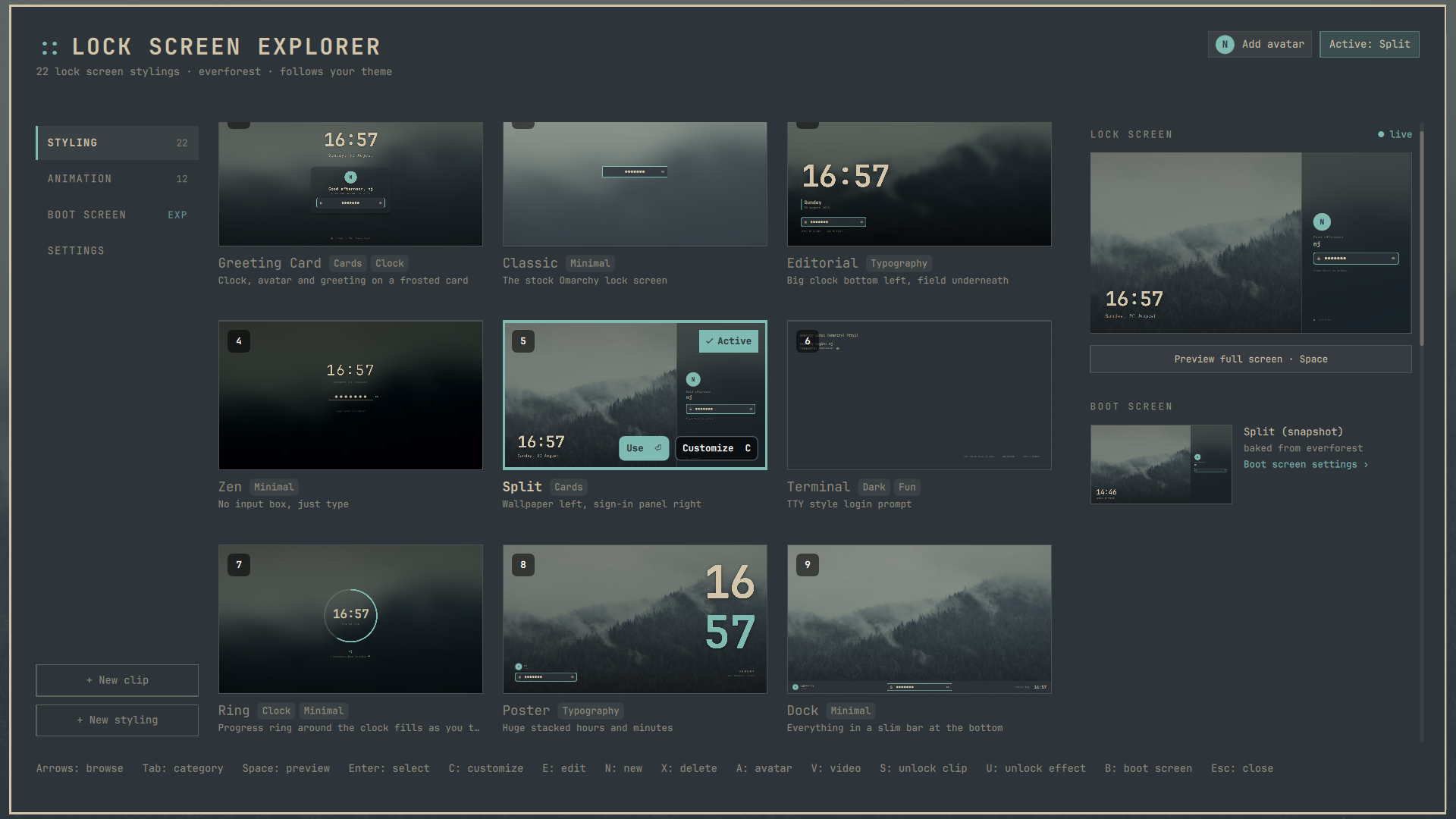
Designs: Greeting Card, Classic (the stock one), Editorial, Zen, Split, Terminal, Ring, Poster, Dock, Aurora, Analog, Flip, Island, Cinema, Sheet, Neon, Calendar, Frame, Dayline, Profile, Weather, Music, System, Rain.
Weather fetches from wttr.in (same location as the bar widget), Music reads MPRIS players, System shows uptime, memory, load and battery.
Every password field has an eye button to show what you typed (Ctrl+E does the same). It hides again after a failed attempt or when the field is cleared.
Install
omarchy plugin add https://github.com/SirJul1337/omarchy-lock-explorer.git --enable
omarchy restart shell
The restart is needed: the shell loads this service before it unloads the stock one, so for a
moment both claim the lock IPC target and the stock one keeps it. Until you restart,
omarchy-shell lock explore answers Function not found.
This replaces the built-in omarchy.lock service (the manifest has clonedFrom: omarchy.lock
so the shell swaps them and everything that locks the screen keeps working). Disable or remove
the plugin to get the stock lock screen back.
Usage
omarchy-shell lock explore
Arrows to browse, Tab to switch category (or click the chips), Space for full-size preview, Enter to select, Esc to close. Scroll with the mouse wheel or PageUp/PageDown. U cycles the unlock animation and Shift+U its length, the same as clicking the Unlock chip in the header.
A picks a profile picture with the normal file dialog (the explorer steps aside while the
dialog is up and comes back when you are done), Shift+A clears it again. The designs that show
the user — Greeting Card, Split, Dock, Poster, Sheet, Island and Profile — use it, and fall back
to your initial when there is none.
With a fingerprint reader enrolled the lock screen listens for it as soon as it comes up, and
with face unlock set up (pam_facelock, the omarchy-lock-face PAM config with a model
enrolled) pressing Enter on an empty password field starts a face check, the same as the stock
lock. The password field shows an icon for each one that is available.
D opens the visual designer — a new design, or the selected one if it was made there (see
The designer). C on any design copies it to ~/.config/omarchy/lock-designs/
(it shows up under Custom) and opens it in the built-in code editor. E edits a design of your
own, in the designer or the code editor depending on where it came from. N starts a new one
from the template. X (or the
Delete button on the card) removes a design of your own — press it twice, the first press just
arms the button. Deleting a clip design also removes its video from ~/.config/omarchy/lock-videos/
unless something else still uses it (another design, the boot screen, the Motion video or the
unlock clip). Built-in designs can't be deleted. The editor has the code on
the left and a live preview on the right: Ctrl+S saves and reloads the preview and the lock screen, Ctrl+O opens
the file in your normal editor (changes made there are picked up too), Esc goes back.
To get it in the app launcher and the Omarchy menu (Style -> Lock Screen, and lock in the
menu's search), set "Omarchy menu" to Added in the Settings tab. Nothing is added on install: a
plugin cannot run anything when it is installed, so it is a choice you make once. The same by hand,
with --remove to take both entries out again:
~/.config/omarchy/plugins/io.github.sirjul1337.lock-explorer/extras/install.sh   # --remove takes them out
omarchy-shell lock setMenuEntry on   # or off
Optional keybinding for ~/.config/hypr/bindings.lua:
o.bind("SUPER + SHIFT + L", "Lock screen explorer", "omarchy-shell lock explore")
Other commands:
omarchy-shell lock designs
omarchy-shell lock design
omarchy-shell lock setDesign zen
omarchy-shell lock previewDesign split   # you can type in the preview
omarchy-shell lock previewFail           # show the failure state in the preview
omarchy-shell lock hidePreview
omarchy-shell lock monitors
omarchy-shell lock setInputMonitor DP-1  # or "all"
omarchy-shell lock avatar
omarchy-shell lock pickAvatar            # the file dialog, same as A in the explorer
omarchy-shell lock setAvatar ~/me.png
omarchy-shell lock clearAvatar           # back to the initial
omarchy-shell lock resetAvatar           # back to whatever is found automatically
omarchy-shell lock unlockAnimation
omarchy-shell lock setUnlockAnimation fade   # none (default), fade, zoom or rise
omarchy-shell lock setUnlockDuration 600     # milliseconds, 0-2000, 400 by default
omarchy-shell lock previewUnlock             # play it on an open preview
omarchy-shell lock clockFormat
omarchy-shell lock setClockFormat 12   # or 24
omarchy-shell lock menuEntry
omarchy-shell lock setMenuEntry on     # launcher + Omarchy menu entries, or off
omarchy-shell lock boot
omarchy-shell lock setBoot follow            # stock, follow, or a design id with a twin
With more than one monitor you can pick which one shows the sign-in with setInputMonitor.
The others get a clock only screen (typing still works there).
The unlock is instant unless you ask for an animation. The Unlock chip in the explorer header
turns one on -- click it to cycle, click the milliseconds next to it for the length, or use U
and Shift+U. With one on, the lock screen animates away rather than blinking out: the design fades into the plain wallpaper and the desktop is behind it on the
same background. fade dissolves it, zoom fades with a slight push in and rise lifts it off
the screen, none is the default instant one. setUnlockDuration takes milliseconds.
previewUnlock plays the animation on the preview so you can see it without locking. The lock
screen is held for the duration of the animation, so keep it short.
Hyprland paints black under the lock screen, which is why the plain wallpaper is drawn behind the
fade: the desktop comes back on the same background instead of through a dark flash. With
misc:session_lock_xray = true the compositor keeps drawing the desktop under the lock screen
instead, and the fade goes straight into it.
The selected design, the avatar, the unlock animation and the boot screen setting are saved on
the plugin entry in ~/.config/omarchy/shell.json.
12-hour clock
Clocks read 24-hour by default. The Settings tab has a "Clock" row — 24h or
12h AM/PM — and it applies to every design, built-in or your own, including
the previews in the explorer and the designer canvas. By hand:
omarchy-shell lock setClockFormat 12, and 24 to go back. It is saved on the
plugin entry in ~/.config/omarchy/shell.json as clock12.
Designs render their clock through lock.clock("HH:mm") rather than
Qt.formatTime directly, which is what lets one setting reach all of them: the
format is used as written on a 24-hour clock, and rewritten to a 12-hour one
with AM/PM after the time when the setting is on. A design that shows a bare
hour on its own — Flip's tiles, Poster's numerals — counts 1 to 12 and puts the
meridiem in lock.meridiem, which those two draw beside the digits.
Blank the display after
By default the lock screen DPMS-offs the display five seconds after locking. The Settings tab has
a "Blank the display after" row — 5s, 15s, 30s, 1m, 5m, Custom, or Never. Custom takes minutes
(1 to 60) typed into an inline field. By hand: omarchy-shell lock setBlankDelay 30000, or
setKeepDisplayOn true for Never — anything longer than an hour is what Never is for.
Never keeps the lock screen lit for the whole lock: video designs keep playing, and slow
monitors are never re-blanked mid-wake on resume — the display was never off to begin with.
For an HDMI setup that fails to wake after DPMS, you can instead keep displays powered
only while HDMI is present. Add "keepDisplaysOnWithHdmi": true to this plugin's
entry in ~/.config/omarchy/shell.json:
{"id": "io.github.sirjul1337.lock-explorer", "keepDisplaysOnWithHdmi": true}
This defaults off. While an HDMI-A-* screen is present, the blank timer turns off
only the keyboard backlight; all displays stay powered and the lock remains active.
When HDMI is removed, the normal blank delay starts again. Never still keeps
displays on regardless of connectors. Set the HDMI option to false or remove it
to disable the workaround. omarchy-shell lock status reports the effective policy
as displayBlankingSuppressed.
This uses more monitor power. It avoids a display-sleep trigger; it does not fix
driver hotplug faults or prevent explicit system suspend. The setting follows
Hyprland's visible HDMI screen names, not USB dock presence.
With no avatar set, the first of ~/.config/omarchy/lock-avatar.{png,jpg,jpeg,webp}, ~/.face,
~/.face.icon and /var/lib/AccountsService/icons/$USER is used, so an existing profile picture
shows up on its own.
Boot screen (drive decryption) — experimental
The boot screen support is experimental: it works and fails safe (a broken theme drops
Plymouth to its plain text prompt, and the boot itself is never touched), but it is younger
than the rest of the plugin.
The screen that asks for your disk passphrase at first boot is Plymouth, not the shell, so it
normally stays the stock Omarchy one no matter which design you pick. Designs with a boot twin
under plymouth/ -- Terminal and Rain so far -- can style it too. Press B in the explorer (or
click the Boot screen chip) and pick "Match lock screen" to keep it in sync with your lock
design, pick a specific design to pin it, or "Untouched" to restore the stock one.
Applying generates a Plymouth theme from your current Omarchy theme colors and ships it as a
systemd-stub initrd addon on the EFI partition (omarchy_linux.efi.extra.d/), which the boot
stub layers over the boot image -- one small file write, near-instant, one password prompt, no
initramfs rebuild. The first apply after updating from an older version of this plugin also
cleans up the previously baked-in theme, which runs one last rebuild (~30s). Colors are baked
into the addon at apply time, so re-apply after switching Omarchy theme (the explorer offers
this automatically). If a generated theme ever misbehaves the boot itself is fine -- Plymouth
falls back to a plain text prompt -- "Untouched" deletes the addon and the stock screen is back.
Snapshot boot entries never see the addon, so rollbacks always show the stock theme. Systems
that don't boot Omarchy's UKI keep the old bake-and-rebuild path automatically.
The twins are honest ports, not screenshots: Terminal keeps the blinking cursor, the bullets and
a caps lock warning, Rain keeps the falling glyphs, animated live by plymouth. Clocks and live
data can't come along (Plymouth has no clock and boots before the network), which is why not
every design has a twin.
You can try a twin without touching your boot:
extras/boot-vm-test.sh "$(plymouth/apply.sh terminal --stage-only)"
boots your real kernel and initramfs in QEMU against a throwaway encrypted disk (passphrase:
omarchy). Needs qemu-system-x86, edk2-ovmf and qemu-ui-gtk.
The designer
"+ New design" in the explorer sidebar (or D) opens the visual designer: pieces on the left,
your lock screen at its real size in the middle, the settings for whatever is selected on the
right. Drag a piece onto the screen — or click it to drop one in the middle — move it around,
and press Ctrl+S. There is no separate preview: the canvas renders through the same components
the lock screen does, so what you arrange is what you get.
What you can drag in: Wallpaper, Video and Solid color for the background; Clock,
Date, Greeting, Text, User name, Host name and a Status line that turns
into the failure message when a password is wrong; a Password box or bare Dots to type
into; Avatar and Image; Panel and Divider to build a card out of; and Custom
QML for anything else — that one is a box you write QML into, with lock.now, lock.userName,
lock.greeting() and the rest in scope, exactly as in a hand-written design.
Nothing is parked at fixed pixel coordinates. Every piece holds on to a corner, an edge or the
middle of the screen ("Sticks to" in the inspector, picked from where you drop it) and keeps its
distance from there, so a design made on one screen still looks right on another. Dragging snaps
to the screen's centre lines and to the other pieces' edges, and arrow keys nudge by a pixel
(Shift for ten).
drag / click a piece   add it            Ctrl+click       add to the selection
arrows                 nudge (Shift 10)  Ctrl+D           duplicate
Del                    remove            [ and ]          send back / bring forward
Ctrl+Z / Ctrl+Shift+Z  undo / redo       Ctrl+S           save
Your own components
Select a piece — or several with Ctrl — press Save as component and give it a name. It goes
into ~/.config/omarchy/lock-components/ as one small JSON file and shows up at the top of the
palette, previewed live, ready to drag into any design from then on. A component keeps the
relative positions of everything in it, so a card built out of a panel, an avatar and a greeting
comes back as that card. Backgrounds are not saved into components — they cover the whole screen,
so there is nothing to place. The ✕ on a component removes it.
Because a component is just a piece of a layout, a Custom QML piece can be saved as one too:
write the QML once, name it, and it becomes a block you drag in like any other.
What it writes
The designer saves an ordinary design into ~/.config/omarchy/lock-designs/, so it appears under
Custom next to everything else and can be applied, previewed and deleted the same way. The file is
a DesignBase with one DesignerItem per piece, and the layout itself sits on a single comment
line at the top — that line is what the designer reads when you open the design again. Edit the
code by hand and the next save from the designer overwrites it, so pick one: "Edit code" in the
designer toolbar moves a design over to the code editor for good, and E on a design opens it
wherever it was made.
Your own designs
Easiest: open the explorer, pick a design you like and press C. That copies it to
~/.config/omarchy/lock-designs/ and opens the editor. N gives you a blank one from
extras/lock-designs/MyDesign.qml. You can also just drop .qml files in that folder yourself;
they show up under Custom, named after the file (My Design for MyDesign.qml, id my-mydesign).
omarchy-shell lock customize zen        # copy the Zen design to ~/.config/omarchy/lock-designs/Zen.qml
omarchy-shell lock editDesign my-zen    # open it in your editor
omarchy-shell lock rescanDesigns        # pick up files added by hand
Keep the import "../plugins/io.github.sirjul1337.lock-explorer/designs" line, that is where
DesignBase, PasswordField, LockInput, Wallpaper and Avatar come from.
Your own video works as an unlock clip too: "+ New clip" in the explorer sidebar (or
omarchy-shell lock newClipDesign) opens the file picker, copies the video to
~/.config/omarchy/lock-videos/ and writes a one-line design for it, which shows up under
Animation. Like Storm and the others, the first frame holds while locked and the video plays
through as the unlock — so a clip that ends on your wallpaper looks best. By hand it is just a
file in ~/.config/omarchy/lock-designs/ containing
ClipDesign { clipName: "my-video.mp4" } after the import line.
"Unlock video ends as your wallpaper" under Settings makes any clip end seamlessly: the clip's
last frame is extracted while the screen is locked and set as the session background
(omarchy-theme-bg-set) the moment the video hands the screen back, so the desktop opens exactly
where the video stopped. Switching theme or cycling backgrounds replaces it again like any other
wallpaper. Off by default; also from the command line:
omarchy-shell lock setClipWallpaper true
"Clip speed" next to it plays the unlock clips faster or slower (0.5x-2x, also
omarchy-shell lock setClipSpeed 1.5). It applies to the clip designs and the separate unlock
clip alike.
To add a design to the plugin itself, copy one of the files in designs/, add it to
Designs.js, run omarchy restart shell.
A design is a DesignBase item. It gets passwordText, failureMessage, failedAttempts,
authenticatingPassword, fingerprintConfigured, faceConfigured, inputEnabled, a ticking now, userName,
hostName and greeting(). Use PasswordField for a normal input box or LockInput if you
want to draw the input yourself, and point inputItem at it so it gets focus. Set
shakeOnFail: true on box-less designs (the base flashes red on a wrong password either way), and
showPasswordToggle: false if you do not want the eye button.
For the profile picture use Avatar { lock: lock; width: 96 }, which shows the chosen image
masked to a circle and the user's initial when there is none. fontSize, fillColor,
textColor, borderWidth, borderColor and shadow are there to fit it into a design. The raw
values are on the base as hasAvatar and avatarUrl if you want to draw it yourself.
Remove
omarchy plugin remove io.github.sirjul1337.lock-explorer
omarchy restart shell
That restores the built-in Omarchy lock screen. Your own designs in
~/.config/omarchy/lock-designs/ are left alone, delete that folder if you want them gone.
The optional launcher entry from extras/install.sh can be removed with
rm ~/.local/share/applications/lock-screen-explorer.desktop ~/.local/share/icons/hicolor/scalable/apps/lock-screen-explorer.svg
and by deleting the style.lockscreen line from ~/.config/omarchy/extensions/omarchy-menu.jsonc.
Troubleshooting
omarchy-shell lock explore says Function not found: the stock lock service is still the one
answering, so this plugin never took over the lock IPC target. Run omarchy restart shell.
If it persists, check that the plugin is enabled and that the stock one got disabled:
omarchy plugin list
jq '.plugins, .disabled' ~/.config/omarchy/shell.json
io.github.sirjul1337.lock-explorer should be enabled and omarchy.lock should be in disabled.
Target not found instead means neither service is loaded, usually because this one failed to
load. omarchy plugin validate ~/.config/omarchy/plugins/io.github.sirjul1337.lock-explorer
and the shell log will say why.
The explorer opens but nothing in it works, and every setting comes back as its default after
omarchy restart shell or an update: that is plugin versions up to 1.6.1 on Omarchy 4.0.3,
which stopped handing third-party plugins their shell.json settings and, for a lock screen,
their own service. Update the plugin (omarchy plugin update io.github.sirjul1337.lock-explorer
then omarchy restart shell); 1.7.0 reads its entry from ~/.config/omarchy/shell.json itself
and hands the explorer a facade of the service instead. Settings that were lost in the meantime
need to be picked again once.
A broken design can never lock you out: if the selected design fails to load (a custom design
with a typo, say), the lock screen falls back to Classic, and if even that fails a plain
built-in password field takes over — the password always works. The boot screen is equally
safe: a broken Plymouth theme drops to a plain text passphrase prompt, and the boot itself is
never touched. If the whole shell ever misbehaves, switch to a console with Ctrl+Alt+F3, log
in, and run omarchy restart shell (or `omarchy plugin remove io.gi

 Lock Screen Explorer is an Omarchy plugin that adds dozens of ready-made lock screen designs (Greeting Card, Terminal, Weather, Music, System, Rain, and more) plus a picker UI to preview, switch, and customize them, while keeping all the normal unlock methods working.