An agent skill. Ask a hard question, get a page you can actually read instead of a wall of text. The model writes about 1/7 of the tokens it would need to hand-write the HTML.
24-second demo. Watch the MP4 for the version with music.
Why not just ask for HTML?
You can. Models write decent HTML now. The problem is the bill you pay in output tokens: the model has to type every line of CSS, every wrapper div and every SVG coordinate. Output tokens are also what you sit and wait for.
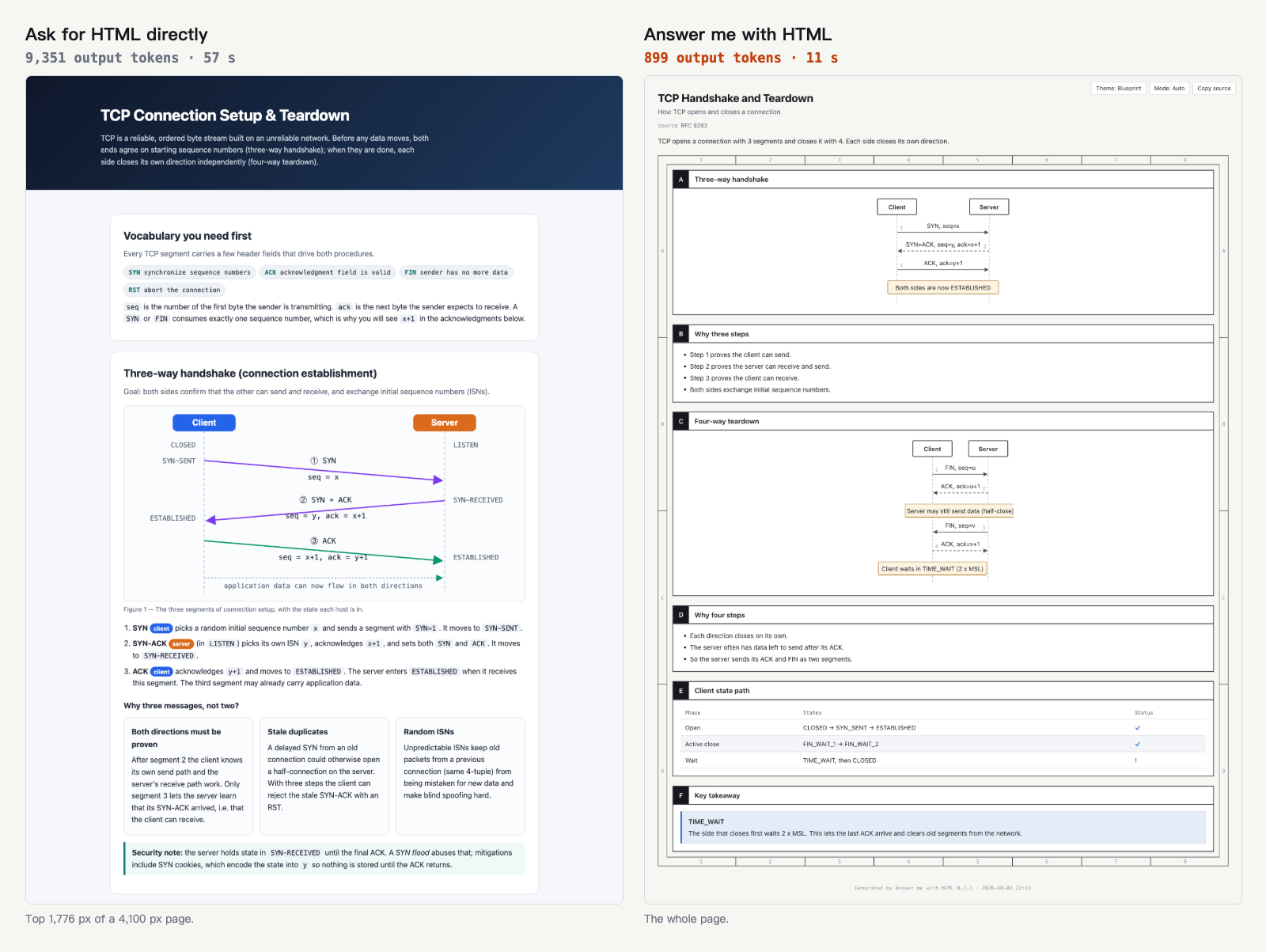
With this skill, the model writes only the content. We asked the same questions with the same model both ways (3 topics × 3 runs, medians, Claude Sonnet 5.5):
Ask for HTML directly
Answer me with HTML
Output tokens
6,873
923
7.4× fewer
Time
46 s
13 s
3.6× faster
Cost per answer
$0.22
$0.26
about the same
Same prompt, same model. Both pages are usable. One took 9,351 output tokens, the other 899.
Why the cost doesn't drop too: the skill adds two short turns (load the skill, run the CLI), and every turn re-reads the conversation context. You save the waiting, not the bill. Per-topic numbers and the script to reproduce them are in bench/.
Install
You need Node.js 20 or newer. There is no npm install step. The CLI is bundled inside the skill.
Let your agent install it (recommended)
Paste this into Claude Code, Codex, Cursor, OpenCode or any other agent:
Install the Answer me with HTML skill: run npx -y skills add QingYunA/answer-me-with-html -g -y, and pass -a with your own agent name (for Claude Code, -a claude-code). Then read its SKILL.md and use it to make a page that explains the TCP three-way handshake, so we know it works.
Skill folders for other agents: Codex ~/.codex/skills/, Cursor ~/.cursor/skills/, OpenCode ~/.config/opencode/skill/.
No setup is needed after install.
What you ask, what you get
You ask
You get
"Explain the TCP three-way handshake"
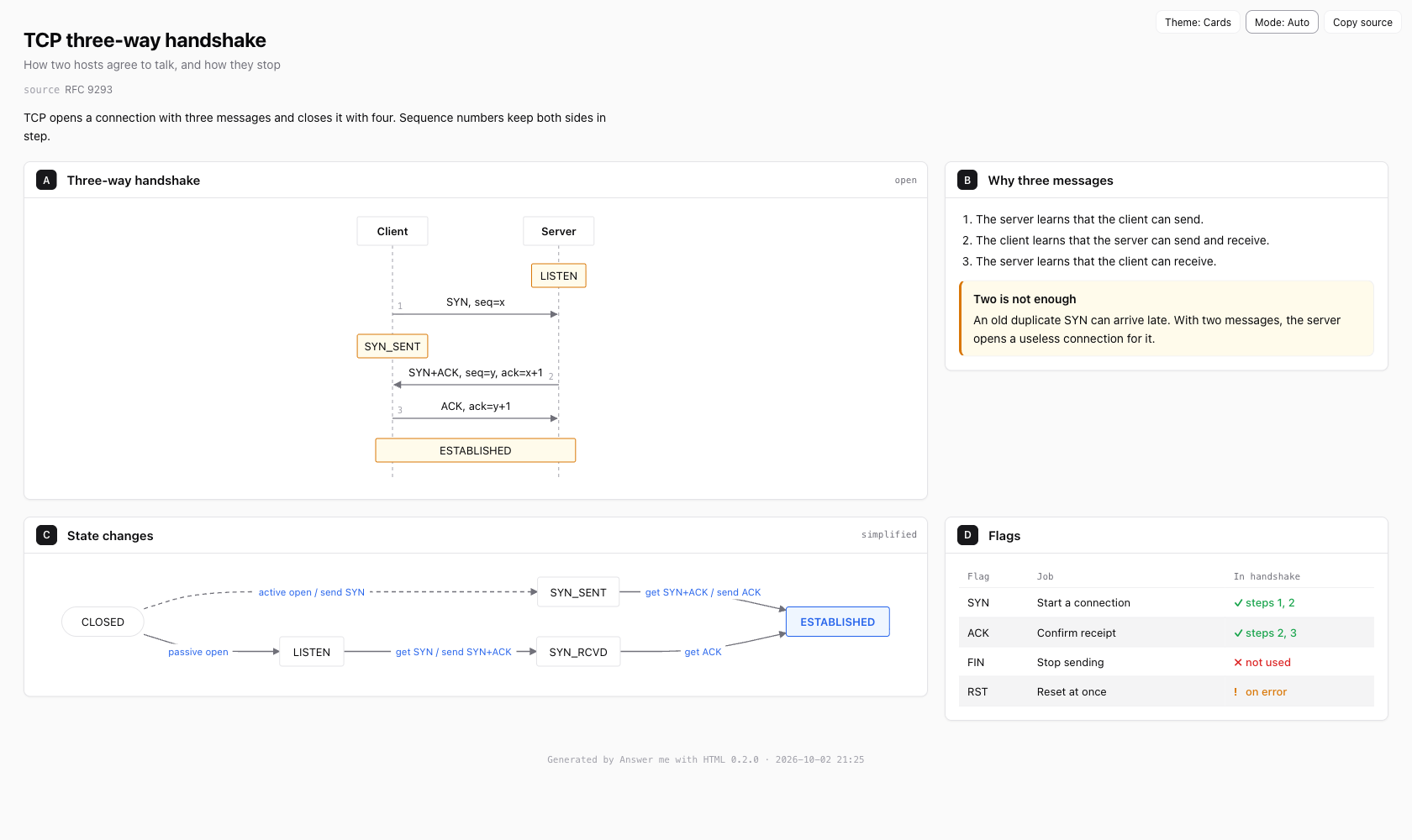
A sequence diagram, a state diagram and a flag table
"How are the modules in this repo organized?"
A folder tree plus a call graph
"Redis or Memcached?"
A comparison table with ✓ and ✗, then a verdict
"What's wrong with this paragraph?"
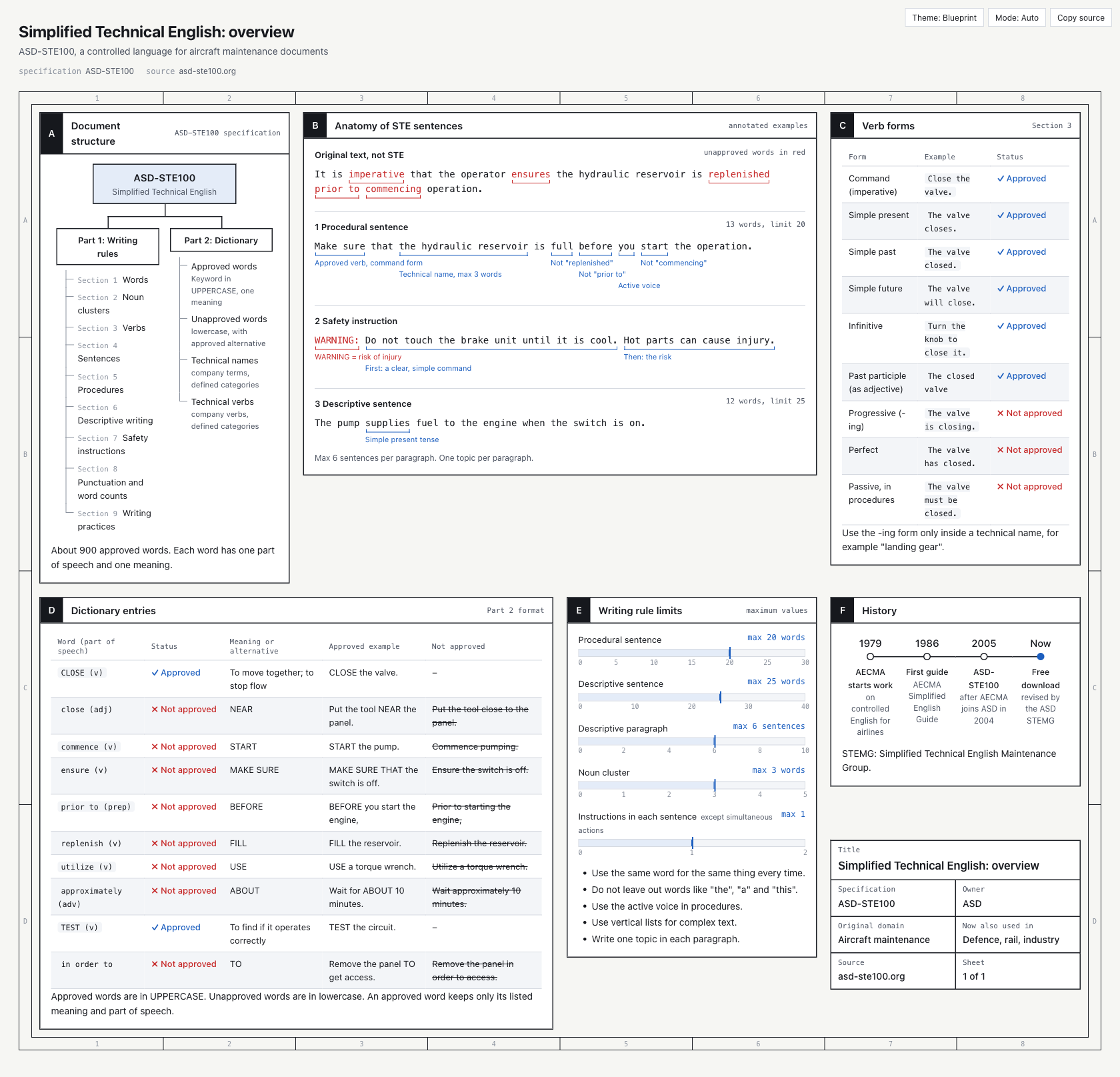
Each sentence annotated, with the problem words and fixes
"How did Kubernetes come about?"
A timeline with the key moments highlighted
"How do I show hidden files with ls?"
No page. A one-line question gets a one-line answer
The agent decides when a page is worth it: related concepts, multi-step flows, multi-way comparisons. You can also just say "explain it in HTML".
Pages are saved in ~/.answer-me-with-html/pages/. The buttons in the top-right corner switch the theme and light/dark mode, and copy the Markdown that produced the page.
Explainer videos (3Blue1Brown style)
Karpathy's ladder for understanding LLM output ends with explainer videos. Ask for one: "make a 3b1b-style video on the TCP handshake".
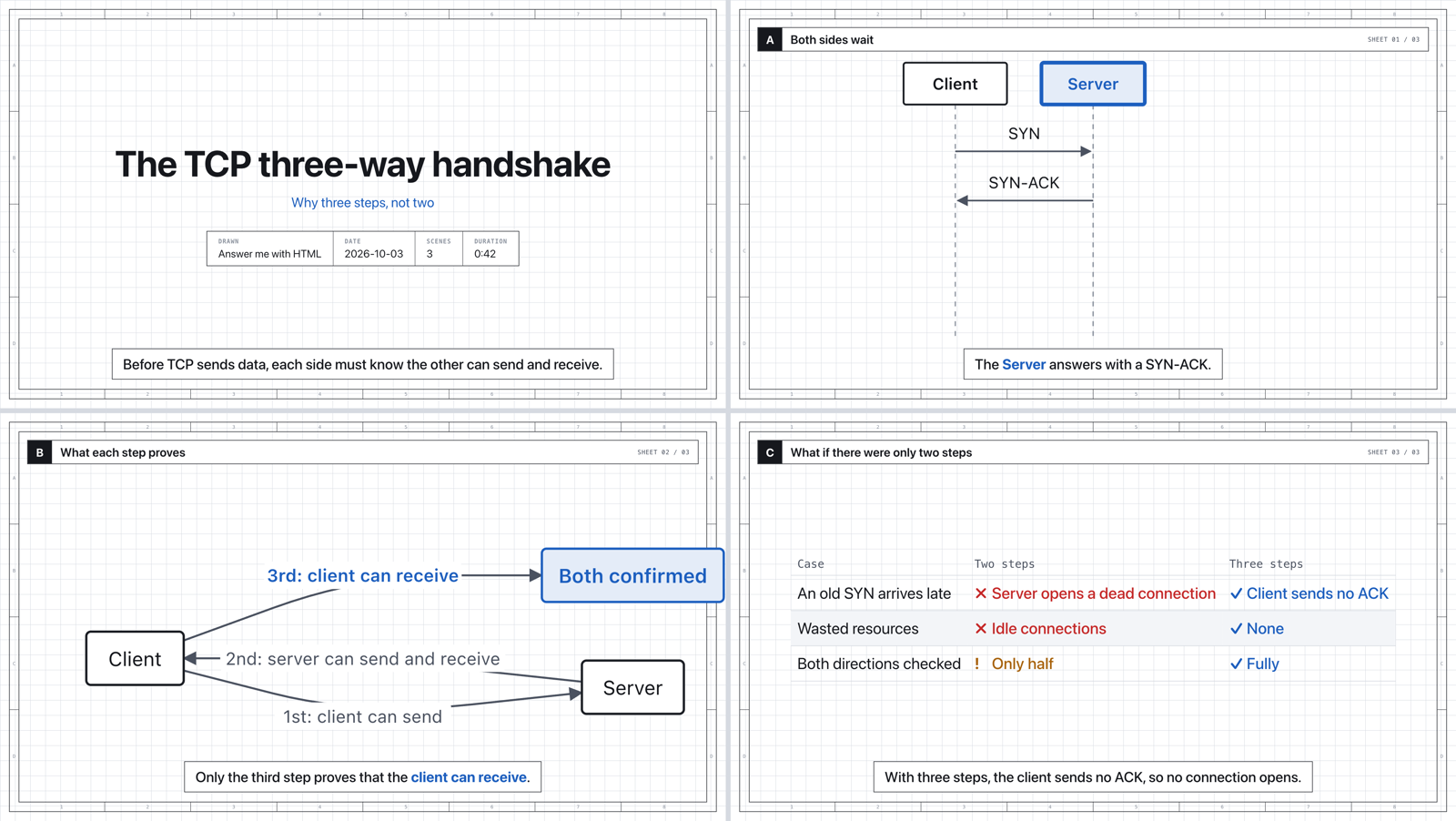
The agent writes the same kind of draft as for a page, plus one line of narration per beat. Nothing else:
## Both sides wait
```sequence
Client -> Server: SYN
Server -> Client: SYN-ACK
```
> The client sends a SYN to ask for a connection.
> The [Server] answers with a SYN-ACK.
am video turns it into a player page:
Built step by step. When the Nth line of narration plays, the Nth step of the diagram appears. Arrows draw themselves. If there are more lines than steps, the extra lines at the start act as an intro.
Spoken narration. The agent writes narration the way a person explains things out loud, not like a manual.
Camera focus.[Server] in the narration pushes the camera toward that node and highlights it. The diagram never leaves the frame.
Objects carry over. A node with the same name in the next scene glides to its new place instead of cutting.
Narration. It uses ElevenLabs if ELEVENLABS_API_KEY is set, the system voice otherwise (macOS say: Tingting for Chinese, Samantha for English), and captions only if neither exists. Each beat lasts as long as its audio, so picture and voice stay in sync.
Same look as the pages. Videos use the blueprint drawing style by default: a ruled frame and lettered sheet heads. Write theme: 3b1b for the dark 3Blue1Brown look. theme: shadcn and mode: dark also work.
One file. The page has the audio inside and plays offline. Add --mp4 for a 1080p video file. This needs Chrome, ffmpeg and Node.js 22+ on your machine. Export takes about 1.3 times the video length.
The draft for the example video (examples/video-tcp.en.md, about 45 seconds) is 1.3 KB, a few hundred output tokens. Rendering takes under a second without voice and about 4 seconds with the system voice. The agent only makes videos when you ask; always-on mode still makes pages. Full syntax: am help video.
Settings
Change settings with a slash command. There are no config files to edit by hand.
Where
How
Claude Code (plugin install)
/answer-me-with-html:config asks what to change. /answer-me-with-html:config open off changes it directly
Any agent
/answer-me-with-html config open off, or just say "stop opening the browser"
Terminal
am config to view, am config set open off to change, am config reset to restore defaults
Key
Default
What it does
open
on
Open each page in the browser after it is made. Turn it off if pop-ups interrupt you
always
on
Always-on mode (see below). Only matters when the always-on plugin is installed
theme
blueprint
Default theme: blueprint or shadcn
mode
auto
Default color mode: auto, light or dark
style
80
Writing check: off, 80 (warn only) or strict (refuse to render)
voice
auto
Video narration: auto (ElevenLabs if ELEVENLABS_API_KEY is set, else system voice), elevenlabs, system or off
Settings live in ~/.answer-me-with-html/config.json. A theme written in a draft beats the default. --open and --no-open affect one run only.
Always-on mode (optional)
By default, the agent makes a page only for questions that need one. If you want a page with every conclusion, turn on always-on mode.
The agent then gets a short reminder each turn (about 90 tokens). Whenever it gives a conclusion, summary, plan or comparison, even a short one, it adds a small page with 2 to 4 panels and puts the path at the end of the reply. These pages never pop open, so they don't interrupt you. Casual chat and replies with no conclusion stay as they are. Claude Code makes no pages in plan mode.
Pause it with /answer-me-with-html:config always off. You don't need to uninstall.
Other agents: paste this to your agent so it writes the rule into its own rules file, such as AGENTS.md:
Turn on always-on mode for Answer me with HTML: add a global rule — "[answer-me-with-html always-on] Whenever a reply gives a conclusion, summary, plan, comparison, review or explanation, even a short one, also make a page with the answer-me-with-html skill (2 to 4 panels for routine answers), render it with --no-open, and end the reply with the page path. Skip casual chat, one- or two-sentence replies with no conclusion, pure command output, and requests for plain text."
Background
Andrej Karpathy posted that as LLMs do more of the work, keeping up with their output becomes the hard part. A diagram or a web page is far easier to take in than a long block of text.
I tried asking agents to answer in HTML directly. The pages were good. They were also slow.
A decent page took a minute or two. Most of that time went into hundreds of lines of CSS that were nearly the same every time. Diagrams were worse: the model had to compute SVG coordinates by hand, and arrows often pointed at nothing.
So Answer me with HTML takes that work away from the model. The model writes content. The CLI handles layout, color and drawing.
How it works
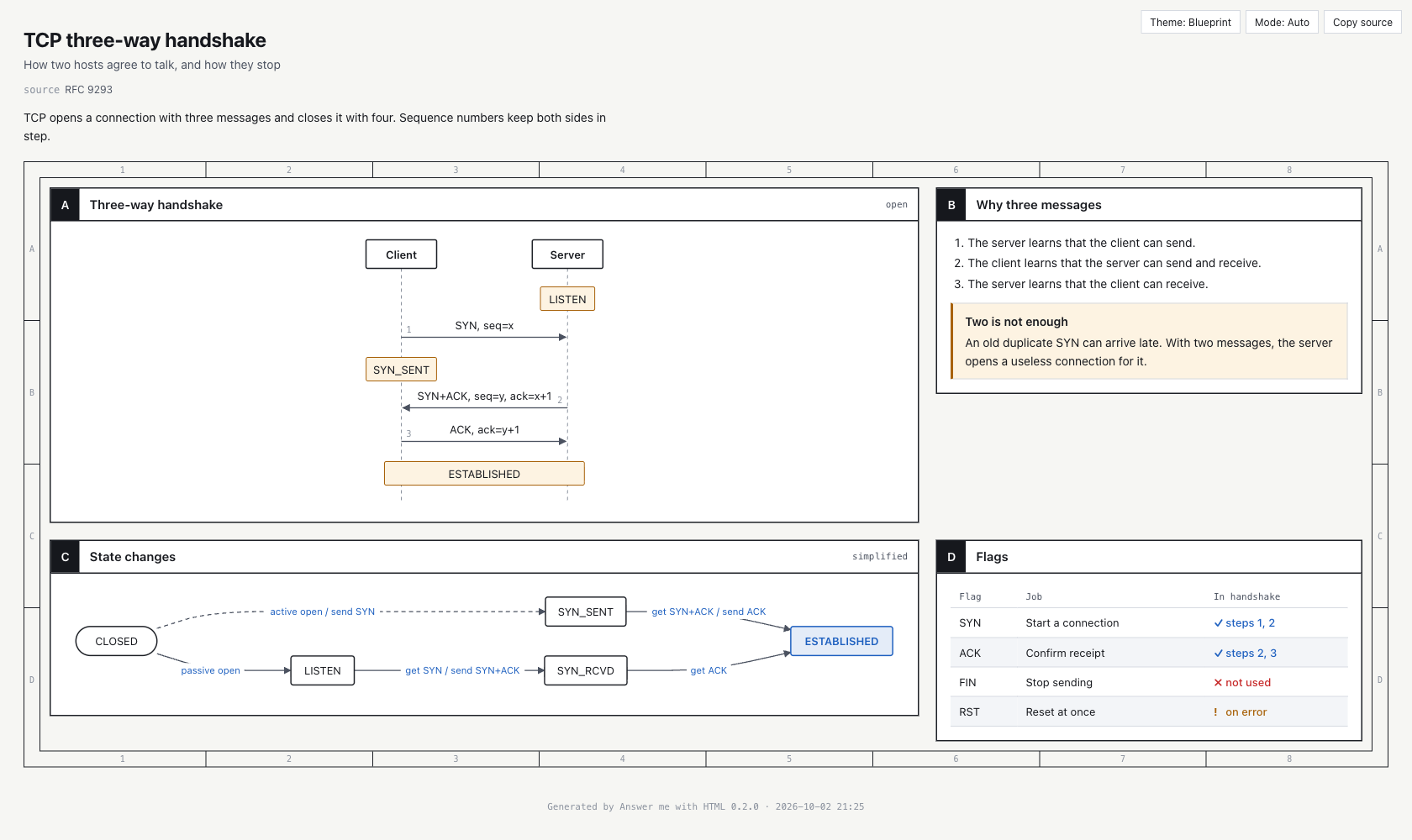
This is all the model writes:
---
title: TCP three-way handshake
---
## A Three-way handshake {span=2}
```sequence num
Client -> Server: SYN, seq=x
Server -> Client: SYN+ACK, seq=y, ack=x+1
Client -> Server: ACK, ack=y+1
note Client, Server: ESTABLISHED
```

## C State changes {span=2}
```flow LR
(CLOSED) -> LISTEN: passive open
LISTEN -> SYN_RCVD: get SYN / send SYN+ACK
SYN_RCVD -> *ESTABLISHED: get ACK
```
The CLI does the rest. It picks the template, places the panels, applies the theme, lays out the flow chart with dagre and spaces the sequence diagram by label width. The full draft, examples/tcp.en.md, becomes this page:
Features
Fewer tokens, less waiting: The model writes a short draft, about 900 output tokens, instead of 7,000 tokens of HTML, CSS and SVG. See the benchmark.
Layout by code: Panel placement and diagram coordinates are computed, not guessed. Labels don't get cut off, and there are no gaps in the grid.
Fixes its own mistakes: When a draft has an error, the CLI returns the line number, the component and a correct example. The agent fixes it in one try.
Two themes:blueprint looks like an engineering drawing. shadcn uses clean cards. Both have light and dark modes.
One file, no dependencies: Each page is a single .html with no CDN links or web fonts. It opens offline and is easy to share.
Writing check: Drafts are checked against rules adapted from ASD-STE100: long sentences, wordy phrases, passive voice. It only warns unless you ask for strict mode.
Keeps its source: Every page embeds the Markdown that made it. Click "Copy source" to get it back.
The agent picks a component by the shape of the information:
Component
Good for
flow
Architecture, call chains, decision branches. Auto layout, with groups, decisions and databases
sequence
Messages going back and forth between several parties over time
tree
Folders, modules, taxonomies
timeline
History, releases, phases
limits
A value against its limit
annot
Word-by-word notes on a sentence
kv
Metadata, a drawing's title block
callout
A conclusion, a tip, a warning
Table
Multi-way comparison. Write ok / no / warn in a cell to get ✓ ✗ !
Draft format (if you want to write drafts yourself)
---
template: sheet        # sheet = grid of panels (default), doc = one column with a table of contents
theme: blueprint       # blueprint or shadcn
title: Page title
subtitle: One line
cols: 3                # columns for sheet
source: RFC 9293       # any other field shows under the title
---
A sentence or two with the main point.

## A Panel title {span=2 meta="small text, top right"}
Plain Markdown: paragraphs, lists, tables.

```flow LR
A -> B: label
```
Every ## heading is a panel. The letters A, B, C are optional and added for you.
span=2 makes a panel two columns wide, rows=2 makes it two rows tall, and bare removes its title bar.
When no component fits, use a ```html or ```svg block to embed raw markup.
Full syntax for a component: am help <component>.
Use the CLI directly, without an agent
The CLI is scripts/am.mjs inside the skill folder.
AM=skills/answer-me-with-html/scripts/am.mjs

node $AM render examples/tcp.en.md                # render and open in the browser
node $AM render notes.md -o out.html --no-open    # choose the output file, don't open
node $AM render notes.md --theme shadcn           # pick a theme for this run
node $AM lint notes.md                            # writing check only
node $AM list                                     # list components
node $AM config                                   # view settings

# Read from stdin. This is how agents call it.
node $AM render - <<'AM_EOF'
## A One panel
```flow
A -> B: hello
```
AM_EOF
Pages go to ~/.answer-me-with-html/pages/ by default. Set AM_HOME to move them.
The STE writing check
ASD-STE100 is a controlled form of English first used for aircraft maintenance manuals. Its rules are concrete: keep sentences short, give each word one meaning, write steps as commands. Karpathy noted that asking an LLM to follow these rules makes its writing much easier to read.
Answer me with HTML turns the parts a machine can check into an English and Chinese rule set, and runs it on every render:
Length: Steps stay under 20 English words or 35 Chinese characters. Descriptions stay under 25 words or 45 characters. Paragraphs have at most 6 sentences.
Words: Prefer common words: "use", not "utilize"; "before", not "prior to". In Chinese, drop empty verbs: write 优化, not 进行优化.
Style: Flags English passive voice, three or more 的 in one sentence, and stock phrases such as 赋能 and 闭环.
Set the strictness with /answer-me-with-html:config style strict, or per page with style: in the draft.
Development
git clone https://github.com/QingYunA/answer-me-with-html.git && cd answer-me-with-html
npm install
npm test          # run the tests
AM_E2E=1 npm test # also run end-to-end video tests (system TTS, Chrome, ffmpeg)
npm run build     # after changing src/, rebuild skills/answer-me-with-html/scripts/am.mjs
There are two runtime dependencies: marked parses Markdown and @dagrejs/dagre lays out flow charts. Both are bundled into am.mjs.
To refresh the demo video: serve docs/demo/demo.html next to the rendered examples/tcp.en.md (tcp.html), open it at 1920×1080, wait for window.ready, then call window.render(i / 30) and screenshot frame-0000.jpg … frame-0719.jpg. Run node docs/demo/make-demo.mjs <frames-dir> to add the music and encode. The animation is deterministic, and the music from docs/demo/music.mjs is synthesized at 120 BPM, so every scene change lands on a beat.
What is this?Answer me with HTML is an agent skill that turns a coding agent's long text answers into a single-page HTML with diagrams, tables, or timelines instead of a wall of text. The model only writes a short Markdown draft and a bundled CLI renders the layout, CSS and SVG.
Is this a standalone app or a skill I add to my coding agent?It is an agent skill plus a bundled CLI, not a separate app. You install it into an existing coding agent, and the agent writes a short Markdown draft that the CLI turns into HTML.
Do I need anything besides Node.js?You need Node.js 20 or newer; there's no separate npm install step because the CLI is bundled inside the skill. For the optional 3b1b-style video export with --mp4 you additionally need Chrome, ffmpeg and Node.js 22+.
Does it turn every answer into a page?No, the agent decides when a page is worth it, like multi-step flows or comparisons; a simple one-line question such as how to show hidden files still gets a plain one-line answer. You can force a page on every reply by turning on the optional always-on mode.
Which coding agents can I use it with?The bundled installer (vercel-labs/skills) supports more than 70 agents, with explicit instructions given for Claude Code, Codex, Cursor and OpenCode.
How much faster or cheaper is this than just asking the model for HTML?In the bundled benchmark (Claude Sonnet 5.5, 3 topics x 3 runs), it cut output tokens from 6,873 to 923 (7.4x fewer) and render time from 46s to 13s, at roughly the same cost per answer.
Can it make explainer videos, not just static pages?Yes. Asking for a '3b1b-style video' has the agent write the same kind of Markdown draft plus one line of narration per beat, which the CLI turns into an animated, voice-synced player page, with an optional --mp4 export.
What kinds of panels can a page use?Panels can be a flow chart, sequence diagram, tree, timeline, limits gauge, sentence annotation, key-value block, callout, or comparison table, chosen automatically by the agent based on the content.
What is the STE writing check?It applies an English/Chinese rule set adapted from the ASD-STE100 aircraft-manual style guide, flagging long sentences, passive voice, and wordy phrases on every render, warning by default or refusing to render in strict mode.




 Answer me with HTML is an agent skill that turns a coding agent's long text answers into a single-page HTML with diagrams, tables, or timelines instead of a wall of text. The model only writes a short Markdown draft and a bundled CLI renders the layout, CSS and SVG.