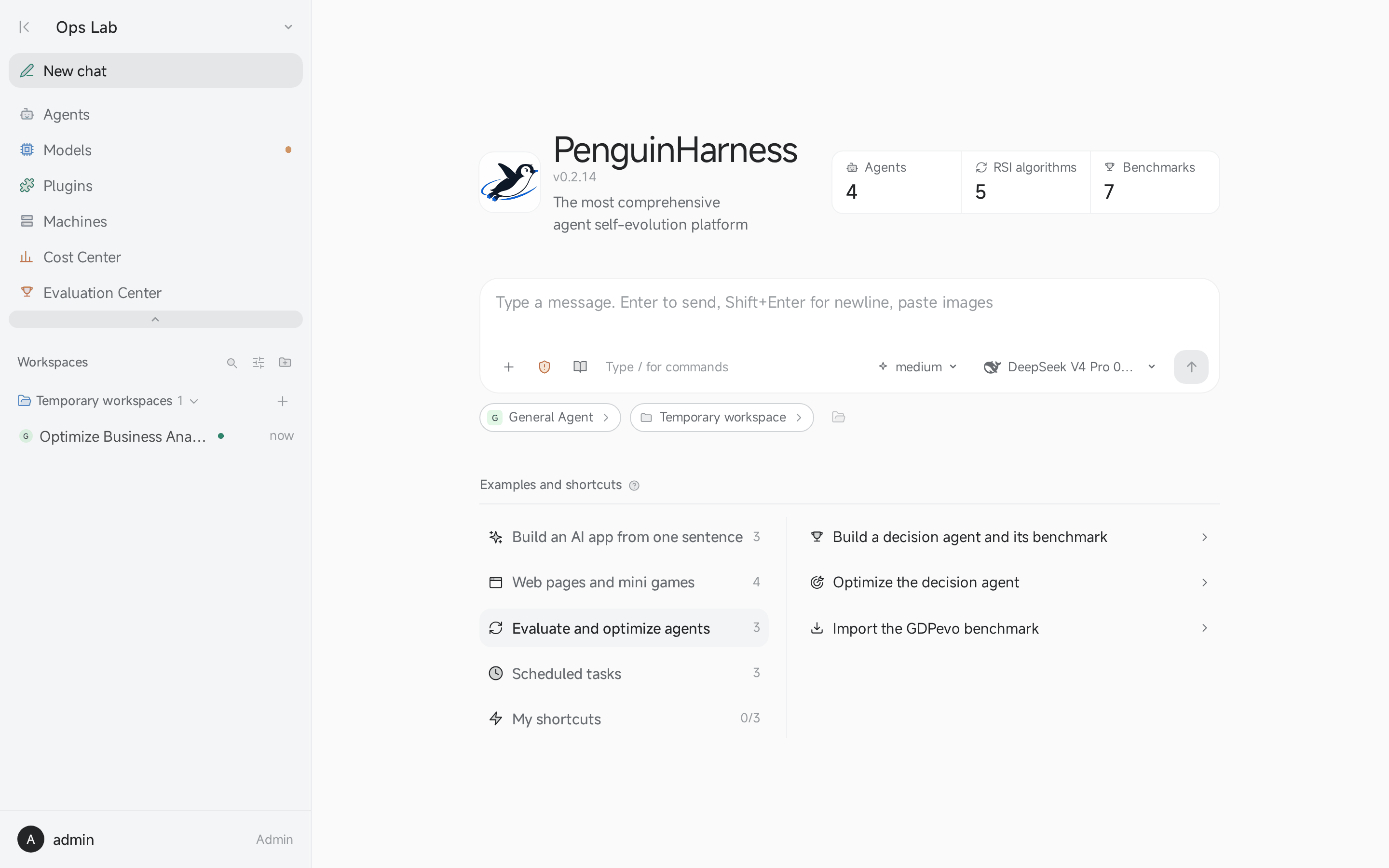
PenguinHarness is an open-source framework for agent self-evolution (recursive self-improvement, RSI). The model stays fixed; the harness evolves: prompts, Skills, tools and hooks. It runs on your computer or server as a desktop app, a Web App, a CLI and an SDK.
Every RSI algorithm in one framework. Default, OPRO, APE, ACE, AWM, SkillAdam, SkillOpt, OpenSkill and TRACE ship as plugins and run on the same built-in Benchmarks, scoreboard and snapshots.
One sentence builds an agent app. Describe what you need, and an agent writes the app, its page and its run instructions.
Cheap to run. A deliberately small toolset, tuned for open models: on our data-analysis suite, the best accuracy at 1/70 of Claude Code's cost.
Self-evolution
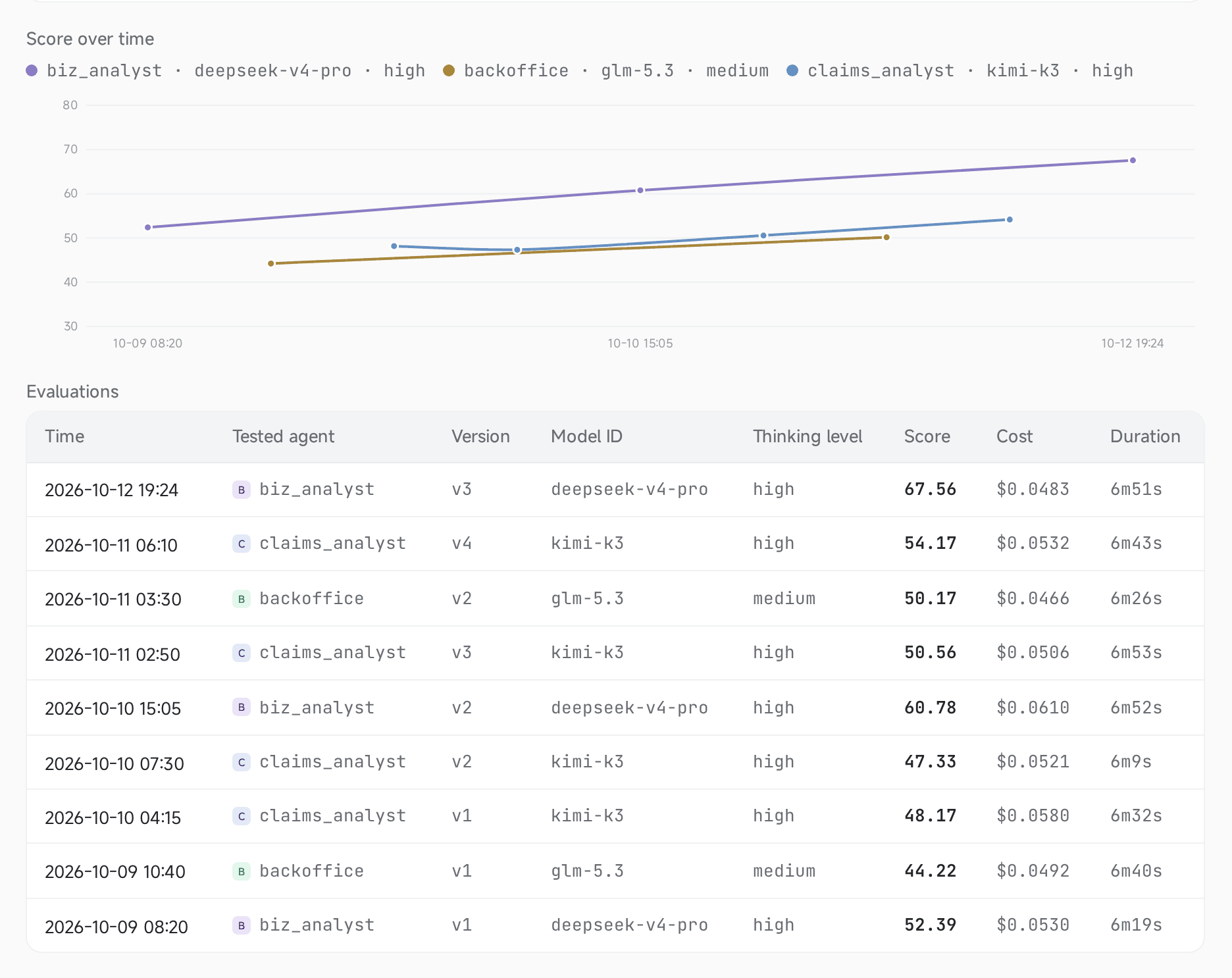
Pick an algorithm, pick a Benchmark, and an agent improves another agent round by round. Every candidate is a new version, snapshotted before it changes, and every score lands in the Evaluation Center.
Toolkit
Algorithm
default-rsi-toolkit
Trial, reflect, improve: one hypothesis and one change per round
opro-rsi-toolkit
OPRO: new instructions from the history of scored ones
SkillAdam: evolving issue tracker and adaptive Skill edit budget
skillopt-rsi-toolkit
SkillOpt: bounded Skill edits, score-based selection and cross-epoch reflection
openskill-rsi-toolkit
OpenSkill: external research and independent virtual tests before frozen-State evaluation
trace-rsi-toolkit
TRACE: skill-bank evolution from contrasting trajectories, with consistency measurement
rrsi-rsi-toolkit
RRSI: annealed edit budget, a leakage Critic before any measurement, a Pruner for what stopped earning, and a noise-floored selection rule
Every new Project includes seventeen Benchmarks, run as Harbor tasks in Docker: PenguinHarness Benchmark Sec A to Sec E (from rag-bench-essential, DeepSWE, AutomationBench, Terminal-Bench-Science and Terminal-Bench) and a Train/Test pair for each of GDPEVO Essential's six scenarios. More are in penguin-harness-benchmark.
Demo: a decision agent is evaluated, revises its working method once, and is retested on the same model. Its score goes from 84 to 100, and the cost of every run is on screen.
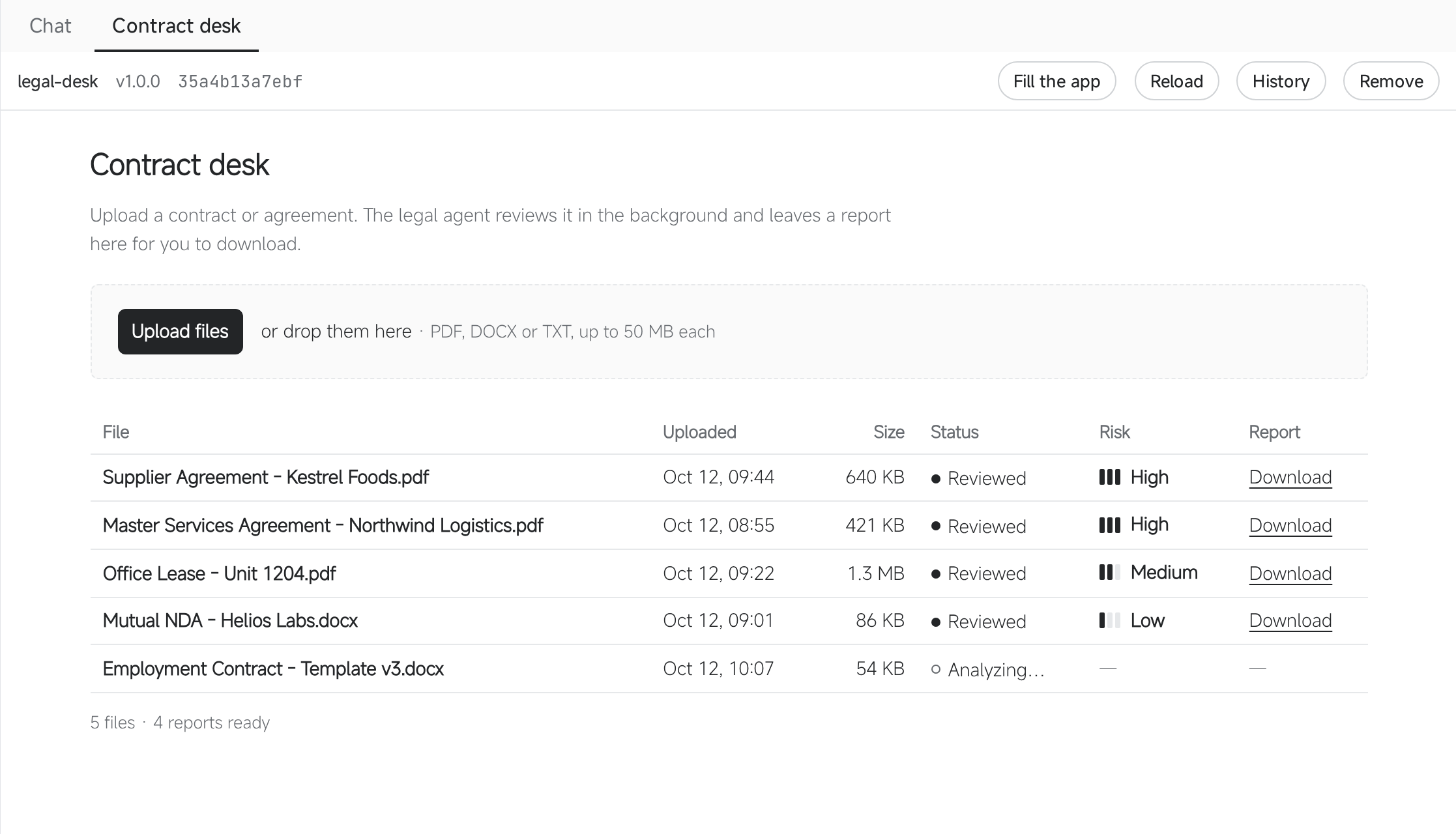
Build a legal review agent with a simple workspace where users upload contracts, track the review, and download a report with risky clauses, explanations, and suggested revisions.
The result: a legal review app. Users upload contracts, follow each file's review, and download a report of risky clauses with explanations and suggested revisions. Five sample reviews cost $0.0423 in model calls.
Browser automation
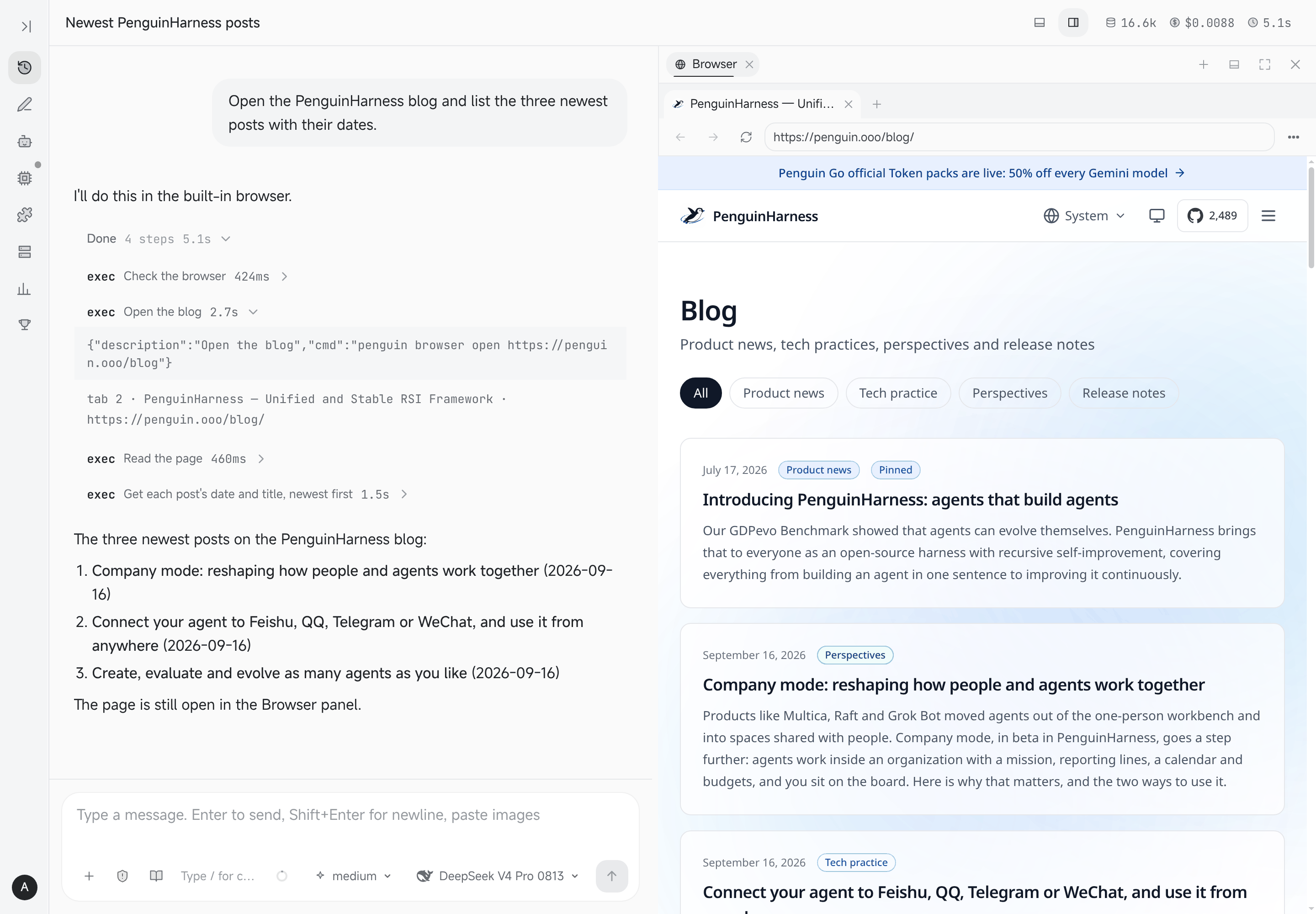
Agents drive your own Chrome through the PenguinHarness Browser extension, or the desktop app's built-in browser. They read pages as text and act through short scripts, so a step costs few tokens. Tutorial
Workbenches
Every agent can have its own hot-reloaded workbench: ask for one and the agent writes the page and its server code. The workbench appears as a tab beside the agent's chat. Tutorial
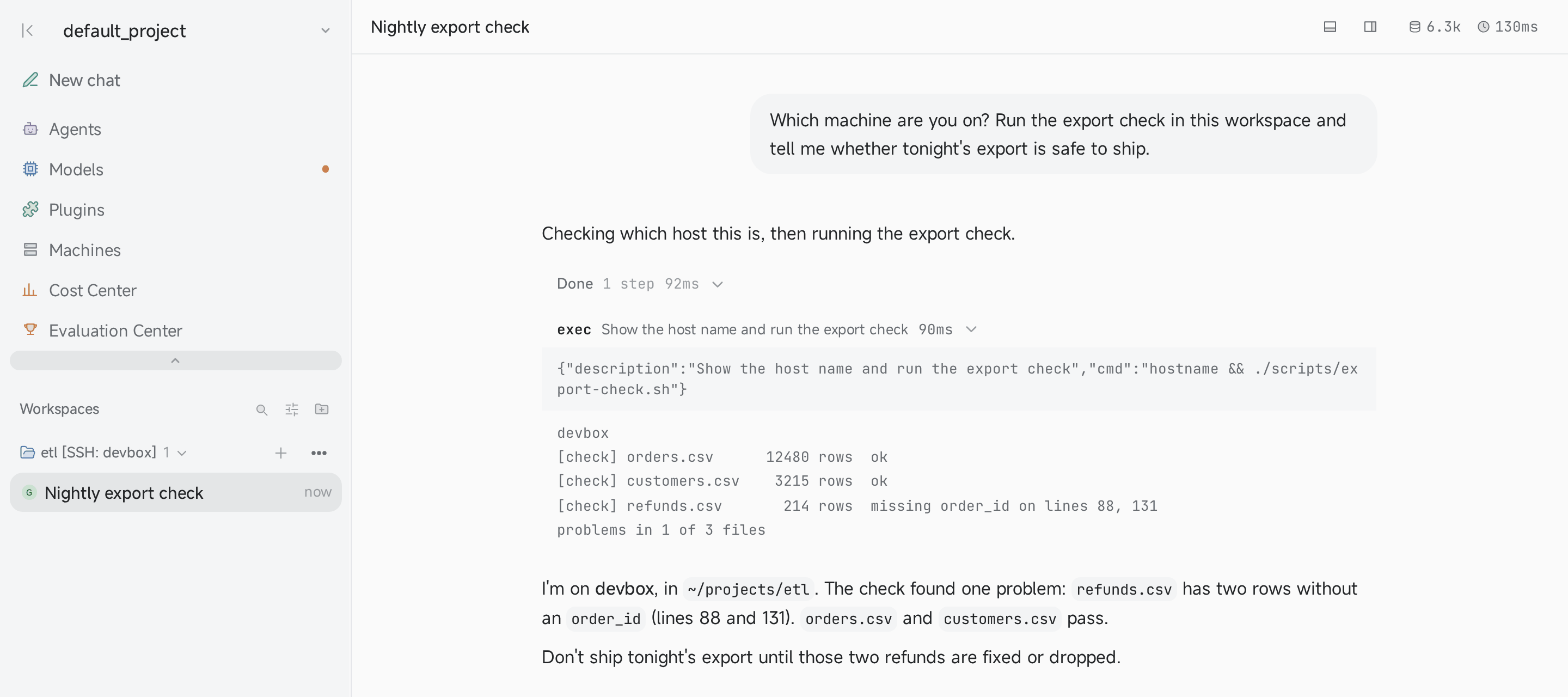
Remote machines
Add a machine the server reaches over ssh. Conversations in a Workspace on that machine run on it, in the same window. Tutorial
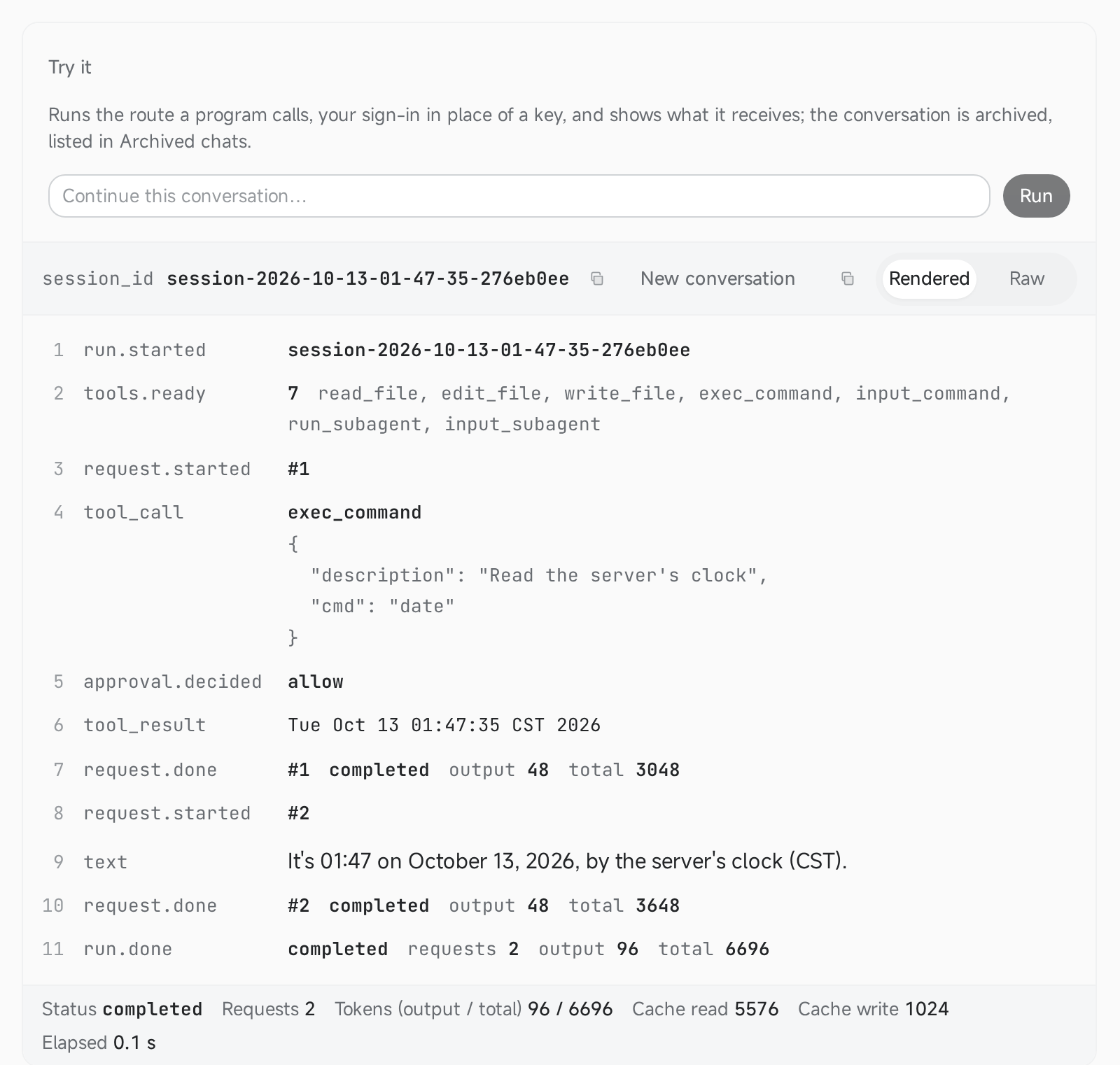
Agent API
One unified API connects any agent to any external app: send input over HTTP and read the run back as a stream of AMSP events. Tutorial
Replies can also carry UI: choices, forms, steps, Mermaid diagrams and live widgets (A2UI).
Results
Each harness on the model it is usually paired with, on the same tasks:
Built-in plugins
Agents can also write and optimize their own Skills (docs).
OpenCode Go offers Claude Haiku 5.5; Fable 5.1, Opus 5.5 and Sonnet 5.5 are available through Anthropic and OpenRouter. Hunyuan 4 uses hy4-preview.
Custom OpenAI-protocol endpoints also work, covering 1000+ online and local models.
Install
Desktop app
Download the installer from penguin.ooo/download: macOS 11+ (dmg), Windows 10+ (exe) or Linux x64 (AppImage, deb). The app opens signed in and needs no terminal.
CLI and server
Platform
Install command
Linux / macOS
curl -fsSL https://penguin.ooo/install.sh | sh
Windows (PowerShell)
irm https://penguin.ooo/install.ps1 | iex
npm (Node >= 24)
npm install -g @prismshadow/penguin-cli
Then run penguin web. It serves the Web App at http://127.0.0.1:7364 and prints a first-login link until a password is set; models are configured on the Models page. The desktop app and the CLI share ~/.penguin/data.
Docker
docker run -d --name penguin -p 127.0.0.1:7364:7364 -v penguin-data:/data hiyouga/penguinharness:0.2.18
docker logs penguin       # the first-login link, openable as it stands on this machine
The image serves on port 7364 with its data on the /data volume, for linux/amd64 and linux/arm64; latest follows changes to the image's runtime or build inputs on main, and each release is also tagged with its version. The example listens on loopback only. For a network-facing deployment, Compose and upgrades, see the Docker quickstart.
Offline install (air-gapped machines)
Every GitHub Release attaches exactly one package per target — Linux and macOS in x64 / arm64, Windows in x64, plus a runtime-less universal package. The same file serves online and offline installation. Each package seals the program payload, its SHA256 checksum and the platform's installer. Download the one file on a networked machine, copy it to the target, extract once and run the bundled installer — no network, no separate checksum file to carry (the sealed SHA256 is always verified).
Linux (on arm64, use penguin-linux-arm64.tar.gz):
mkdir penguin-install
tar -xzf penguin-linux-x64.tar.gz -C penguin-install
./penguin-install/install.sh
macOS (Apple silicon shown; on Intel, use penguin-darwin-x64.tar.gz):
mkdir penguin-install
tar -xzf penguin-darwin-arm64.tar.gz -C penguin-install
./penguin-install/install.sh
Windows (unzip, then double-click install.cmd — or run it in PowerShell):
Expand-Archive penguin-win32-x64.zip -DestinationPath penguin-install
cd penguin-install
.\install.cmd
pnpm install && pnpm build   # build first: core's exports point at dist/
pnpm dev                     # backend + web app together (prefixed logs, deps built once)
Working on this repository with a coding agent: its development Skills are in .agents/skills/ (penguin-harness-dev, penguin-harness-frontend, penguin-harness-manual-test, penguin-harness-writing). Claude Code loads them with no install, through the .claude → .agents symlink; for another agent, link or copy .agents/skills/* into the directory it reads Skills from.
See CONTRIBUTING.md for the full workspace guide: dev commands, quality gates, repo layout, and the changelog rule.
Contributors
Thanks to everyone who has contributed to PenguinHarness!
Citation
If you use PenguinHarness in your research, please cite:
@software{penguinharness2026,
  author  = {{PrismShadow Team}},
  title   = {PenguinHarness: Efficient Self-Improving Harness for Everyone},
  year    = {2026},
  url     = {https://github.com/Prism-Shadow/penguin-harness},
  license = {Apache-2.0}
}
Acknowledgements
This repo benefits from:
MinGit: the POSIX shell and Git bundled on Windows







 PenguinHarness 是一个开源框架,用于智能体自我进化(递归自我改进,RSI)。模型本身保持不变,而它外围的框架(harness),包括提示词、Skills、工具和钩子,会一轮接一轮地被自动改进。