











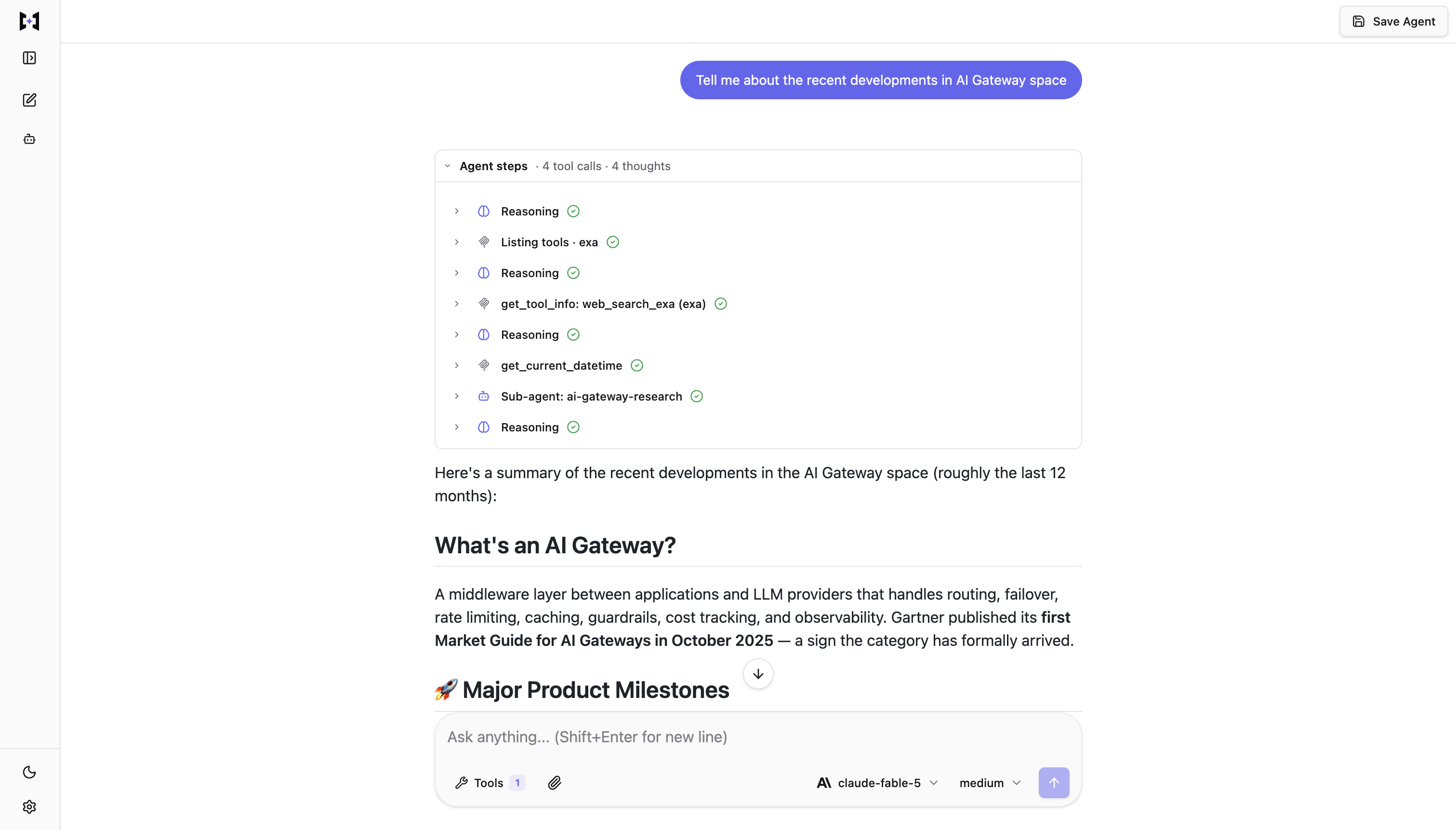

What is this?
 TrueForge is an open-source agent harness - the runtime layer that runs the full agent execution loop (model calls, MCP tools, skills, sandboxing, approvals, context management, session state) and exposes it via a chat UI, an HTTP API with a TypeScript SDK, and an embeddable UI SDK.
TrueForge is an open-source agent harness - the runtime layer that runs the full agent execution loop (model calls, MCP tools, skills, sandboxing, approvals, context management, session state) and exposes it via a chat UI, an HTTP API with a TypeScript SDK, and an embeddable UI SDK.Is this a framework I code against, or a ready-to-run app?It's both: run it as a standalone service (chat UI + API) to get a working agent immediately, or build on top of it using the @truefoundry/trueforge-sdk TypeScript client and the embeddable @truefoundry/trueforge-ui.
It's both: run it as a standalone service (chat UI + API) to get a working agent immediately, or build on top of it using the @truefoundry/trueforge-sdk TypeScript client and the embeddable @truefoundry/trueforge-ui.How do I get it running?Run `npx @truefoundry/trueforge` for a quick local setup backed by SQLite in a single process. For shared or production use, deploy hosted mode with Postgres + Redis via Docker Compose, Helm, or Railway.
Run `npx @truefoundry/trueforge` for a quick local setup backed by SQLite in a single process. For shared or production use, deploy hosted mode with Postgres + Redis via Docker Compose, Helm, or Railway.Which model providers and tools can I connect?TrueForge works with OpenAI, Anthropic, Google Gemini, other catalog providers, or any OpenAI-compatible endpoint, and connects to remote MCP servers (with header auth or OAuth) plus git-backed SKILL.md skill packs.
TrueForge works with OpenAI, Anthropic, Google Gemini, other catalog providers, or any OpenAI-compatible endpoint, and connects to remote MCP servers (with header auth or OAuth) plus git-backed SKILL.md skill packs.Is local mode safe to expose beyond my own machine?No - local mode has no login by default and stores data in a local SQLite file; the project explicitly says to keep it on localhost and disclaims responsibility for data loss or unauthorized access if used beyond that. For shared or production deployments, use hosted mode instead.
No - local mode has no login by default and stores data in a local SQLite file; the project explicitly says to keep it on localhost and disclaims responsibility for data loss or unauthorized access if used beyond that. For shared or production deployments, use hosted mode instead.What sandbox provider does it use for code execution?It currently uses Daytona for isolated sandbox execution, provisioned only when an agent needs it; more sandbox providers are planned.
It currently uses Daytona for isolated sandbox execution, provisioned only when an agent needs it; more sandbox providers are planned.How does it compare to Claude Managed Agents or deepagents?TrueForge benchmarks itself against Claude Managed Agents and deepagents on the same tasks, tools, and model, reporting the same accuracy at lower cost.
TrueForge benchmarks itself against Claude Managed Agents and deepagents on the same tasks, tools, and model, reporting the same accuracy at lower cost.What does context engineering mean here?It refers to built-in techniques like subagents, deferred tool loading, Code Mode, large-result offloading, and compaction, used to keep agent context manageable.
It refers to built-in techniques like subagents, deferred tool loading, Code Mode, large-result offloading, and compaction, used to keep agent context manageable.Can I review or block tool calls before they run?Yes - TrueForge supports human checkpoints such as tool approval, ask-user-questions, and Generative UI prompts in chat.
Yes - TrueForge supports human checkpoints such as tool approval, ask-user-questions, and Generative UI prompts in chat.Which topics is it in?npx, helm, harness-engineering, context-engineering, harness, oauth, sandbox, redis, model-context-protocol, orchestration, agent-orchestration, chatbot
npx, helm, harness-engineering, context-engineering, harness, oauth, sandbox, redis, model-context-protocol, orchestration, agent-orchestration, chatbot