







What is this?
 PaddleOCR is an OCR and document AI toolkit that converts PDFs and images into structured, LLM-ready data (JSON or Markdown), supporting over 100 languages.
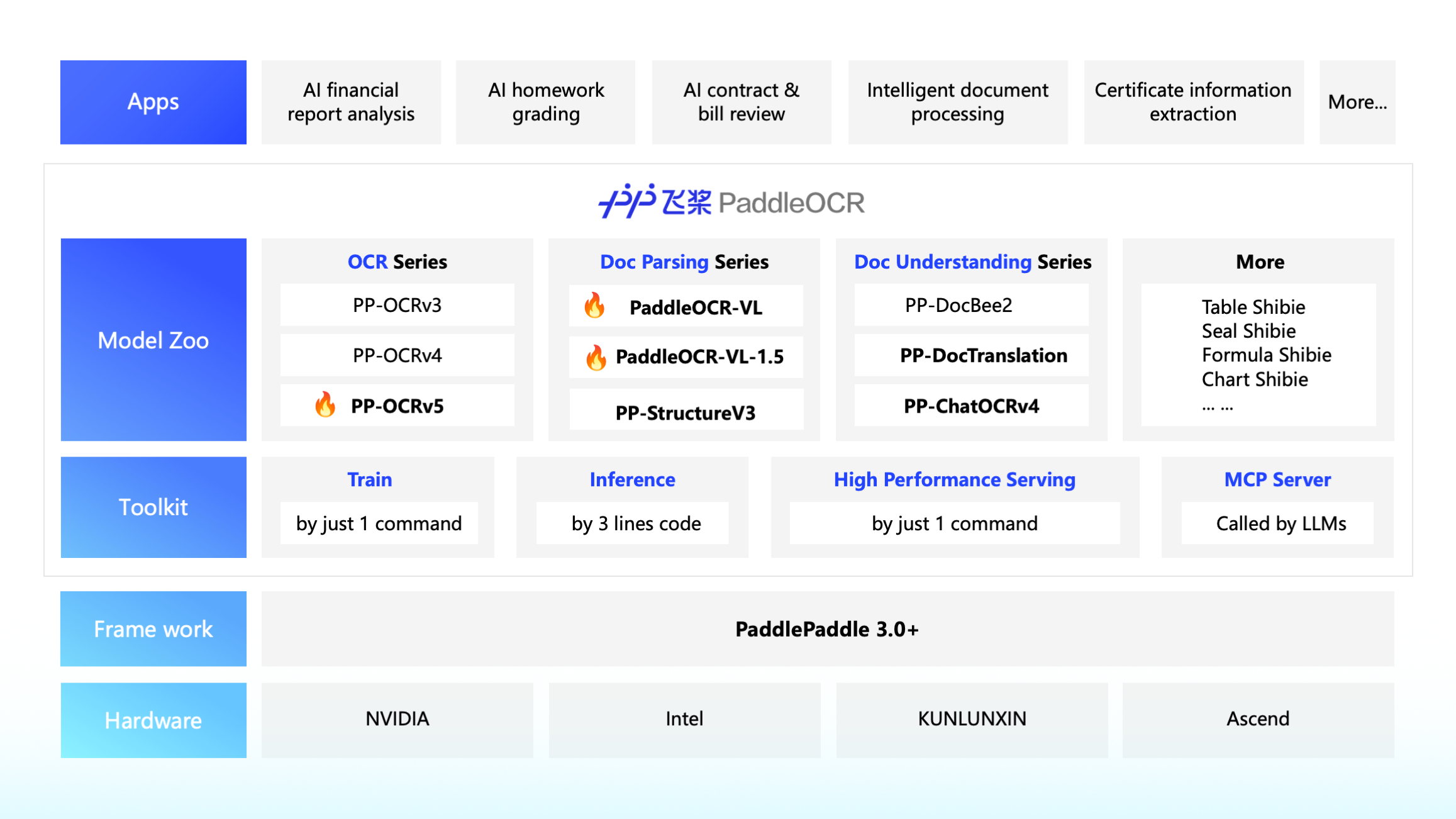
PaddleOCR is an OCR and document AI toolkit that converts PDFs and images into structured, LLM-ready data (JSON or Markdown), supporting over 100 languages.Is this a standalone app or a library I integrate into my own pipeline?It's a Python toolkit/library with multiple production pipelines (PP-OCR, PP-StructureV3, PaddleOCR-VL) that you call from code, plus service deployment options and a browser SDK (PaddleOCR.js).
It's a Python toolkit/library with multiple production pipelines (PP-OCR, PP-StructureV3, PaddleOCR-VL) that you call from code, plus service deployment options and a browser SDK (PaddleOCR.js).How do I get it running?Install the core package via pip for basic text recognition, and add optional dependencies for document parsing or information extraction features as needed.
Install the core package via pip for basic text recognition, and add optional dependencies for document parsing or information extraction features as needed.Is high accuracy only for Chinese/English, or does it hold up across other languages too?PP-OCRv6 unifies 50 languages in a single model including Chinese, English, Japanese and 46 Latin-script languages, and the PaddleOCR-VL line separately covers 100+ languages including Tibetan and Bengali, but language coverage differs between the lightweight OCR models and the VLM-based parsing models.
PP-OCRv6 unifies 50 languages in a single model including Chinese, English, Japanese and 46 Latin-script languages, and the PaddleOCR-VL line separately covers 100+ languages including Tibetan and Bengali, but language coverage differs between the lightweight OCR models and the VLM-based parsing models.What is PaddleOCR-VL?PaddleOCR-VL is a compact 0.9B-parameter vision-language model built on a NaViT-style visual encoder plus the ERNIE-4.5-0.3B language model, designed for state-of-the-art document parsing (text, tables, formulas, charts) with minimal compute.
PaddleOCR-VL is a compact 0.9B-parameter vision-language model built on a NaViT-style visual encoder plus the ERNIE-4.5-0.3B language model, designed for state-of-the-art document parsing (text, tables, formulas, charts) with minimal compute.Can it convert Word, Excel or PowerPoint files too, not just PDFs?Yes, since the 3.5.0 release PaddleOCR can convert Office documents like Word, Excel, and PowerPoint into Markdown, and parsed results can also be exported to DOCX.
Yes, since the 3.5.0 release PaddleOCR can convert Office documents like Word, Excel, and PowerPoint into Markdown, and parsed results can also be exported to DOCX.What tools does PaddleOCR integrate with?It's deeply integrated with AI agent and RAG ecosystem tools like Dify, RAGFlow, Pathway, and Cherry Studio, serving as a data pipeline for building LLM-ready datasets.
It's deeply integrated with AI agent and RAG ecosystem tools like Dify, RAGFlow, Pathway, and Cherry Studio, serving as a data pipeline for building LLM-ready datasets.How fast is the latest OCR model compared to the previous version?PP-OCRv6 improves detection accuracy by 4.6% and recognition by 5.1% over PP-OCRv5 while running 5.2x faster on CPU, and it outperforms larger mainstream vision-language models despite having only 34.5M parameters.
PP-OCRv6 improves detection accuracy by 4.6% and recognition by 5.1% over PP-OCRv5 while running 5.2x faster on CPU, and it outperforms larger mainstream vision-language models despite having only 34.5M parameters.What are similar projects?MinerU, surya, PDF-Extract-Kit, olmocr, X-AnyLabeling, nougat, opendataloader-pdf, marker
MinerU, surya, PDF-Extract-Kit, olmocr, X-AnyLabeling, nougat, opendataloader-pdf, markerWhich topics is it in?pdf-parser, document-parsing, table, vlm, ocr, multimodal, multilingual, image-processing, pdf, rag, computer-vision, mobile
pdf-parser, document-parsing, table, vlm, ocr, multimodal, multilingual, image-processing, pdf, rag, computer-vision, mobile