[!IMPORTANT]
GlucoFlow is research software, not a medical device. It must not be used for diagnosis, insulin dosing, treatment, alarms, or other clinical decisions.
Why GlucoFlow?
Many forecasting projects have the same data problem: historical time series are plentiful, but the target cohort or target modality is small. GlucoFlow is designed for that setting.
| What you need |
What GlucoFlow provides |
| Reliable uncertainty, not only a point estimate |
Samples complete future trajectories and returns medians, intervals, event probabilities, or any task-specific summary. |
| Fast probabilistic inference |
Uses a conditional rectified flow with only 1, 2, or 4 Euler steps instead of a long diffusion chain. |
| Better use of scarce target data |
Learns reusable temporal dynamics from larger source datasets before adapting to the smaller target dataset. |
| Optional side information |
Conditions on images, nutrients, metadata, learned embeddings, or a null token when side information is unavailable. |
| A practical transfer path |
Includes a released temporal checkpoint, reusable model modules, reference training scripts, and a custom dataset-adapter example. |
GlucoFlow is especially useful when:
- you have one or more large source time-series datasets and a smaller target dataset;
- the target task needs calibrated ranges or sampled futures rather than a single prediction;
- side information is informative but incomplete or expensive to collect;
- iterative generative forecasting is too slow for the intended deployment path.
Install
git clone https://github.com/OliverDOU776/Few-step-probabilistic-glucose-forecasting-from-continuous-glucose-monitoring-and-meal-images.git
cd Few-step-probabilistic-glucose-forecasting-from-continuous-glucose-monitoring-and-meal-images

python3.11 -m venv .venv
source .venv/bin/activate          # Windows PowerShell: .venv\Scripts\Activate.ps1
python -m pip install --upgrade pip
python -m pip install -e ".[vision]"
For development:
python -m pip install -e ".[vision,dev]"
pytest -q
Quick start: sample future trajectories
The repository includes a Stage-A temporal checkpoint at checkpoints/stage_a.pt. Inputs must be normalized using statistics fitted on the training split of your target application.
from pathlib import Path

import torch

from glucoflow.models import build_flow_model

model = build_flow_model(history_len=24, prediction_len=24)
state = torch.load(
    Path("checkpoints/stage_a.pt"),
    map_location="cpu",
    weights_only=True,
)
model.load_state_dict(state, strict=True)
model.eval()

# Example: two normalized histories with 24 time points each.
history = torch.randn(2, 24)
time_features = torch.zeros(2, 24, 4)

with torch.no_grad():
    samples = model.sample(
        history,
        nfe=4,
        num_samples=100,
        time_features=time_features,
        meal_embed=None,
    )

# samples: [batch, sampled futures, forecast length]
median = samples.median(dim=1).values
lower = samples.quantile(0.05, dim=1)
upper = samples.quantile(0.95, dim=1)

print(samples.shape)  # torch.Size([2, 100, 24])
Run the data-free checkpoint verification:
python scripts/smoke_test.py
Add optional conditioning
The flow model accepts an optional conditioning tensor through meal_embed. In the associated glucose study, that tensor represents meal photographs and nutrients, but it can represent any target-domain context with the configured embedding dimension.
conditioning = torch.randn(2, 512)

with torch.no_grad():
    conditioned_samples = model.sample(
        history,
        nfe=2,
        num_samples=100,
        time_features=time_features,
        meal_embed=conditioning,
    )
The supplied MealEncoder demonstrates one image–nutrient implementation. A new application can replace it with an encoder for text, categorical metadata, sensor context, interventions, or another modality.
Bring your own dataset
1. Implement the shared adapter contract
glucoflow.data.adapters.base.DatasetOutput defines the data interface. For the supplied glucose-oriented schema, the minimum time-series table is:
subject_id | timestamp | glucose_mgdl
A ready-to-run CSV template is provided in examples/custom_adapter.py.
python examples/custom_adapter.py /path/to/my_dataset
The example expects:
my_dataset/
├── cgm.csv          # required
├── meals.csv        # optional conditioning events
└── subjects.csv     # optional subject metadata
For a non-glucose application, map the target signal into the supplied schema for a quick prototype, or fork the schema with domain-appropriate names.
2. Set the forecasting task
Choose the history length, forecast length, sampling interval, normalization strategy, and evaluation metrics for the target application. Do not inherit the glucose-study defaults without checking whether they fit the new problem.
3. Pretrain or start from the released checkpoint
Use scripts/pretrain.py as a reference for multi-dataset temporal pretraining. The released checkpoint is a useful initialization when the target signal is sufficiently related to the original physiological time series; otherwise, pretrain the same architecture on your own source datasets.
4. Adapt to the target dataset
Use scripts/finetune_cgmacros.py as a reference for target-domain adaptation with optional conditioning and modality dropout. The reusable modules in src/glucoflow/ can also be called directly from a cleaner application-specific trainer.
5. Keep model selection honest
Fit normalization, choose checkpoints, tune uncertainty scales, and select operating parameters using training and validation data only. Evaluate the held-out test split after the configuration is fixed.
Main entry points
| Path |
Purpose |
src/glucoflow/models/ |
Rectified-flow backbone, Euler sampling, and conditioning modules. |
src/glucoflow/data/ |
Shared schema, adapters, normalization, and dataset utilities. |
src/glucoflow/evaluation/ |
Reusable splits, windows, and probabilistic metrics. |
scripts/pretrain.py |
Reference multi-dataset temporal pretraining. |
scripts/finetune_cgmacros.py |
Reference target adaptation with optional multimodal conditioning. |
scripts/prepare_data.py |
Reference preprocessing and feature caching. |
examples/custom_adapter.py |
Minimal template for connecting a new dataset. |
scripts/smoke_test.py |
Data-free checkpoint and NFE=1/2/4 inference test. |
scripts/validate_release.py |
Source-tree and release-integrity checks. |
Repository layout
.
├── src/glucoflow/
│   ├── models/              # Conditional rectified flow and conditioning
│   ├── data/                # Shared schema, normalization, adapters
│   └── evaluation/          # Splits, windows, probabilistic metrics
├── scripts/                 # Preparation, pretraining, adaptation, validation
├── examples/                # Bring-your-own-data templates
├── checkpoints/stage_a.pt   # Released temporal initialization
├── tests/                   # Data-free unit and integrity tests
└── assets/overview.png      # Architecture overview
Associated research
Paper: arXiv preprint coming soon.
The associated study applies GlucoFlow to multimodal glucose forecasting using CGMacros, cross-dataset CGM pretraining, five GlucoBench evaluation cohorts, OhioT1DM, and the official controlled-access DiaTrend cohort. The software architecture is designed to be reused beyond that study by replacing the data adapter, target-specific conditioning, and evaluation layer.
Checkpoint and responsible use
checkpoints/stage_a.pt is a CGM-only temporal initialization, not a calibrated model for a new population or application.
SHA-256 759dabb7a5b20f9377a8d9ddaa2ae333d8e7166bc07c8d17a04f14d58acdd5a7
Before using it on a new dataset:
- fit target-specific normalization;
- evaluate distribution shift and missingness;
- adapt and calibrate using target-domain data;
- test uncertainty quality, not only point error;
- conduct application-specific safety and privacy review.
See MODEL_CARD.md for intended use, limitations, and out-of-scope applications.
Citation
@misc{wang2026glucoflow,
  title  = {GlucoFlow: Cross-Dataset Pretraining for Few-Step
            Probabilistic Glucose Forecasting},
  author = {Wang, Zijia and Toumazou, Christofer},
  year   = {2026},
  note   = {Research software; arXiv preprint forthcoming},
  url    = {https://github.com/OliverDOU776/Few-step-probabilistic-glucose-forecasting-from-continuous-glucose-monitoring-and-meal-images}
}
Third-party components and data terms
The optional image path uses OpenCLIP and public LAION ViT-B/32 weights. Dataset licenses and controlled-access agreements do not transfer to this repository. See THIRD_PARTY.md before redistributing derived models, embeddings, or data artifacts.




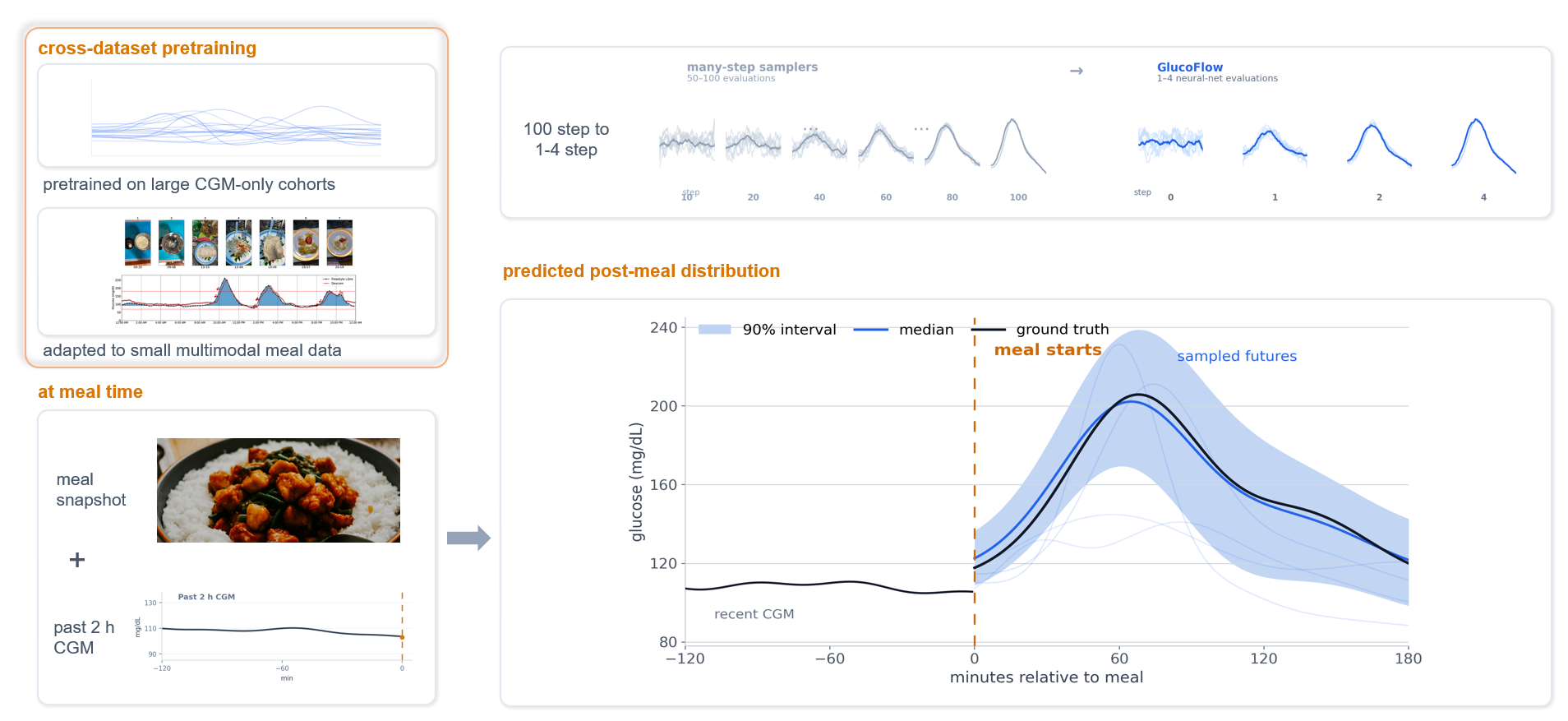

 GlucoFlow 是用于概率性血糖预测的研究代码:它使用条件整流流(rectified-flow)模型,仅用 1-4 个采样步就能生成完整的未来轨迹(中位数、区间、事件概率),还可以选择以餐食照片或其他辅助信息为条件。