



Что это?
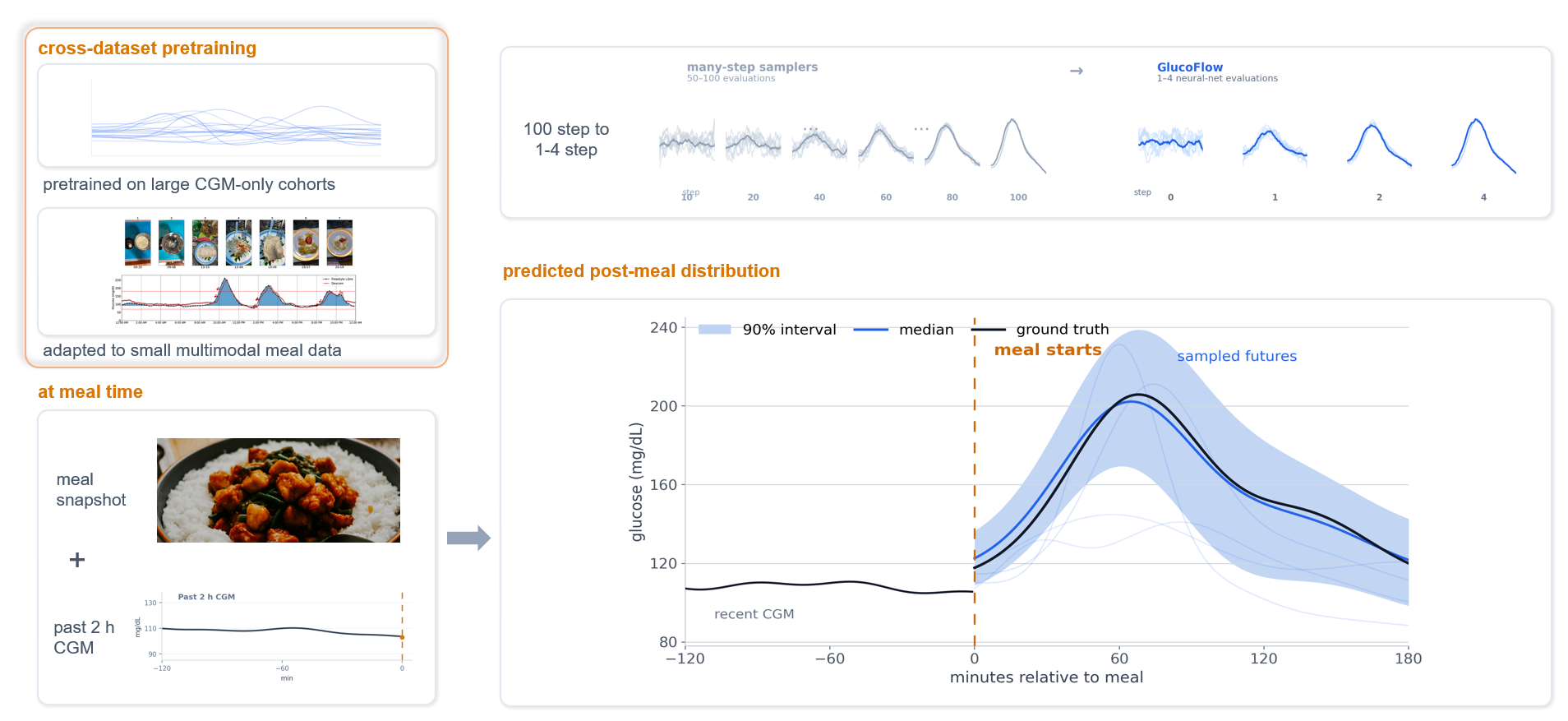
 GlucoFlow — исследовательский код для вероятностного прогнозирования глюкозы: он генерирует полные будущие траектории (медианы, интервалы, вероятности событий) всего за 1-4 шага сэмплирования с помощью условной модели rectified flow, опционально с кондиционированием на фото еды или другую дополнительную информацию.
GlucoFlow — исследовательский код для вероятностного прогнозирования глюкозы: он генерирует полные будущие траектории (медианы, интервалы, вероятности событий) всего за 1-4 шага сэмплирования с помощью условной модели rectified flow, опционально с кондиционированием на фото еды или другую дополнительную информацию.Это готовое приложение или исследовательская кодовая база для дальнейшей разработки?Это исследовательская кодовая база на PyTorch: переиспользуемые модули модели, опубликованный чекпоинт Stage-A, эталонные скрипты обучения и шаблон для подключения своего датасета, а не упакованное приложение.
Это исследовательская кодовая база на PyTorch: переиспользуемые модули модели, опубликованный чекпоинт Stage-A, эталонные скрипты обучения и шаблон для подключения своего датасета, а не упакованное приложение.Как быстро его попробовать?Установите пакет для разработки, затем запустите скрипт проверки чекпоинта без данных, который тестирует включённый чекпоинт stagea.pt с инференсом на 1/2/4 шага и не требует никаких данных.
Установите пакет для разработки, затем запустите скрипт проверки чекпоинта без данных, который тестирует включённый чекпоинт stagea.pt с инференсом на 1/2/4 шага и не требует никаких данных.Что нужно помимо Python для кондиционирования по изображениям?Базовый стек — Python и PyTorch; опциональный путь кондиционирования по фото еды дополнительно зависит от OpenCLIP и публичных весов LAION ViT-B/32.
Базовый стек — Python и PyTorch; опциональный путь кондиционирования по фото еды дополнительно зависит от OpenCLIP и публичных весов LAION ViT-B/32.Можно ли использовать это для реальных клинических решений?Нет. Авторы прямо заявляют, что это исследовательское ПО, а не медицинское устройство, и его нельзя использовать для диагностики, дозирования инсулина, лечения или тревожных оповещений.
Нет. Авторы прямо заявляют, что это исследовательское ПО, а не медицинское устройство, и его нельзя использовать для диагностики, дозирования инсулина, лечения или тревожных оповещений.Для кого это создано?Он нацелен на ML-исследователей с одним или несколькими большими исходными датасетами временных рядов и меньшей целевой когортой, которым нужны калиброванные сэмплированные прогнозы, а не одна точечная оценка, возможно с дополнительной информацией вроде изображений или метаданных.
Он нацелен на ML-исследователей с одним или несколькими большими исходными датасетами временных рядов и меньшей целевой когортой, которым нужны калиброванные сэмплированные прогнозы, а не одна точечная оценка, возможно с дополнительной информацией вроде изображений или метаданных.Какие датасеты использует связанное исследование глюкозы?Исследование применяет GlucoFlow к CGMacros, кросс-датасетным данным CGM для предобучения, пяти оценочным когортам GlucoBench, OhioT1DM и когорте DiaTrend с ограниченным доступом.
Исследование применяет GlucoFlow к CGMacros, кросс-датасетным данным CGM для предобучения, пяти оценочным когортам GlucoBench, OhioT1DM и когорте DiaTrend с ограниченным доступом.Можно ли подставить другой сигнал кондиционирования вместо фото еды?Да. Поставляемый MealEncoder — лишь один пример связки «изображение—нутриенты»; его можно заменить на энкодер для текста, категориальных метаданных, сенсорного контекста или других модальностей, либо использовать null-токен, если дополнительной информации нет.
Да. Поставляемый MealEncoder — лишь один пример связки «изображение—нутриенты»; его можно заменить на энкодер для текста, категориальных метаданных, сенсорного контекста или других модальностей, либо использовать null-токен, если дополнительной информации нет.Как подключить свой датасет?Реализуйте общий контракт адаптера DatasetOutput (шаблон в examples/customadapter.py), определите задачу прогнозирования, затем предобучите или адаптируйте из опубликованного чекпоинта с помощью scripts/pretrain.py и scripts/finetunecgmacros.py.
Реализуйте общий контракт адаптера DatasetOutput (шаблон в examples/customadapter.py), определите задачу прогнозирования, затем предобучите или адаптируйте из опубликованного чекпоинта с помощью scripts/pretrain.py и scripts/finetunecgmacros.py.Зачем rectified flow вместо стандартной диффузионной модели?Rectified flow позволяет GlucoFlow сэмплировать полные прогностические распределения всего за 1 шаг Эйлера вместо длинной итеративной диффузионной цепочки, что сильно ускоряет вероятностный вывод.
Rectified flow позволяет GlucoFlow сэмплировать полные прогностические распределения всего за 1 шаг Эйлера вместо длинной итеративной диффузионной цепочки, что сильно ускоряет вероятностный вывод.What are similar projects?video-prediction-policy-2, pointdit, damo-radar, vision_transformer, timeseries-atlas, WorldSculpt, VisionHOPE, OpenWAM
video-prediction-policy-2, pointdit, damo-radar, vision_transformer, timeseries-atlas, WorldSculpt, VisionHOPE, OpenWAMWhich topics is it in?generative-model, healthcare, transfer-learning, research-tools, health, time-series, arxiv, pretrained-models, evaluation, academic-research, computer-vision, pytorch
generative-model, healthcare, transfer-learning, research-tools, health, time-series, arxiv, pretrained-models, evaluation, academic-research, computer-vision, pytorch