



What is this?
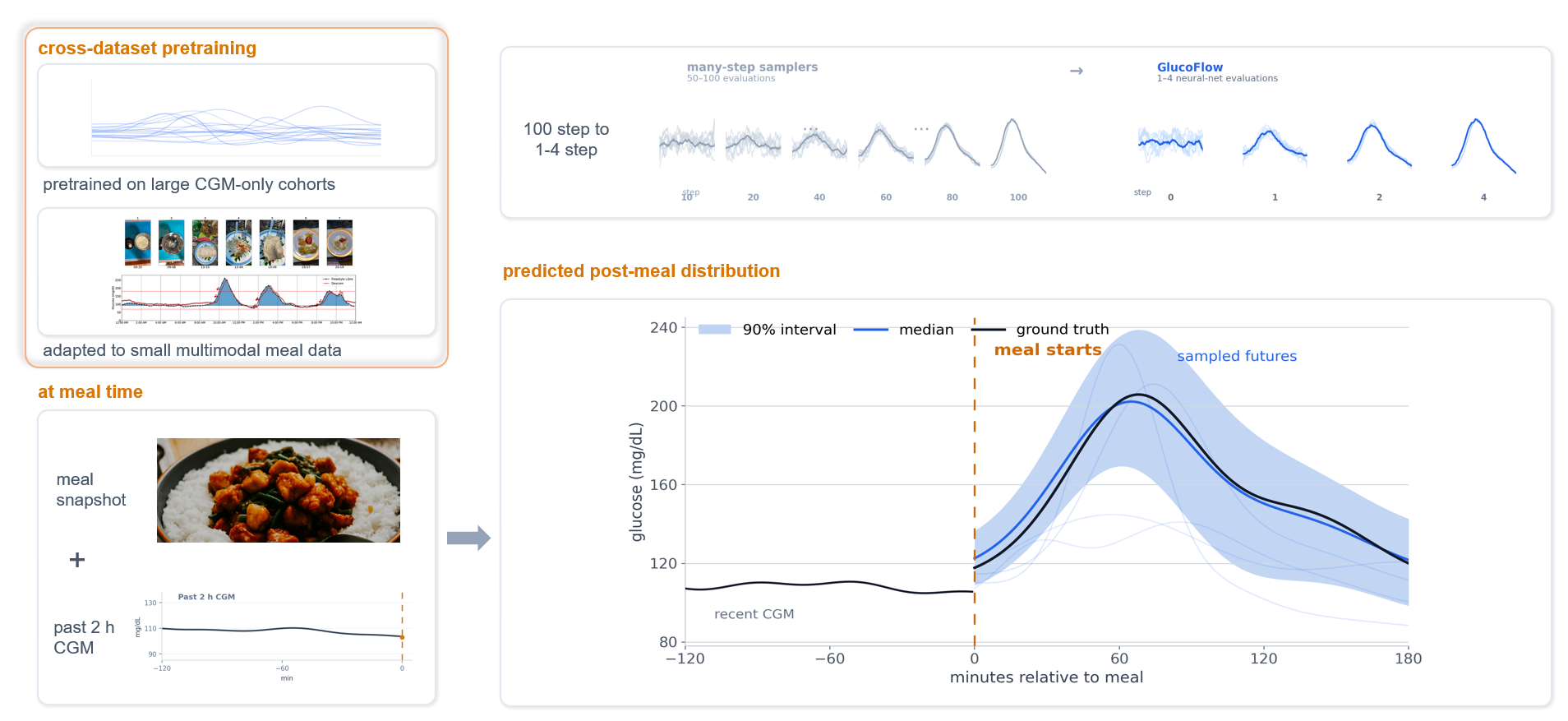
 GlucoFlow is research code for probabilistic glucose forecasting: it generates full future trajectories (medians, intervals, event probabilities) in just 1-4 sampling steps using a conditional rectified-flow model, optionally conditioned on meal photos or other side information.
GlucoFlow is research code for probabilistic glucose forecasting: it generates full future trajectories (medians, intervals, event probabilities) in just 1-4 sampling steps using a conditional rectified-flow model, optionally conditioned on meal photos or other side information.Is this a ready-made app or a research codebase to build on?It is a PyTorch research codebase: reusable model modules, a released Stage-A checkpoint, reference training scripts, and a template for plugging in your own dataset, not a packaged application.
It is a PyTorch research codebase: reusable model modules, a released Stage-A checkpoint, reference training scripts, and a template for plugging in your own dataset, not a packaged application.How do I try it out quickly?Install the package for development, then run the data-free checkpoint verification script, which tests the included stagea.pt checkpoint with 1/2/4-step inference without needing any data.
Install the package for development, then run the data-free checkpoint verification script, which tests the included stagea.pt checkpoint with 1/2/4-step inference without needing any data.What do I need besides Python to use the image conditioning?The core stack is Python and PyTorch; the optional meal-image conditioning path additionally depends on OpenCLIP and public LAION ViT-B/32 weights.
The core stack is Python and PyTorch; the optional meal-image conditioning path additionally depends on OpenCLIP and public LAION ViT-B/32 weights.Can I use this for real clinical decisions?No. The authors explicitly state it is research software, not a medical device, and it must not be used for diagnosis, insulin dosing, treatment, or alarms.
No. The authors explicitly state it is research software, not a medical device, and it must not be used for diagnosis, insulin dosing, treatment, or alarms.Who is this built for?It targets ML researchers with one or more large source time-series datasets and a smaller target cohort who need calibrated, sampled forecasts rather than a single point prediction, possibly with extra side information like images or metadata.
It targets ML researchers with one or more large source time-series datasets and a smaller target cohort who need calibrated, sampled forecasts rather than a single point prediction, possibly with extra side information like images or metadata.What datasets does the associated glucose study use?The study applies GlucoFlow to CGMacros, cross-dataset CGM pretraining data, five GlucoBench evaluation cohorts, OhioT1DM, and the controlled-access DiaTrend cohort.
The study applies GlucoFlow to CGMacros, cross-dataset CGM pretraining data, five GlucoBench evaluation cohorts, OhioT1DM, and the controlled-access DiaTrend cohort.Can I swap in a different conditioning signal besides meal photos?Yes. The supplied MealEncoder is just one image-nutrient example; you can replace it with an encoder for text, categorical metadata, sensor context, or other modalities, or use a null token if no side information is available.
Yes. The supplied MealEncoder is just one image-nutrient example; you can replace it with an encoder for text, categorical metadata, sensor context, or other modalities, or use a null token if no side information is available.How do I plug in my own dataset?Implement the shared DatasetOutput adapter contract (template in examples/customadapter.py), define the forecasting task, then pretrain or adapt from the released checkpoint using scripts/pretrain.py and scripts/finetunecgmacros.py.
Implement the shared DatasetOutput adapter contract (template in examples/customadapter.py), define the forecasting task, then pretrain or adapt from the released checkpoint using scripts/pretrain.py and scripts/finetunecgmacros.py.Why use rectified flow instead of a standard diffusion model?Rectified flow lets GlucoFlow sample full predictive distributions in as few as 1 Euler step instead of running a long iterative diffusion chain, making probabilistic inference much faster.
Rectified flow lets GlucoFlow sample full predictive distributions in as few as 1 Euler step instead of running a long iterative diffusion chain, making probabilistic inference much faster.What are similar projects?video-prediction-policy-2, pointdit, damo-radar, vision_transformer, timeseries-atlas, WorldSculpt, VisionHOPE, OpenWAM
video-prediction-policy-2, pointdit, damo-radar, vision_transformer, timeseries-atlas, WorldSculpt, VisionHOPE, OpenWAMWhich topics is it in?generative-model, healthcare, transfer-learning, research-tools, health, time-series, arxiv, pretrained-models, evaluation, academic-research, computer-vision, pytorch
generative-model, healthcare, transfer-learning, research-tools, health, time-series, arxiv, pretrained-models, evaluation, academic-research, computer-vision, pytorch