
worldmodels101 README

The project's README from github.com/NiluK/worldmodels101. As one markdown file: README.md.

World Models 101

A free, interactive course on how machines learn to predict, simulate, and plan.

Read the course · Star the repository

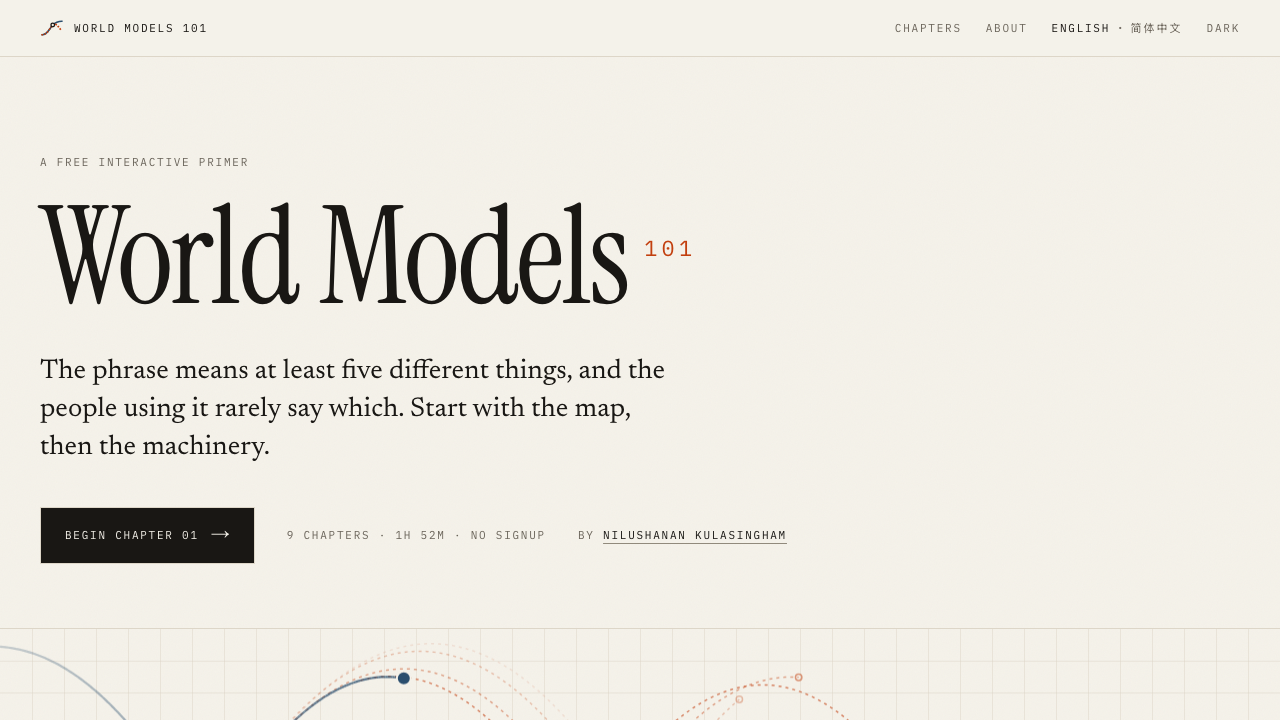
The World Models 101 course homepage

The phrase "world model" now describes at least five different classes of system, and the people using it rarely specify which. World Models 101 sorts that out first, then teaches the machinery.

Nine chapters. About two hours. No signup. Every chapter has an interactive and a printable PDF.

What people mean by world model

Definition Predicts Examples
Renderer Pixels Genie 3, Sora, GameNGen
Simulator Geometry and physics Marble, NVIDIA Cosmos*
Controller Compact state Dreamer, PlaNet, Ha and Schmidhuber
Representation Embeddings V-JEPA 2, I-JEPA
Implicit model Nothing; researchers find it rather than run it Othello-GPT

* Cosmos straddles Renderer and Simulator. That ambiguity is the point. Before asking whether something is a world model, ask what it predicts and what you can do with the why-prediction-is-learning.

The course

Chapter The thing you can poke
01 What Is a World Model? A map of five definitions and the question that separates them
02 How Do World Models Work? A planner that gets worse as it searches harder inside a flawed model
03 Why Is Prediction the Same as Learning? Possible futures collapsing as new evidence arrives
04 What Is Latent Space? A two-number space that decodes into a room
05 What Is a Dynamics Model? One model run with corrections, then left to consume its own output
06 Can an AI Learn Inside Its Own World Model? The point where cheaper imagined experience becomes worse experience
07 What Is JEPA, and Why Not Predict Pixels? Two possible futures and the impossible blur that scores above both
08 Are Video Models World Simulators? One starting frame and three futures selected by an action
09 What Is Still Broken in World Models? A thousand-step rollout showing which properties fail first

The chapters are ordered for learning rather than history. Each one states which definition of world model is in use, cites the underlying papers, and ends with a short quiz. You can read the whole course online or download any chapter as a PDF from its page.

Run it locally

pnpm install
pnpm dev

The production checks are:

pnpm lint
pnpm build

Print and PDF

Every chapter has a print layout. Interactive controls disappear, quizzes become static questions with an answer key, and unrevealed sections remain visible.

pnpm dev                         # in another shell
pnpm pdf what-is-a-world-model 1

The command writes to public/pdf/. A chapter page links its PDF automatically when the corresponding file exists.

Design rules

Colour carries meaning. Vermilion marks what a model imagined. Slate marks what happened. Neither colour is available for decoration.

Contrast is a contract. Every text token clears WCAG AA on the background where it appears. Muted text must also stay visibly separate from body text, or the reading hierarchy collapses. The contrast notes live at the top of src/app/globals.css.

State never depends on dimmed text. Lowering text opacity can break contrast. Active states add emphasis instead.

Sources and corrections

Videos come from the lab that built the system or a researcher who authored the work. Every YouTube ID is checked against the oEmbed endpoint before it ships. Claims that cannot be independently verified are attributed rather than stated as fact.

Technical corrections, translation fixes, and broken demos are worth reporting. Open an issue. Corrections are credited.

License and attribution

The application code and course material in this repository are licensed under CC BY-SA 4.0. Reuse must credit Nilushanan Kulasingham and World Models 101, identify changes, and keep adaptations under the same license.

worldmodels101 (NiluK/worldmodels101)

Searching Database…

这是什么?一个免费的交互式在线课程,讲解 AI 中的世界模型是如何工作的,涵盖预测、潜在动力学、规划、JEPA、视频模型,以及它们会在哪里失灵。
这是我要运行的工具,还是只是拿来读的网站?它是一个 Next.js web 应用,有九个章节页面,每章都包含交互式可视化、一个小测验,以及可下载的 PDF 版本。
课程是怎么组织的?我该从哪里开始?共有九章,按学习顺序而非历史顺序排列,从“什么是世界模型?”开始,到“世界模型还有哪些没解决?”结束;可以在线阅读,也可以下载章节 PDF。
需要机器学习基础才跟得上吗?文中没有明确说明,但每章都引用了底层论文,并循序渐进地构建概念(潜在空间、动力学模型、JEPA),可见具备基本的机器学习/强化学习基础会有帮助。
课程中的论断都经过充分验证吗?只有能被独立验证的论断才作为事实陈述;其余内容都明确标注出处,且每个嵌入的 YouTube 视频在发布前都会通过 oEmbed 端点核验。
我可以复用或改编这套课程材料吗?可以,依据 CC BY-SA 4.0 协议,但必须注明原作者和课程出处、说明所做的修改,并让你的改编沿用同样的许可证。
整套课程要花多长时间?九章内容大约两小时,无需注册。
课程为什么如此费心地定义“世界模型”?因为这个词至少被用来指五种不同的系统(渲染器、模拟器、控制器、表征模型、隐式模型),课程认为在评估任何相关论断之前,必须先弄清指的是哪一种。
JEPA 是什么?课程为什么讲它?JEPA(联合嵌入预测架构)被介绍为预测原始像素之外的另一种选择:在潜在空间中进行预测;第 07 章专门解释为什么这能避开像素预测的“不可能的模糊”问题。
我怎么自己生成各章的 PDF 版本?运行项目的 pdf 脚本(node scripts/make-pdf.mjs),它会把章节 PDF 写入 public/pdf/ 文件夹;文件一旦生成,章节页面就会自动链接对应的 PDF。
Creator
NiluK
Size
48.2 MB
Stars
205
Updated
CommitAug 24
Age
1mo
Commits · 90 Days