




macUSB README

The project's README from github.com/Kruszoneq/macUSB. As one markdown file: README.md.

macUSB  macUSB

The all-in-one bootable USB creator for Mac

Platform Architecture License Security Website

macUSB is a guided macOS app for creating bootable USB media on Apple Silicon and Intel Macs using local files or the built-in macOS downloader.


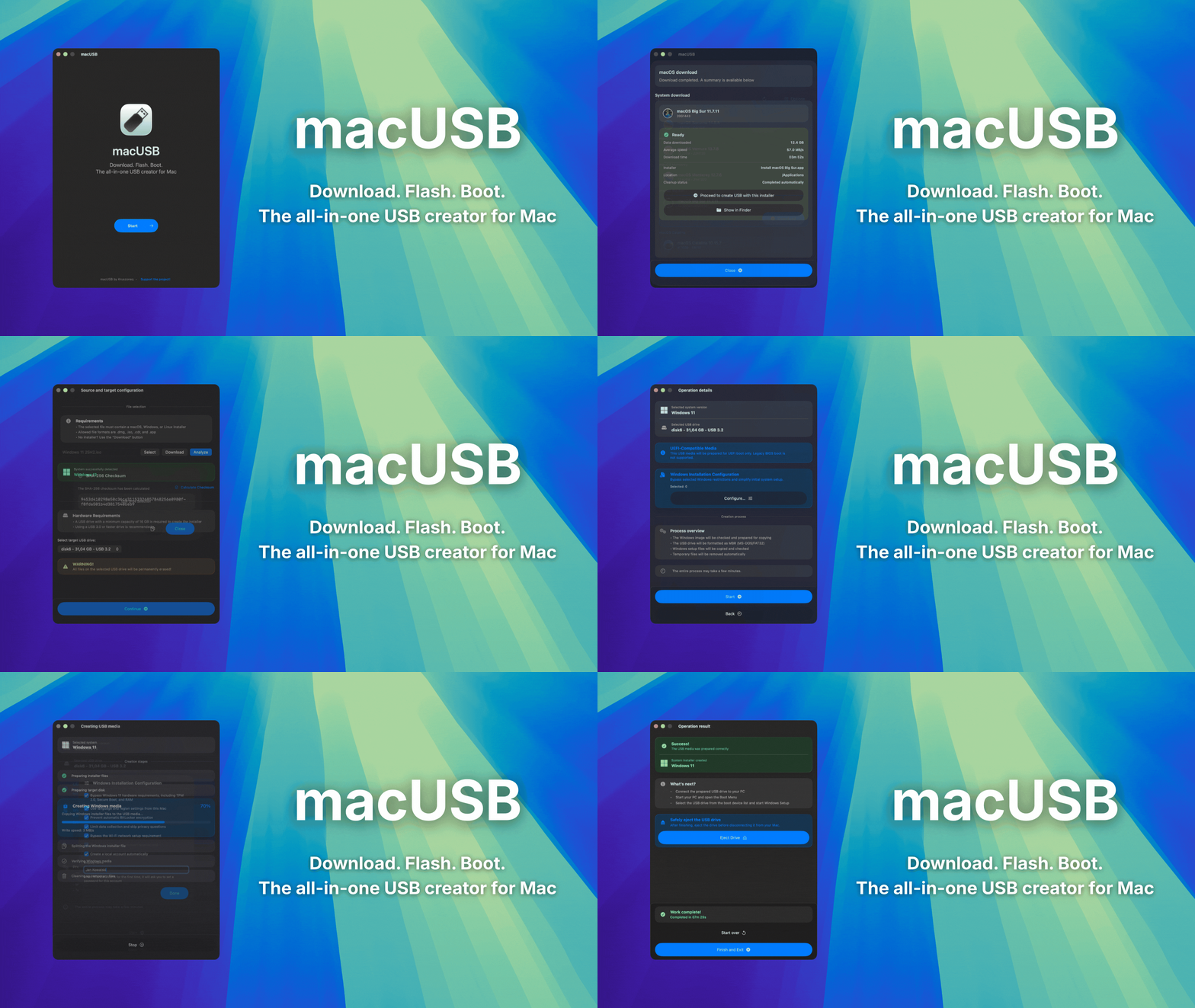
macUSB UI preview


☕ Support the Project

macUSB is and will always remain completely free. Every update and feature is available to everyone.
If the project helps you, you can support ongoing development:

Buy Me A Coffee


📥 How to Download macUSB

Choose one installation method:

  1. GitHub Releases: Download the latest release

  2. Homebrew:

    brew install --cask macusb
    

🔍 Why macUSB Exists

Creating bootable USB installers for macOS Catalina and older on modern Macs, especially Apple Silicon models, can be challenging because legacy installer workflows often conflict with newer system requirements. macUSB was created to make this process guided and reliable through solutions developed and verified during practical troubleshooting.

Thanks to user feedback, macUSB has grown beyond legacy macOS installer creation to include an integrated macOS downloader and support for creating bootable Linux and Windows media, evolving into an all-in-one tool for bootable USB workflows on Mac.


✅ Key Features


⚡ Quick Start

[!WARNING] Creating bootable media erases all data on the selected USB drive.

  1. Install macUSB using one of the methods listed in How to Download macUSB.
  2. Open macUSB and either:
    • choose a local source, or
    • use the built-in Downloader to fetch a macOS installer from Apple.
  3. Select the target USB drive and review the operation details.
  4. Start the process and monitor bootable media creation stage by stage.
  5. Review the final result and safely eject the USB drive directly from the final screen.

[!IMPORTANT] For reliable media creation, enable Allow in the Background and Full Disk Access for macUSB in System Settings. Without them, creation workflows may fail.

Allow in the Background
macOS Login Items settings with macUSB enabled in Allow in the Background
General → Login Items & Extensions
Full Disk Access
macOS Privacy settings with macUSB enabled in Full Disk Access
Privacy & Security → Full Disk Access

🧭 Workflow Details

Click a screenshot to view it at full size.

macOS Installer
macOS installer workflow details
Review the selected macOS version, target USB drive, and creation steps before starting.
Linux Image
Linux workflow details
The Linux workflow includes guidance for handling the expected unreadable-disk prompt shown by macOS during creation.
Windows Installer
Windows setup configuration options
The Windows workflow offers optional configuration for selected Windows restrictions and first-run setup choices.

🌐 Downloader Workflow

Click a screenshot to view it at full size.

1. Installer List
Downloader installer list
Browse macOS installers available from Apple servers.
2. Download Progress
Downloader progress view
Track download and preparation progress in real time.
3. Download Summary
Downloader summary view
Review the final status, then continue to USB creation with the downloaded installer.

Downloader options can save the completed installer as a read-only DMG in a selected destination folder.


⚙️ Requirements

Host Computer

USB Media

[!NOTE] External HDD/SSD support is disabled by default each time the app launches to improve safety and reduce the risk of accidental target selection. It can be enabled from Options → Enable external hard drive support.

Source Inputs

Accepted local source formats:


💿 macOS Support

macUSB supports creating bootable USB installers across the macOS, OS X, and Mac OS X system families, from macOS Golden Gate 27 through Mac OS X Tiger 10.4. Some systems have additional requirements or limitations.[^1]

On Macs running macOS Golden Gate, Rosetta is not installed by default. It is required for installers from OS X Yosemite through macOS Catalina that include an Intel-only createinstallmedia tool. macUSB checks for Rosetta automatically and, when needed, offers to install it with one click.

[!NOTE] For OS X Yosemite and later, if the target USB drive is already partitioned as GPT and contains an HFS+ volume, hold Option (⌥) while selecting the target to choose an individual volume without reformatting the entire drive. The selected volume itself will still be erased during installer creation.

[^1]: System-specific requirements and limitations:

- **macOS Golden Gate 27:** Creating its bootable USB installer is supported only on Macs with **Apple silicon**. The Mac used to create the installer does not need to be running macOS Golden Gate.
- **macOS Sierra 10.12:** Only **10.12.6** is supported.
- **OS X Mavericks 10.9:** Fully verified with the image from [Mavericks Forever](https://mavericksforever.com/). Other sources may fail.
- **Mac OS X Tiger 10.4:** **Single-DVD** images are auto-detected. For **Multi-DVD** images, only the first disc is recognized correctly. Other discs may appear as unrecognized or be identified incorrectly. To use them, force detection manually from **Options** → **Skip file analysis** → **Mac OS X Tiger 10.4 (Multi DVD)**.

🪟 Windows Support

macUSB recognizes original Microsoft Windows .iso images from Windows XP through Windows 11 and Windows Server 2003 through Windows Server 2025, and automatically detects their Windows family, optional Service Pack, and architecture.

Bootable USB creation is supported for Windows Vista through Windows 11 and Windows Server 2008 R2 through Windows Server 2025. Windows XP and Windows Server 2003 are recognized but are not supported for media creation.

Available boot modes depend on the Windows version:

For legacy BIOS support, macUSB installs the macUSBoot bootloader on the prepared media.

For 64-bit Windows 10 and Windows 11 images, macUSB can optionally prepare an Autounattend.xml file. It can automate selected first-run options, including local-account creation, language and region transfer, skipping selected network and privacy steps, bypassing the Microsoft account requirement, and preventing automatic BitLocker device encryption. For Windows 11, it can also bypass supported hardware checks.

Regardless of the selected boot mode, macUSB formats the target as MBR with FAT32. Because FAT32 has a 4 GB limit per file, some modern Windows images may require extra preparation. If install.wim exceeds that limit, macUSB automatically splits it into smaller .swm parts using wimlib.

[!IMPORTANT] wimlib is required only when the selected Windows image contains an install.wim file that must be split. It is not bundled with macUSB and must be installed separately by the user. The simplest way to install it is with Homebrew:

brew install wimlib

macUSB automatically checks whether wimlib-imagex is available when this step is required.


🐧 Linux Support

macUSB also supports creating bootable USB media from Linux .iso images.

When a Linux image is recognized, macUSB attempts to detect its distribution, version, and architecture automatically. Images with Linux signals but without a recognized distribution can still use the Linux creation workflow. The detected name explicitly identifies ARM builds, for example Linux - Ubuntu 26.04 (ARM).

[!NOTE] Linux support has been tested with 19 distributions.[^2]

[^2]: Validated distributions: Ubuntu, Kali Linux, NixOS, Garuda Linux, openSUSE Leap, Gentoo, Rocky Linux, Linux Mint, Fedora Workstation, Manjaro, Zorin OS, CachyOS, AlmaLinux, Debian, Arch Linux, MX Linux, Pop!_OS, EndeavourOS, and elementary OS. Testing covered the latest versions available as of April 30, 2026. Boot behavior was verified on a 2017 MacBook Air, a Dell OptiPlex 5040 with UEFI, and an ASUS F52Q with legacy BIOS.


💾 Raw Image Writing

macUSB can write .iso and .img files directly to external USB drives using Tools → Write a Raw Image to a Drive….

This method can also be used when a Linux image is not recognized during analysis.

After writing a Linux or raw image, macUSB verifies the written data against the source using SHA-256.

[!NOTE] The resulting media is not guaranteed to be bootable. Bootability depends on the structure and compatibility of the source image.


🧩 PowerPC Notes

For instructions on booting a USB installer created with macUSB on a PowerPC Mac, see the Open Firmware USB boot guide.

[!NOTE] USB boot compatibility depends on the Mac model and its Open Firmware version. Not every PowerPC Mac can boot from USB.


🌍 Available Languages

By default, the interface follows the system language automatically. A supported language can also be selected manually from Options → Language:


🛠️ Troubleshooting

If you encounter a problem or have a question, please open an issue.


⚖️ License

Licensed under the MIT License.

Copyright © 2025-2026 Krystian Pierz

macUSB (Kruszoneq/macUSB)

Searching Database…

3.3K ·GitHub
Что это?macUSB — пошагово управляемое десктопное приложение для macOS, создающее загрузочные USB-носители с macOS, Windows и Linux и служащее комплексной альтернативой инструментам вроде Rufus.
Это приложение с GUI или утилита командной строки?Это нативное десктопное приложение на SwiftUI с пошаговым мастером, показывающим скриншоты и этапы прогресса для каждого процесса, а не утилита CLI.
Как установить и пользоваться macUSB?Скачайте последний релиз из GitHub Releases или установите через Homebrew, затем откройте приложение, выберите локальный файл установщика или воспользуйтесь встроенным загрузчиком, чтобы скачать установщик macOS с серверов Apple, укажите целевой USB-накопитель и запустите процесс.
Что нужно Mac для работы macUSB?Нужен macOS Sonoma 14.6 или новее на Apple Silicon или Intel; Rosetta ставится автоматически при необходимости для старых установщиков только под Intel, а разделение больших Windows-файлов install.wim требует отдельной установки wimlib через Homebrew.
О чём помнить перед использованием?Создание загрузочного носителя стирает всё на целевом USB-накопителе, поддержка внешних HDD/SSD по умолчанию отключена из соображений безопасности, а запись «сырых» образов не гарантирует загрузочности.
Нужен Apple Silicon или работает и на Intel Mac?macUSB работает как хост-приложение и на Apple Silicon, и на Intel Mac; для старых установщиков macOS, использующих инструмент createinstallmedia только под Intel, он автоматически ставит Rosetta, когда требуется.
Почему автор сделал macUSB, а не просто пользовался Rufus?macUSB был создан, чтобы сделать надёжным создание загрузочных установщиков старых версий macOS на современных Mac с Apple Silicon, поскольку старые сценарии установки часто конфликтуют с текущими системными требованиями; позже он расширился и на носители с Windows и Linux.
Для каких версий macOS можно создать установочный носитель?Он охватывает всю линейку macOS/OS X, от грядущей macOS Golden Gate 27 до Mac OS X Tiger 10.4, с некоторыми особенностями конкретных версий, например Sierra поддерживает только 10.12.6.
Что особенного он делает для установщиков Windows?Он автоматически определяет семейство Windows, сервис-пак и архитектуру из .iso, поддерживает версии от Vista до Windows 11 и от Server 2008 R2 до 2025, а также может сгенерировать Autounattend.xml, чтобы пропустить вход в аккаунт Microsoft, обойти проверки железа Windows 11 и разделить слишком большие файлы install.wim через wimlib.
Можно ли загрузить полученный USB на старом PowerPC Mac?Да, но это зависит от конкретной модели PowerPC Mac и её версии Open Firmware, так что не каждый PowerPC Mac может грузиться с USB.
Creator
Kruszoneq
Size
83 MB
Stars
3.3K
Age
10mo
Commits · 90 Days
