🧵 RecallWeave
a local-first agent memory lifecycle engine
Threads of memory, laid one pass at a time, into a cloth you can inspect,
mend, and fold — never a black box, never the cloud.
Every long-running agent accumulates a tangle of things it "knows": facts it was
told, preferences it inferred, procedures it was taught, events it witnessed.
Most memory tooling reaches straight for a vector database and calls the problem
solved. But a vector index answers exactly one question — "what is similar to
this?" — and stays silent on all the questions a memory actually has to answer
over its lifetime:
- Where did this belief come from, and how sure am I?
- This contradicts what I knew yesterday — which one wins?
- This was only ever true for an afternoon; when do I let it go?
- Has anyone tampered with what I remember?
- Can I hand my whole memory to another tool without leaking the machinery?
RecallWeave is the loom, not the thread. It is the lifecycle layer: it
gives every memory an identity, a provenance, a confidence, a time-to-live, and a
place in an append-only, tamper-evident weave. It dedupes, detects conflicts,
forgets on schedule, compacts, verifies its own integrity, and exports a portable
memory-pack that a companion viewer turns into a woven tapestry you can read at
a glance.
It is written in Rust with the standard library only — no serde, no
clap, no crypto crates — so the entire format, from the JSON codec to the hash
chain, is a few hundred lines you can audit in an afternoon. The companion
tapestry viewer is TypeScript and consumes only the exported pack.
What it is not. RecallWeave does no semantic search. Matching is
lexical. It is a lifecycle engine you run beside a vector store, not a
replacement for one. The honest limitations section
means every word of that.
Table of contents
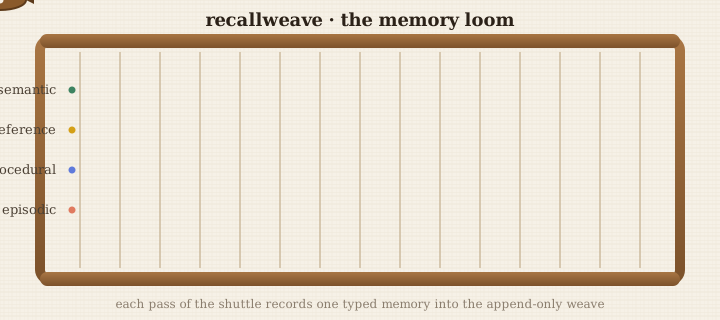
A loom holds a set of taut vertical threads — the warp — under tension. The
weaver passes a shuttle back and forth, trailing a horizontal thread — the
weft — over and under the warp. Row by row, the passes accumulate into cloth.
Once a row is beaten into place it is fixed; you do not go back and re-thread
it. To change the finished cloth you either weave more on top, or you cut a
thread and let it fray.
RecallWeave takes that literally:
| loom |
RecallWeave |
| a pass of the shuttle |
appending one event to the log |
| a weft thread |
a single memory |
| the colour of a thread |
the memory's kind |
| thread thickness / length |
confidence |
| a finished, beaten-in row |
an immutable log record |
| cutting a thread |
a tombstone |
| re-weaving over an old row |
a supersession |
| a thread that frays with time |
a TTL expiry |
| folding the cloth to store it |
compaction |
| checking the weave for slips |
integrity verification |
| rolling the cloth off the loom to show someone |
exporting a memory-pack |
The two animated panels in this README (docs/assets/memory-loom.svg and
docs/assets/forgetting-weave.svg) are hand-authored SVGs that show the shuttle
weaving typed threads, and threads fading, being cut, and re-woven during
forgetting and compaction. They are local files — no external assets, no
tracking — so they render anywhere the SVG does.
🚀 Quick start
You need a Rust toolchain (1.74+). Node 18+ is only needed for the viewer.
# build the engine
cargo build --release

# point every command at a store directory with --dir (default: .RecallWeave)
alias rw='./target/release/RecallWeave --dir mymemory'

# weave in some memories
rw add --kind semantic   --content "prod region is eu-west-1" --tags infra,region
rw add --kind preference --content "prefers concise answers"  --tags style --confidence 0.8
rw add --kind procedural --content "rotate the API token via ops runbook step 3" --tags ops
rw add --kind episodic   --content "deploy failed at 14:03"    --tags infra --ttl 86400

# read the cloth
rw list
rw query --kind preference --contains concise
rw stats

# check the weave has not been tampered with
rw verify

# roll it off the loom into a portable pack
rw export --out memory-pack.json
Then turn the pack into a tapestry:
cd viewer
npm install
npm run build
node dist/cli.js ../memory-pack.json --svg tapestry.svg
🎨 The threads: memory kinds
RecallWeave is typed on purpose. A memory's kind changes how you should treat
it, so the type is first-class rather than a free-text tag.
- 🟢 semantic — durable facts. "The prod region is eu-west-1." These are the
backbone threads; they rarely expire, and when they change you usually
supersede rather than delete.
- 🟡 preference — stated or inferred preferences. "Prefers concise answers."
The liveliest, most conflict-prone threads: people change their minds. This is
the only kind the polarity conflict detector inspects.
- 🔵 procedural — how-to knowledge. "Rotate the token by running step 3 of the
ops runbook." Recipes worth keeping verbatim.
- 🔴 episodic — things that happened at a moment. "Deploy failed at 14:03."
The threads most likely to fray: give them a TTL and let the loom forget
them on schedule.
Every thread also carries the metadata that makes a memory trustworthy:
provenance (source + detail — why do I believe this?), confidence
in [0,1], tags, links to related memories, a fingerprint for
dedupe, and lifecycle fields (ttl_secs, supersedes, superseded_by,
tombstoned). The full schema lives in docs/MEMORY.md.
🧶 The loom: the append-only weave
The store is a directory (default .RecallWeave/) holding a single
log.jsonl — one JSON event per line, in the order it happened. Three event
types are ever written:
assert — a new memory (a new weft thread).tombstone — retire a memory (cut a thread), with a reason.supersede — replace one memory with another (re-weave a row).
The current state is not stored anywhere. It is derived by replaying every
event in order:
   log.jsonl (events)  ──replay──▶  materialized state (id → Memory)
         ▲                                   │
         │ append                            ▼
    assert / tombstone / supersede    query · verify · export · compact
Because state is a pure function of the log, the log is the single source of
truth and nothing is silently lost. You can always ask "how did I come to
believe this?" and replay to find out.
Tamper-evidence: the integrity chain
Each record commits to the one before it. It stores prev — the digest of the
previous record — and digest, a 256-bit hash over its own canonical payload
chained with prev. The first record's prev is 64 zeros (GENESIS). Alter any
byte of any record and every digest downstream stops matching:
$ rw verify
integrity OK: 7 records, chain intact

# ... someone edits log.jsonl by hand ...
$ rw verify
integrity FAILED (7 records):
  - seq 3: digest mismatch (record contents were altered)
This is a checksum chain, not a signature. It catches accidental corruption
and casual tampering. It does not stop a determined attacker who rewrites the
whole file — for that, sign the exported pack out of band. (Said plainly again in
the limitations.)
🧷 Tending the cloth: the lifecycle
Deterministic dedupe
Before fingerprinting, content is normalized: trimmed, internal whitespace
collapsed, lowercased. So these two are the same memory:
rw add --kind semantic --content "prod region is eu-west-1"
rw add --kind semantic --content "PROD region   is  eu-west-1"   # → deduped
If a live memory of the same kind already has that fingerprint, no new
record is written and the existing id comes back with deduped: true. Fully
deterministic, fully explainable — and, honestly, only lexical: a paraphrase is a
different thread.
Supersession — re-weaving a row
When a fact changes, you do not delete the old one; you weave a new row over it:
rw supersede --old mem_9f21b35efe51 --content "prod region is us-east-1"
The old memory gains a superseded_by pointer and drops out of the live set; the
new one records what it supersedes. History is intact until you compact.
Conflict detection — spotting crossed threads
conflicts reports (and never mutates) two kinds of clash among live memories:
- duplicate-content-different-kind — the same normalized content stored as,
say, both
semantic and preference. Usually a modelling slip.
- preference-polarity — two live preferences that share a subject token but
differ on a recognised antonym (
dark/light, concise/verbose, …):
$ rw conflicts
1 conflict(s):
  [preference-polarity] mem_0572… <-> mem_881f…: preferences appear to conflict on 'dark' vs 'light'
The shared-subject guard means "prefers dark theme" vs "prefers light beer"
does not trip it. This is a small, transparent heuristic — a nudge, not an
oracle.
🍂 Forgetting, on purpose
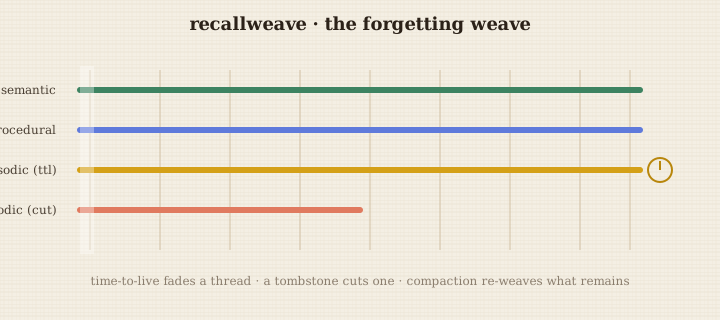
Forgetting is a feature, not a failure. Three mechanisms let the cloth shed what
it no longer needs:
- Time-to-live. Give a memory
--ttl <seconds>; once created_at + ttl has
passed it drops out of list/query automatically, and rw gc makes the
retirement explicit by tombstoning it with reason ttl-expired.
- Manual tombstones.
rw forget <id> --reason "no longer relevant" cuts a
specific thread.
- Compaction.
rw compact folds the cloth: it reads the live set, drops
every tombstoned / superseded / expired record, and re-weaves the survivors
into a fresh log from GENESIS — preserving their ids and creation times, so the
materialized live set is byte-for-byte identical before and after, and the
integrity chain is rebuilt cleanly.
$ rw compact
compacted 12 -> 6 records (dropped 3 tombstoned, 2 superseded, 1 expired)
$ rw verify
integrity OK: 6 records, chain intact
The forgetting-weave.svg panel animates exactly this: a TTL thread fading to
dashed as its little clock drains, a tombstoned thread being cut with a marker
dropped in the gap, and a compaction sweep tightening the remaining cloth.
🖼 The tapestry viewer
The engine and the viewer are decoupled by design: the viewer never reads the
log or understands the hash chain. It consumes only the portable memory-pack
(format: "recallweave-pack"), a self-describing JSON document with the live
memories, per-kind and per-tag counts, detected conflicts, and the integrity
head.
The TypeScript viewer (viewer/) renders two things from a pack:
- a text report for the terminal and CI logs, and
- a woven SVG tapestry: each kind is a warp band, each memory a weft thread
(length = confidence, colour = kind, a knot = has links), retired threads
dashed and faded, and conflicts drawn as animated crossed red threads.
cd viewer && npm install && npm run build
node dist/cli.js ../examples/memory-pack.json                     # text report
node dist/cli.js ../examples/memory-pack.json --svg tapestry.svg  # + SVG
node dist/cli.js ../examples/memory-pack.json --svg -             # SVG to stdout
The rendering is deterministic: the same pack always yields byte-identical SVG,
and all user content is XML-escaped (there is a test for a <script> payload).
📖 Command reference
Every command takes --dir <path> (default .RecallWeave), an optional
--now <epoch> to pin the clock for reproducible runs, and --json where a
machine-readable form makes sense.
| command |
what it weaves |
add |
assert a memory (--kind --content [--confidence --ttl --tags --links --source --detail --supersedes]) |
supersede |
replace a memory (--old --content [--kind --confidence ...]) |
list [--all] |
list live memories (--all includes retired) |
query |
filter (--kind --tag --contains --min-confidence --source --sort --limit [--all]) |
get <id> |
show one memory in detail |
forget <id> [--reason] |
tombstone a memory |
gc |
tombstone all TTL-expired memories |
conflicts |
report conflicts among live memories |
compact |
rewrite the log, dropping retired records |
verify |
check the integrity chain (non-zero exit on failure) |
export [--out file] |
write a portable memory-pack |
stats |
summarize the store |
help, version |
the usual |
Run RecallWeave help for the full flag list.
🧪 Worked example: an agent's week
The repository ships a real, runnable demo (see examples/). It builds a store,
records a spread of memories, changes its mind, lets an episodic note expire, and
exports a pack — every step executed by the real binary, not mocked:
# from the project root, on any OS with a shell
sh examples/demo.sh          # bash / sh
# or
pwsh examples/demo.ps1        # PowerShell
That produces examples/memory-pack.json (committed) whose tapestry is rendered
to docs/assets/tapestry-demo.svg. The demo store shows a superseded region
fact, two preferences in genuine polarity conflict, a procedural runbook, and an
episodic note with a one-day TTL — the exact scene both README panels illustrate.
🎯 Design principles
- Lifecycle over lookup. The hard part of agent memory is not finding a
string; it is knowing what to trust, what changed, and what to forget.
- The log is the truth. State is always a pure replay of an append-only log,
so history is inspectable and forgetting is a deliberate act.
- Deterministic and explainable. Same inputs, same ids, same fingerprints,
same SVG. Every dedupe and every conflict has a reason you can print.
- Auditable to the bottom. Standard library only; the JSON codec, hash
chain, and CLI parser are all short enough to read.
- Local-first. Everything is a file on your disk. No network, no service, no
telemetry. Portability is an explicit export, not an accident.
- Honest about scope. It says loudly what it does not do.
⚠️ Honest limitations
Read this. It is the difference between using RecallWeave well and being
surprised by it.
- No semantic matching, at all. Dedupe, conflict detection, and
query --contains are purely lexical. "Prefers dark theme" and "wants a
dark colour scheme" are unrelated strings to this engine. No embeddings, no
vectors, no synonyms, no paraphrase detection. If you need similarity search,
run a vector store alongside RecallWeave and let each do what it is good at.
- The conflict detector is a small heuristic. Preference-polarity uses a
hand-curated antonym table plus a shared-token check. It misses conflicts
phrased outside the table and can false-positive on coincidental antonyms. It
is a nudge, not a truth oracle.
- The digest is a checksum, not cryptography.
verify catches accidental
corruption and casual tampering. It is not SHA-256 and makes no
collision/preimage-resistance claims. Anyone who can rewrite the whole file can
recompute a valid chain; sign the exported pack out of band if you need
authenticity.
- Confidence is metadata, never computed. The engine stores and filters on
it but never updates it. There is no belief revision.
- Single-writer, no locking. Concurrent writers to one directory can corrupt
the log. In-process writes are atomic (temp file + rename); across processes,
you are on your own.
- Time is simple. Epoch-second arithmetic, overridable with
--now. No
timezones, no calendars.
- History grows until you compact, and compaction discards the audit trail of
retired memories to reclaim space.
These are deliberate trade-offs for a small, auditable, local-first tool. See
docs/MEMORY.md for the reasoning behind each.
🛠 Building, testing, and project layout
make build     # cargo build --release
make test      # cargo test  +  viewer tests
make demo      # run the demo and regenerate the tapestry SVG
make verify    # build, test, clippy, fmt-check, viewer build+test
make clean     # remove build artifacts
RecallWeave/
├── src/                    # Rust engine (stdlib only)
│   ├── json.rs             #   hand-written JSON codec
│   ├── hash.rs             #   FNV fingerprints + 256-bit digest chain
│   ├── model.rs            #   Memory, Event, LogRecord + (de)serialization
│   ├── store.rs            #   append-only log, dedupe, conflicts, compaction…
│   ├── query.rs            #   deterministic filtering
│   ├── lib.rs              #   library crate
│   └── main.rs             #   the CLI
├── tests/                  # integration + black-box CLI tests
├── viewer/                 # TypeScript tapestry viewer
│   └── src/                #   pack parser, text report, SVG renderer, tests
├── examples/               # runnable demo + committed memory-pack
├── docs/
│   ├── MEMORY.md           # the data model & lifecycle reference
│   └── assets/             # hand-authored animated SVGs
├── Cargo.toml  Makefile  LICENSE  CHANGELOG.md
└── .github/workflows/ci.yml
📜 License
MIT — see LICENSE. Weave freely.
RecallWeave · a loom for what your agent remembers · local-first, dependency-light, honestly scoped

 RecallWeave — это движок жизненного цикла памяти агентов, работающий в первую очередь локально: он хранит типизированные воспоминания в журнале с добавлением записей в конец и хеш-цепочкой, а также берёт на себя дедупликацию, обнаружение конфликтов, забывание, компакцию и переносимый экспорт.