


SystemOneHarness README

The project's README from github.com/HarnessRouter/SystemOneHarness. As one markdown file: README.md.

System One Harness
The harness for System One models.

GitHub stars License: Apache 2.0 Version 0.3.1 UHP conformance: Core Python 3.10 or newer

Turn a System One decision model into an agent loop. System One Harness observes an environment, compiles its finite action space into typed questions, gates each decision by confidence, executes the chosen action, and records the complete trace.

One model call per step. No generated actions. A probability on every transition.

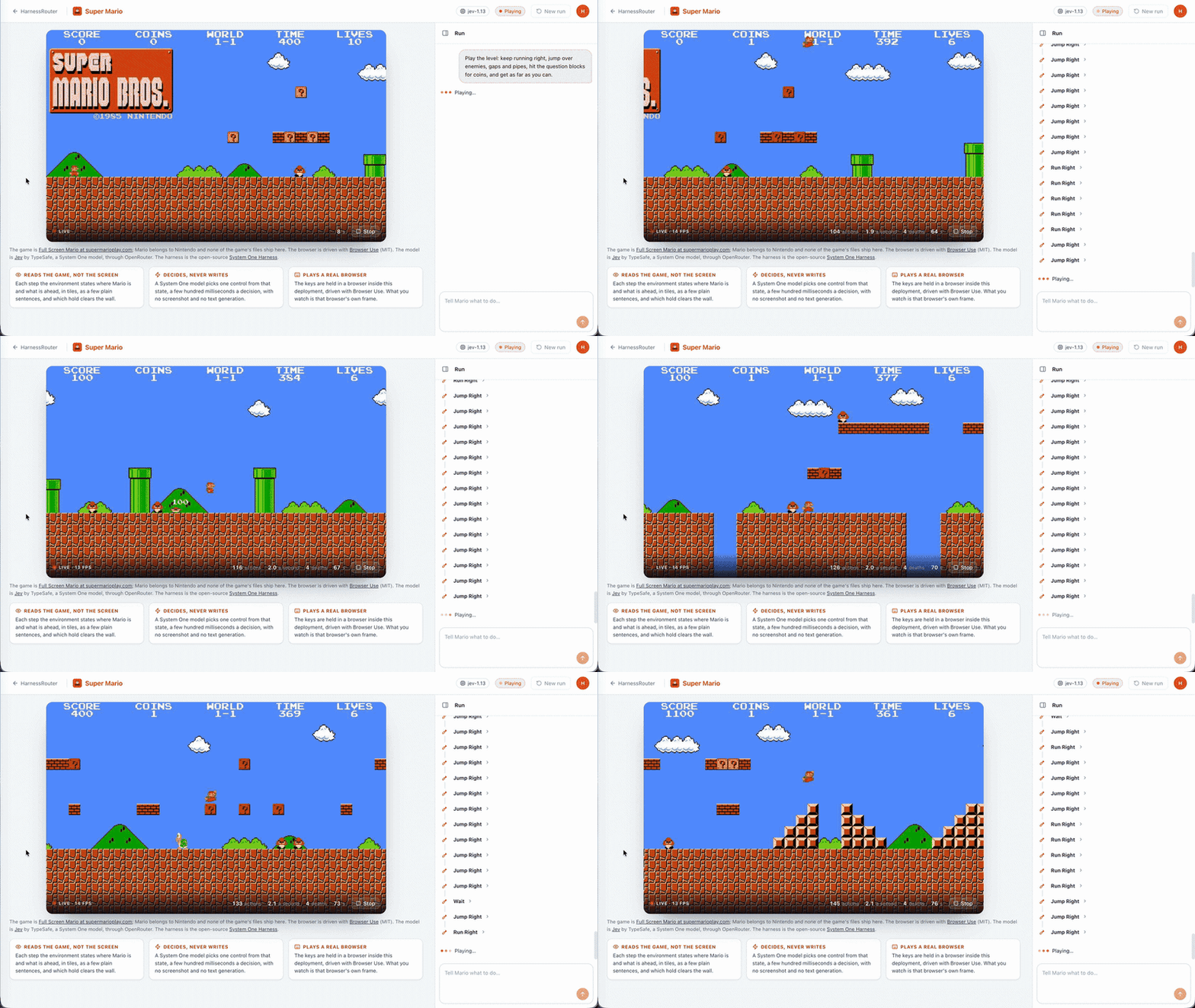
Jev uses System One Harness to play a live browser game by choosing one typed action per step.
Jev playing a live browser game through System One Harness — one typed decision per step, with no generated control text.

The first supported model is Jev by TypeSafe, available through OpenRouter or TypeSafe directly.

Help build the System One ecosystem. Star this repo.

[!TIP] Start here: Run the example · Understand the loop · Connect an environment · Read the design

Quickstart

git clone https://github.com/HarnessRouter/SystemOneHarness.git
cd SystemOneHarness
pip install -e .

export OPENROUTER_API_KEY=sk-or-...   # or TYPESAFE_API_KEY=...
s1 run --env order:ship_fastest_gift

This runs the built-in order fulfilment environment against the live model:

goal: Order B-220 is a gift: note it, then ship it by the fastest carrier.
model: ~typesafe/jev-latest
    0  add_note(note='gift')              p=0.96  241 ms
    1  pick_item(item='scarf')            p=1.00  269 ms
    2  pack()                             p=0.99  166 ms
    3  choose_carrier(carrier='express')  p=0.98  151 ms
    4  ship()                             p=0.93  152 ms

status=completed reason=environment_terminal steps=5 wall=0.98s cost=$0.000208

Each step shows the selected action, its weakest required probability, and the model round trip. The final line records how the run ended, how long it took, and what it cost.

What it provides

Finite actions The model chooses only from actions and parameter values declared by the environment.
Confidence gates Read, write, and destructive actions can require different probability thresholds.
Explicit outcomes Every run ends as completed, incomplete, failed, or cancelled with a structured reason.
Complete traces State, questions, distributions, verdicts, results, latency, and usage are recorded step by step.
Pluggable environments Drive Python processes, MCP servers, or web pages with the same controller.
UHP compatibility Serve the loop through the Unified Harness Protocol for streaming, continuation, cancellation, and discovery.

Real-time environments

Games, live feeds, and other moving environments can return "realtime": true. The controller then treats a refused or repeated decision as a clock tick, keeps the model's history short, and lets the last action remain active until it changes.

How it works

            ┌──────────────────────────────────────────────────────────┐
            │                        controller                        │
 goal ────► │ observe ─► compile ─► encode ─► decide ─► gate ─► execute │ ────► trace
            │    ▲                                           │         │
            │    └────────────── environment ◄───────────────┘         │
            └──────────────────────────────────────────────────────────┘
  1. Observe. The environment reports text, structured fields, candidates, and terminal state.
  2. Compile. The available actions become typed choice, noul, and score questions.
  3. Encode. Goal, observation, bounded history, and memory become a state within the model budget.
  4. Decide. The model answers the action, its parameters, and the goal check in one request.
  5. Gate. The weakest required probability must clear the selected action's risk threshold.
  6. Execute. The environment applies the action and returns the next state.

finish and escalate are actions, not generated prose. The controller always knows why it stopped.

Read the measured design and architecture →

Connect an environment

Choose the smallest boundary that fits your system.

Environment Use it when Start with
Action space + process You own a local program or service loop. s1 run --actions actions.yaml --env-cmd "python3 env.py" --goal "..."
MCP server Your tools already expose enumerable inputs over MCP. s1 run --mcp "python -m your_server" --goal "..."
Browser The task is expressed through DOM controls in Chrome. s1 run --browser --headless --start-url https://example.com --goal "..."
Python You want an in-process integration. Subclass Environment and implement observe() and execute().

Declare an action space

An action space is YAML or the same structure in Python. Every parameter must be enumerable.

instructions: >-
  Move the order to shipped, or cancel it when the goal says so.

actions:
  choose_carrier:
    description: Select a carrier for the packed order.
    risk: write
    params:
      carrier:
        from: available_carriers
  ship:
    description: Hand the packed order to the selected carrier.
    risk: destructive

gate:
  read: 0.5
  write: 0.6
  destructive: 0.8
  finish: 0.5

Parameters can use fixed choices, observation candidates, a boolean flag, or ordered levels. Free text is rejected because a System One model does not generate text.

Open the complete example →

Use an MCP server

The harness lists an MCP server's tools, compiles supported schemas into actions, and explains every unsupported tool instead of silently dropping it.

pip install -e ".[mcp]"
s1 tools --mcp "python -m systemone_harness.envs.order_mcp"
s1 run --mcp "python -m systemone_harness.envs.order_mcp --scenario ship_fastest_gift" \
  --goal "Order B-220 is a gift. Ship it by the fastest carrier."

An observe tool provides state. An optional reset tool starts a run. Every other compatible tool becomes an action. MCP annotations determine whether the action is read, write, or destructive.

Drive a browser

The browser environment uses Browser Use to turn visible DOM controls into a finite action space. Text comes from named values supplied by the caller. The model chooses values by name and never writes them.

pip install -e ".[browser]"
s1 run --browser --headless --start-url https://example.com/book \
  --text name=Customer --text [email protected] \
  --goal "Book a table at 19:30 with a window seat."

Browser setup, measurements, and limits →

Serve over UHP

Expose any configured loop as a Unified Harness Protocol server:

export OPENROUTER_API_KEY=sk-or-...
s1 serve --api-key choose-a-secret --port 8710
input                  → goal
function_call          → selected action
function_call_output   → environment result
reasoning              → distribution and gate verdict
previous_response_id   → continued environment and history

Streaming emits each item as it happens. Cancellation lets the current model step finish and records it. The included report passes all 40 checks in the UHP core conformance class.

View the conformance report →

Measured, not implied

Five live runs per scenario on 2026-09-19 with typesafe/jev-1.13-20260917 through OpenRouter:

Scenario Goal met Mean steps Mean model latency Mean wall time Cost per run
Ship by cheapest carrier 5/5 6.0 241 ms 1.45 s $0.000265
Ship fastest and add gift note 5/5 5.0 199 ms 0.99 s $0.000214
Cancel a fraudulent order 5/5 1.0 197 ms 0.20 s $0.000044

The benchmark proves the controller, compiler, gate, and model can complete these small deterministic tasks. It does not claim the same result for ambiguous state, arithmetic, dates, or long irrelevant context.

Inspect the raw benchmark rows →

Configuration, objective and the outer loop

Everything that shapes the reflex's decisions except the model and the world is one versioned YAML, the action-space file extended: version, instructions, gate, encoder, tunables (numbers an environment's rendering reads), the optional declared actions, and an objective (what the environment counts as success, failure, ordered metrics and place). Skills, directories of SKILL.md, are compiled into the instructions once per load, since a reflex cannot open a file mid-step. The trace carries the configuration's version.

s1 run --mcp ./bin/env --config config.yaml --skills ./skills --goal "..." --json trace.json
s1 run --mcp ./bin/env --config config.yaml --script "run_right,jump_right,jump_right"   # a probe
s1 bench --mcp ./bin/env --config config.yaml --runs 3 --json-dir traces/               # one at a time, then the report
s1 report --config config.yaml traces/run-*.json                                        # scoreboard and failure groups

A run that ends because the reflex could not decide (no_confident_action, or escalate chosen) carries a handoff on its record: the state it refused on, the questions, its answers with their probabilities, the weakest judgment and the threshold it failed. That is the branch for whoever takes over, a reasoning harness or a person. docs/dual-loop.md describes the outer loop that uses all of this to improve a configuration version by version.

Command line

s1 run    Run one goal against a built-in, process, MCP, or browser environment
s1 tools  Inspect how an MCP server compiles into supported actions
s1 serve  Expose a configured loop as a UHP server
s1 bench  Run the built-in live benchmark

Use s1 <command> --help for every option. Add --json trace.json to run, tools, or bench when you need machine-readable output.

Test

pip install -e . pytest
pytest -q tests

The suite covers action compilation, unsupported inputs, state truncation, confidence gates, every terminal reason, cancellation, continuation, MCP, browser actions, and the UHP server. Recorded model answers keep the default suite deterministic and keyless.

Project status

Version 0.3.1
Models Jev through OpenRouter or TypeSafe directly
UHP core, 40 of 40 checks
Environments Python, stdio, MCP, browser, and real-time loops
Python 3.10 or newer

Next milestones are a systemone base in HarnessRouter, skills as loadable actions, the Chrome side panel as a plain UHP client, and the UHP extended conformance class.

Resources

Goal Resource
Understand the model and architecture Design of record
Configure the browser environment Browser guide
Try the protocol client Chrome extension
Review benchmark evidence Benchmark report
Review protocol evidence UHP conformance report

License

System One Harness is licensed under Apache 2.0.

SystemOneHarness (HarnessRouter/SystemOneHarness)

Searching Database…

Что это такое?Open-source каркас на Python, который превращает модель принятия решений System One в агентный цикл: он наблюдает за окружением, компилирует конечное пространство действий в типизированные вопросы, пропускает каждое решение через проверку уверенности, выполняет действие и записывает полный трассировочный лог.
Чем это отличается от обычного LLM-агента, который сам пишет свои действия?Модель никогда не генерирует текст: она отвечает на типизированные вопросы по пространству действий, которое объявляет окружение, одним вызовом на каждый шаг, и на каждом переходе выдаёт вероятность. Свободный текст отклоняется.
Как его запустить?Используйте утилиту командной строки s1: Quickstart запускает встроенное окружение обработки заказов на живой модели, s1 --help перечисляет все опции, а --json trace.json выдаёт результат в машиночитаемом виде.
Какая модель им управляется и что для этого нужно?Сейчас он работает с моделью Jev от TypeSafe, доступной через OpenRouter или напрямую у TypeSafe, так что нужен доступ хотя бы к одной из них. Самому каркасу требуется Python 3.10 или новее; его тесты запускаются без ключа на записанных ответах.
Насколько ему можно доверять на реальных задачах?Замеренный бенчмарк доказывает работоспособность только на небольших детерминированных задачах — он явно не утверждает того же для неоднозначных состояний, арифметики, дат или длинного нерелевантного контекста.
Что мешает ему что-то сломать, когда он не уверен?Пороги уверенности: для чтения, записи и разрушительных действий можно задать разные пороги вероятности, и наименьший требуемый порог должен быть пройден порогом выбранного действия. Если рефлекс не может определиться, запуск завершается как noconfidentaction или escalate, а в трассировочном логе остаётся передача человеку или каркасу с рассуждением.
А он вообще работает? Что показали запуски бенчмарка?Пять живых запусков на каждый сценарий через OpenRouter (typesafe/jev-1.13, 2026-09-19) достигли цели 5/5 на всех трёх сценариях обработки заказов — от 1 до 6 шагов, средняя задержка модели около 200 мс, примерно $0.00004–$0.00027 за запуск.
Как работает режим браузера?Браузерное окружение использует Browser Use, чтобы превратить видимые элементы DOM в Chrome в конечное пространство действий. Текст берётся из именованных значений, которые вы задаёте, — модель выбирает значения по имени и никогда не пишет их сама, а --headless запускает работу без окна.
Как объяснить ему, что делать, и что считается успехом?Один версионируемый YAML — файл пространства действий с расширениями: инструкции, gate, энкодер, настраиваемые параметры, опционально объявленные действия и целевая функция, которая определяет успех, провал и упорядоченные метрики. Навыки (каталоги SKILL.md) компилируются в инструкции один раз при каждой загрузке.
Size
10.1 MB
Stars
194
Age
27d
Commits · 90 Days