



What is this?
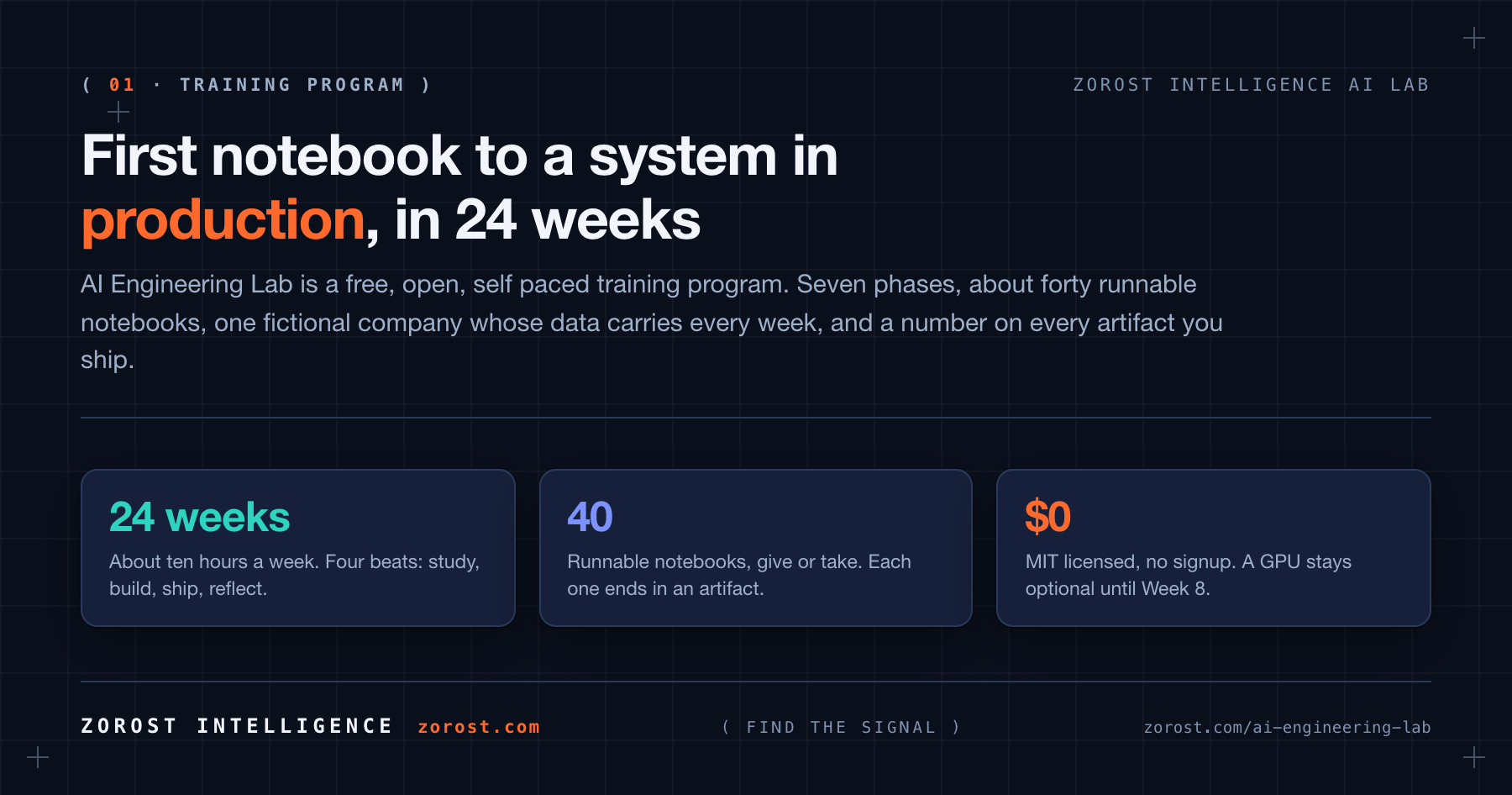
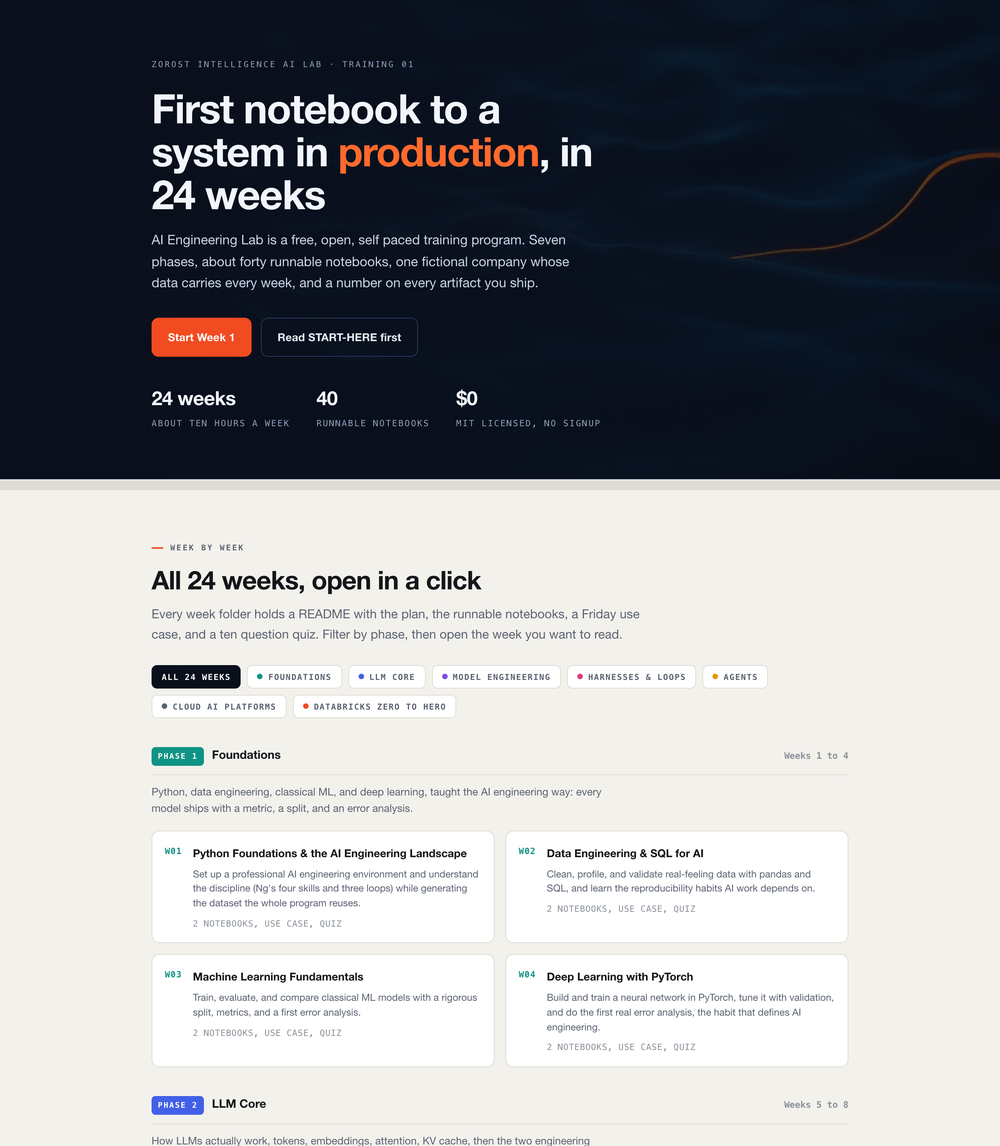
 A free, self-paced 24-week AI engineering course by Zorost Intelligence AI Lab that takes a motivated beginner from Python to production-grade AI systems: ML, LLMs, RAG, fine-tuning, agents and MCP, the major clouds, and Databricks.
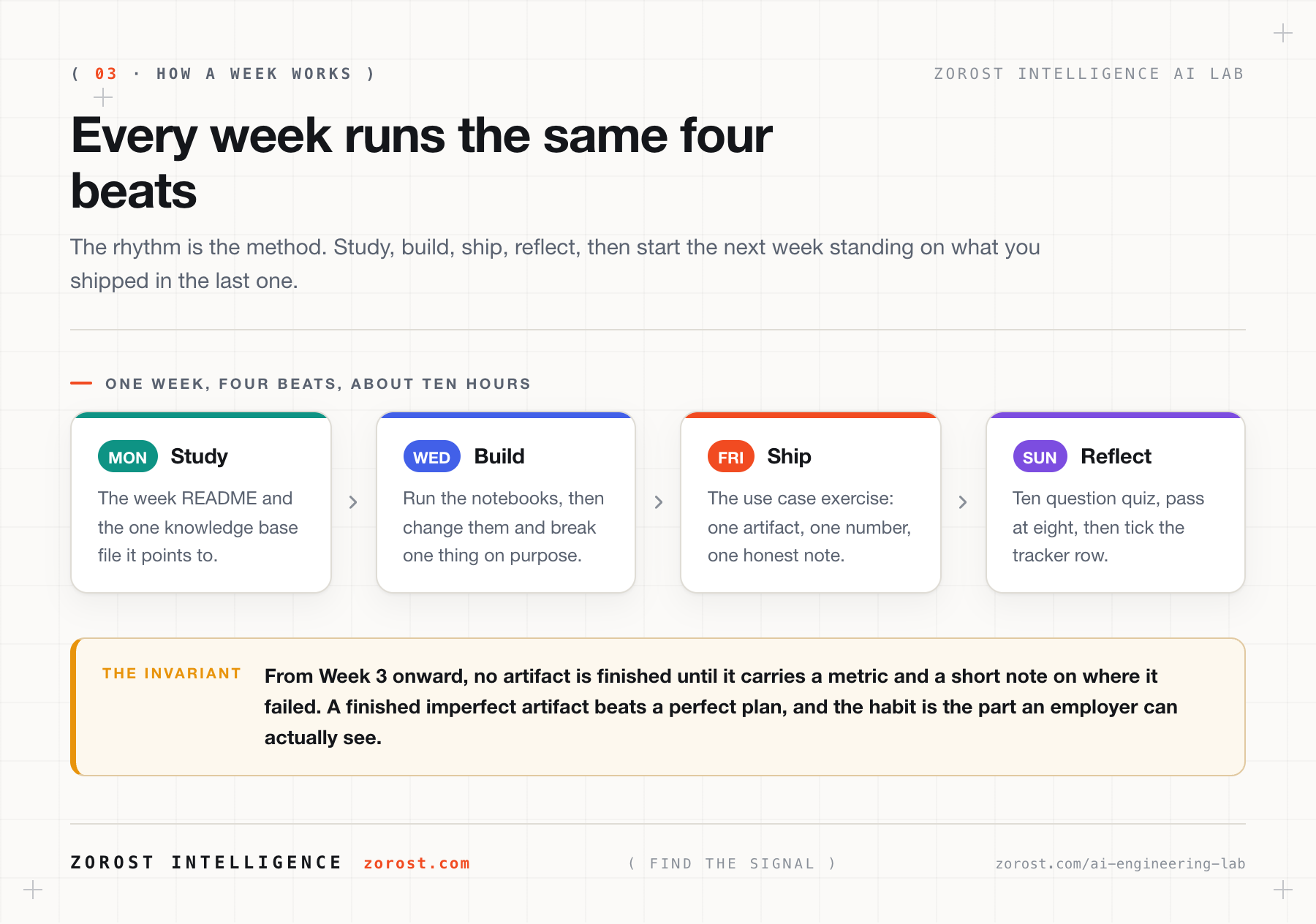
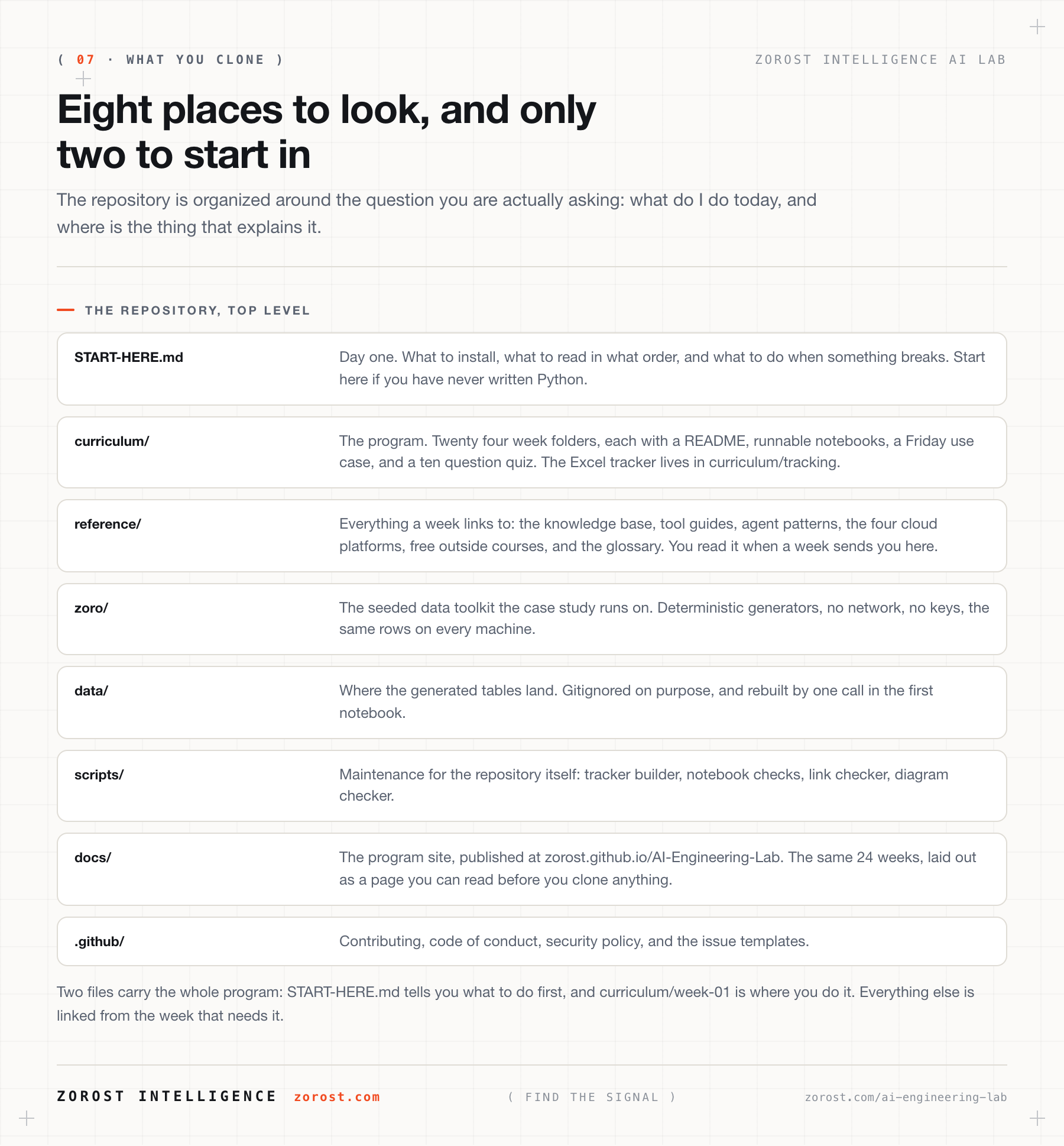
A free, self-paced 24-week AI engineering course by Zorost Intelligence AI Lab that takes a motivated beginner from Python to production-grade AI systems: ML, LLMs, RAG, fine-tuning, agents and MCP, the major clouds, and Databricks.Is it a real course with exercises, or just a curated list of links?A full hands-on curriculum: 43 runnable notebooks in Python, SQL and PySpark, one continuous case study across all 24 weeks, a tracker that tells you what to do next, and weekly ten-question quizzes you pass at eight out of ten.
A full hands-on curriculum: 43 runnable notebooks in Python, SQL and PySpark, one continuous case study across all 24 weeks, a tracker that tells you what to do next, and weekly ten-question quizzes you pass at eight out of ten.Do I need to know Python already, or own a GPU?No prior Python is required — Week 1 sets up your machine — and no GPU either, since one is only optional from Week 8. Weeks 1-13 run without any paid API key.
No prior Python is required — Week 1 sets up your machine — and no GPU either, since one is only optional from Week 8. Weeks 1-13 run without any paid API key.Will I need to pay for cloud or API usage along the way?No signup is needed at all. Weeks 1-13 run entirely on a free path, and Weeks 18-24 use cloud free tiers and tell you how to stay inside them, so no API budget is required.
No signup is needed at all. Weeks 1-13 run entirely on a free path, and Weeks 18-24 use cloud free tiers and tell you how to stay inside them, so no API budget is required.Who is this course actually for?Software developers adding AI, analysts moving toward engineering, students, career changers and technical founders — no prior coding or AI background is assumed. It is explicitly not for model-architecture research or a weekend prompt workshop.
Software developers adding AI, analysts moving toward engineering, students, career changers and technical founders — no prior coding or AI background is assumed. It is explicitly not for model-architecture research or a weekend prompt workshop.Can I reuse or adapt the course material?Yes — it is MIT licensed, so you can learn, build and reuse freely, with a request to attribute Zorost Intelligence.
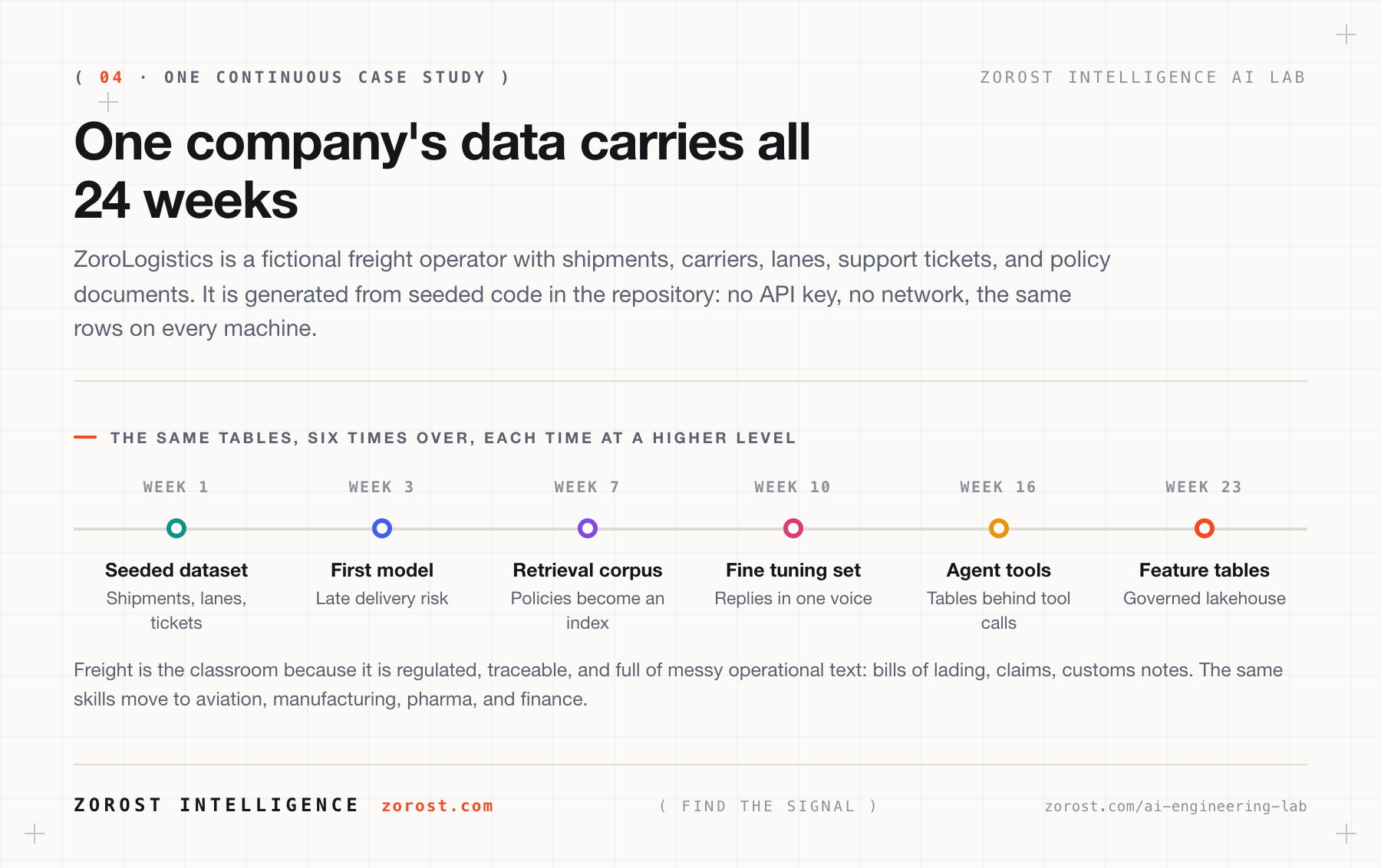
Yes — it is MIT licensed, so you can learn, build and reuse freely, with a request to attribute Zorost Intelligence.What will I actually build over the 24 weeks?One graded artifact per week on the fictional ZoroLogistics freight case: the Week 1 dataset becomes SQL practice, training data, a retrieval corpus, a fine-tuning set, agent tools and feature tables. You graduate with a portfolio of interconnected artifacts instead of 24 disconnected demos.
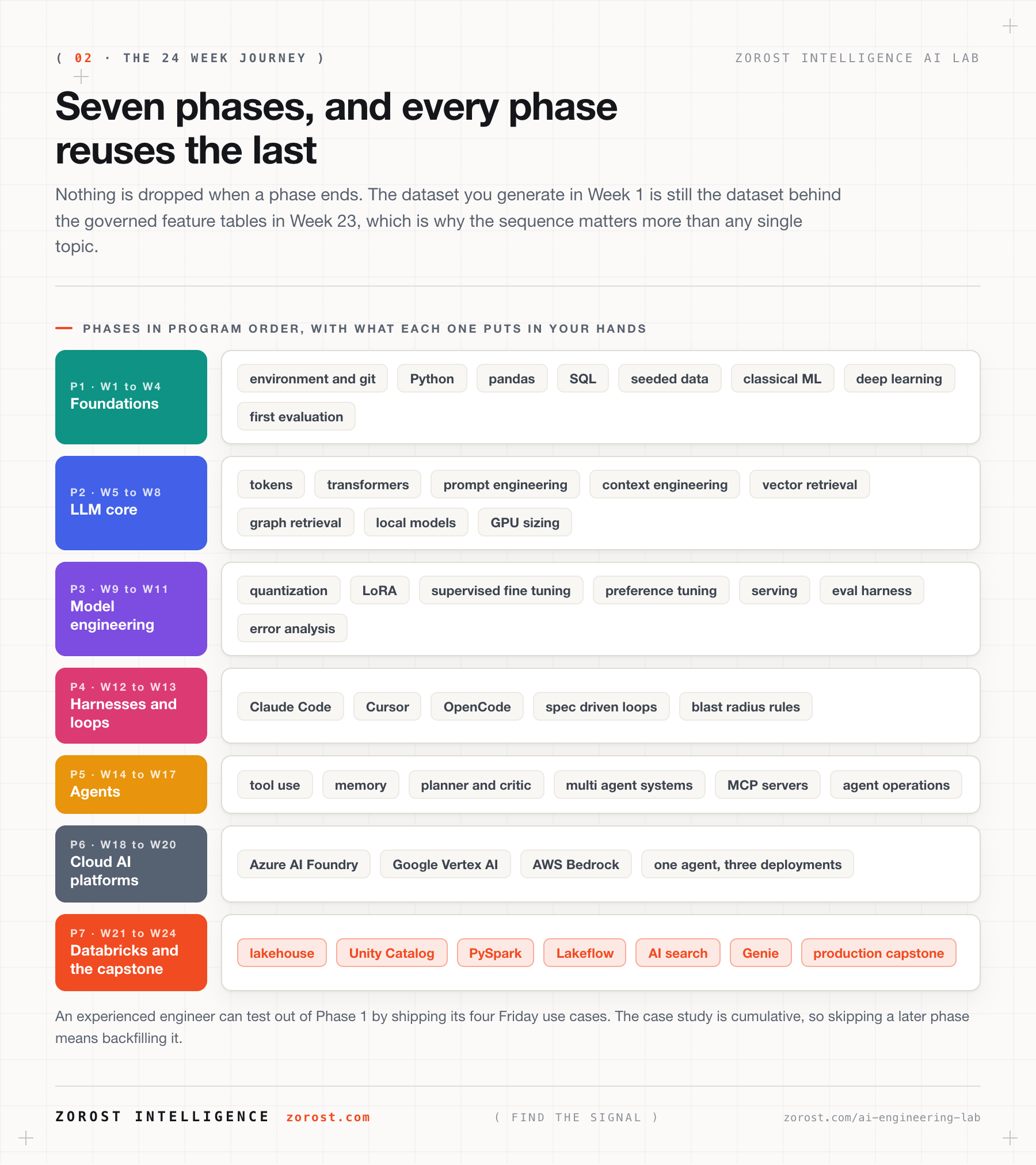
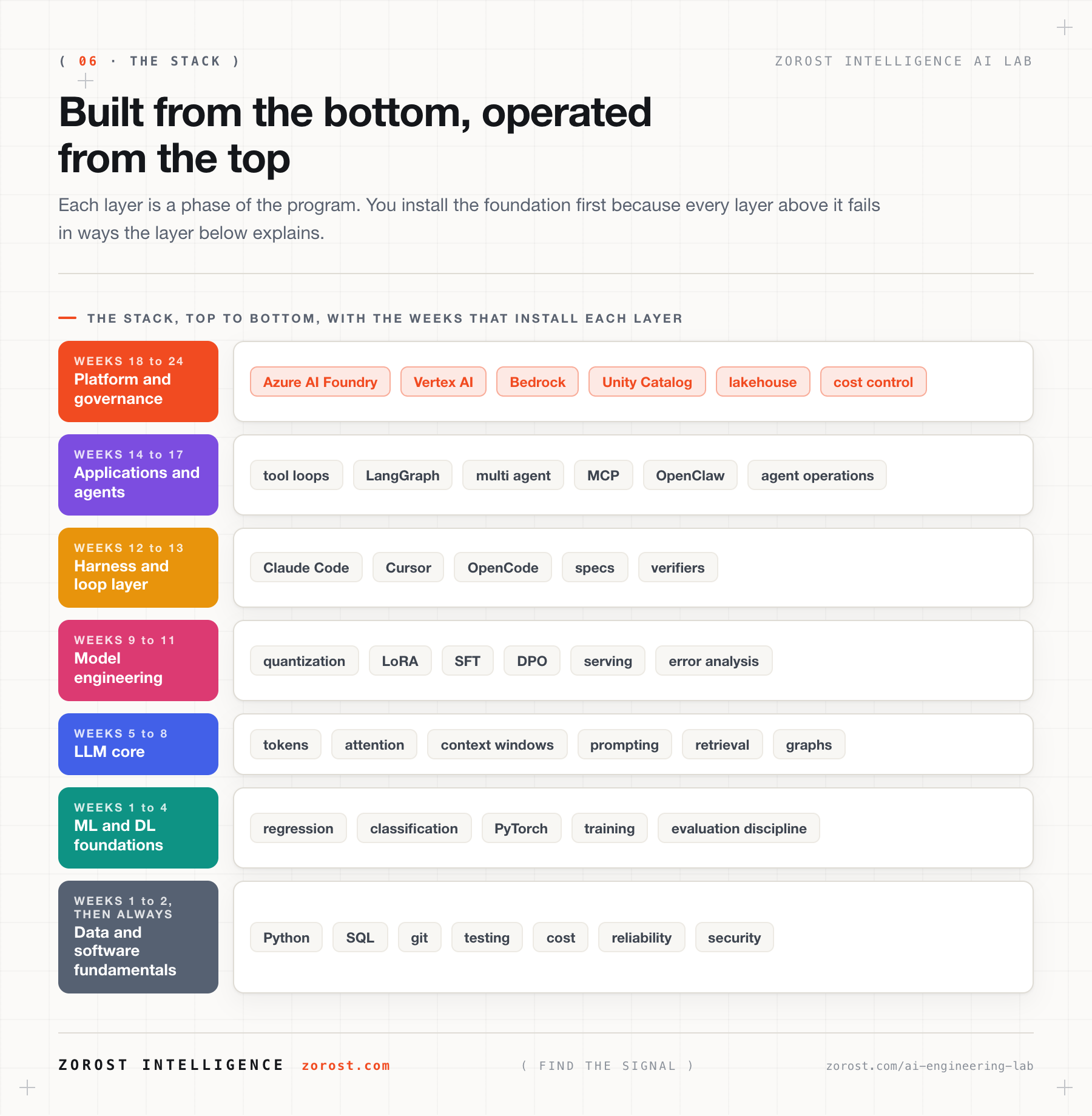
One graded artifact per week on the fictional ZoroLogistics freight case: the Week 1 dataset becomes SQL practice, training data, a retrieval corpus, a fine-tuning set, agent tools and feature tables. You graduate with a portfolio of interconnected artifacts instead of 24 disconnected demos.What does the second half of the course cover?Weeks 12-13 cover coding-agent harnesses like Claude Code and Cursor, Weeks 14-17 agents and MCP, Weeks 18-20 build one agent across Azure AI Foundry, Google Vertex AI and AWS Bedrock, and Weeks 21-24 are a Databricks lakehouse track with PySpark and Unity Catalog.
Weeks 12-13 cover coding-agent harnesses like Claude Code and Cursor, Weeks 14-17 agents and MCP, Weeks 18-20 build one agent across Azure AI Foundry, Google Vertex AI and AWS Bedrock, and Weeks 21-24 are a Databricks lakehouse track with PySpark and Unity Catalog.Why is the case study about a freight company?Freight is regulated, traceable and full of messy operational text, which mirrors real production conditions. The Lab says the skills transfer to aviation, manufacturing, pharma, government and finance.
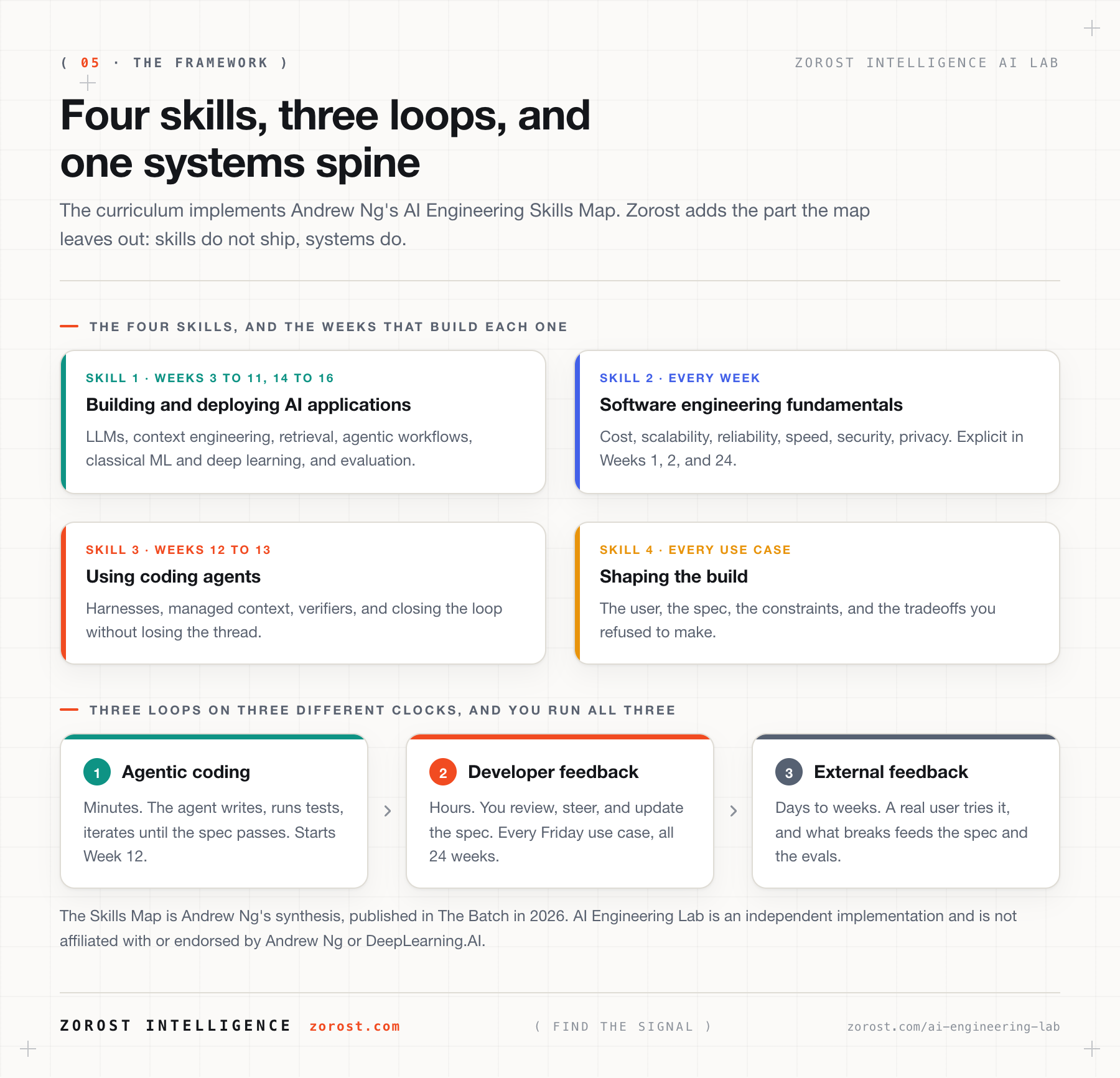
Freight is regulated, traceable and full of messy operational text, which mirrors real production conditions. The Lab says the skills transfer to aviation, manufacturing, pharma, government and finance.What is the Andrew Ng connection?The curriculum implements Andrew Ng's AI Engineering Skills Map and his three loops for building software in the AI era, but as an independent project — it is not affiliated with or endorsed by Andrew Ng or DeepLearning.AI.
The curriculum implements Andrew Ng's AI Engineering Skills Map and his three loops for building software in the AI era, but as an independent project — it is not affiliated with or endorsed by Andrew Ng or DeepLearning.AI.What are similar projects?ai-engineer-notebooks, nlp_course, ai-engineering-hub, awesome-ai-engineering, generative-ai-for-beginners, llm-course, llm-cookbook, ai-system-design
ai-engineer-notebooks, nlp_course, ai-engineering-hub, awesome-ai-engineering, generative-ai-for-beginners, llm-course, llm-cookbook, ai-system-designWhich topics is it in?databricks, ai-engineering, roadmap, mlops, azure, vector-search, aws, curriculum, course, jupyter notebook, quantization, fine-tuning
databricks, ai-engineering, roadmap, mlops, azure, vector-search, aws, curriculum, course, jupyter notebook, quantization, fine-tuning