Extract huge archives in place. The archive shrinks as your files hatch,
so you only need free space for the output, not for the output and the archive.
HatchZip is a free, open-source archive extractor for Windows, macOS and Linux, with a desktop app and a command line tool. It extracts ZIP, 7z, RAR, tar and split archives in place, for when there is not enough disk space to extract an archive next to itself, such as a large game download on a nearly full disk. Download it from hatchzip.dev.
A 180 GB game download that unpacks to 200 GB needs 380 GB of disk with WinRAR, 7-Zip or unzip, because the archive and everything extracted from it have to exist at the same time. HatchZip needs a little over 200 GB. It extracts the archive from the end and cuts each finished part off the archive file as it goes, so the space the archive gives back is reused for the next files.
It checks that the extraction will fit before it changes anything, keeps a safety margin of free space the whole way through, and can be stopped or crash at any moment and pick up where it left off. It reads ZIP, 7z, tar, .tar.gz, .tar.bz2, .tar.xz, RAR volume sets and split archives.
Get it
[!IMPORTANT]
HatchZip is only distributed from this repository's releases and its site, hatchzip.dev. Other sites using the name, such as hatchzip.com, are not affiliated with this project.
Run the installer. Windows may show "Windows protected your PC" because HatchZip is not code-signed yet: choose More info, then Run anyway.
Right-click the archive, choose HatchZip, then Extract here. On Windows 11 the menu is under Show more options. To pick the destination folder first, choose Extract files… instead.
Or open HatchZip from the Start menu, open the archive, and choose Extract.
HatchZip shows whether the files will fit before it changes anything. The archive is used up as the files come out, so when it finishes, only the extracted files are left.
Extract here puts an archive with one folder or one file at its top next to the archive. An archive with several files or folders at its top goes into a new folder named after it, so its files never mix with what is already there. The progress window closes when the extraction completes; to keep it open, clear Close the progress window when extraction completes in the app's Settings menu.
To keep the archive when there is room for both, choose Extract here (keep archive) in the right-click menu. To always keep archives, as other extractors do, clear Remove the archive during extraction in the app's Settings menu; every right-click entry then keeps the archive too. That is a normal extraction: the archive is not changed, and space is required for all extracted files.
When there is not enough disk space to extract
The same 200 MB of game data (21 files), packed by the real tools, extracted on a 220 MiB disk with about 50 MB free:
Archive
unzip / 7-Zip
HatchZip
ZIP, 180 MB
unzip ran out of space at file 6 of 21
Finished, every file byte-identical
7z from 7-Zip 25.01, -ms=20m (10 solid blocks)
Needs 380 MB
Finished in 0.64 s, every file byte-identical
7z split into 5 volumes of 40 MB
Needs 380 MB
Finished; volumes deleted one at a time, peak 210 MB used
tar from GNU tar, 200 MB
Needs 400 MB
Finished in 0.12 s, every file byte-identical
7z from 7-Zip with default settings (1 solid block)
Needs 380 MB
Refused before touching anything: one solid block can't be freed until all of it is out, so it needs 200 MB free
Result
ZIP extraction speed, same data
0.25 to 0.35 s, against 1.48 to 1.50 s for unzip 6.00, including an fsync unzip skips
Crash safety
Killed at both unsafe moments of a batch at many points of each format's run; every resume finished with identical output
Works on
Any filesystem that can shrink a file: ext4, btrfs, XFS, NTFS, APFS, and also exFAT and FAT32 USB drives
Measured on Fedora 43, Intel Core i7-14700HX, SK Hynix NVMe SSD, warm page cache; the disk-space runs used a 220 MiB tmpfs to stand in for a full laptop disk, the speed runs ext4. Speed comes from decompressing files in parallel, so an archive holding one giant file extracts at the speed of a single core.
The extra space HatchZip needs beyond the output is about the size of the largest single unit it can free at once: one file for ZIP and tar, one solid block for 7z. On filesystems that can punch holes (ext4, XFS, btrfs, tmpfs; NTFS and APFS not yet verified), a large file stored or deflated in a ZIP, or in a tar, frees its archive bytes every 256 MiB while it is extracted: a ZIP holding one 600 MiB stored file extracted on a 950 MiB tmpfs with 367 MB free, where it needed 629 MB before. hatchzip check computes the exact figure for any archive.
HatchZip-x64.msi: the same app and install as the setup, as a Windows Installer package for deployment tools and msiexec /i HatchZip-x64.msi /qn. Install one or the other
Windows 10 and 11 (x64), portable
HatchZip-x64-portable.zip: the same app and command line tool with nothing to install. Unzip it anywhere and run hatchzip-gui.exe; Settings, "Show in the Explorer context menu" adds the right-click entries for that location
The installers also put the hatchzip command (and its short name hz) on your PATH. The Windows installers and the macOS apps are not code-signed yet: on Windows choose More info, then Run anyway; on macOS 15 and later, open the app once, then allow it under System Settings, Privacy & Security.
Command line only
Linux and macOS:
curl -fsSL https://raw.githubusercontent.com/xevrion/hatchzip/main/install.sh | sh
Both download the build for your machine from the latest release, check it against its published SHA-256 checksum, and install hatchzip and hz for your user only, with the man page and shell completions. No root or administrator rights.
Every release file from 0.1.3 on carries signed build provenance. To check that a download really was built from this repository by its release workflow, wherever you got it:
Homebrew and Scoop are live. winget and Chocolatey are in review, and the AUR packages are coming soon; until they are listed as live here, a package under those names does not come from this project.
System
Command
Installs
Arch Linux (AUR)
Not published yet. Until then, use the AppImage or the install script
App and CLI
Windows (winget)
In review; until it is accepted, use the setup
App and CLI, same as the setup
Windows (Chocolatey)
In review; until it is accepted, use the setup
App and CLI, same as the setup
Windows (Scoop)
scoop bucket add xevrion https://github.com/xevrion/scoop-bucket, then scoop install xevrion/hatchzip
CLI
macOS and Linux (Homebrew)
brew install xevrion/tap/hatchzip
CLI
macOS (Homebrew)
brew install --cask xevrion/tap/hatchzip
App and CLI
With Cargo
cargo install hatchzip
This builds the command line tool from crates.io. The engine is a library too: hatchzip-core. It reads every format but RAR; cargo install hatchzip --features rar adds RAR support, which compiles UnRAR's C++ source under its own license and needs a C++ compiler.
With cargo-binstall, cargo binstall hatchzip downloads the release build for your system instead of compiling it, with RAR support, on Linux, macOS and Windows (x64; Arm on Linux and macOS).
From source
With Rust (the version is pinned in rust-toolchain.toml and installed automatically):
git clone https://github.com/xevrion/hatchzip.git
cd hatchzip
cargo build --release
The binaries are target/release/hatchzip and target/release/hatchzip-gui (.exe on Windows). Building the desktop app on Linux needs the fontconfig headers (libfontconfig1-dev or fontconfig-devel). cargo build --release --features rar adds RAR support, as in the release builds; it needs a C++ compiler.
Shell completions and man page
hatchzip completions bash > ~/.local/share/bash-completion/completions/hatchzip
hatchzip completions zsh > "${fpath[1]}/_hatchzip"
hatchzip completions fish > ~/.config/fish/completions/hatchzip.fish
hatchzip completions powershell >> $PROFILE

hatchzip man > ~/.local/share/man/man1/hatchzip.1    # then: man hatchzip
Usage
See whether it fits
hatchzip check game.zip
game.zip  180.2 MB zip, 200.0 MB uncompressed in 22 entries
  available                    50.5 MB
  standard extraction needs    200.0 MB
  required                     29.9 MB (+5.0 MB reserved)
  available after              30.6 MB
check reads the archive's index and the disk's free space and changes nothing. "Standard extraction needs" is what extracting while keeping the archive requires; when that fits too, check says so. hatchzip check game.zip --keep-archive shows the plan for keeping it.
Extract
hatchzip extract game.zip                 # into ./game/
hatchzip extract game.zip -o D:\Games\Foo # somewhere else
hatchzip x game.7z.001                    # split archive; any part's name works
HatchZip prints the same space plan, asks for confirmation, then extracts. When the extraction is complete, the archive has been removed and the files are in the output folder. For a split archive, each volume is deleted as soon as everything in it is extracted.
Option
Effect
-o, --output <dir>
Output folder. Defaults to a folder named after the archive, next to it. It may hold other files, but none where the archive's files go, unless --replace is given.
--keep-archive
Keep the archive: a normal extraction that removes nothing. Space is required for all extracted files. No confirmation is asked.
Keep files that already exist in the output folder instead of the archive's copies.
--keep-free <size>
Free space HatchZip never uses, such as 500MB or 10GB. Default 2GB, so the disk never fills to zero.
--verify-first
Read the whole archive and check every file's checksum before deleting anything. Takes extra time, recommended for downloads you can't easily get again.
-y, --yes
Skip the confirmation prompt. Required when not run from a terminal, unless --keep-archive is given.
-q, --quiet
Print only errors and prompts.
Keep the archive
hatchzip extract game.zip --keep-archive
When the disk has room for the archive and all its files, --keep-archive extracts like any other tool and leaves the archive byte for byte as it was, for when it is needed again. The space check, path and collision checks, checksums and password handling are the same as for an extraction in place. If keeping the archive does not fit, HatchZip says so, by how much, and what extracting in place would require instead.
An interrupted run resumes like any other, and goes on keeping the archive even when resumed without --keep-archive. An extraction that started in place cannot switch to keeping the archive, since part of it is already removed. hatchzip restore on an archive being kept only discards the progress: the archive was never changed.
HatchZip does not overwrite files. When a file the archive contains already exists in the output folder, extraction is refused before anything is changed, unless --replace or --skip-existing is given, as for a game patch or a mod extracted over an installed game. In the desktop app, HatchZip asks about each file instead: Replace, Skip, which keeps the existing file, or Keep both, which adds the archive's copy beside it as name (2).ext, with an option to do the same for the rest.
When the archive is removed during extraction, a skipped file's copy in the archive is not kept: it is extracted, then discarded, and the existing file stays.
With --replace, before anything is extracted, every existing file or link at the path of a file in the archive is moved into a .hatchzip-replaced folder inside the output folder, keeping its relative path. The move is a rename on the same disk, so it needs no extra space and no data is copied; a link is moved, never followed. The replaced files are deleted when the extraction completes, and the ones to keep are moved back. The space plan is unchanged: the replaced files keep their space until the end.
An interrupted run resumes as usual, with or without --replace: the progress file records that files were moved aside.
hatchzip restore moves the replaced files back to where they were. An extraction in place is the exception: a file already extracted there is no longer in the archive, so the file it replaced stays in .hatchzip-replaced, and restore says how many did. With --keep-archive, every replaced file goes back.
A folder is never replaced: a folder where the archive has a file, or a file where it needs a folder, is refused as before. So is a link on the way to any path, and an archive that contains .hatchzip-replaced itself.
Several archives
hatchzip extract a.zip b.7z c.tar.gz
The archives are extracted one after another, each into its own folder, or all into the folder given with -o. The space for each one is checked just before it starts, so the space one archive frees is available to the next. The first archive that does not complete stops the run, and HatchZip lists which archives were extracted, which one stopped and whether its progress is saved, and which were not started; the exit status is that archive's. check, test and list also take several archives, go through all of them, and exit with the status of the first one that did not succeed. Naming every volume of a split archive, as a shell pattern like game.7z.* does, counts as that archive once.
Stop and resume
Press Ctrl+C and HatchZip finishes the files it is writing, saves its progress and exits. A second Ctrl+C quits immediately, which is also safe. To continue, run the same command again:
hatchzip extract game.zip
The same applies after a crash, a power cut, or running out of space because something else filled the disk. Progress lives in small files next to the archive: game.zip.hatchzip and game.zip.hatchzip-tail, and game.zip.hatchzip-folders when the archive's folders have permissions or times to set. Do not delete them while an extraction is unfinished: they hold the archive's index, which is no longer inside the archive itself.
Anyone who supplies an archive could also supply progress files next to it, so HatchZip follows them only to the archive's own files, and only for an extraction started on this computer. Every extraction notes its output folder in your user profile, outside the archive's folder, so a resume on the same computer needs no options. On another computer, or for an extraction that HatchZip 0.1.5 or earlier started in the default folder, name the folder again with -o; restore takes it too.
Stop for good
To give up on an unfinished extraction instead, restore the archive:
hatchzip restore game.zip
What is left of the archive becomes a normal archive again, holding exactly the entries not yet extracted, which 7-Zip, WinRAR, unzip or tar open as usual. The files already extracted stay in the output folder. Restore only appends a new index, so it needs only the free space that index takes, and if it is interrupted, running it again finishes it.
List and test
hatchzip list game.7z    # what's inside, with sizes
hatchzip test game.7z    # read every file and verify its checksum, writing nothing
Plain tar has no checksums for file contents, so test on a tar only proves every file can be read in full.
Exit status
Code
Meaning
0
Success
1
Failure. If extraction had started, progress is saved.
2
Invalid command line
3
Not enough free space. Nothing was changed.
4
The archive is damaged. Nothing was deleted.
5
The archive is password protected and no correct password was given.
130
Paused with Ctrl+C. Run the same command to continue.
With several archives, the status is that of the first archive that did not succeed.
Is HatchZip safe
HatchZip destroys the archive as it extracts, so it is built around never losing a file that has not safely landed on disk.
Nothing changes until the plan fits. The space check runs before the first byte is touched, and it replays the whole extraction to find the moment that needs the most free space, not just the total.
A file is written, flushed to the physical disk and renamed into place before the part of the archive holding it is cut off. A crash at any point leaves either the file or its bytes in the archive, never neither.
Damage stops the run where it is. Every file's CRC-32 is checked as it is extracted. A damaged file is not written, and it stays in the archive along with everything before it.
An .sfv file is checked first. When one named after the archive is next to it, as split downloads often have, every volume is checked against it before anything changes. A damaged or missing volume stops the extraction with nothing modified.
Hostile archives are refused before anything is deleted: paths that escape the output folder, entries that overlap each other, entries that appear twice, names that differ only in case on a destination not known to keep them apart, and links where other entries need a folder. Setuid and setgid bits are never restored, and symlinks are created only after every regular file is written, so nothing can be written through one. Progress files found next to an archive are checked the same way: they may only name that archive's own volumes and links inside the output folder.
A hard-linked archive is left alone. Shrinking a file shrinks it under every name it has, so an archive or volume with another hard link is refused in place before anything changes. --keep-archive still extracts it.
A kept archive stays as it was. With --keep-archive, the code that shrinks, frees or deletes archive bytes refuses to run for the whole extraction, and its progress file has a format older versions refuse, so none of them can resume it in place.
A replaced file is never deleted early. With --replace, existing files are moved aside, and the moves flushed to disk, before the first file is extracted, and they are deleted only when the extraction completes. The progress file records the move in a format older versions refuse, since they would not put the files back.
What it cannot protect against: if the download itself is damaged, the files before the damaged spot are extracted and the archive is partly gone. Use --verify-first when the archive can't be downloaded again and has no .sfv file. On btrfs or APFS, space held by a snapshot that includes the archive is not freed until the snapshot is deleted.
Antivirus warnings
HatchZip does not connect to the network. It has no networking code and no networking library, and CI fails if an HTTP, TLS or socket crate enters the dependency tree (deny.toml). It collects nothing and sends nothing.
The release files are not code-signed yet, and some antivirus engines that score files by machine learning or behaviour flag new, unsigned programs. On VirusTotal, the v0.1.3 Windows setup is flagged by 4 of 70 engines, all heuristic or machine-learning scores; Microsoft Defender reports it clean. What sandboxes list is what any installer does: it writes program files, adds the right-click menu and "Open with" entries, and runs Inno Setup's helper process. Code signing is planned.
To check that a download is genuine, compare its SHA-256 with the .sha256 file next to it, or verify that this repository's release workflow built it:
Verify your download has the commands for every system and the checksum of every release file, each with its VirusTotal report. Or build it yourself: cargo install hatchzip.
Supported formats
Format
Status
Freed in steps of
ZIP, ZIP64, self-extracting .exe ZIPs
Supported. Tested: Stored, Deflate, Deflate64, bzip2, LZMA, PPMd, XZ and Zstandard, including archives made by 7-Zip itself, and entries past the 4 GiB mark.
One file
7z, solid and non-solid
Supported. Tested with archives made by 7-Zip 25.01: LZMA2 (its default), LZMA, BCJ with LZMA2, bzip2, Deflate and PPMd; Zstandard with an archive made by py7zr, since 7-Zip has no Zstandard coder for the 7z format; and LZ4 and Brotli with archives made by 7-Zip ZS 25.01, the 7-Zip build that adds those coders. A coder this build has no decoder for is refused before anything is touched.
One solid block
tar (uncompressed)
Supported, including long names, symlinks and hard links
One file
.tar.gz, .tgz
Supported, including multi-member gzip (bgzip, pigz -i) and split .tar.gz.001 sets. Extracted from the front, freeing the compressed bytes behind the decoder where the filesystem can punch holes; every gzip CRC-32 and length is checked before anything is touched. Tested with archives from GNU tar with gzip, and pigz. Elsewhere (FAT32, exFAT) it still extracts and resumes, but needs room for the archive and every file at once, and check says so.
256 MiB of output
.tar.bz2, .tbz2, .tbz
Supported, including concatenated bzip2 streams and split .tar.bz2.001 sets. Extracted from the front, freeing bytes at CRC-checked block boundaries where hole punching is available. Every block and combined stream CRC is checked before anything is touched. Damage and a bare bzip2 file without a tar are refused before extraction. On FAT32 and exFAT it needs room for the archive and every file at once.
256 MiB of output
.tar.xz
Supported when the xz stream holds more than one block, which is xz's multithreaded default and what xz -T4 -6 --block-size=8MiB writes. Each block is decoded on its own and its CRC-32 or CRC-64 checked; an LZMA2 dictionary is not carried between blocks, so a point needs no window. A one-block archive (xz -T1) is refused in place, since nothing can be freed while it decodes, and extracts with --keep-archive. Refused before anything is touched: SHA-256 or unknown checks, unknown filters, concatenated xz streams, and dictionaries over 1 GiB. A stream with no checks (--check=none) is refused in place, since damage inside it could not be caught before the bytes are freed, and extracts with --keep-archive.
256 MiB of output
Split archives (.001, .002, ...) of ZIP or 7z, as 7-Zip makes them
Supported
One file or block; each volume is deleted once emptied
Password-protected ZIP (ZipCrypto and AES) and 7z (AES, including encrypted file lists)
Supported. HatchZip asks for the password, or takes --password or HATCHZIP_PASSWORD, and proves it on one file before anything is deleted. It is never saved, so a resumed run asks again.
Works, but needs free space for the whole block, as the table above shows. Freeing space inside a block is the same planned technique.
RAR, RAR 5 and RAR 4, single files and volume sets (.part1.rar, .part2.rar, ... or .rar, .r00, ...)
Supported in the release builds, decoded by UnRAR (see License); builds without the rar feature, such as cargo install hatchzip, refuse RAR before anything is touched. Password-protected files work as for ZIP: a RAR 5 password is proven by its check value, a RAR 4 one by decoding the smallest encrypted file, which for a large file can take a while. Archives with encrypted file names ("Encrypt file names", rar -hp) need the password even to be listed, and are freed file by file like any other. A large stored file is freed while it is written, as in tar. Refused before anything is touched: links, dictionaries over 4 GB, and sets with a volume missing or a stray one after the last. restore works, except for archives with encrypted file names, since it takes no password; such an extraction can only be completed. Tested with archives made by RAR 6.24 (RAR 5 and RAR 4) and archives written by the test suite; sets made by WinRAR 7.23 were tested on Windows when RAR support was first written.
One file; a volume once every file that reaches into it is out
Solid RAR
Extracted only while the archive is kept (--keep-archive): a solid archive decodes front to back in one pass and UnRAR can't save its state, so it can't be freed as it goes or resumed mid-way. In place, it is refused before anything is touched.
Native split ZIP (.z01)
Planned
How it works
ZIP, 7z and tar all store their contents as a sequence of independent pieces: files for ZIP and tar, solid blocks for 7z. ZIP and 7z keep their index at the very end. HatchZip saves that index to a side file, then extracts pieces starting from the last one in the archive. After each batch it truncates the archive to where that batch began, which every operating system and filesystem supports; for a split archive, that means deleting whole volumes and shortening one. RAR stores files one after another like tar, so it is freed file by file too, and a volume is deleted once every file reaching into it is out. A .tar.gz, .tar.bz2 or .tar.xz is one compressed stream that can only be decoded from the front, so HatchZip extracts it front to back and punches holes in the compressed bytes it has used, at resume points it can restart from after a crash. The full design, including the exact order of writes that makes a crash safe, is in How it works.
How it is built
HatchZip is written with the help of AI coding assistants, and AGENTS.md is the rulebook they work under. It is the strict part of the project: the tool deletes its own input, so a change only lands with proof.
More than 130 tests run on Linux, macOS and Windows for every change, in CI on real machines of each kind.
Crash tests kill the process at every step where it writes a file, saves its progress or cuts the archive, then resume and compare every extracted file byte for byte.
Freeing space is checked, not assumed. CI fails if ext4, APFS or NTFS do not really give the space back.
Damaged and hostile archives are part of the suite: paths that escape the folder, overlapping entries, bad CRCs, truncated downloads, wrong passwords.
Every number in this README was measured on real hardware, and the conditions are written next to it.
Pull requests and bug reports from people are held to the same rules, and are very welcome.
Star history
Sponsors
HatchZip is free and open source, and it stays that way. Sponsorship pays for its maintenance, macOS signing, more formats and an outside security review; hatchzip.dev/sponsor has the details, including options for companies that embed hatchzip-core.
Sponsor through GitHub Sponsors or Buy Me a Coffee. Sponsors from 10 USD a month are listed here, and companies from 100 USD a month with their logo.
RAR archives are decoded by the UnRAR source code, which is freeware under its own license: free to use for extracting RAR archives, but not to build a RAR compatible archiver. It is compiled in only with the rar cargo feature, which is off by default, so cargo install hatchzip, the crates on crates.io and distribution builds are open source throughout and need no C++ compiler. The release builds on the releases page have it on, and every release download includes LICENSE-UNRAR.
Contributing
Bug reports, especially from filesystems and operating systems not covered by CI, are welcome. Read CONTRIBUTING.md first.
Unless you explicitly state otherwise, any contribution intentionally submitted for inclusion in HatchZip by you, as defined in the Apache-2.0 license, shall be dual licensed as above, without any additional terms or conditions.
hatchzip (xevrion/hatchzip)
Выберите тег — он появится здесь. Пока теги не выбраны, показаны все проекты каталога.
Ищем в базе…
Выберите тег — он появится здесь. Пока теги не выбраны, показаны все проекты каталога.
Что это такое?HatchZip — бесплатный программный архиватор с открытым исходным кодом для распаковки архивов ZIP, 7z, RAR, tar и разделённых архивов. Он распаковывает файлы «на месте», поглощая архив по мере работы, поэтому для распаковки нужно свободное место только под результат, а не под архив и результат вместе.
Это приложение для рабочего стола или инструмент командной строки?И то, и другое: есть настольное приложение с пунктом контекстного меню «Распаковать здесь» для Windows, macOS и Linux, а также CLI hatchzip (короткий псевдоним hz), который устанавливается вместе с ним;基础 ядро доступно ещё и как библиотека на Rust (hatchzip-core).
Нужно ли что-то дополнительно для поддержки RAR?Чтение архивов RAR по умолчанию не встроено; нужна команда 'cargo install hatchzip --features rar', которая собирает C++-исходники UnRAR и требует компилятор C++.
Какие подводные камни при установке стоит ожидать?Установщик для Windows и приложение для macOS пока не подписаны кодом, поэтому Windows показывает предупреждение SmartScreen (нужно выбрать «Подробнее», затем «Выполнить в любом случае»), а macOS требует один раз подтвердить запуск приложения в разделе «Конфиденциальность и безопасность»; кроме того, пакеты winget и AUR пока официально не опубликованы, поэтому пакеты с такими названиями в других местах не относятся к этому проекту.
Работает ли это на Mac с процессором Intel, или только на Apple Silicon?Поддерживаются оба варианта, для каждого есть отдельная сборка dmg.
Насколько HatchZip быстрее unzip или 7-Zip?На одних и тех же данных ZIP он распаковал их за 0,25–0,35 с против 1,48–1,50 с у unzip 6.00, в основном потому, что распаковывает файлы параллельно на всех ядрах процессора.
Что будет, если распаковка прервётся на середине?HatchZip устойчив к сбоям: файл сначала записывается на диск и переименовывается на своё место, и только потом его байты удаляются из архива, поэтому сбой никогда не приводит к потере файла, а продолжить можно, просто повторно запустив ту же команду.
Можно ли сохранить исходный архив после распаковки?Да, используйте --keep-archive (или пункт контекстного меню «Распаковать здесь (сохранить архив)») для обычной распаковки, которая оставляет архив нетронутым, при условии, что места на диске хватает на оба.
Что делать, если нужно отменить распаковку на полпути и восстановить архив?Выполните 'hatchzip restore', чтобы собрать обычный архив, содержащий только записи, которые ещё не были распакованы; его можно открыть в 7-Zip, WinRAR и других программах как обычно.



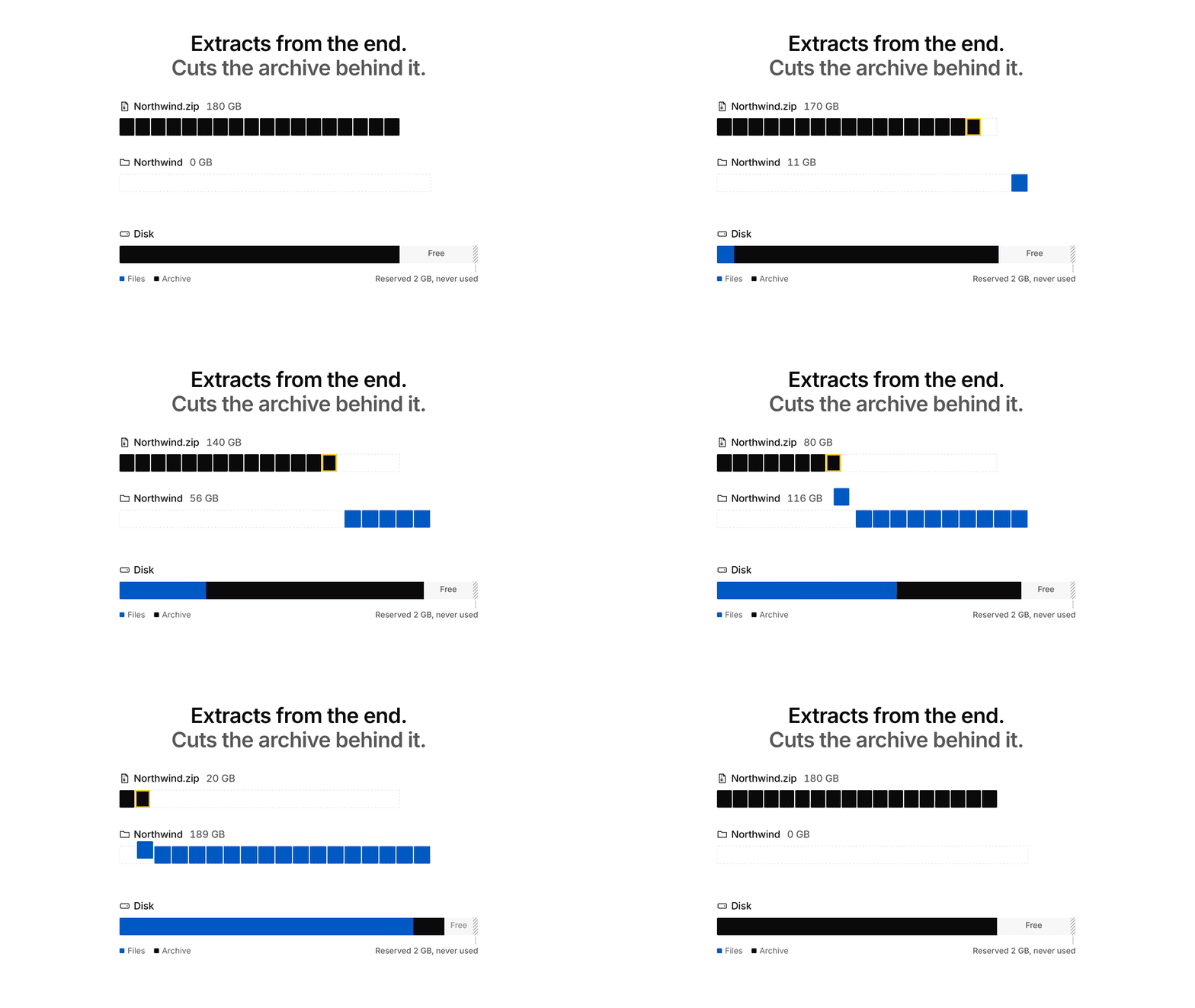

 HatchZip — бесплатный программный архиватор с открытым исходным кодом для распаковки архивов ZIP, 7z, RAR, tar и разделённых архивов. Он распаковывает файлы «на месте», поглощая архив по мере работы, поэтому для распаковки нужно свободное место только под результат, а не под архив и результат вместе.