[!IMPORTANT]
The active Rust workspace now lives in rust/. Start with USAGE.md for build, auth, CLI, session, and parity-harness workflows, then use rust/README.md for crate-level details.
This repo is maintained by lobsters/claws, not by a conventional human-only dev team.
The people behind the system are Bellman / Yeachan Heo and friends like Yeongyu, but the repo itself is being pushed forward by autonomous claw workflows: parallel coding sessions, event-driven orchestration, recovery loops, and machine-readable lane state.
In practice, that means this project is not just about coding agents — it is being actively built by them. Features, tests, telemetry, docs, and workflow hardening are landed through claw-driven loops using clawhip, oh-my-openagent, oh-my-claudecode, and oh-my-codex.
This repository exists to prove that an open coding harness can be built autonomously, in public, and at high velocity — with humans setting direction and claws doing the grinding.
the exposed snapshot is no longer part of the tracked repository state
The current Python workspace is not yet a complete one-to-one replacement for the original system, but the primary implementation surface is now Python.
Why this rewrite exists
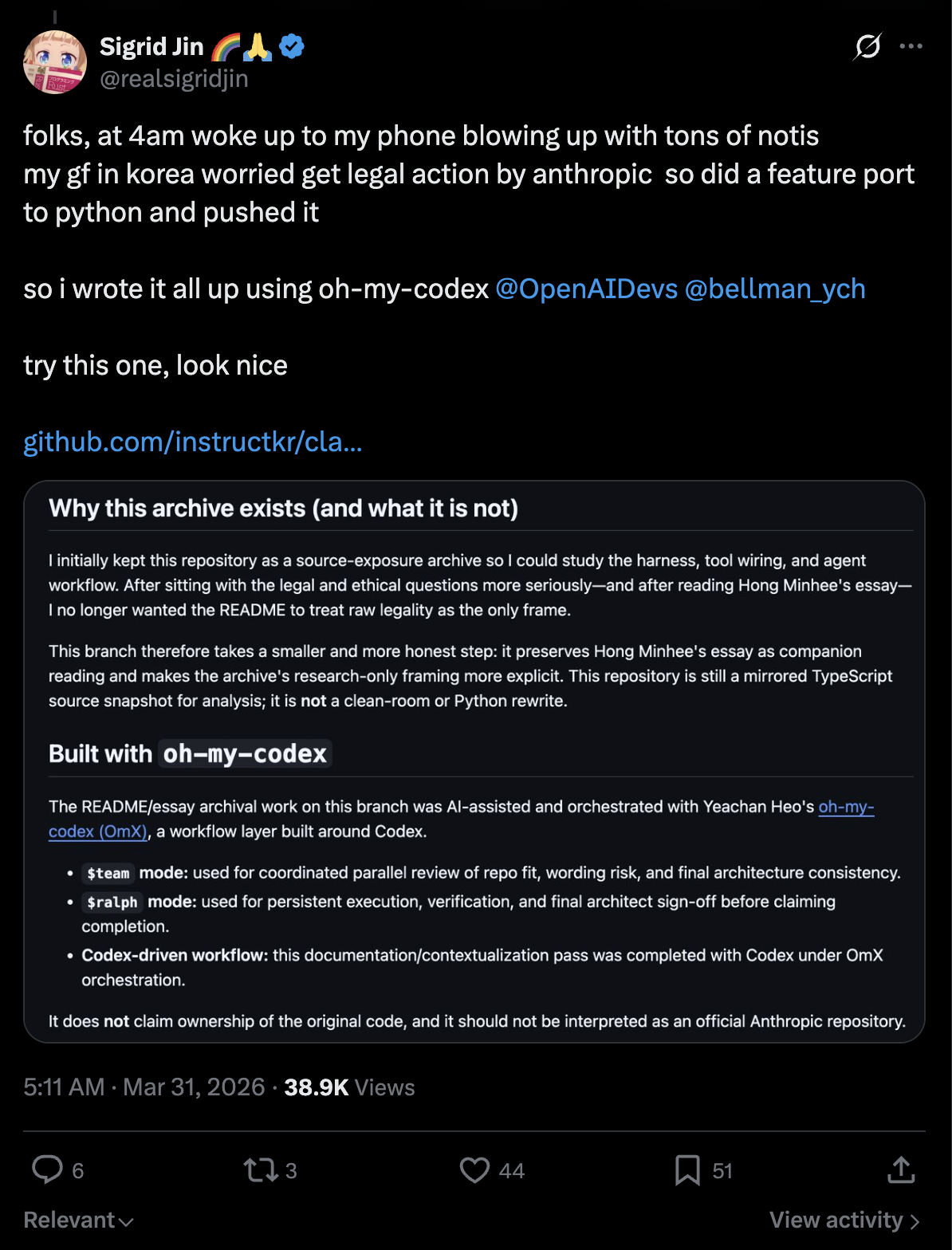
I originally studied the exposed codebase to understand its harness, tool wiring, and agent workflow. After spending more time with the legal and ethical questions—and after reading the essay linked below—I did not want the exposed snapshot itself to remain the main tracked source tree.
This repository now focuses on Python porting work instead.
The port now mirrors the archived root-entry file surface, top-level subsystem names, and command/tool inventories much more closely than before. However, it is not yet a full runtime-equivalent replacement for the original TypeScript system; the Python tree still contains fewer executable runtime slices than the archived source.
Built with oh-my-codex
The restructuring and documentation work on this repository was AI-assisted and orchestrated with Yeachan Heo's oh-my-codex (OmX), layered on top of Codex.
$team mode: used for coordinated parallel review and architectural feedback
$ralph mode: used for persistent execution, verification, and completion discipline
Codex-driven workflow: used to turn the main src/ tree into a Python-first porting workspace
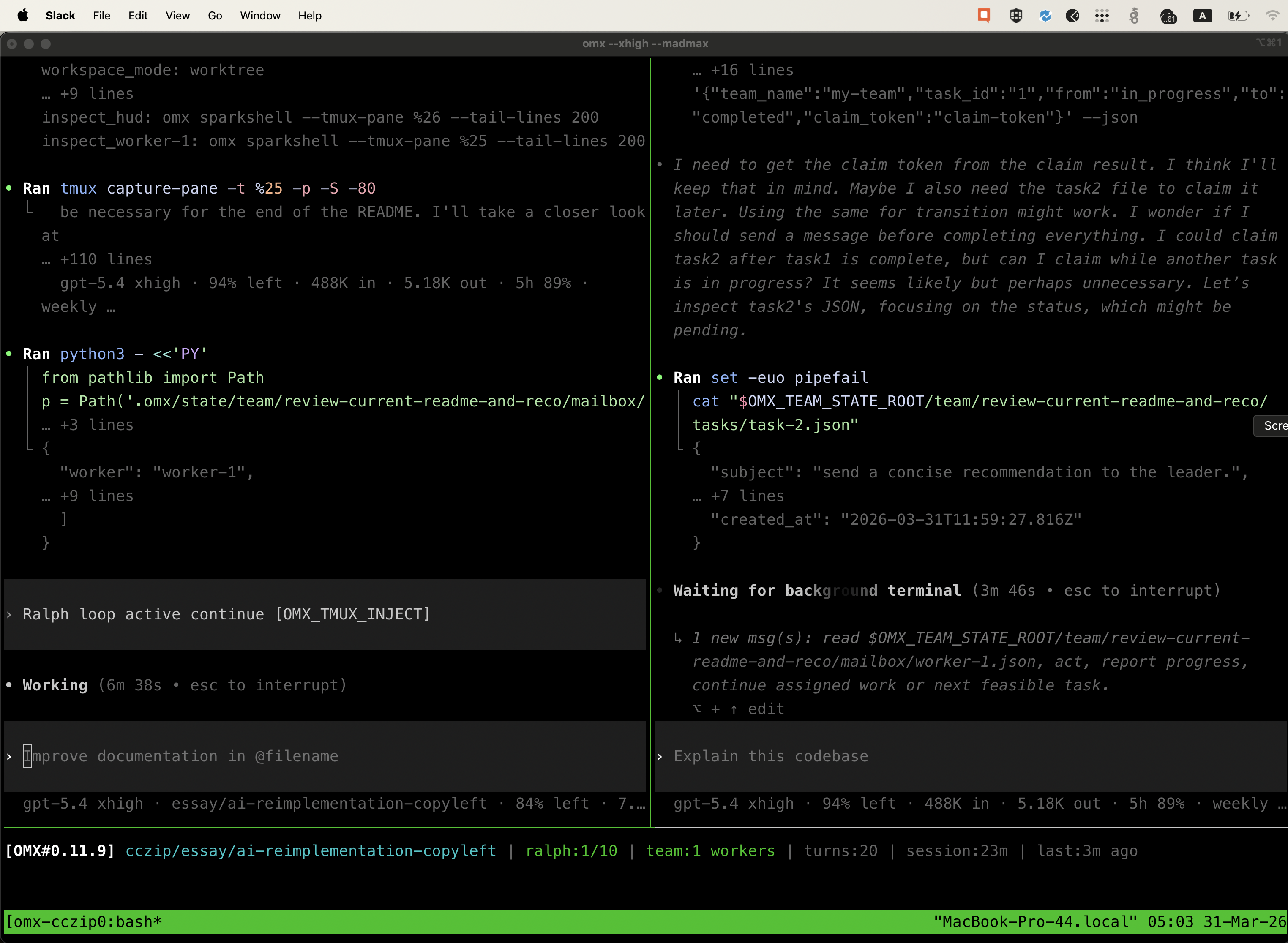
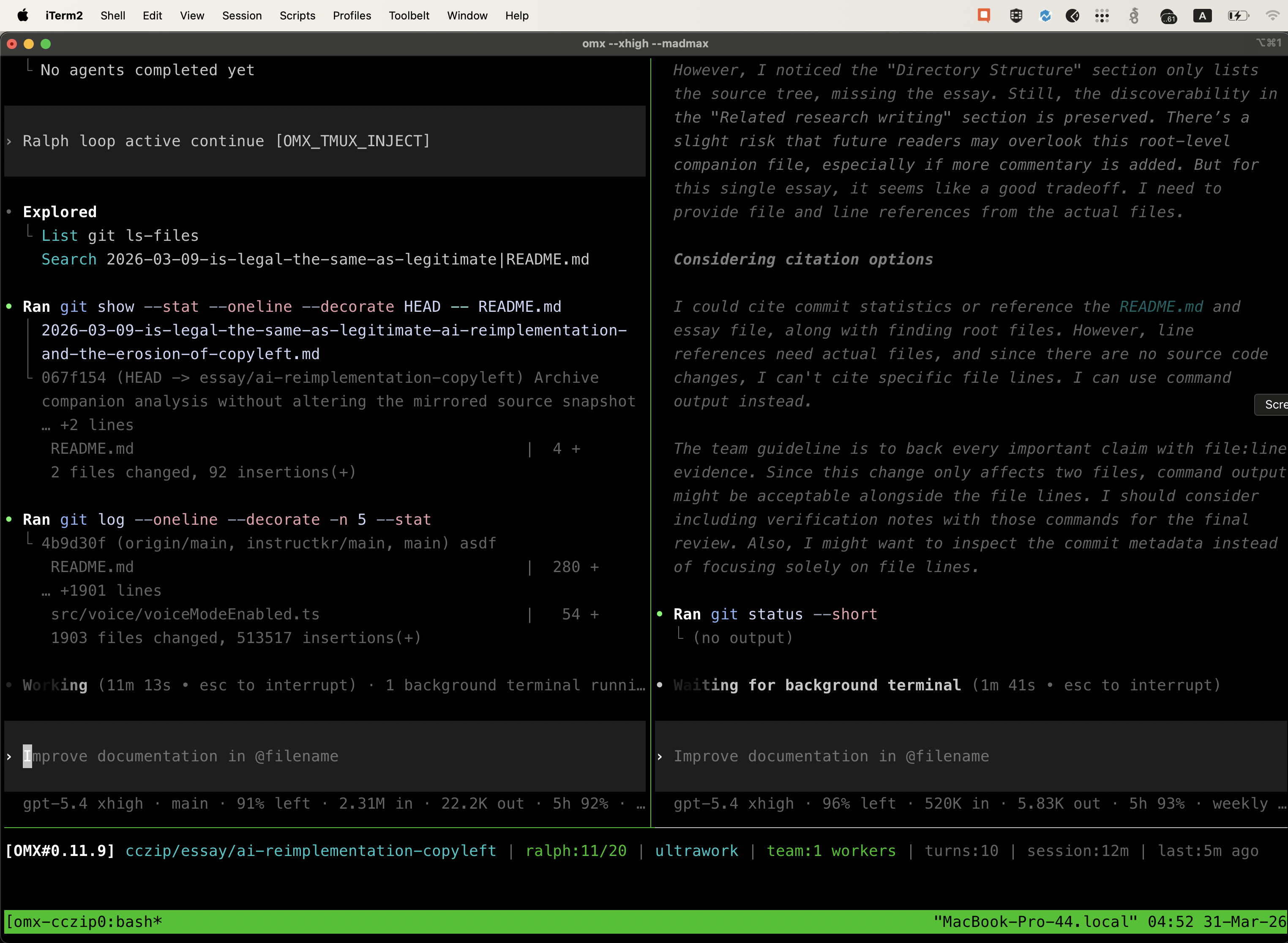
OmX workflow screenshots
Ralph/team orchestration view while the README and essay context were being reviewed in terminal panes.
Split-pane review and verification flow during the final README wording pass.
Community
Join the instructkr Discord — the best Korean language model community. Come chat about LLMs, harness engineering, agent workflows, and everything in between.
Star History
See the chart at the top of this README.
Ownership / Affiliation Disclaimer
This repository does not claim ownership of the original Claude Code source material.
This repository is not affiliated with, endorsed by, or maintained by Anthropic.
claw-code-parity (ultraworkers/claw-code-parity)
Choose a tag and it will appear here. With no tags selected, all catalog projects are shown.
Searching Database…
Choose a tag and it will appear here. With no tags selected, all catalog projects are shown.


 Project Claw Code 的对等移植项目——重建 Claude Code 编码工具框架,而作者选择不再跟踪其被泄露的快照。声明目标是:证明一个开放的编码工具框架能够以高速、公开、自主的方式构建出来。