
What is this?
 A parity port of Project Claw Code — a rebuild of the Claude Code coding harness whose exposed snapshot the author chose not to track. The stated goal: prove an open coding harness can be built autonomously, in public, at high velocity.
A parity port of Project Claw Code — a rebuild of the Claude Code coding harness whose exposed snapshot the author chose not to track. The stated goal: prove an open coding harness can be built autonomously, in public, at high velocity.So is this a coding agent I can actually use, or still a work-in-progress port?Right now it's a porting workspace, not a finished agent: the Python tree in src/ exposes a CLI (main.py) that renders porting manifests and summaries, while the active Rust workspace lives in rust/.
Right now it's a porting workspace, not a finished agent: the Python tree in src/ exposes a CLI (main.py) that renders porting manifests and summaries, while the active Rust workspace lives in rust/.How do I get started with it?Start with USAGE.md in rust/ for build, auth, CLI, session and parity-harness workflows; rust/README.md covers the crates. On the Python side the quickstart renders the porting summary, manifest, module list and verification.
Start with USAGE.md in rust/ for build, auth, CLI, session and parity-harness workflows; rust/README.md covers the crates. On the Python side the quickstart renders the porting summary, manifest, module list and verification.What do I need installed to run or hack on it?No requirements are spelled out. Since the repo mixes a Rust workspace (rust/, with its own Rust CI) and a Python porting tree (src/), you would need both toolchains to work across it.
No requirements are spelled out. Since the repo mixes a Rust workspace (rust/, with its own Rust CI) and a Python porting tree (src/), you would need both toolchains to work across it.Does the port actually behave like the original yet?Not yet: it mirrors the archived file surface, subsystem names and command/tool inventories, but is not runtime-equivalent — the Python tree has fewer executable runtime slices. The repo is also archived as temporary work while claw-code migrates.
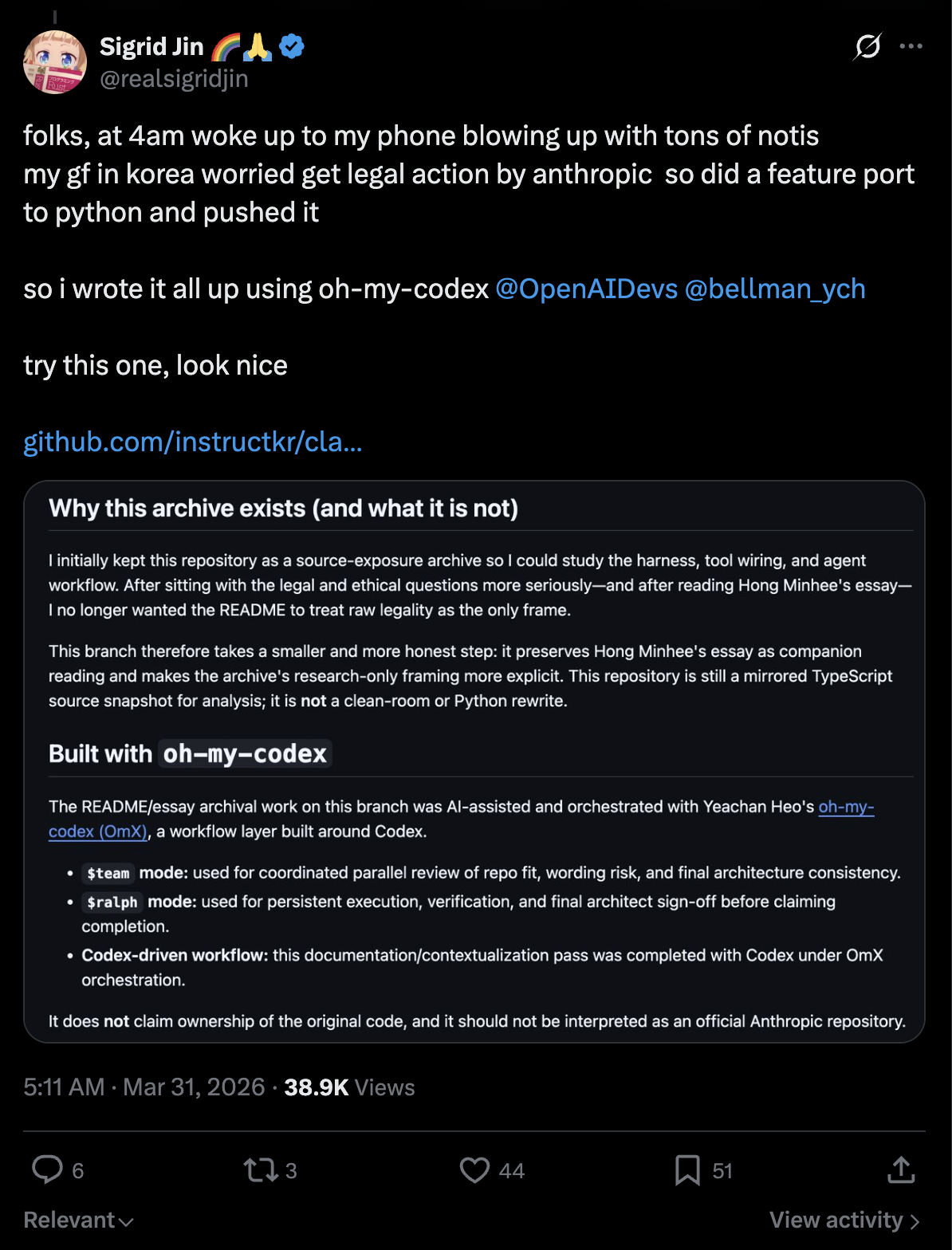
Not yet: it mirrors the archived file surface, subsystem names and command/tool inventories, but is not runtime-equivalent — the Python tree has fewer executable runtime slices. The repo is also archived as temporary work while claw-code migrates.Why not just use the exposed Claude Code source this came from?After weighing the legal and ethical questions (and reading an essay on the topic), the author did not want the exposed snapshot to remain the tracked source tree, so the repo pivoted to porting work instead.
After weighing the legal and ethical questions (and reading an essay on the topic), the author did not want the exposed snapshot to remain the tracked source tree, so the repo pivoted to porting work instead.Is this officially connected to Anthropic or Claude Code?No. The README states the repo does not claim ownership of the original Claude Code source material and is not affiliated with, endorsed by, or maintained by Anthropic.
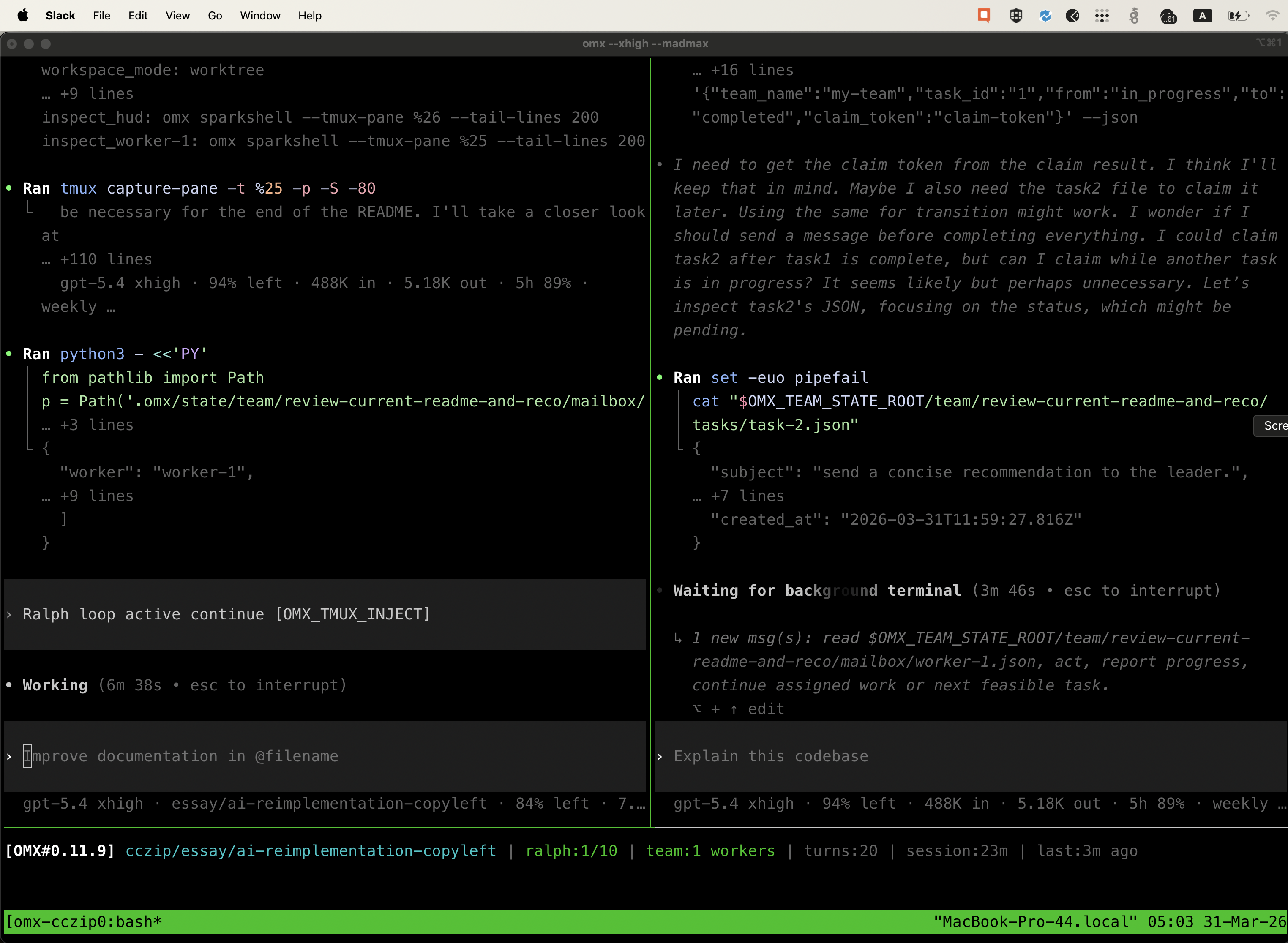
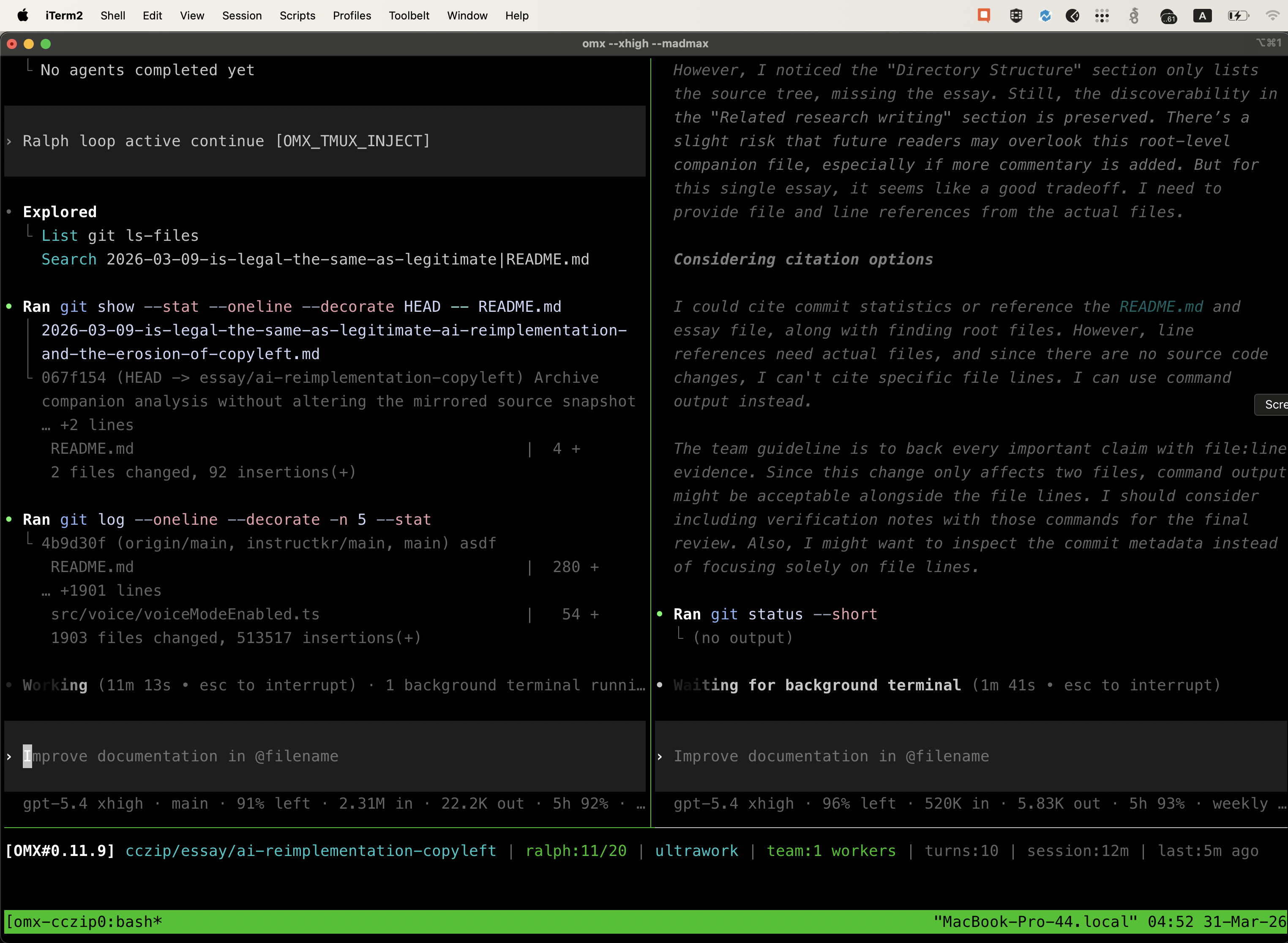
No. The README states the repo does not claim ownership of the original Claude Code source material and is not affiliated with, endorsed by, or maintained by Anthropic.If humans are not writing the code, who is?Autonomous claw workflows (lobsters/claws): parallel coding sessions, event-driven orchestration, recovery loops and machine-readable lane state. Humans like Bellman / Yeachan Heo set direction; restructuring and docs were orchestrated with oh-my-codex (OmX) on top of Codex.
Autonomous claw workflows (lobsters/claws): parallel coding sessions, event-driven orchestration, recovery loops and machine-readable lane state. Humans like Bellman / Yeachan Heo set direction; restructuring and docs were orchestrated with oh-my-codex (OmX) on top of Codex.The description says a Rust port, but the README says Python-first — which is it?Both exist: the README banner points to an active Rust workspace in rust/, while Porting Status says the main source tree is now Python-first in src/. The two surfaces coexist during the migration.
Both exist: the README banner points to an active Rust workspace in rust/, while Porting Status says the main source tree is now Python-first in src/. The two surfaces coexist during the migration.What are similar projects?munder-difflin, openrig, hive, deer-flow, ruflo, OpenTrade-Agent, fractal, agentbox
munder-difflin, openrig, hive, deer-flow, ruflo, OpenTrade-Agent, fractal, agentboxWhich topics is it in?harness-engineering, harness, autonomous-agents, orchestration, multi-agent, developers, coding-agent, rust, codex, claude-code, automation, ai-agents
harness-engineering, harness, autonomous-agents, orchestration, multi-agent, developers, coding-agent, rust, codex, claude-code, automation, ai-agents