








16.6K ·GitHub
What is this?
 Trigger.dev is an open-source platform for building and deploying durable AI agents and workflows written in TypeScript, giving you long-running tasks with retries, queues, observability and elastic scaling.
Trigger.dev is an open-source platform for building and deploying durable AI agents and workflows written in TypeScript, giving you long-running tasks with retries, queues, observability and elastic scaling.Is this a hosted service or a code library I add to my project?It is both: you write tasks in your codebase using the Trigger.dev JavaScript/TypeScript SDK, then deploy them to Trigger.dev's managed cloud (no infrastructure to manage) or to your own self-hosted instance.
It is both: you write tasks in your codebase using the Trigger.dev JavaScript/TypeScript SDK, then deploy them to Trigger.dev's managed cloud (no infrastructure to manage) or to your own self-hosted instance.How do I build and deploy my first task?Create an account and project in the Trigger.dev web app and follow the onboarding flow; you can have your first task built and deployed within minutes.
Create an account and project in the Trigger.dev web app and follow the onboarding flow; you can have your first task built and deployed within minutes.Can I self-host it instead of using the cloud service?Yes — Trigger.dev provides a Docker Compose self-hosting guide and an official Helm chart for deploying to a Kubernetes cluster if you don't want to use the managed cloud.
Yes — Trigger.dev provides a Docker Compose self-hosting guide and an official Helm chart for deploying to a Kubernetes cluster if you don't want to use the managed cloud.Can I write tasks in languages other than JavaScript/TypeScript?Tasks are written with the JS/TS SDK, but build extensions let you hook into the build process to run Python scripts, FFmpeg, browsers and other system packages inside a task.
Tasks are written with the JS/TS SDK, but build extensions let you hook into the build process to run Python scripts, FFmpeg, browsers and other system packages inside a task.Does it only work with serverless platforms like Vercel or AWS Lambda?No — a key selling point is that Trigger.dev tasks have no timeouts at all, unlike AWS Lambda, Vercel and other serverless platforms, so long-running AI agent jobs can run to completion.
No — a key selling point is that Trigger.dev tasks have no timeouts at all, unlike AWS Lambda, Vercel and other serverless platforms, so long-running AI agent jobs can run to completion.What actually makes a task 'durable' instead of just a regular background job?Checkpointing makes tasks inherently durable, and failed tasks are automatically retried on uncaught errors, so work survives crashes and transient failures.
Checkpointing makes tasks inherently durable, and failed tasks are automatically retried on uncaught errors, so work survives crashes and transient failures.Can a human intervene in the middle of an automated workflow?Yes, waitpoints let you pause a task so a human can approve, reject or give feedback before the workflow continues.
Yes, waitpoints let you pause a task so a human can approve, reject or give feedback before the workflow continues.Can I stream AI responses to my app's frontend in real time?Yes, Trigger.dev Realtime lets you subscribe to runs and stream LLM responses live, with a companion React hooks package for frontend integration.
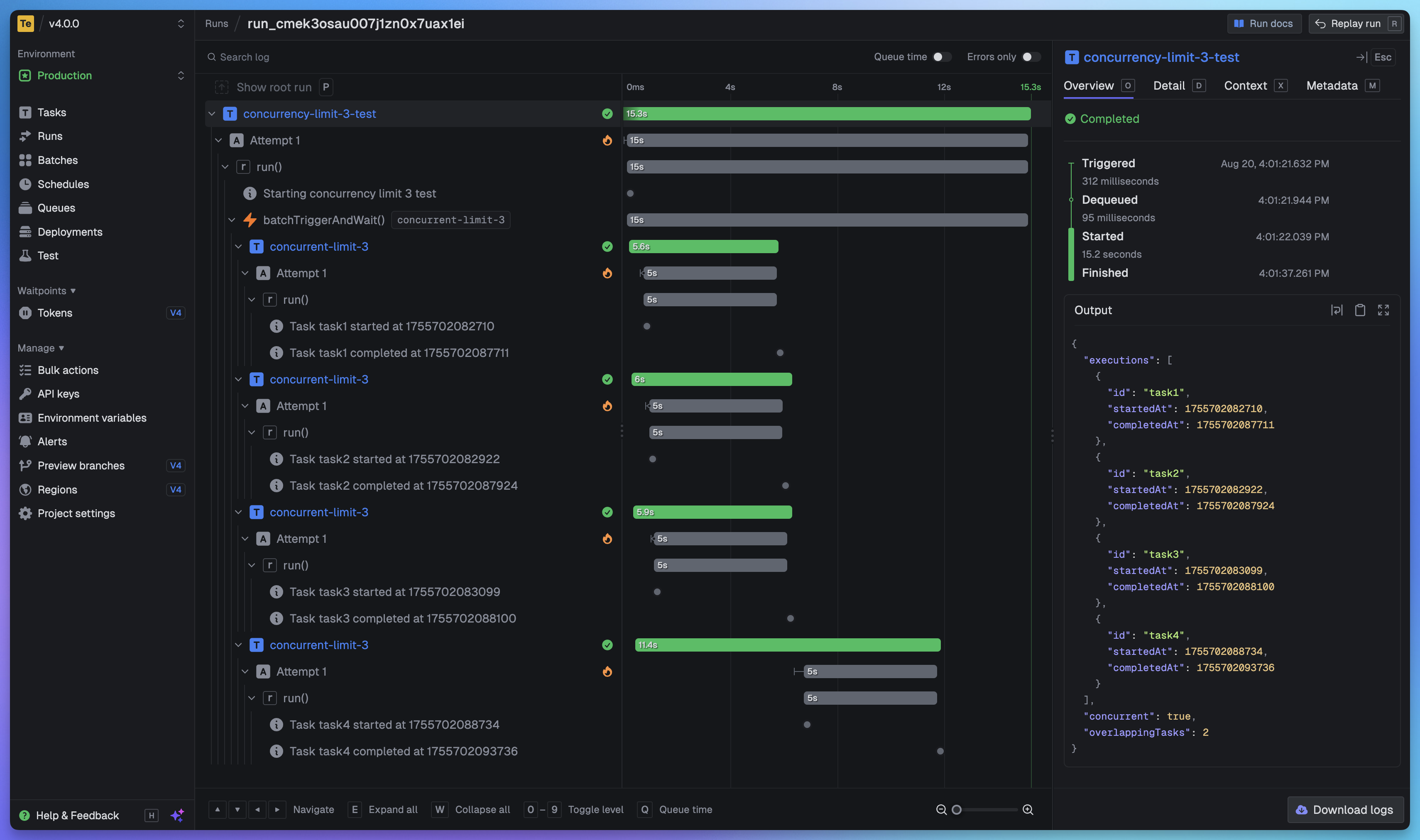
Yes, Trigger.dev Realtime lets you subscribe to runs and stream LLM responses live, with a companion React hooks package for frontend integration.How do I control concurrency and run multiple environments safely?You can set concurrency rules and queues per task, and the platform supports separate DEV, PREVIEW, STAGING and PROD environments so testing never collides with production runs.
You can set concurrency rules and queues per task, and the platform supports separate DEV, PREVIEW, STAGING and PROD environments so testing never collides with production runs.Which topics is it in?durable-execution, background-jobs, workflows, scheduler, serverless, workflow-automation, orchestration, observability, nextjs, kubernetes, sdk, monitoring
durable-execution, background-jobs, workflows, scheduler, serverless, workflow-automation, orchestration, observability, nextjs, kubernetes, sdk, monitoring