
FiraCode README

The project's README from github.com/tonsky/FiraCode. As one markdown file: README.md.

Fira Code: free monospaced font with programming ligatures

Fira Code

Read in Español | 简体中文 | 日本語 | Português brasileiro

Problem

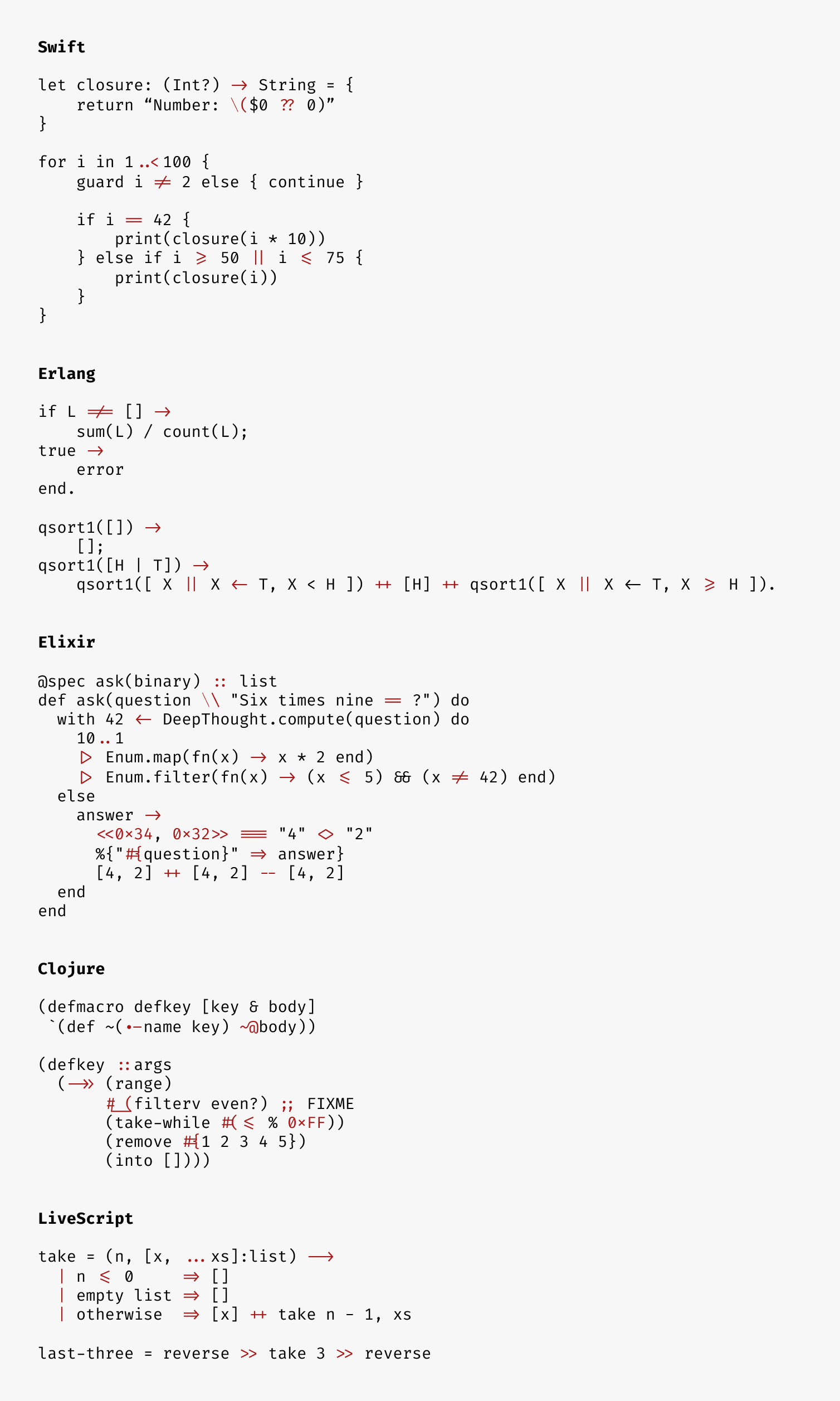
Programmers use a lot of symbols, often encoded with several characters. For the human brain, sequences like ->, <=, or := are single logical tokens, even if they take two or three characters on the screen. Your eye spends a non-zero amount of energy to scan, parse and join multiple characters into a single logical one. Ideally, all programming languages should be designed with full-fledged Unicode symbols for operators, but that’s not the case yet.

Solution

Fira Code is a free monospaced font containing ligatures for common programming multi-character combinations. This is just a font rendering feature: underlying code remains ASCII-compatible. This helps to read and understand code faster. For some frequent sequences like .. or //, ligatures allow us to correct spacing.

Download & Install

Fira_Code_v6.2.zip - December 6, 2021 - 2.5 MB

Then:

What’s in the box?

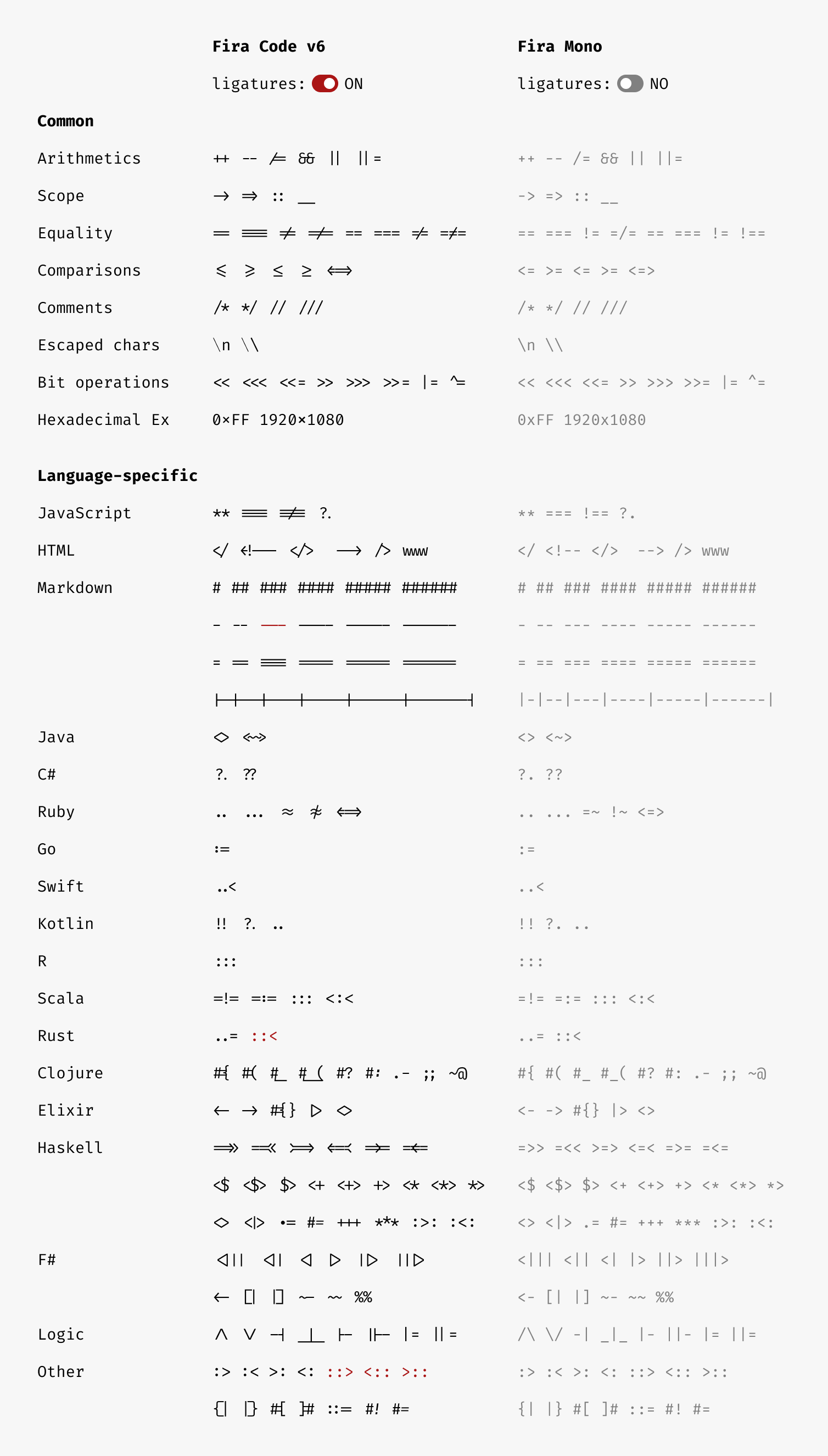
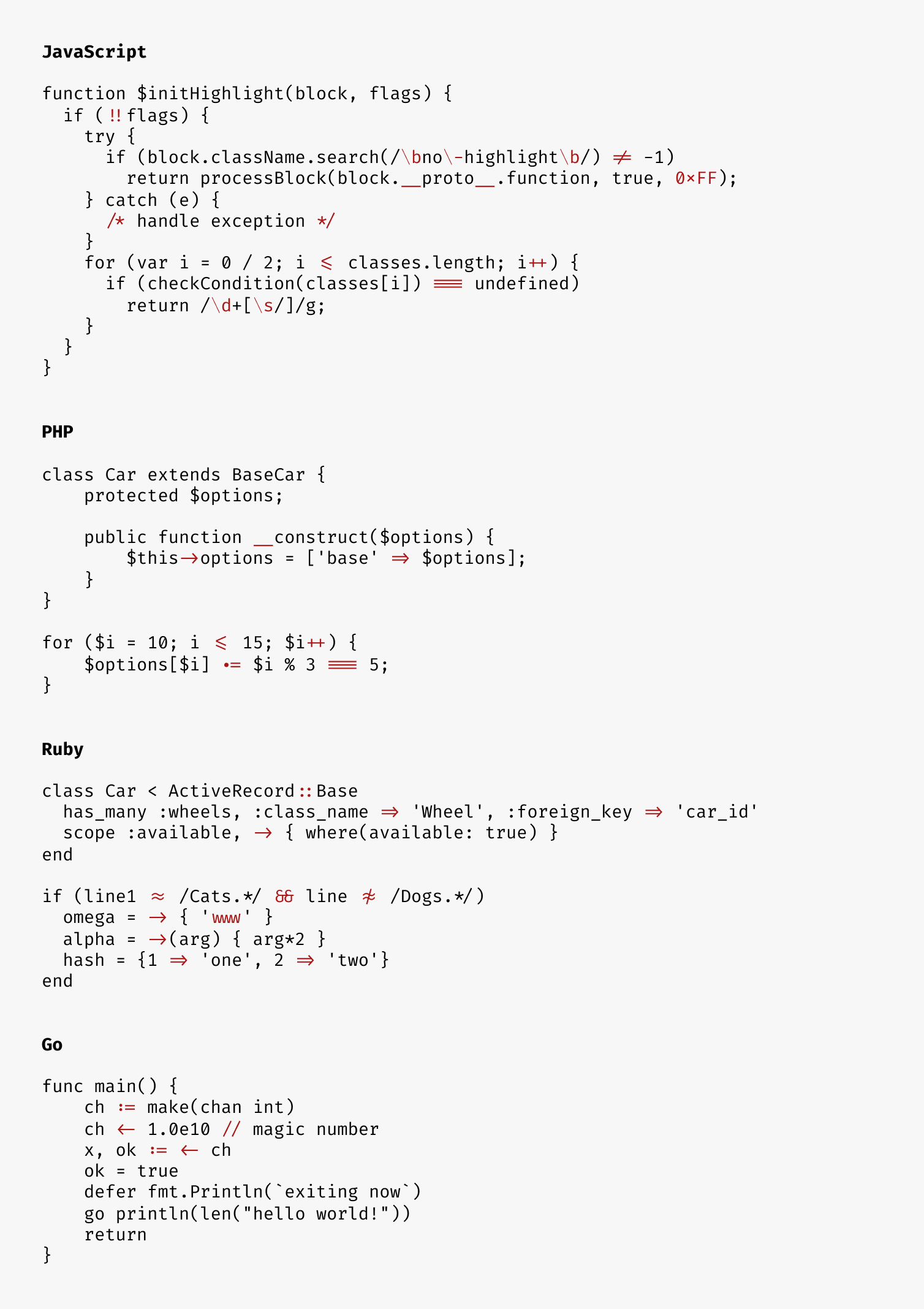
Left: ligatures as rendered in Fira Code. Right: same character sequences without ligatures.

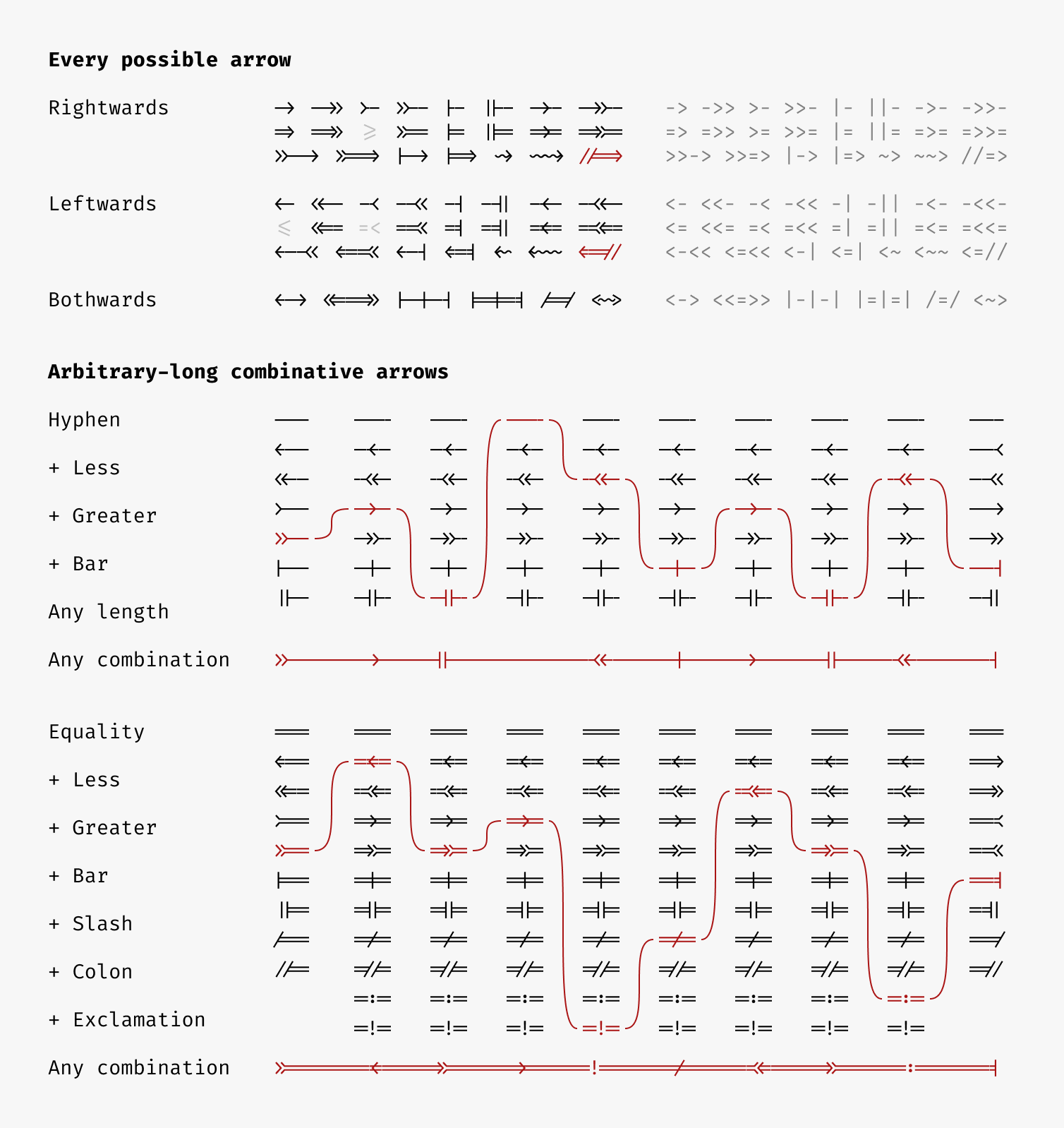
Fira Code comes with a huge variety of arrows. Even better: you can make them as long as you like and combine start/middle/end fragments however you want!

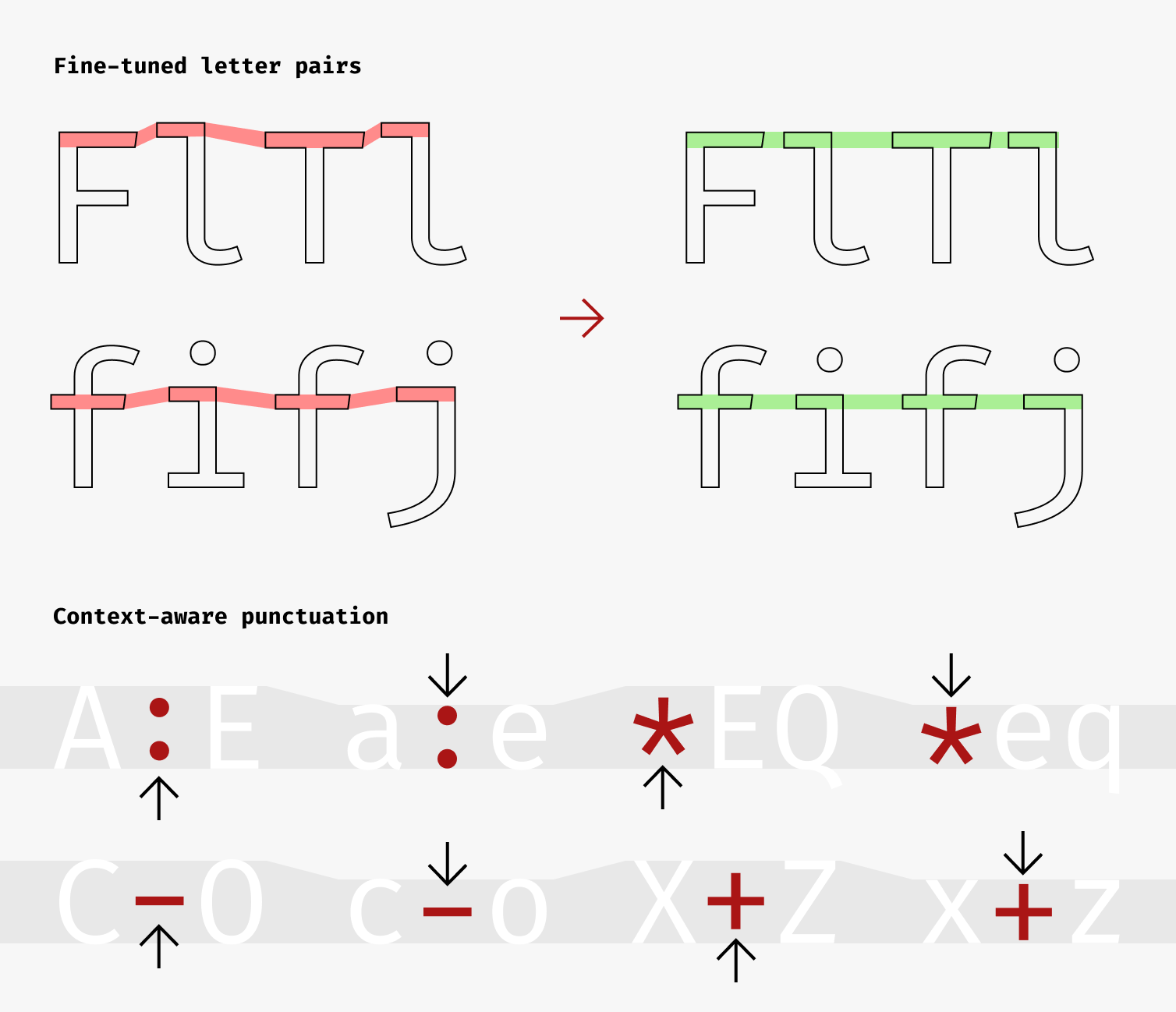
Fira Code is not only about ligatures. Some fine-tuning is done for punctuation and frequent letter pairs.

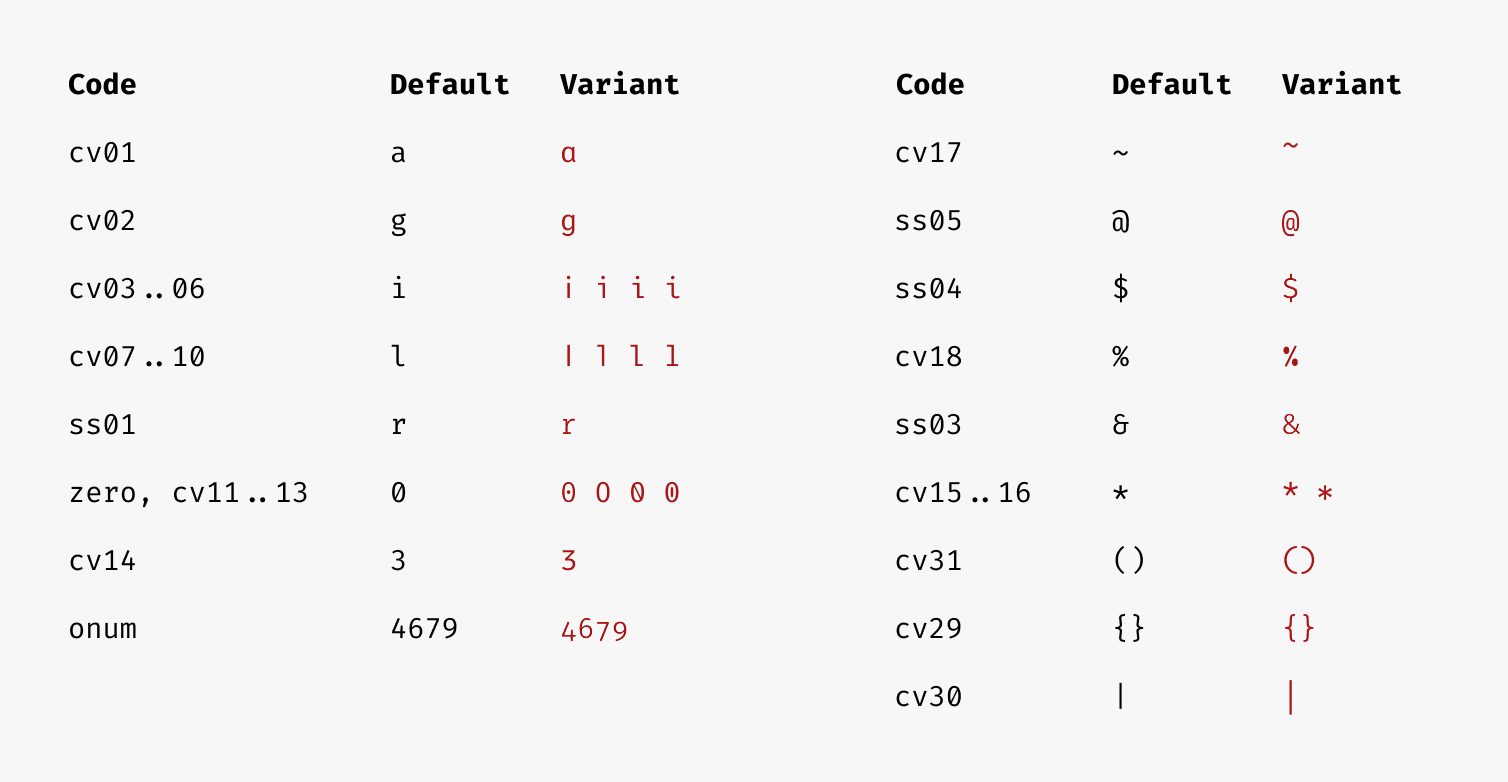
Fira Code comes with a few different character variants (cv01, cv02, etc), stylistic sets (ss01, ss02, etc), and other font features (zero, onum, calt, etc), so that everyone can choose what’s best for them. How to enable

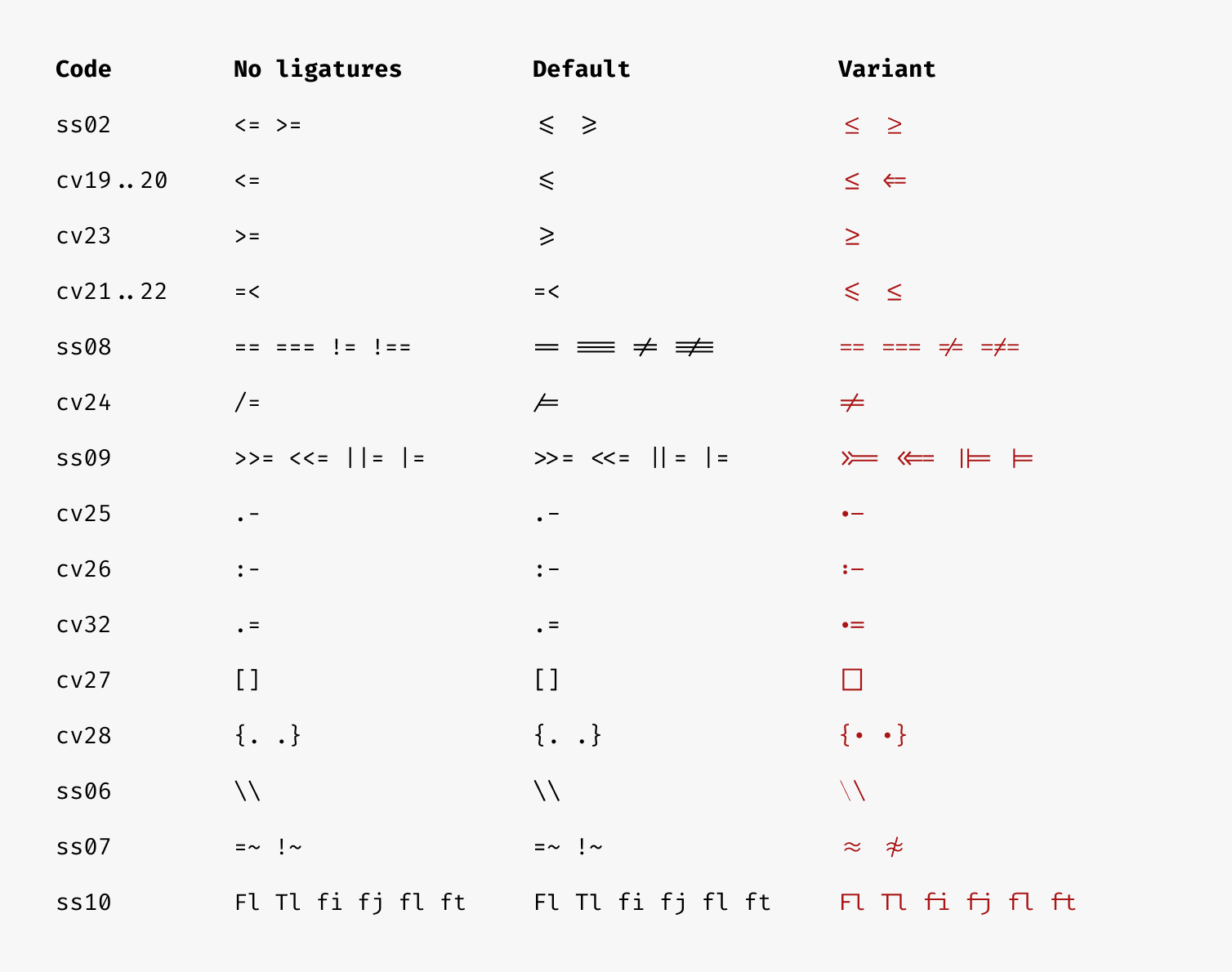
Some ligatures can be altered or enabled using stylistic sets/character variants:

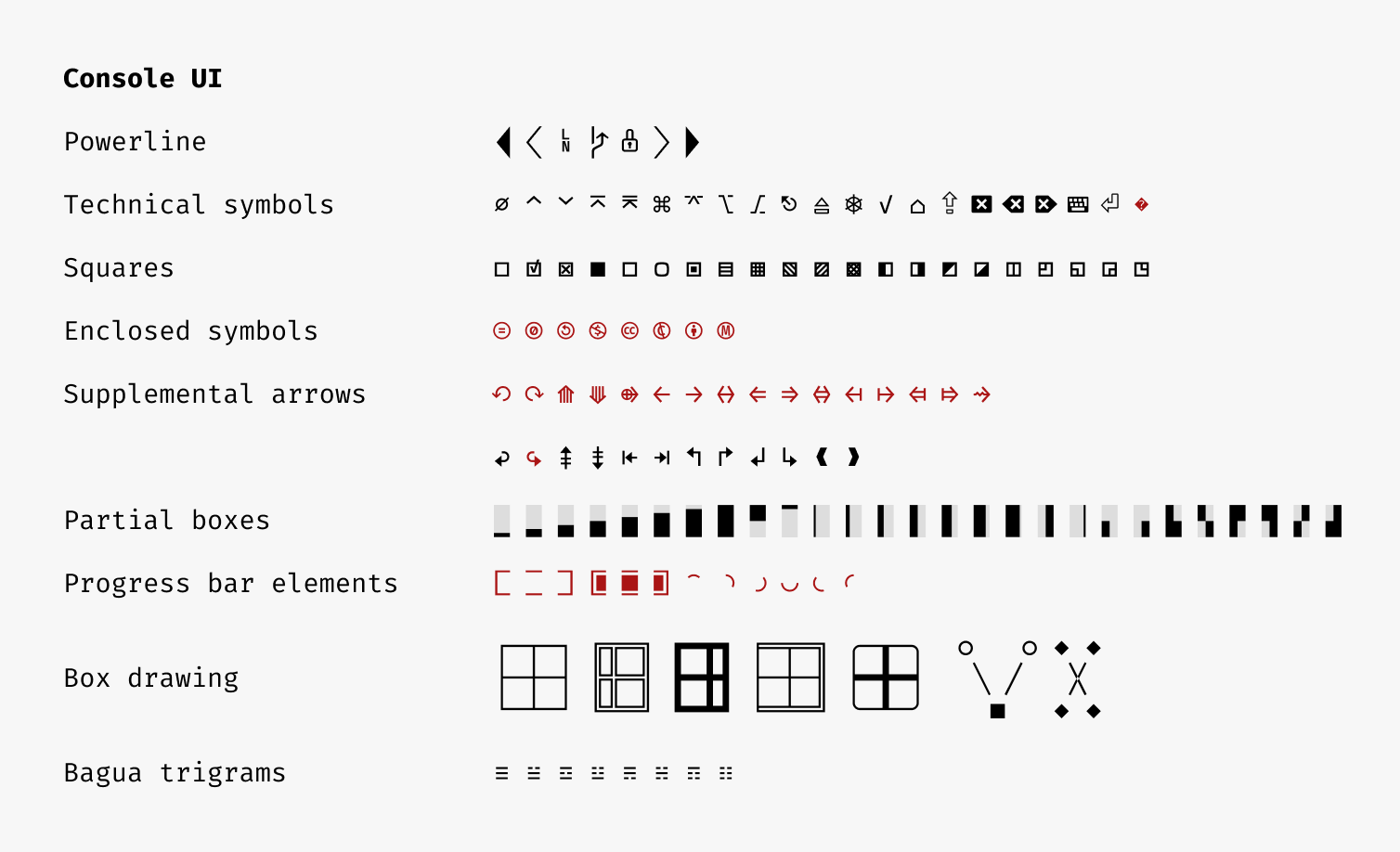
Being a programming font, Fira Code has fantastic support for ASCII/box drawing, powerline, and other forms of console UIs:

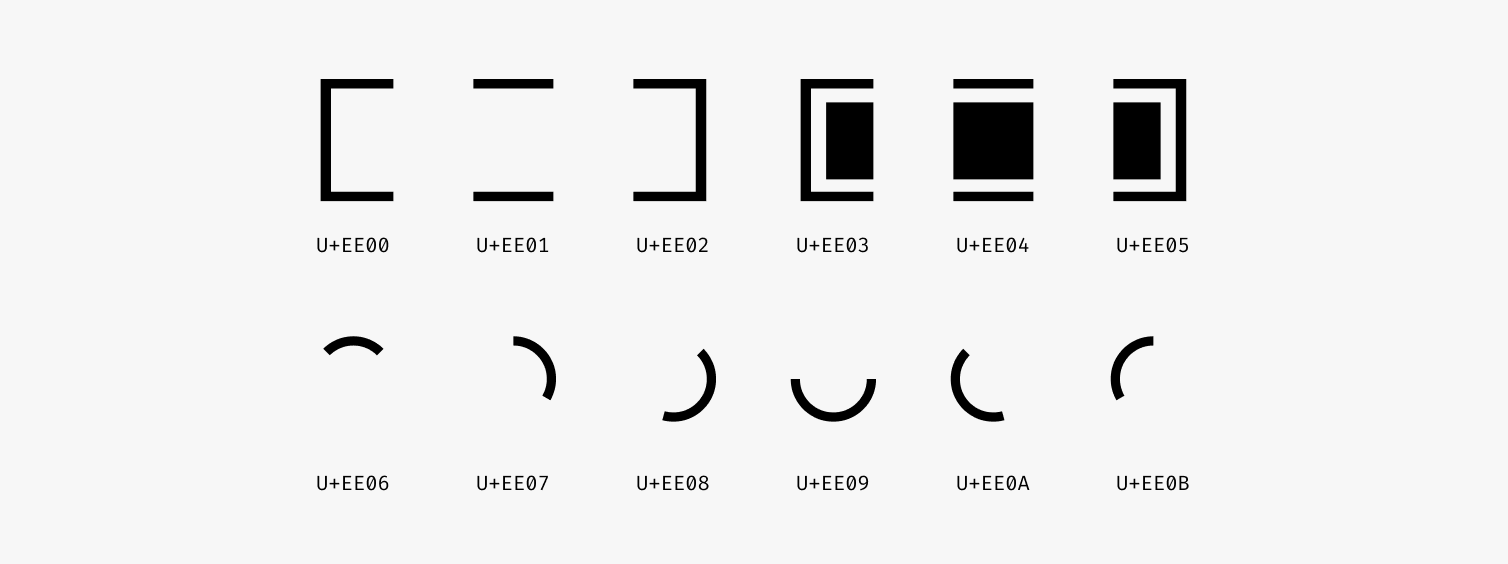
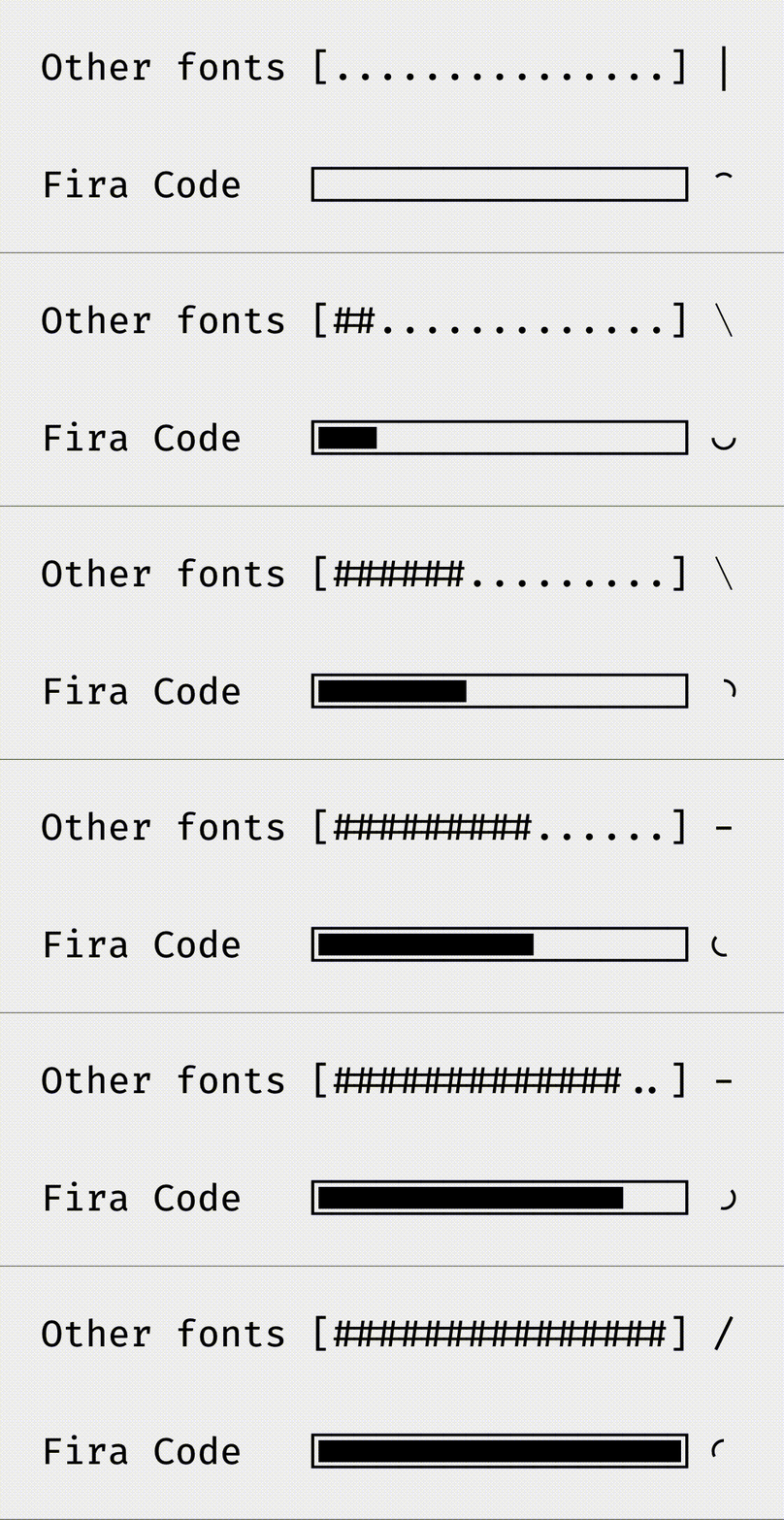
Fira Code is the first programming font to offer dedicated glyphs to render progress bars:

In action:

We hope more programming fonts will adopt this convention and ship their own versions. Implementation detail: there is no way for programs to detect whether a font has progress bar glyphs at U+EE00, so they need to decide what to output without knowing if it will be rendered properly or not. We propose a new environment variable, UNICODE_PROGRESS_BAR=true, to use as a heuristic. If present, it’s safe to assume U+EE00..EE0B will be rendered properly.

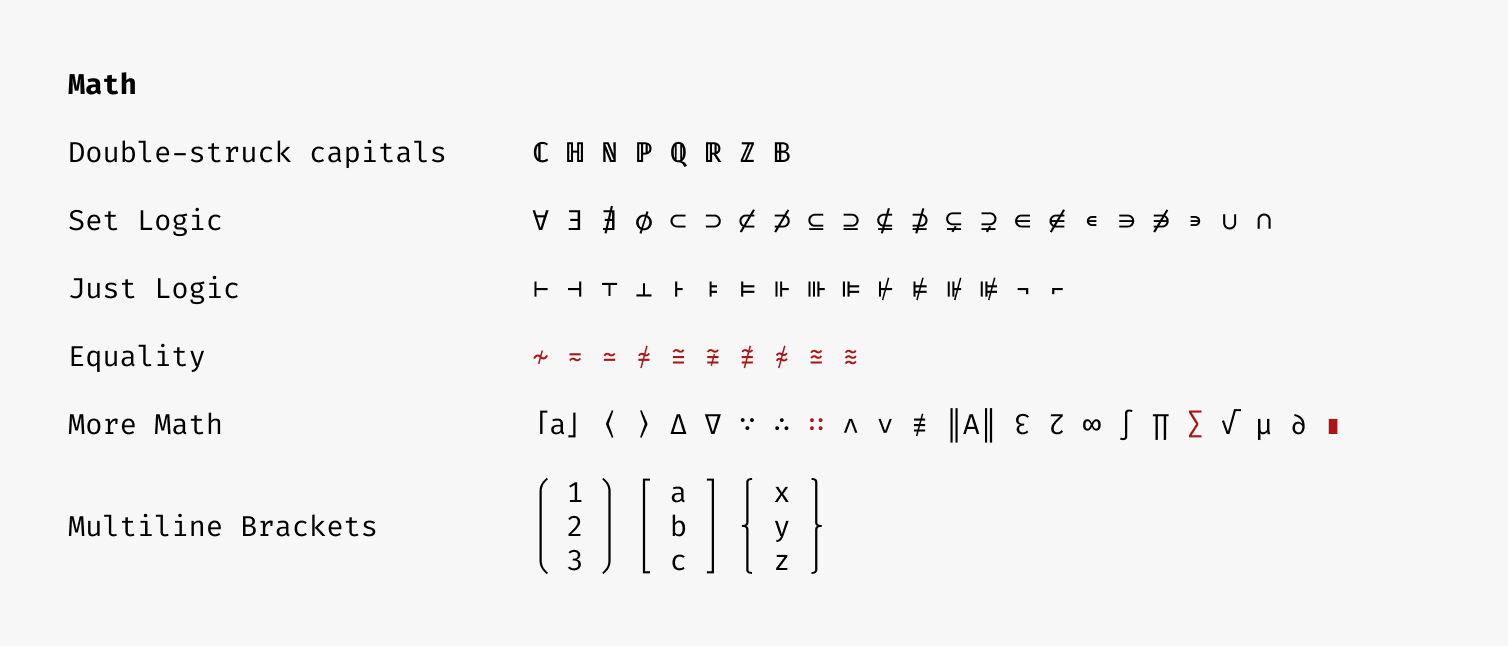
Unicode coverage makes Fira Code a great choice for mathematical writing:

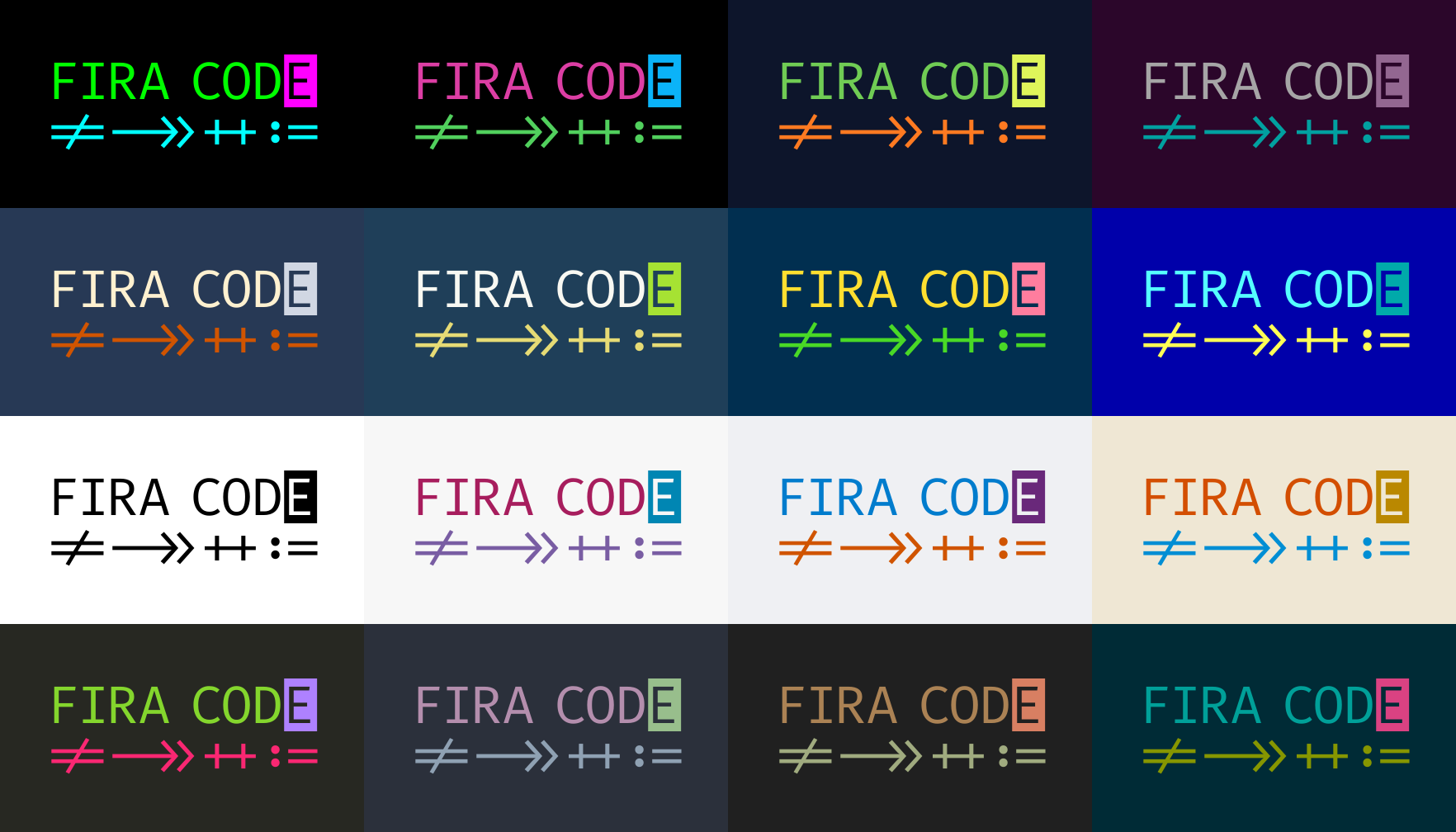
How does it look?

Editor compatibility list

Works Doesn’t work
Arduino IDE (2.0+,same instructions as vscode) Adobe Dreamweaver
Abricotine Delphi IDE
Android Studio (2.3+, instructions) Standalone Emacs (workaround)
Anjuta (unless at the EOF) IDLE
AppCode (2016.2+, instructions) KDevelop 4
Atom 1.1 or newer (instructions) Monkey Studio IDE
BBEdit (14.6+ instructions) UltraEdit (Windows)
Brackets (with this plugin)
Chocolat
CLion (2016.2+, instructions)
Cloud9 (instructions)
Coda 2
CodeLite
CodeRunner
Comma (Under: Preferences > Editor > Font)
CotEditor
Eclipse
EditPad
elementary Code
Geany (1.37+)
gEdit / Pluma
GNOME Builder
Godot
GoormIDE (instructions)
gVim (Windows, GTK)
IntelliJ IDEA (2016.2+, instructions)
Kate, KWrite
KDevelop 5+
Komodo
Leafpad
LibreOffice
LightTable (instructions)
LINQPad
MacVim 7.4 or newer (instructions)
Mancy
MATLAB (instructions)
Meld
Mousepad
NeoVim-gtk
NetBeans
Notepad (Windows)
Notepad++ (instructions)
Notepad3 (instructions)
Nova
PhpStorm (2016.2+, instructions)
PyCharm (2016.2+, instructions)
QOwnNotes (21.16.6+)
QtCreator
Rider
RStudio (instructions)
RubyMine (2016.2+, instructions)
Scratch
Scribus (1.5.3+)
SublimeText (3146+)
Spyder IDE (only with Qt5)
SuperCollider 3
TeXShop
TextAdept (Linux, macOS)
TextEdit
TextMate 2
UltraEdit (UEX) (Linux)
VimR (instructions)
Visual Studio (2015+, instructions)
Visual Studio Code (instructions)
WebStorm (2016.2+, instructions)
Xamarin Studio/Monodevelop
Xcode (8.0+, otherwise with plugin)
Xi
Probably work: Smultron, Vico Under question: Code::Blocks IDE
Zed (instructions)

Terminal compatibility list

Works Doesn’t work
crosh (instructions) Alacritty
Ghostty Asbru Connection Manager
Hyper (see #3607) Cmder
iTerm 2 ConEmu
Kitty GNOME Terminal (ticket)
Konsole gtkterm (ticket)
Mintty guake (ticket)
QTerminal LXTerminal (ticket)
st (patch) mate-terminal
Tabby PuTTY
Terminal.app rxvt
Termux sakura (ticket)
Token2Shell SecureCRT
Wez’s terminal Terminator (ticket)
Windows Terminal terminology
ZOC (macOS) Tilix
Windows Console
xfce4-terminal (ticket)
xterm
ZOC (Windows)

Browser support

<!-- HTML -->
<link rel="stylesheet" href="https://cdn.jsdelivr.net/npm/[email protected]/distr/fira_code.css">
/* CSS */
@import url(https://cdn.jsdelivr.net/npm/[email protected]/distr/fira_code.css);
/* Specify in CSS */
code { font-family: 'Fira Code', monospace; }

@supports (font-variation-settings: normal) {
  code { font-family: 'Fira Code VF', monospace; }
}

Projects using Fira Code

Alternatives

Free monospaced fonts with ligatures:

Paid monospaced fonts with ligatures:

Building Fira Code locally

In case you want to alter FiraCode.glyphs and build OTF/TTF/WOFF files yourself, this is the setup I use on macOS:

# install all required build tools
./script/bootstrap_macos.sh

# build the font files
./script/build.sh

# install OTFs to ~/Library/Fonts
cp distr/otf/*.otf ~/Library/Fonts

Alternatively, you can build Fira Code using Docker:

# install dependencies in a container and build the font files
make

# package the font files from dist/ into a zip
make package

If you want to permanently enable certain style sets or character variations, maybe because your editor of choice does not allow you to toggle these individually, you can provide the desired features as a comma separated list to the build script via the -f / --features flag.
Default: none.

To separate different versions of your font you can specify the desired font family name with the -n / --family-name flag. The special value 'features' will append a sorted, space separated list of enabled features to the default family name.
Default: "Fira Code"

You can also limit the font weights that will be created with the -w / --weights option.
Default: "Light,Regular,Retina,Medium,SemiBold,Bold"

# locally in your shell
./script/build.sh --features "ss02,ss08,ss10,cv03,cv07,cv14" --family-name "Fira Code straight" --weights "Regular,Bold"

# or via a docker container (creates the family name 'Fira Code cv01 cv02 cv06 cv31 onum ss01 ss03 ss04 zero')
docker run --rm -v "${PWD}":/opt tonsky/firacode:latest ./script/build.sh -f "cv01,cv02,cv06,ss01,zero,onum,ss03,ss04,cv31" -n "features"

# in Git Bash from Git for Windows, or any other MSYS2 based shell, you might need to disable path conversion
MSYS2_ARG_CONV_EXCL="*" docker run --rm -v "${PWD}":/opt tonsky/firacode:latest ./script/build.sh -f "ss02,ss03,ss04,ss05,ss06,ss07"

Credits

FiraCode (tonsky/FiraCode)

Searching Database…

82.1K ·GitHub
What is this?Fira Code is a free monospaced font designed for programmers, which uses ligatures to turn common multi-character symbol sequences (like -> or ==) into single, easier-to-read glyphs.
Is this a font file or a code editor plugin?It is just a font (based on Fira Mono) that you install on your system; ligature rendering is handled by your editor, terminal, or browser, not by the font installer itself.
How do I install and enable it?Download and install the font like any other font, then enable ligature support in your specific editor or terminal following its instructions; many apps need a setting like 'calt' or 'font-variant-ligatures: contextual' turned on.
Will ligatures work in any editor or terminal I use?No, support varies widely: many popular tools like IDLE, Dreamweaver, Alacritty, ConEmu, GNOME Terminal, and PuTTY don't render ligatures at all, so check the compatibility tables first.
Who is this font aimed at?Programmers who stare at symbol-heavy code and want common operator sequences to read more like a single visual unit.
Can I customize which stylistic sets or weights get built?Yes, the build script accepts a -f/--features flag for stylistic sets and character variants, and a -w/--weights flag to limit which weights (Light, Regular, Retina, Medium, SemiBold, Bold) are generated.
What is the progress bar feature?Fira Code is the first programming font to include dedicated glyphs at U+EE00-EE0B for rendering progress bars in terminal UIs, with a proposed UNICODEPROGRESSBAR environment variable as a detection heuristic.
Are there alternative fonts if Fira Code doesn't fit my needs?The README lists free alternatives like Hasklig, Iosevka, Cascadia Code, and JetBrains Mono, plus paid options like PragmataPro and Mono Lisa.
Does it work well for math or box-drawing characters?Yes, it has strong Unicode coverage for mathematical writing and dedicated support for ASCII/box drawing and powerline symbols used in console UIs.
Creator
tonsky
Size
88.5 MB
Stars
82.1K
Age
11y
Commits · 90 Days