







What is this?
 Quickwit is an open-source, cloud-native search engine built for observability - log management and distributed tracing - that runs sub-second search directly on cloud storage like S3.
Quickwit is an open-source, cloud-native search engine built for observability - log management and distributed tracing - that runs sub-second search directly on cloud storage like S3.Is this a database, a search engine, or something else?It is a standalone search engine server with decoupled compute and storage, stateless indexers and searchers, exposed through a RESTful API and an Elasticsearch-compatible API.
It is a standalone search engine server with decoupled compute and storage, stateless indexers and searchers, exposed through a RESTful API and an Elasticsearch-compatible API.How do I get it running?Follow the Quickstart guide to search and analyze a Stack Overflow dataset, or try trace analytics with Grafana or Jaeger; a Docker image and docker-compose setup are also provided.
Follow the Quickstart guide to search and analyze a Stack Overflow dataset, or try trace analytics with Grafana or Jaeger; a Docker image and docker-compose setup are also provided.Do I need Kafka or a cloud storage account to use it?Not strictly - it works with any object storage (S3, Azure Blob, GCS) for search, but high-availability indexing specifically requires a Kafka data source.
Not strictly - it works with any object storage (S3, Azure Blob, GCS) for search, but high-availability indexing specifically requires a Kafka data source.Is high availability fully supported for indexing too?No - HA is available for search, but HA indexing currently only works when using a Kafka source.
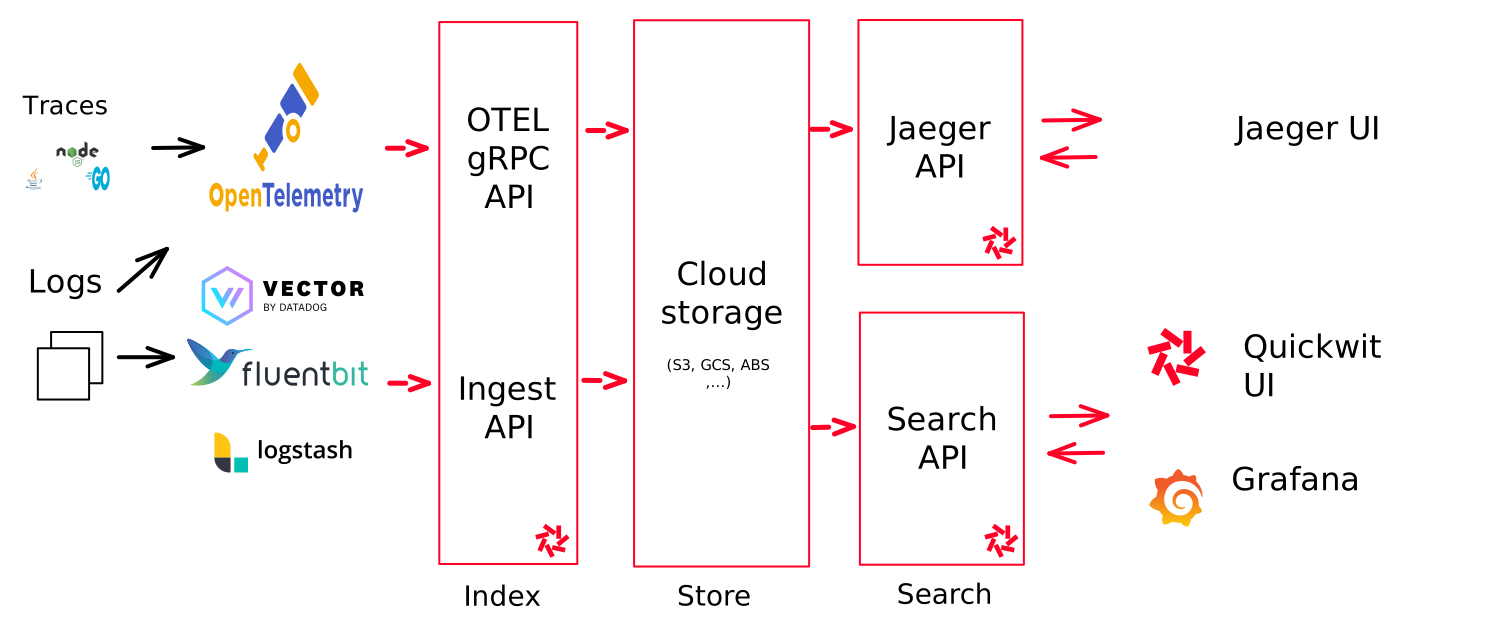
No - HA is available for search, but HA indexing currently only works when using a Kafka source.Can I just point my existing Elasticsearch/OpenSearch tooling at it?Yes, Quickwit supports a large subset of the Elasticsearch/OpenSearch API, including an ES-compatible ingest API, so log shippers like Vector, Fluent Bit, and Syslog can be redirected to it with minimal changes.
Yes, Quickwit supports a large subset of the Elasticsearch/OpenSearch API, including an ES-compatible ingest API, so log shippers like Vector, Fluent Bit, and Syslog can be redirected to it with minimal changes.How does Quickwit differ architecturally from Elasticsearch or Solr?Quickwit was built from the ground up to search directly on cloud storage, with optimized IO paths and revamped index data structures that make search stateless and sub-second, unlike traditional engines designed around local disk.
Quickwit was built from the ground up to search directly on cloud storage, with optimized IO paths and revamped index data structures that make search stateless and sub-second, unlike traditional engines designed around local disk.How much cheaper is Quickwit compared to Elastic?Quickwit estimates it can be up to 10x cheaper on average than Elastic, mainly due to its cloud-storage-native architecture that decouples compute from storage.
Quickwit estimates it can be up to 10x cheaper on average than Elastic, mainly due to its cloud-storage-native architecture that decouples compute from storage.What data sources can feed into Quickwit?It natively supports multiple data sources including Kafka, Kinesis, and Pulsar for ingestion, plus OTEL-native ingestion for logs and traces and Jaeger-native support.
It natively supports multiple data sources including Kafka, Kinesis, and Pulsar for ingestion, plus OTEL-native ingestion for logs and traces and Jaeger-native support.Does Quickwit support multi-tenancy and data retention policies?Yes, it offers multi-tenancy via indexing with many indexes and partitioning, configurable retention policies, and delete tasks for GDPR compliance use cases.
Yes, it offers multi-tenancy via indexing with many indexes and partitioning, configurable retention policies, and delete tasks for GDPR compliance use cases.What are similar projects?openobserve, OpenSearch, vector, elasticsearch, signoz, xerj, encore, qdrant
openobserve, OpenSearch, vector, elasticsearch, signoz, xerj, encore, qdrantWhich topics is it in?distributed-tracing, logs, cloud-storage, elasticsearch, search-engine, big-data, gpl, aws, cloud-native, observability, kubernetes, rest-api
distributed-tracing, logs, cloud-storage, elasticsearch, search-engine, big-data, gpl, aws, cloud-native, observability, kubernetes, rest-api