





PM Skills Marketplace: The AI Operating System for Better Product Decisions
68 PM skills and 42 chained workflows across 9 plugins. Claude Code, Cowork, and more. From discovery to strategy, execution, launch, growth, and shipping AI-built code.
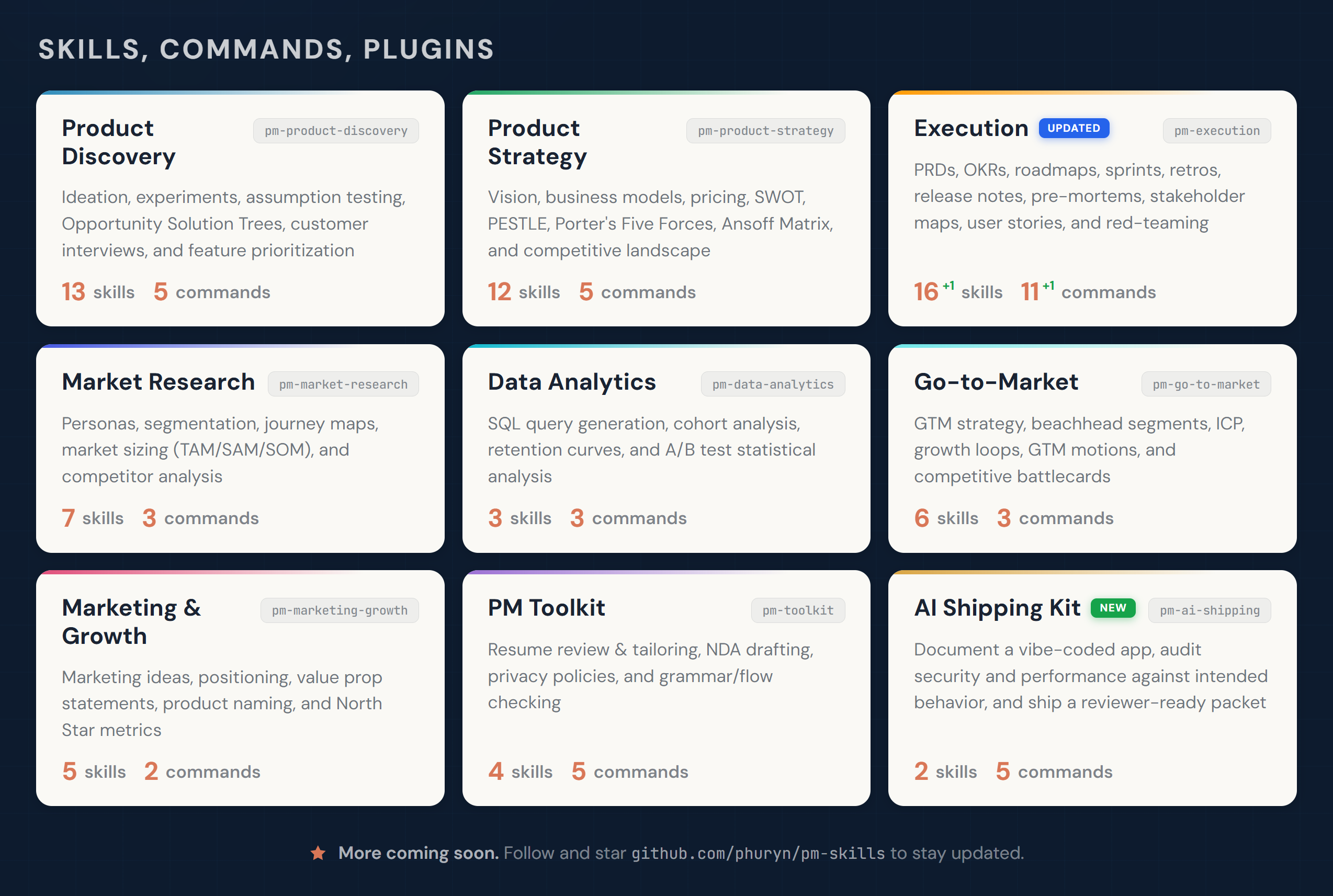
Designed for Claude Code and Cowork. Skills compatible with other AI assistants.
Start Here
New idea? → /discover
Need strategic clarity? → /strategy
Writing a PRD? → /write-prd
Planning a launch? → /plan-launch
Defining metrics? → /north-star
If this project helps you, ⭐ the repo.
Why PM Skills Marketplace?
Generic AI gives you text. PM Skills Marketplace gives you structure.
Each skill encodes a proven PM framework — discovery, assumption mapping, prioritization, strategy — and walks you through it step by step. You get the rigor of Teresa Torres, Marty Cagan, and Alberto Savoia built into your daily workflow, not sitting on a bookshelf.
The result: better product decisions, not just faster documents.
How It Works (Skills, Commands, Plugins)
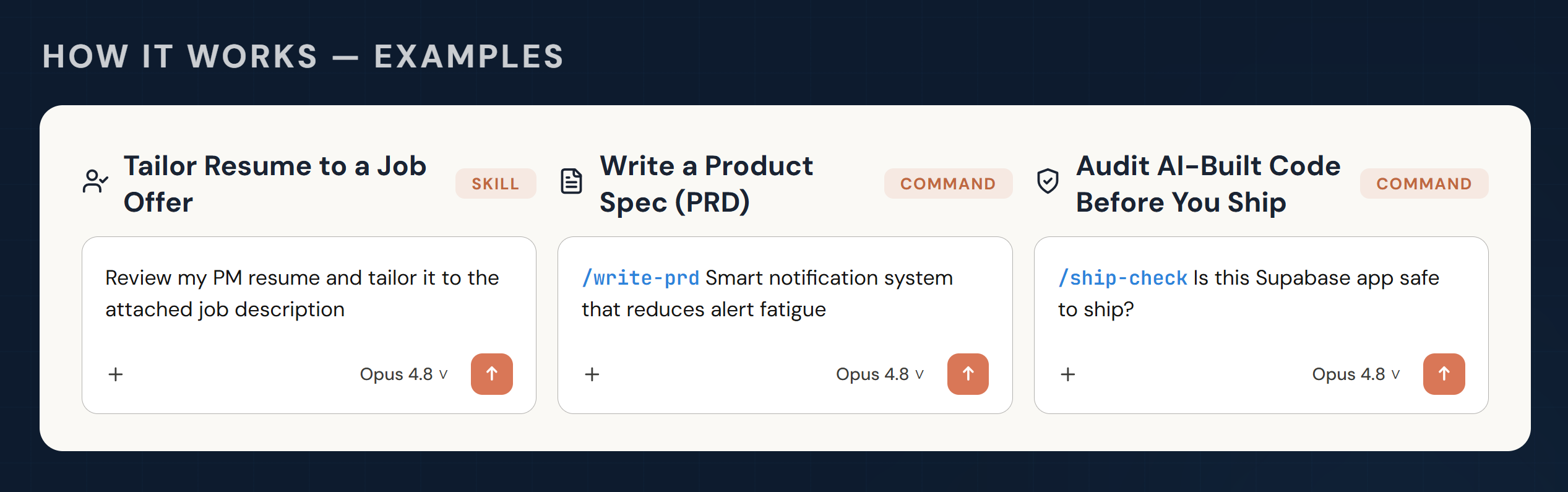
Skills are the building blocks of the marketplace. Each skill gives Claude domain knowledge, analytical frameworks, or a guided workflow for a specific PM task. Some skills also work as reusable foundations that multiple commands share.
Skills are loaded automatically when relevant to the conversation — no explicit invocation needed. If needed (e.g., prioritizing skills over general knowledge), you can force loading skills with /plugin-name:skill-name or /skill-name (Claude will add the prefix).
Commands are user-triggered workflows invoked with /command-name. They chain one or more skills into an end-to-end process. For example, /discover chains four skills together: brainstorm-ideas → identify-assumptions → prioritize-assumptions → brainstorm-experiments.
Plugins group related skills and commands into installable packages. Each plugin covers a PM domain — discovery, strategy, execution, and so on. Installing the marketplace gives you all 9 plugins at once.
Commands use skills. Some skills serve multiple commands. Some skills (like prioritization-frameworks or opportunity-solution-tree) are standalone references that Claude draws on whenever relevant — no command needed.
Commands are designed to flow into each other, matching the PM workflow. After any command completes, it suggests relevant next commands — just follow the prompts.
Installation
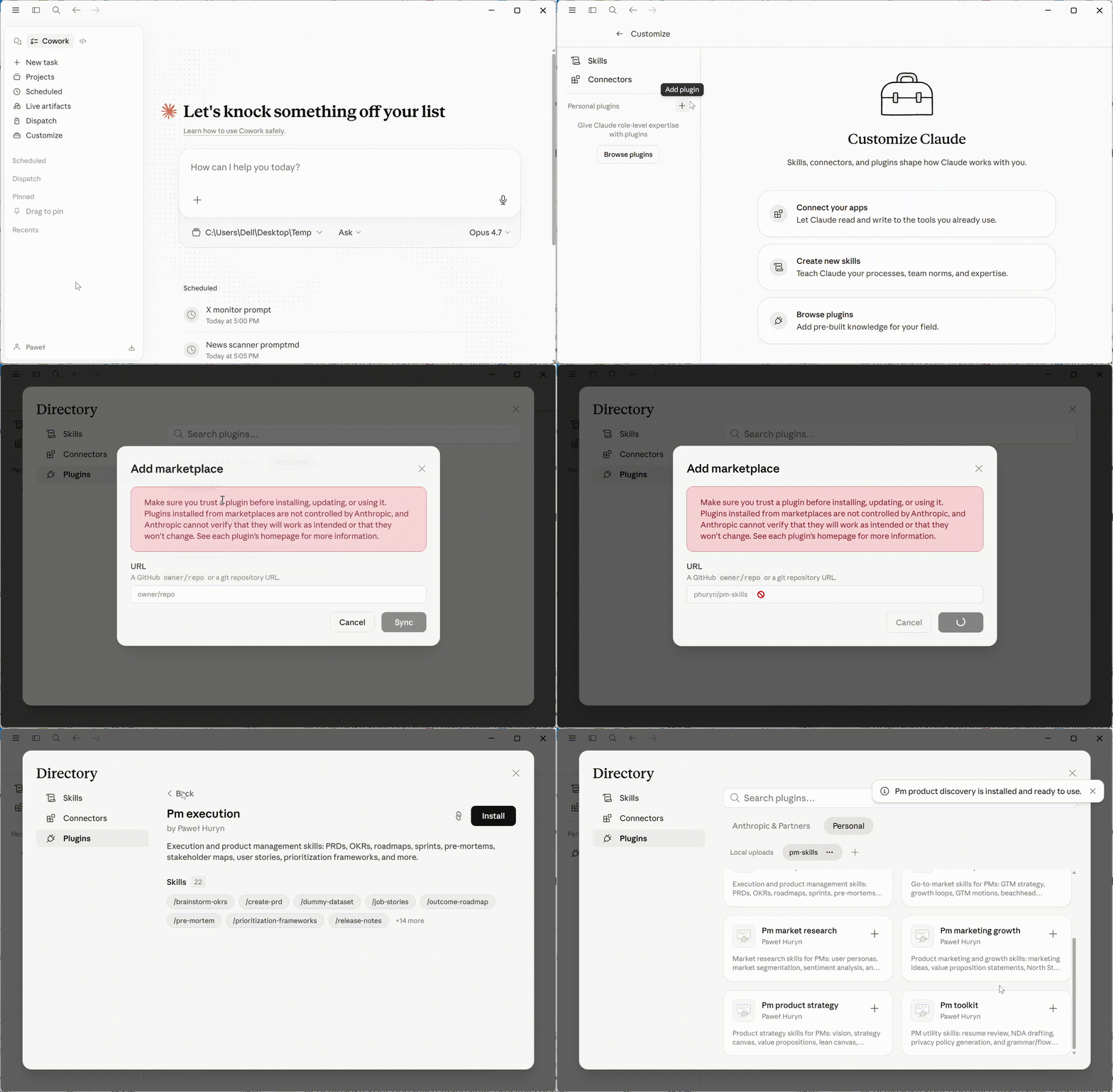
Claude Cowork (recommended for non-developers)
- Open Customize (bottom-left)
- Go to Browse plugins → Personal → +
- Select Add marketplace from GitHub
- Enter:
phuryn/pm-skills
All 9 plugins install automatically. You get both commands (/discover, /strategy, etc.) and skills.
Claude Code (CLI)
# Step 1: Add the marketplace
claude plugin marketplace add phuryn/pm-skills

# Step 2: Install individual plugins
claude plugin install pm-toolkit@pm-skills
claude plugin install pm-product-strategy@pm-skills
claude plugin install pm-product-discovery@pm-skills
claude plugin install pm-market-research@pm-skills
claude plugin install pm-data-analytics@pm-skills
claude plugin install pm-marketing-growth@pm-skills
claude plugin install pm-go-to-market@pm-skills
claude plugin install pm-execution@pm-skills
claude plugin install pm-ai-shipping@pm-skills
Codex CLI (OpenAI)
Codex reads the same plugin marketplace file as Claude Code, so you can install PM Skills natively — no conversion or file-copying needed:
# Step 1: Add the marketplace
codex plugin marketplace add phuryn/pm-skills

# Step 2: Install the plugins you want
codex plugin add pm-toolkit@pm-skills
codex plugin add pm-product-strategy@pm-skills
codex plugin add pm-product-discovery@pm-skills
codex plugin add pm-market-research@pm-skills
codex plugin add pm-data-analytics@pm-skills
codex plugin add pm-marketing-growth@pm-skills
codex plugin add pm-go-to-market@pm-skills
codex plugin add pm-execution@pm-skills
codex plugin add pm-ai-shipping@pm-skills
What you get: every skill (the PM frameworks), available to Codex and invocable by name. Install whole plugins rather than cherry-picking individual skills — a workflow usually relies on several skills that ship together.
What's different from Claude Code: the /slash commands (/discover, /write-prd, …) install but don't run as Codex slash commands — Codex plugins don't expose commands. To run a workflow, just describe the steps in plain language, for example:
Run product discovery on [your idea]: brainstorm options, map assumptions, prioritize the risky ones, then design experiments — pause between each step.
Optional — let Codex turn the workflows into skills. Because the command files ship inside each installed plugin, you can ask Codex to convert the ones you use most:
Read the command files in the pm-execution plugin and create equivalent Codex skills for the workflows I use most often.
This is a best-effort, model-driven conversion (some Claude-specific command syntax won't translate), but it's a quick way to get the guided workflows on Codex without leaving the CLI.
Other AI assistants (skills only)
The skills/*/SKILL.md files follow the universal skill format and work with any tool that reads it. Commands (/slash-commands) are Claude-specific.
| Tool |
How to use |
What works |
| Gemini CLI |
Copy skill folders to .gemini/skills/ |
Skills only |
| OpenCode |
Copy skill folders to .opencode/skills/ |
Skills only |
| Cursor |
Copy skill folders to .cursor/skills/ |
Skills only |
| Kiro |
Copy skill folders to .kiro/skills/ |
Skills only |
# Example: copy all skills for OpenCode (project-level)
for plugin in pm-*/; do
  mkdir -p .opencode/skills/
  cp -r "$plugin/skills/"* .opencode/skills/ 2>/dev/null
done

# Example: copy all skills for Gemini CLI (global)
for plugin in pm-*/; do
  cp -r "$plugin/skills/"* ~/.gemini/skills/ 2>/dev/null
done
Available Plugins
1. pm-product-discovery — Ideation, experiments, assumption testing, OSTs, interviews (13 skills, 5 commands)
Skills (13):
brainstorm-ideas-existing — Multi-perspective ideation for existing products (PM, Designer, Engineer)brainstorm-ideas-new — Ideation for new products in initial discoverybrainstorm-experiments-existing — Design experiments to test assumptions for existing productsbrainstorm-experiments-new — Design lean startup pretotypes for new products (Alberto Savoia)identify-assumptions-existing — Identify risky assumptions across Value, Usability, Viability, and Feasibilityidentify-assumptions-new — Identify risky assumptions across 8 risk categories including Go-to-Market, Strategy, and Teamprioritize-assumptions — Prioritize assumptions using an Impact × Risk matrix with experiment suggestionsprioritize-features — Prioritize a feature backlog based on impact, effort, risk, and strategic alignmentanalyze-feature-requests — Analyze and categorize customer feature requests by theme and strategic fitopportunity-solution-tree — Build an Opportunity Solution Tree (Teresa Torres) — outcome → opportunities → solutions → experimentsinterview-script — Create a structured customer interview script with JTBD probing questionssummarize-interview — Summarize an interview transcript into JTBD, satisfaction signals, and action itemsmetrics-dashboard — Design a product metrics dashboard with North Star, input metrics, and alert thresholds
Commands (5):
/discover — Full discovery cycle: ideation → assumption mapping → prioritization → experiment design/brainstorm — Multi-perspective ideation (ideas|experiments × existing|new)/triage-requests — Analyze and prioritize a batch of feature requests/interview — Prepare an interview script or summarize a transcript (prep|summarize)/setup-metrics — Design a product metrics dashboard
Examples:
Skills:
What are the riskiest assumptions for our AI writing assistant idea?Help me build an Opportunity Solution Tree for improving user activationPrioritize these 12 feature requests from our enterprise customers [attach CSV]
Commands:
/discover AI-powered meeting summarizer for remote teams/brainstorm experiments existing — We need to reduce churn in our onboarding flow/interview prep — We're interviewing enterprise buyers about their procurement workflow
2. pm-product-strategy — Vision, business models, pricing, competitive landscape (12 skills, 5 commands)
Product strategy, vision, business models, pricing, and macro environment analysis. Covers the full strategic toolkit from vision crafting through competitive landscape scanning.
Skills (12):
product-strategy — Comprehensive 9-section Product Strategy Canvas (vision → defensibility)startup-canvas — Startup Canvas combining Product Strategy (9 sections) + Business Model — an alternative to BMC and Lean Canvas for new productsproduct-vision — Craft an inspiring, achievable, and emotional product visionvalue-proposition — 6-part JTBD value proposition (Who, Why, What before, How, What after, Alternatives)lean-canvas — Lean Canvas business model for startups and new productsbusiness-model — Business Model Canvas with all 9 building blocksmonetization-strategy — Brainstorm 3–5 monetization strategies with validation experimentspricing-strategy — Pricing models, competitive analysis, willingness-to-pay, and price elasticityswot-analysis — SWOT analysis with actionable recommendationspestle-analysis — Macro environment: Political, Economic, Social, Technological, Legal, Environmentalporters-five-forces — Competitive forces analysis (rivalry, suppliers, buyers, substitutes, new entrants)ansoff-matrix — Growth strategy mapping across markets and products
Commands (5):
/strategy — Create a complete 9-section Product Strategy Canvas/business-model — Explore business models (lean|full|startup|value-prop|all)/value-proposition — Design a value proposition using the 6-part JTBD template/market-scan — Macro environment analysis combining SWOT + PESTLE + Porter's + Ansoff/pricing — Design a pricing strategy with competitive analysis and experiments
Examples:
Skills:
Compare Lean Canvas vs Business Model Canvas vs Startup Canvas for my marketplace startupDesign a value proposition for our AI writing assistant targeting non-native English speakersRun a Porter's Five Forces analysis for the project management SaaS market
Commands:
/strategy B2B project management tool for agencies/business-model startup — AI writing tool for non-native English speakers/value-proposition SaaS onboarding tool for enterprise customers
3. pm-execution — PRDs, OKRs, roadmaps, sprints, retros, release notes, stakeholder management (16 skills, 11 commands)
Day-to-day product management: PRDs, OKRs, roadmaps, sprints, retrospectives, release notes, pre-mortems, stakeholder management, user stories, and prioritization frameworks.
Skills (16):
create-prd — Comprehensive 8-section PRD templatebrainstorm-okrs — Team-level OKRs aligned with company objectivesoutcome-roadmap — Transform a feature list into an outcome-focused roadmapsprint-plan — Sprint planning with capacity estimation, story selection, and risk identificationretro — Structured sprint retrospective facilitationrelease-notes — User-facing release notes from tickets, PRDs, or changelogspre-mortem — Risk analysis with Tigers/Paper Tigers/Elephants classificationstakeholder-map — Power × Interest grid with tailored communication plansummarize-meeting — Meeting transcript → decisions + action itemsuser-stories — User stories following the 3 C's and INVEST criteriajob-stories — Job stories: When [situation], I want to [motivation], so I can [outcome]wwas — Product backlog items in Why-What-Acceptance formattest-scenarios — Test scenarios: happy paths, edge cases, error handlingdummy-dataset — Realistic dummy datasets as CSV, JSON, SQL, or Pythonprioritization-frameworks — Reference guide to 9 prioritization frameworks (Opportunity Score, ICE, RICE, MoSCoW, Kano, etc.)strategy-red-team — Adversarial stress-test of a plan: surface load-bearing assumptions, name what would make each one fail, and rank by cheapest test
Commands (11):
/write-prd — Create a PRD from a feature idea or problem statement/plan-okrs — Brainstorm team-level OKRs/transform-roadmap — Convert a feature-based roadmap into outcome-focused/sprint — Sprint lifecycle (plan|retro|release)/pre-mortem — Pre-mortem risk analysis on a PRD or launch plan/red-team-prd — Adversarially stress-test a PRD, roadmap, or strategy and rank the riskiest assumptions by cheapest test/meeting-notes — Summarize a meeting transcript into structured notes/stakeholder-map — Map stakeholders and create a communication plan/write-stories — Break features into backlog items (user|job|wwa)/test-scenarios — Generate test scenarios from user stories/generate-data — Create realistic dummy datasets
Examples:
Skills:
Which prioritization framework should I use for a 50-item backlog?Map our stakeholders for the platform migration projectWhat's the difference between Opportunity Score, ICE, and RICE?
Commands:
/write-prd Smart notification system that reduces alert fatigue/sprint retro — Here are the notes from our last sprint/write-stories job — Break down the "team dashboard" feature into job stories
4. pm-market-research — Personas, segmentation, journey maps, market sizing, competitor analysis (7 skills, 3 commands)
User research and competitive analysis: personas, segmentation, journey maps, market sizing, competitor analysis, and feedback analysis.
Skills (7):
user-personas — Create refined user personas from research datamarket-segments — Identify 3–5 customer segments with demographics, JTBD, and product fituser-segmentation — Segment users from feedback data based on behavior, JTBD, and needscustomer-journey-map — End-to-end journey map with stages, touchpoints, emotions, and pain pointsmarket-sizing — TAM, SAM, SOM with top-down and bottom-up approachescompetitor-analysis — Competitor strengths, weaknesses, and differentiation opportunitiessentiment-analysis — Sentiment analysis and theme extraction from user feedback
Commands (3):
/research-users — Build personas, segment users, and map the customer journey/competitive-analysis — Analyze the competitive landscape/analyze-feedback — Sentiment analysis and segment insights from user feedback
Examples:
Skills:
Estimate TAM/SAM/SOM for an AI code review tool in the US marketCreate a customer journey map for our e-commerce checkout flowSegment these survey respondents by behavior and needs [attach CSV]
Commands:
/research-users We have interview data from 12 users of our fitness app/competitive-analysis Figma competitors in the design tool space/analyze-feedback Here's 200 NPS responses from Q4 [attach file]
5. pm-data-analytics — SQL generation, cohort analysis, A/B test analysis (3 skills, 3 commands)
Data analytics for PMs: SQL query generation, cohort analysis, and A/B test analysis.
Skills (3):
sql-queries — Generate SQL from natural language (BigQuery, PostgreSQL, MySQL)cohort-analysis — Retention curves, feature adoption, and engagement trends by cohortab-test-analysis — Statistical significance, sample size validation, and ship/extend/stop recommendations
Commands (3):
/write-query — Generate SQL queries from natural language/analyze-cohorts — Cohort analysis on user engagement data/analyze-test — Analyze A/B test results
Examples:
Skills:
How large a sample do I need for 95% confidence with a 2% MDE?What retention metrics should I track for a subscription app?
Commands:
/write-query Show me monthly active users by country for Q4 2025 (BigQuery)/analyze-test Here are the results from our checkout flow A/B test [attach CSV]/analyze-cohorts Weekly retention for users who signed up in January vs February
6. pm-go-to-market — Beachhead segments, ICPs, messaging, growth loops, GTM motions, battlecards (6 skills, 3 commands)
Go-to-market strategy: beachhead segments, ideal customer profiles, messaging, growth loops, GTM motions, and competitive battlecards.
Skills (6):
gtm-strategy — Full GTM strategy: channels, messaging, success metrics, and launch planbeachhead-segment — Identify the first beachhead market segmentideal-customer-profile — ICP with demographics, behaviors, JTBD, and needsgrowth-loops — Design sustainable growth loops (flywheels)gtm-motions — Evaluate GTM motions and tools (product-led, sales-led, etc.)competitive-battlecard — Sales-ready battlecard with objection handling and win strategies
Commands (3):
/plan-launch — Full GTM strategy from beachhead to launch plan/growth-strategy — Design growth loops and evaluate GTM motions/battlecard — Create a competitive battlecard
Examples:
Skills:
What's the best beachhead segment for a developer productivity tool?Design a growth loop for a B2B SaaS with a freemium tierDefine our ICP for an AI-powered HR screening platform
Commands:
/plan-launch AI code review tool targeting mid-size engineering teams/battlecard Our CRM vs Salesforce for the SMB market/growth-strategy Two-sided marketplace for connecting freelancers with startups
7. pm-marketing-growth — Marketing ideas, positioning, value props, naming, North Star metrics (5 skills, 2 commands)
Product marketing and growth: marketing ideas, positioning, value proposition statements, product naming, and North Star metrics.
Skills (5):
marketing-ideas — Creative

 A marketplace of product-management skills for AI assistants: 68 PM skills and 42 chained workflows across 9 plugins, covering discovery, strategy, execution, launch, and growth. You install it into Claude Code or Cowork and run guided PM workflows on demand.