
22.2K ·GitHub
What is this?
 OSSU Data Science is a free, self-taught curriculum that mirrors an undergraduate degree in data science, built from MOOCs offered by top universities, covering everything from intro programming through machine learning and a final project.
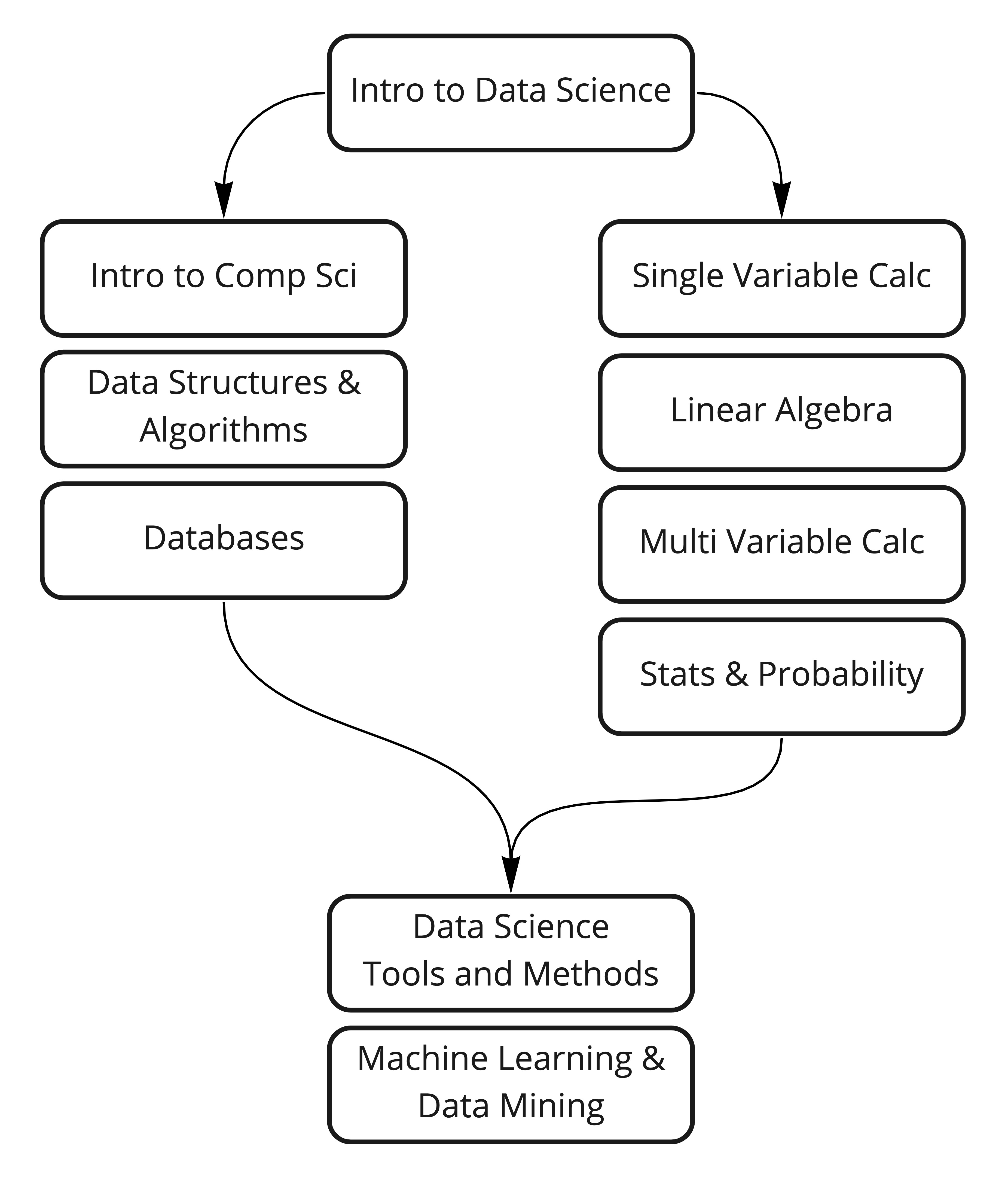
OSSU Data Science is a free, self-taught curriculum that mirrors an undergraduate degree in data science, built from MOOCs offered by top universities, covering everything from intro programming through machine learning and a final project.Is this a single course or a list of courses?It's a curated sequence of MOOCs grouped into topics (Intro to CS, Data Structures, Databases, Calculus, Linear Algebra, Statistics, Machine Learning, and a final project) that you work through roughly in order, with some topics done in parallel.
It's a curated sequence of MOOCs grouped into topics (Intro to CS, Data Structures, Databases, Calculus, Linear Algebra, Statistics, Machine Learning, and a final project) that you work through roughly in order, with some topics done in parallel.How do I actually follow this guide?Fork the GitHub repo and mark off topics with a checkmark as you finish them to track progress; there's also an optional spreadsheet where you enter your start date and weekly study hours to estimate a finish date.
Fork the GitHub repo and mark off topics with a checkmark as you finish them to track progress; there's also an optional spreadsheet where you enter your start date and weekly study hours to estimate a finish date.Do I need any prior programming or math knowledge to start?You're expected to have high-school-level math and statistics; if you already know basic programming you can skip the introductory CS course and go straight into Data Structures and Algorithms.
You're expected to have high-school-level math and statistics; if you already know basic programming you can skip the introductory CS course and go straight into Data Structures and Algorithms.Do I get an actual degree at the end?No, it's not accredited, but completing the full curriculum is described as equivalent in content to a bachelor's degree in Data Science.
No, it's not accredited, but completing the full curriculum is described as equivalent in content to a bachelor's degree in Data Science.How long does finishing this realistically take?It's designed to take about 2 years if you can commit roughly 20 hours per week to studying.
It's designed to take about 2 years if you can commit roughly 20 hours per week to studying.Is there a community for OSSU Data Science students?Yes, there's a Discord server where students introduce themselves and discuss progress, plus GitHub issues for asking questions.
Yes, there's a Discord server where students introduce themselves and discuss progress, plus GitHub issues for asking questions.What should I do after finishing the whole curriculum?The guide suggests looking for a data science job, reading classic books on the topic, joining local data science meetups, and keeping up with emerging technologies in the field.
The guide suggests looking for a data science job, reading classic books on the topic, joining local data science meetups, and keeping up with emerging technologies in the field.Is the curriculum content kept up to date?The GitHub repo is the only maintained source; the project warns that outdated third-party Trello boards and Notion templates exist and should be ignored.
The GitHub repo is the only maintained source; the project warns that outdated third-party Trello boards and Notion templates exist and should be ignored.Is there a tool to estimate my finish date?Yes, a shared spreadsheet lets you enter your start date and weekly study hours, then log actual course completions to get an updated end-date estimate.
Yes, a shared spreadsheet lets you enter your start date and weekly study hours, then log actual course completions to get an updated end-date estimate.What are similar projects?open-source-cs, awesome-datascience, AI-Expert-Roadmap, game-programmer, mlcourse.ai, machine-learning-for-software-engineers, go, stanford-cs-229-machine-learning
open-source-cs, awesome-datascience, AI-Expert-Roadmap, game-programmer, mlcourse.ai, machine-learning-for-software-engineers, go, stanford-cs-229-machine-learningWhich topics is it in?study-plan, online-learning, university, roadmap, mathematics, statistics, data-analysis, curriculum, course, career, computer-science, data-science
study-plan, online-learning, university, roadmap, mathematics, statistics, data-analysis, curriculum, course, career, computer-science, data-science