
English |
简体中文 |
繁體中文 |
Español |
Français |
Bahasa Indonesia |
日本語 |
한국어 |
Русский |
Tiếng Việt








nanoMuse is an open-source personal agent for every device you own. One agent with a name and a look of its own, in the style of Meta's Muse: it does things instead of answering questions, keeps working while the app is closed, remembers you, and stops to ask before anything you could not undo.
nano means the whole set, small enough to run and deploy yourself: the phone app, the desktop app, the web console and the relay that joins them are all in this repository, under GPL-3.0-or-later. Free, open source, non-profit. Let's build it together. Sign in and you get a free allowance of model use on the community relay (the developer pays for it); when it is gone, use your own key. The same relay runs on a server of yours, so nothing has to leave your house. Latest: 0.1.41 Choice, release notes · try it in the browser.
https://github.com/user-attachments/assets/c7694d5a-9450-4f99-9254-5d70560d7565
English · 中文 · nanomuse.cn
🗞️ News
2026-10-07 📄 Our paper is available on arXiv.2026-10-07 🚀 Latest version: 0.1.41 Choice.2026-09-25 🎉 nanoMuse is released.
Every version: releases.
Install
All downloads come from the latest release; the same files are on nanomuse.cn/dl when GitHub is slow where you are. Open the app, sign in with an e-mail or a mainland-China phone number, and it has a model to think with. The phone, the desktop and the web share one account and show the same conversations.
What it does
Does things.
A Linux shell, a browser, MCP servers and skills, and, with Hands on, the apps on your phone and the windows on your computer through their screens, for everything that never had an API. |
Asks first.
A stop before deleting, sending or paying, remembered for once, this chat or always; passwords and codes are yours to type. A login or a CAPTCHA is handed to you, Done resumes. |
Reaches your other devices.
Say it on the phone, it runs on your PC; @Mac … at the start of a message sends the task there. Approvals come back to the device in your hand. |
Keeps going.
Goals checked on a schedule, routines that run while the app is closed, a feed written for you each morning. |
Remembers you.
What it is, what it knows about you and when it wakes are Markdown files you can read and edit. |
Lives in your chat apps.
It answers in 飞书, 钉钉, 企业微信 and Telegram. |
A look of its own.
Describe one, your image model draws it, a video model makes it move. A small dragon by default. |
Any model.
The relay's allowance, your own key at one of eighteen providers (Bailian, OpenRouter, OpenAI, Gemini, DeepSeek and more), or a plan you already pay for: ChatGPT, Claude, Kimi. A provider without picture or video models leaves those two off, and the app says so. |
How it works
Each device runs its own agent: the phone inside the APK (Alpine Linux under proot, a shell, a browser, MCP), the computer inside nanoMuse Desktop (DeepSeek Harness with the Python runtime for the hands). Signed in, they meet on the relay and can ask each other for things; the text of the conversations travels through it, files and screenshots stay where they were made.
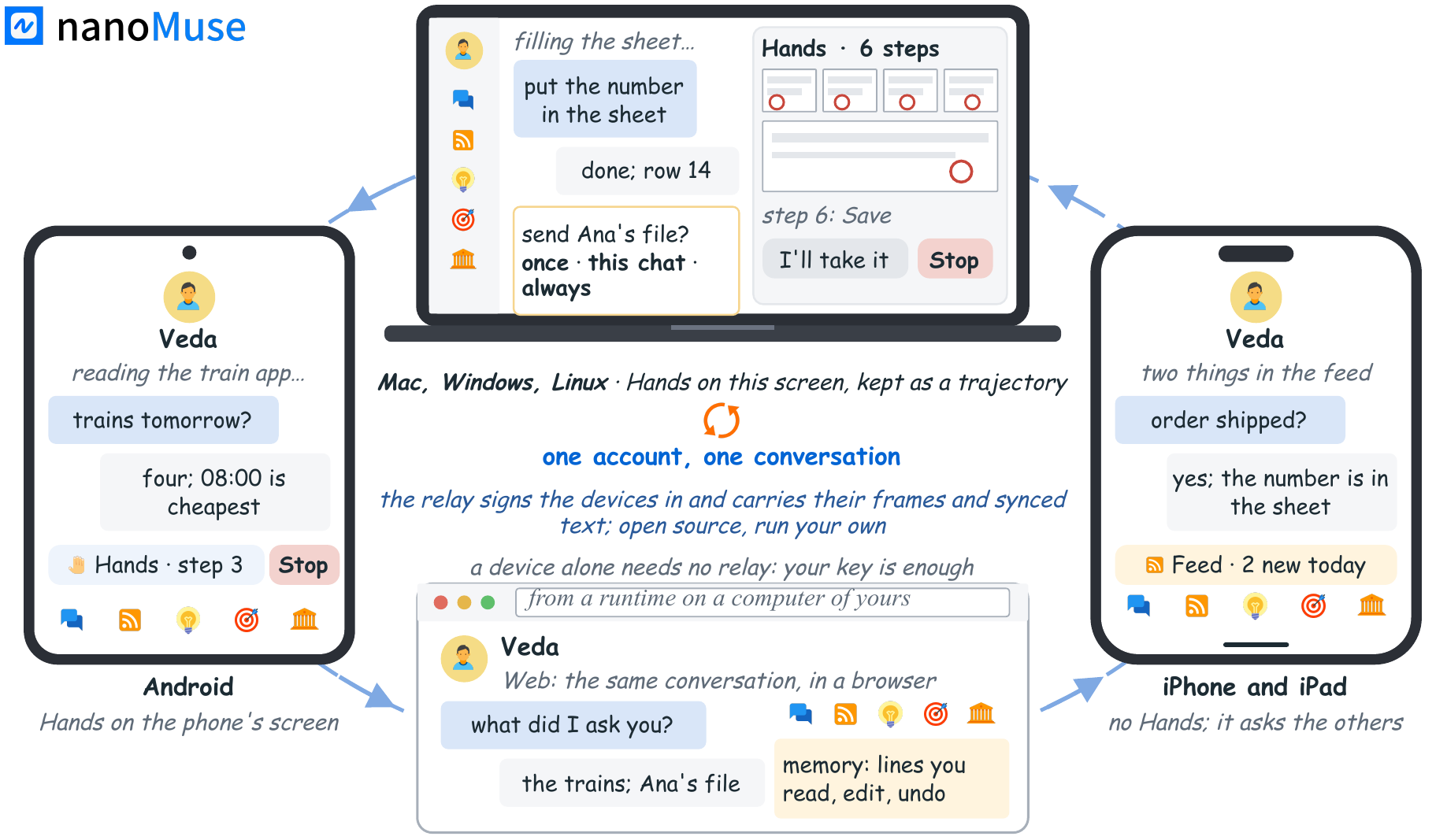
docs/every-device.md explains the devices, docs/hub.md the frames, docs/cloud.md the relay, docs/privacy.md what it keeps.
Compared with Muse and OpenMinis
|
Meta Muse |
OpenMinis |
nanoMuse |
| Where the agent runs |
A cloud VM per user |
The phone it is installed on |
Your phone, your computer, or a server of yours, one account across them |
| Apps without an API |
Out of reach; the VM never touches your devices |
An accessibility CLI on Android |
The screen as a hand on the phone and the computer: screenshots, APIs first, you take over for logins. Not on iOS, where the system does not allow it |
| Other devices |
Clients of one VM |
The one it is installed on |
Devices ask each other for things over the hub, with approvals where you are |
| Models |
Meta's |
Bring your own |
The relay's free allowance, or your own |
| Licence |
Closed |
GPL-3.0 |
GPL-3.0-or-later, built on OpenMinis |
Docs
nanomuse.cn/docs: install per platform, every device, hands, connectors, memory, self-hosting, the protocols. The sources are in docs/; what changed in each version is in the CHANGELOG and docs/releases/.
Self-host
One VPS, one hour: docs/self-hosting.md. Three ways: no server at all with your own key, your own relay with scripts/self-host.sh, or a runtime of your own for the web app.
Contribute
Use it for a real task, report what broke, then pick something focused: CONTRIBUTING.md has the setup and the conventions, AGENTS.md the rules a coding agent follows in this tree, and the roadmap says where to start. Issues · Discussions · Discord.
⭐️ Citation
If you find nanoMuse useful, please cite the paper.
@misc{liu2026nanomuseopensourcepersonalagent,
      title={nanoMuse: An Open-Source Personal Agent for Every Device You Own},
      author={Guangyi Liu and Yong Liu and Jiangning Zhang},
      year={2026},
      eprint={2610.08699},
      archivePrefix={arXiv},
      primaryClass={cs.AI},
      url={https://arxiv.org/abs/2610.08699},
}
Acknowledgements
nanoMuse stands on other people's work; THIRD_PARTY_NOTICES.md has the terms.
Disclaimer
nanoMuse is an independent community project, not affiliated with or endorsed by Meta Platforms, Inc.; Muse is their trademark. The dragon is the project's own.
License
GPL-3.0-or-later. The phone app is based on OpenMinis 1.13 (GPL-3.0), modified since 2026-09-24; see NOTICE. Earlier versions of the Python line were MIT (tag pre-openminis).

 nanoMuse 是一个开源的个人 AI 智能体,可以在你拥有的每台设备上运行。它不只是回答问题,还会动手做事;应用关闭后仍继续工作;它记得你是谁,并在做任何不可逆操作前先停下来询问。