Your personal AI assistant — deploy locally or in the cloud, extend with Skills & Plugins, connect across every channel.
|
|
| Never forgets |
Three-layer memory — live working context, full verbatim history, and a self-evolving personal knowledge base powered by ReMe. Conversations and resources continuously become readable, editable, searchable, and linked Markdown memory. |
| Local or cloud, runs free |
QwenPaw-Flash models (2B / 4B / 9B) trained for agent tasks. Built-in QwenPaw Local runtime — no API key, no cloud dependency. Also works with Ollama, LM Studio, or 14+ cloud providers. |
| Security built in |
Kernel-level Sandbox, Tool Guard, File Guard, Skill Scanner, and Access Policy. Dangerous commands are blocked before they run. |
| Multi-agent & parallel |
Spawn independent agents with their own memory and skills. Sub-agents at runtime. Agent Communication Protocol (ACP) for cross-system orchestration. |
| File workspace |
Unified file navigation, preview, editing, diffs, upload, and download across project and Agent files. |
| Extensible |
Skills for scheduling, documents, browser, news, and more. Plugin architecture with a marketplace. MCP integration for external tools. Combine them into purpose-built workflows. |
| Reachable anywhere |
DingTalk, Lark, WeChat, Discord, Telegram, iMessage, QQ — one instance, all channels. Console, TUI, and desktop app for direct access. |
| Yours, not ours |
Deploy locally — data stays on your machine. No third-party hosting, no data upload. |
What you can do with QwenPaw
- Automation & scheduling: Set up recurring tasks — news digests, report generation, multi-channel broadcasting — all on your schedule.
- Code & development: Read, edit, review, and test code in your projects with the unified file workspace.
- Document processing: Read, write, and convert PDF, Word, Excel, and PowerPoint files.
- Information gathering: Search the web, follow subscriptions, summarize videos, and find what you need in your personal knowledge base.
- Multi-channel ops: Push alerts, summaries, or AI-generated content to DingTalk, Lark, Discord, Telegram, and more — simultaneously or per channel.
- Custom workflows: Combine built-in capabilities, plugins, and scheduled tasks into workflows tailored to your needs.
News
[2026-09-03] v2.2.0 | Self-hosted multi-user QwenPaw Hub, QwenPaw Mail, native QwenPaw Data, unified model routing, Creator 1.1, a unified marketplace, and major Console, Skills, channel, and reliability improvements. v2.2.0 Release Notes →
[2026-08-13] v2.1.0 | QwenPaw OS Shell, unified Files workspace, QwenPaw Creator, Codex/Qoder Agent integration, Browser-use, Computer-use, workspace checkpoints, and long-running conversation continuity. v2.1.0 Release Notes →
[2026-07-24] v2.0.1 | PawApp mini-app platform, user-editable Agent Modes, Oh-My-Paw plugins, ReMe memory enhancements, desktop UX improvements, and more. v2.0.1 Release Notes →
[2026-07-10] v2.0.0 — QwenPaw 2.0 Official Release 🎉 | An AgentScope 2.0 based ground-up rewrite delivering the Agent OS architecture, Loop Engineering, Scroll Context, ReMe v0.4 Self-evolving Personal Knowledge Base, and a bundled Terminal UI.
| Highlight |
What's new |
| Agent OS — Workspace |
Three pillars per agent: Resources (transparent on disk), Governance (allow/deny/ask/sandbox), Sandbox (macOS / Linux / Windows). |
| Agent OS — Drivers |
Protocol-neutral MCP / A2A / ACP connector layer with encrypted credentials and per-call policy gate. |
| Loop Engineering |
Advanced agent loop templates (Coding Mode, Mission Mode, more to come) with composable approval gates. |
| Scroll Context |
Every turn persisted; evicted turns indexed with on-demand recall — nothing summarized away. |
| ReMe v0.4 Self-evolving Personal Knowledge Base |
Continuously turns conversations and resources into readable, editable, searchable, and linked Markdown memory. |
| Terminal UI (TUI) |
Full-screen terminal chat — same agent, memory, and sessions as Console and channels. |
Built on Agent OS, we will be launching out-of-box QwenPaw applications — such as QwenPaw Creator and QwenPaw Insight — stay tuned. v2.0.0 Release Notes →
All release notes →
Table of Contents
Quick Start
Option 1: Pip Install
If you prefer managing Python yourself (requires Python >= 3.11, < 3.14):
pip install qwenpaw
qwenpaw init --defaults
qwenpaw app
Then open the Console in your browser at http://127.0.0.1:8088/ to configure your model. To chat in DingTalk, Lark, WeChat, etc., see the Channel setup documentation.
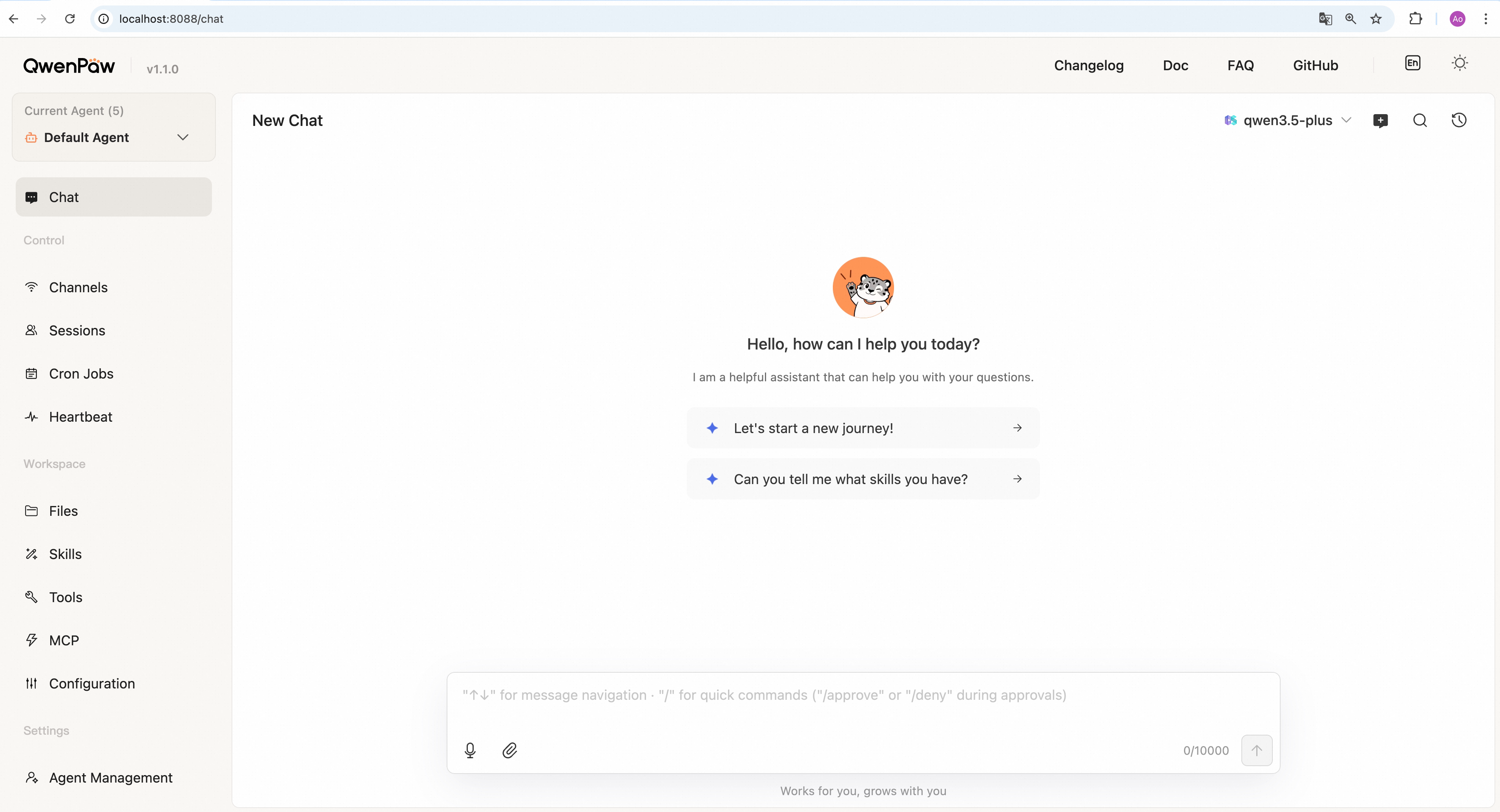
Option 2: Script Install
No Python setup required, one command installs everything. The script will automatically download uv (Python package manager), create a virtual environment, and install QwenPaw with all dependencies (including Node.js and frontend assets). Note: May not work in restricted network environments or corporate firewalls.
macOS / Linux:
curl -fsSL https://qwenpaw.agentscope.io/install.sh | bash
Windows (CMD):
curl -fsSL https://qwenpaw.agentscope.io/install.bat -o install.bat && install.bat
Windows (PowerShell):
irm https://qwenpaw.agentscope.io/install.ps1 | iex
Note: The installer will automatically check the status of uv. If it is not installed, it will attempt to download and configure it automatically. If the automatic installation fails, please follow the on-screen prompts or execute python -m pip install -U uv, then rerun the installer.
⚠️ Special Notice for Windows Enterprise LTSC Users
If you are using Windows LTSC or an enterprise environment governed by strict security policies, PowerShell may run in Constrained Language Mode, potentially causing the following issue:
If using CMD (.bat): Script executes successfully but fails to write to Path
The script completes file installation. Due to Constrained Language Mode, it cannot automatically update environment variables. Manually configure as follows:
- Locate the installation directory:
- Check if
uv is available: Enter uv --version in CMD. If a version number appears, only configure the QwenPaw path. If you receive the prompt 'uv' is not recognized as an internal or external command, operable program or batch file, configure both paths.
- uv path (choose one based on installation location; use if
uv fails): Typically %USERPROFILE%\.local\bin, %USERPROFILE%\AppData\Local\uv, or the Scripts folder within your Python installation directory
- QwenPaw path: Typically located at
%USERPROFILE%\.qwenpaw\bin.
- Manually add to the system's Path environment variable:
- Press
Win + R, type sysdm.cpl and press Enter to open System Properties.
- Click “Advanced” -> “Environment Variables”.
- Under “System variables”, locate and select
Path, then click “Edit”.
- Click “New”, enter both directory paths sequentially, then click OK to save.
If using PowerShell (.ps1): Script execution interrupted
Due to Constrained Language Mode, the script may fail to automatically download uv.
- Manually install uv: Refer to the GitHub Release to download
uv.exe and place it in %USERPROFILE%\.local\bin or %USERPROFILE%\AppData\Local\uv; or ensure Python is installed and run python -m pip install -U uv.
- Configure
uv environment variables: Add the uv directory and %USERPROFILE%\.qwenpaw\bin to your system's Path variable.
- Re-run the installation: Open a new terminal and execute the installation script again to complete the
QwenPaw installation.
- Configure the
QwenPaw environment variable: Add %USERPROFILE%\.qwenpaw\bin to your system's Path variable.
Once installed, open a new terminal and run:
qwenpaw init --defaults   # or: qwenpaw init (interactive)
qwenpaw app
Install options
macOS / Linux:
# Install a specific version
curl -fsSL ... | bash -s -- --version 1.1.0

# Install from source (dev/testing)
curl -fsSL ... | bash -s -- --from-source

# Upgrade — just re-run the installer
curl -fsSL ... | bash

# Uninstall
qwenpaw uninstall          # keeps config and data
qwenpaw uninstall --purge  # removes everything
Windows (PowerShell):
# Install a specific version
irm ... | iex; .\install.ps1 -Version 1.1.12

# Install from source (dev/testing)
.\install.ps1 -FromSource

# Upgrade — just re-run the installer
irm ... | iex

# Uninstall
qwenpaw uninstall          # keeps config and data
qwenpaw uninstall --purge  # removes everything
Option 3: Docker
Images are on Docker Hub (agentscope/qwenpaw). Image tags: latest (stable); pre (PyPI pre-release).
docker pull agentscope/qwenpaw:latest
docker run -p 127.0.0.1:8088:8088 \
  -v qwenpaw-data:/app/working \
  -v qwenpaw-secrets:/app/working.secret \
  -v qwenpaw-backups:/app/working.backups \
  agentscope/qwenpaw:latest
Also available on Alibaba Cloud Container Registry (ACR) for users in China: agentscope-registry.ap-southeast-1.cr.aliyuncs.com/agentscope/qwenpaw (same tags).
Then open http://127.0.0.1:8088/ for the Console. Config, memory, and skills are stored in the qwenpaw-data volume; model provider settings and API keys are in the qwenpaw-secrets volume; backup archives are stored in the qwenpaw-backups volume. To pass API keys (e.g. DASHSCOPE_API_KEY), add -e VAR=value or --env-file .env to docker run.
Connecting to Ollama or other services on the host machine
Inside a Docker container, localhost refers to the container itself, not your host machine. If you run Ollama (or other model services) on the host and want QwenPaw in Docker to reach them, use one of these approaches:
Option A — Explicit host binding (all platforms):
docker run -p 127.0.0.1:8088:8088 \
  --add-host=host.docker.internal:host-gateway \
  -v qwenpaw-data:/app/working \
  -v qwenpaw-secrets:/app/working.secret \
  -v qwenpaw-backups:/app/working.backups \
  agentscope/qwenpaw:latest
Then in QwenPaw Settings → Models, change the Base URL to http://host.docker.internal:<port> — for example, http://host.docker.internal:11434 for Ollama, or http://host.docker.internal:1234/v1 for LM Studio.
Option B — Host networking (Linux only):
docker run --network=host \
  -v qwenpaw-data:/app/working \
  -v qwenpaw-secrets:/app/working.secret \
  -v qwenpaw-backups:/app/working.backups \
  agentscope/qwenpaw:latest
No port mapping (-p) is needed; the container shares the host network directly. Note that all container ports are exposed on the host, which may cause conflicts if the port is already in use.
The image is built from scratch. To build the image yourself, please refer to the Build Docker image section in scripts/README.md, and then push to your registry.
Option 4: Deploy on Alibaba Cloud ECS
To run QwenPaw on Alibaba Cloud (ECS), use the one-click deployment: open the QwenPaw on Alibaba Cloud (ECS) deployment link and follow the prompts. For step-by-step instructions, see Alibaba Cloud Developer: Deploy your AI assistant in 3 minutes.
AgentScope Platform provides one-click cloud QwenPaw deployment, plugin sharing, and a Skill marketplace. Free, 7/24 online.
Option 6: Using ModelScope
ModelScope Studio also supports cloud QwenPaw deployment. Note: set your Studio to non-public so others cannot control your QwenPaw.
Option 7: Desktop Application (Beta)
Beta Notice: The desktop application is currently in Beta testing phase with the following known limitations:
- Incomplete compatibility testing: Not fully tested across all system versions and hardware configurations
- Potential performance issues: Startup time, memory usage, and other performance aspects may need further optimization
- Features under development: Some features may be unstable or missing
If you're not comfortable with command-line tools, you can download and use QwenPaw's desktop application without manually configuring Python environments or running commands.
Download
Download the desktop app (Tauri build) from the official download page:
- Windows:
QwenPaw-Tauri-<version>-Windows-setup.exe
- macOS:
QwenPaw-Tauri-<version>-macOS.zip (Apple Silicon recommended)
Features
- ✅ Zero configuration: Download and double-click to run, no need to install Python or configure environment variables
- ✅ Cross-platform: Supports Windows 10+ and macOS 14+
- ✅ Visual interface: Automatically opens the app window, no need to manually enter addresses
- ⚠️ Beta stage: Features are continuously being improved, feedback welcome
First Launch
Important: The first launch may take 10-60 seconds (depending on your system configuration). The application needs to initialize the Python environment and load dependencies. Please wait patiently for the window to open automatically.
macOS: Bypass System Security Restrictions
When you download the QwenPaw macOS app from Releases, macOS may show: "Apple cannot verify that 'QwenPaw' contains no malicious software". This happens because the app is not notarized. You can still open it as follows:
Right-click to open (recommended)
Right-click (or Control+click) the QwenPaw app → Open → in the dialog click Open again. This tells Gatekeeper you trust the app; after that you can double-click to launch as usual.
Allow in System Settings
If it is still blocked, go to **System Setting
















 QwenPaw is a personal AI assistant that you deploy yourself (locally or in the cloud), which remembers context across sessions, runs tasks/automations, and reaches you through chat apps like Discord, Telegram, and WeChat. It is extensible with Skills, Plugins, and MCP tools.