cmux
A Ghostty-based macOS terminal with vertical tabs and notifications for AI coding agents

English | 日本語 | Tiếng Việt | 简体中文 | 繁體中文 | 한국어 | Deutsch | Español | Français | Italiano | Dansk | Polski | Русский | Bosanski | العربية | Norsk | Português (Brasil) | ไทย | Türkçe | ភាសាខ្មែរ | Українська


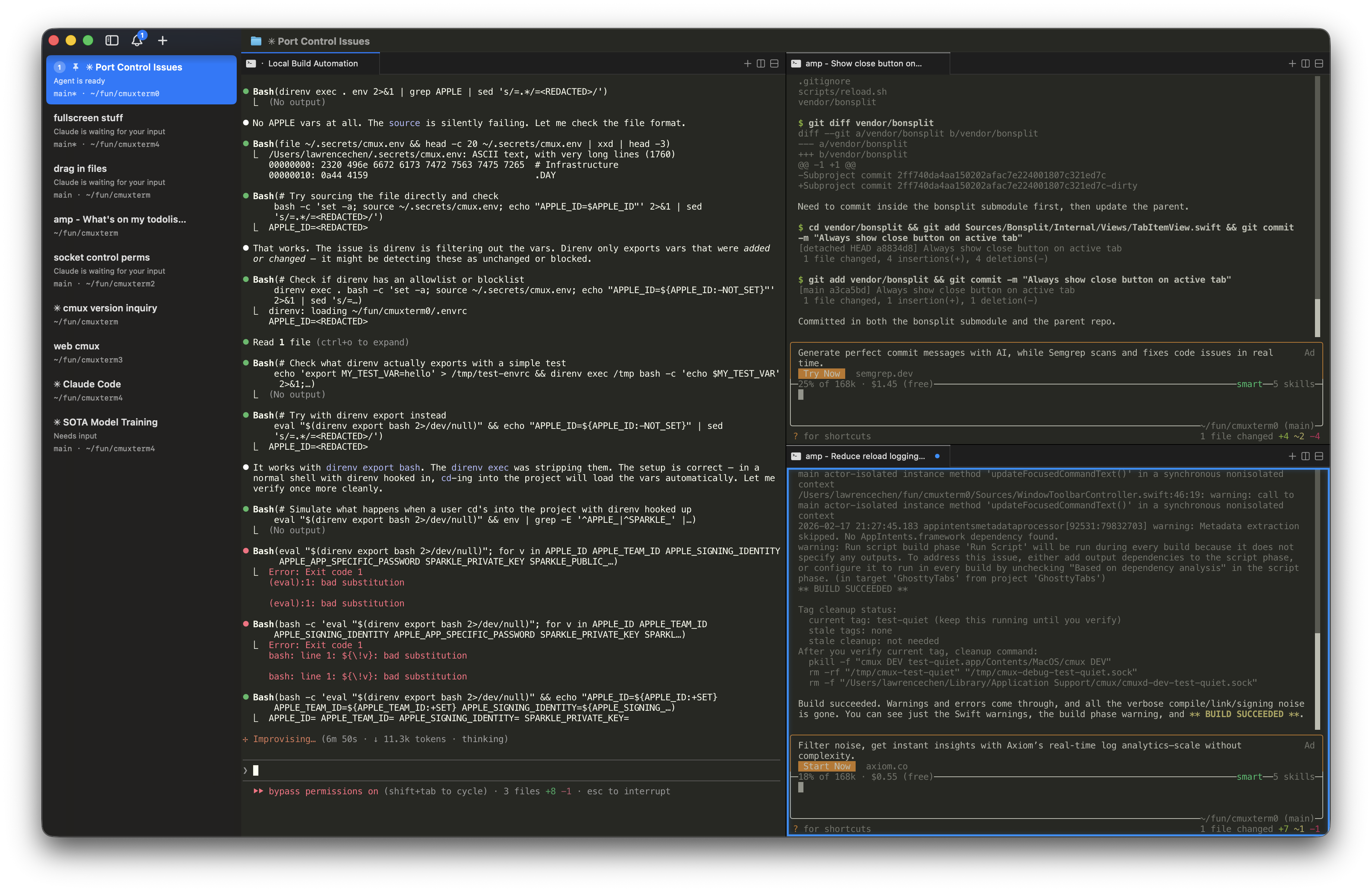
▶ Demo video · The Zen of cmux
Features
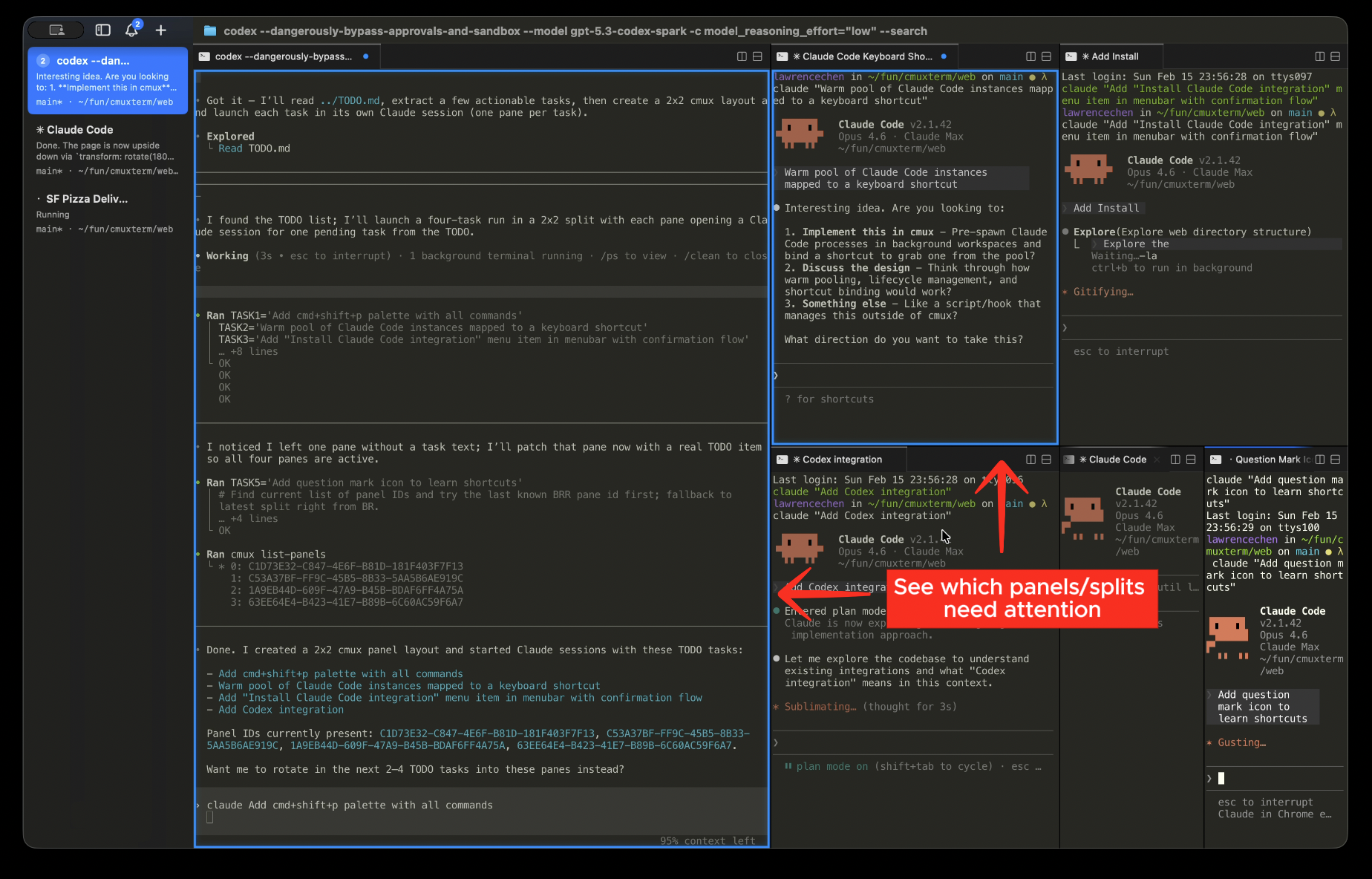
Notification rings
Panes get a blue ring and tabs light up when coding agents need your attention
|
|
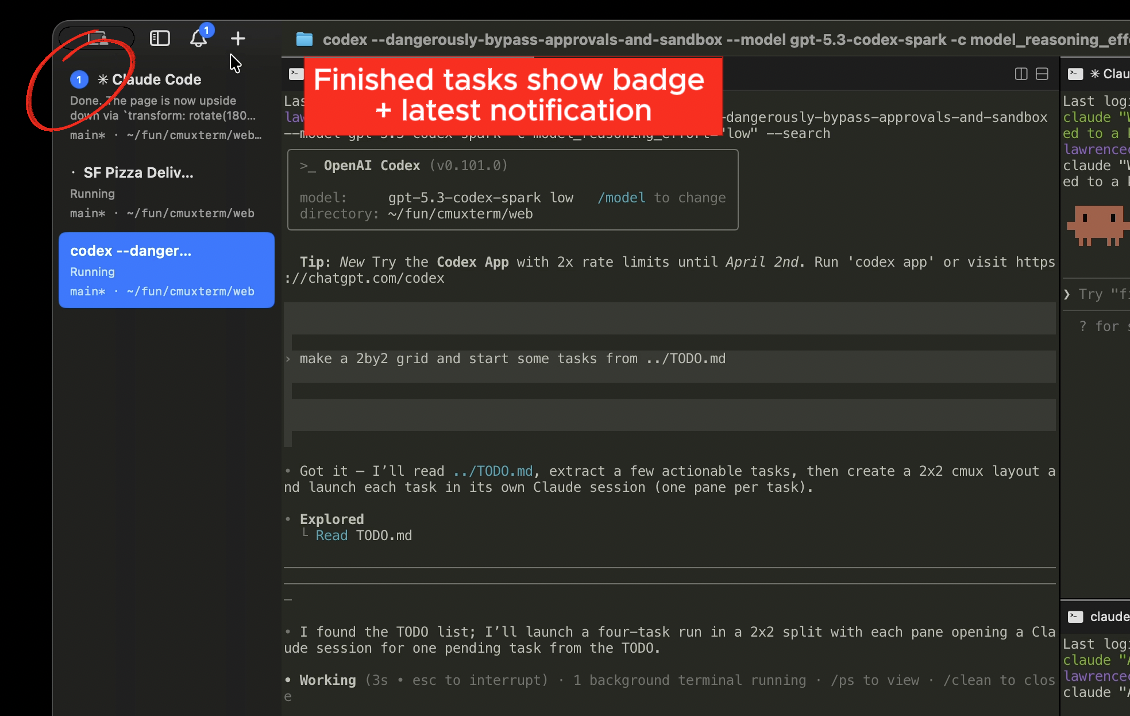
Notification panel
See all pending notifications in one place, jump to the most recent unread
|
|
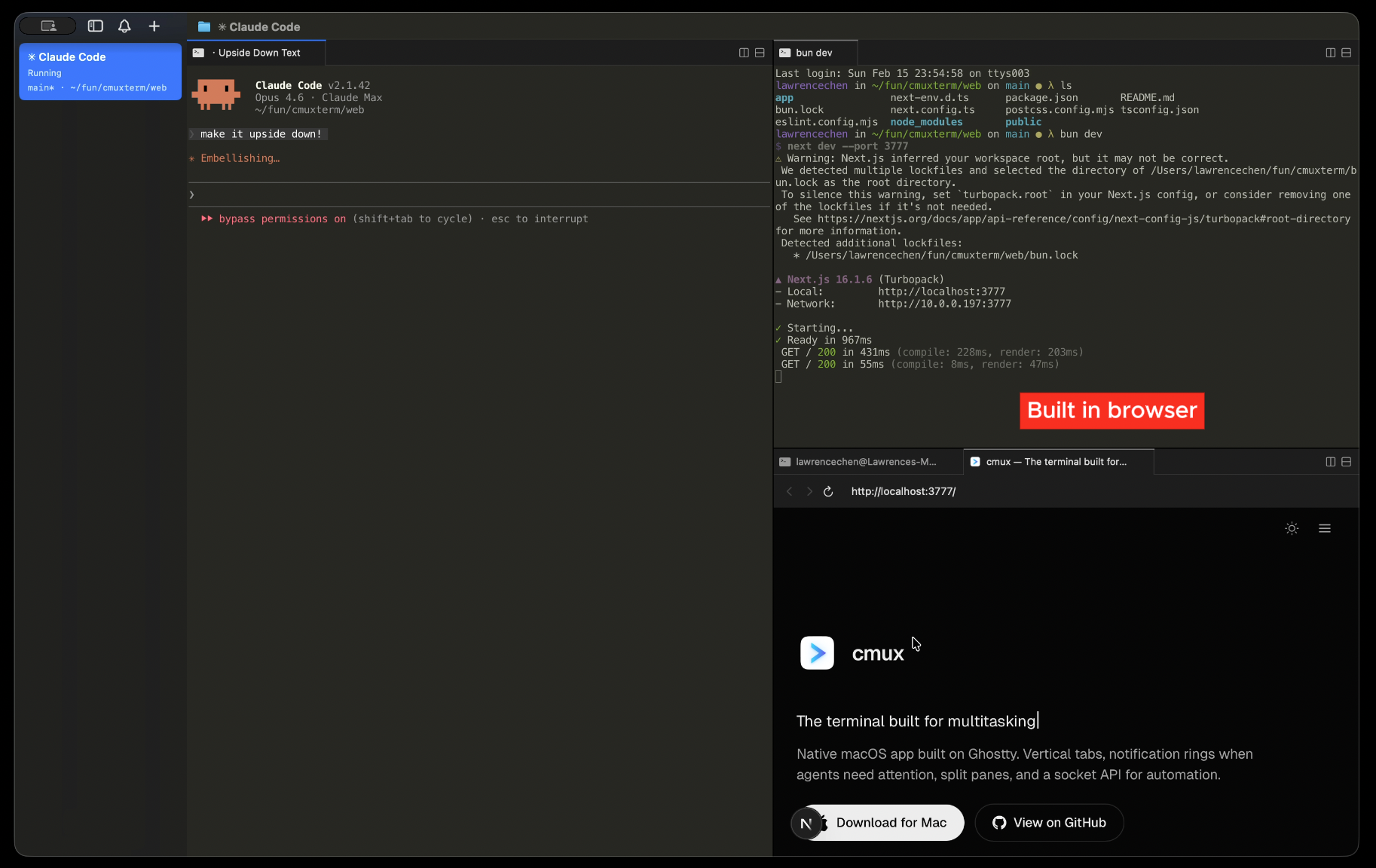
In-app browser
Split a browser alongside your terminal with a scriptable API ported from agent-browser
|
|
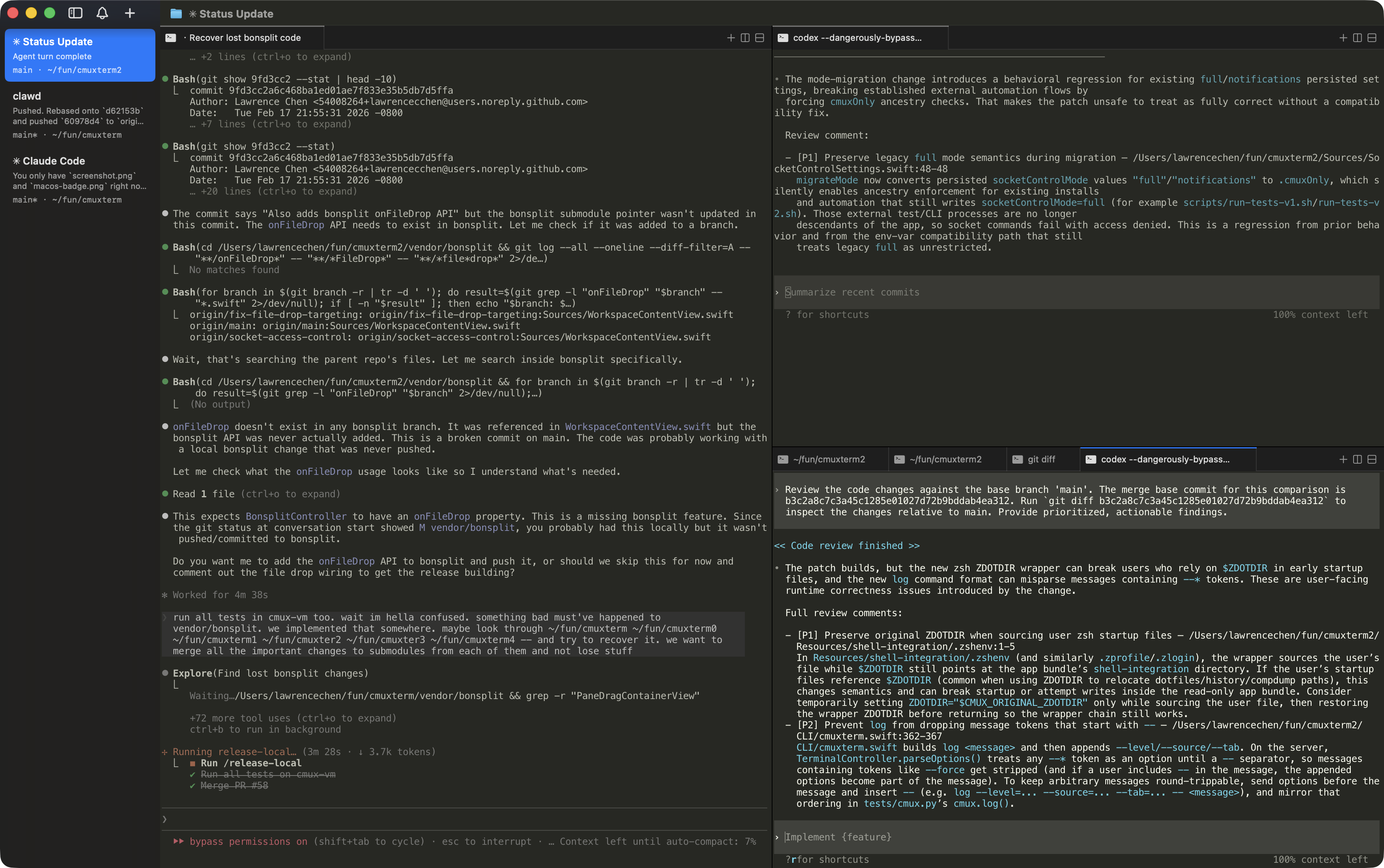
Vertical + horizontal tabs
Sidebar shows git branch, linked PR status/number, working directory, listening ports, and latest notification text. Split horizontally and vertically.
|
|
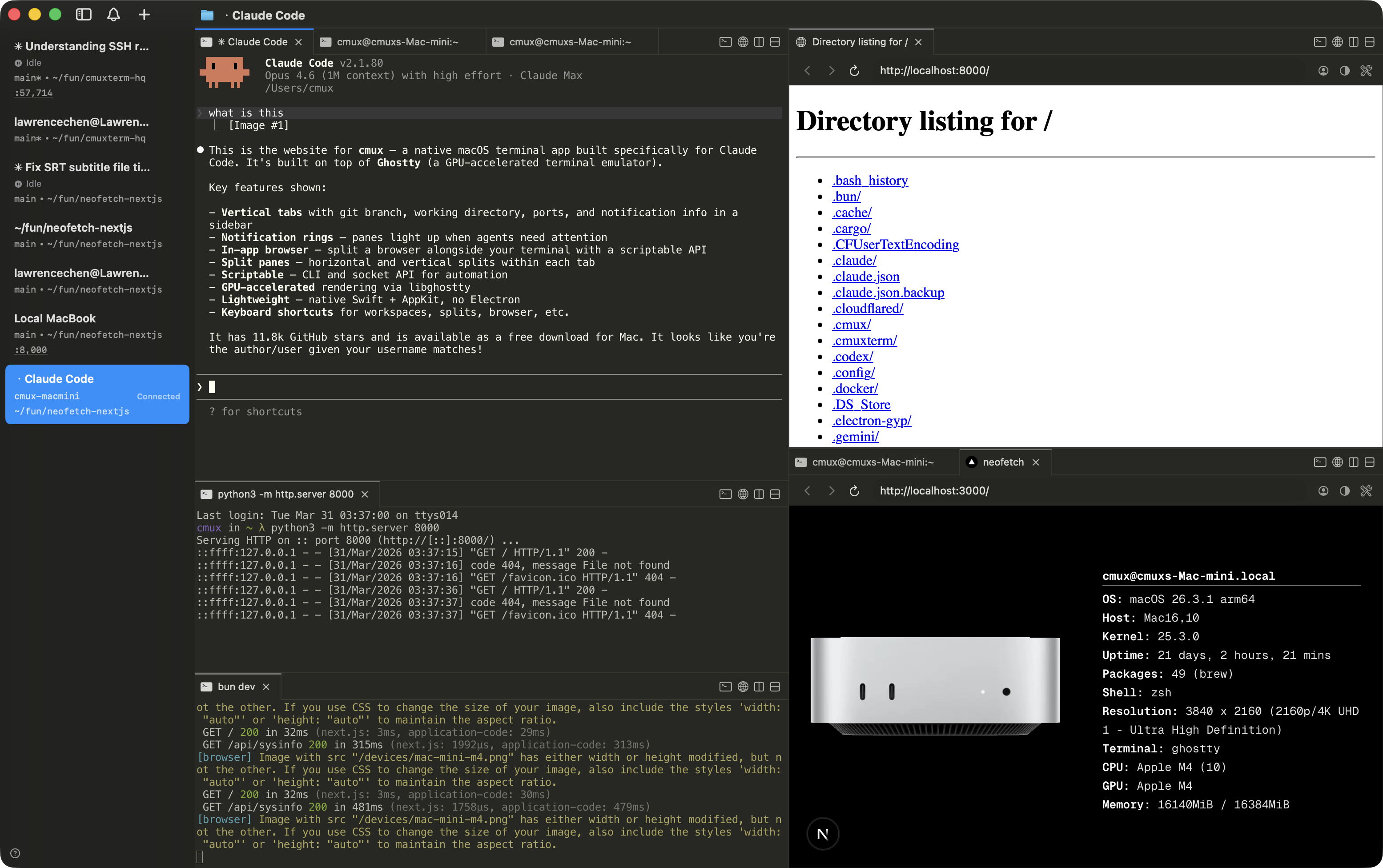
SSH
cmux ssh user@remote creates a workspace for a remote machine. Pass --command 'omp "investigate auth"' to run an initial command once in its first remote terminal. Browser panes route through the remote network so localhost just works. Drag an image into a remote session to upload via scp.
|
|
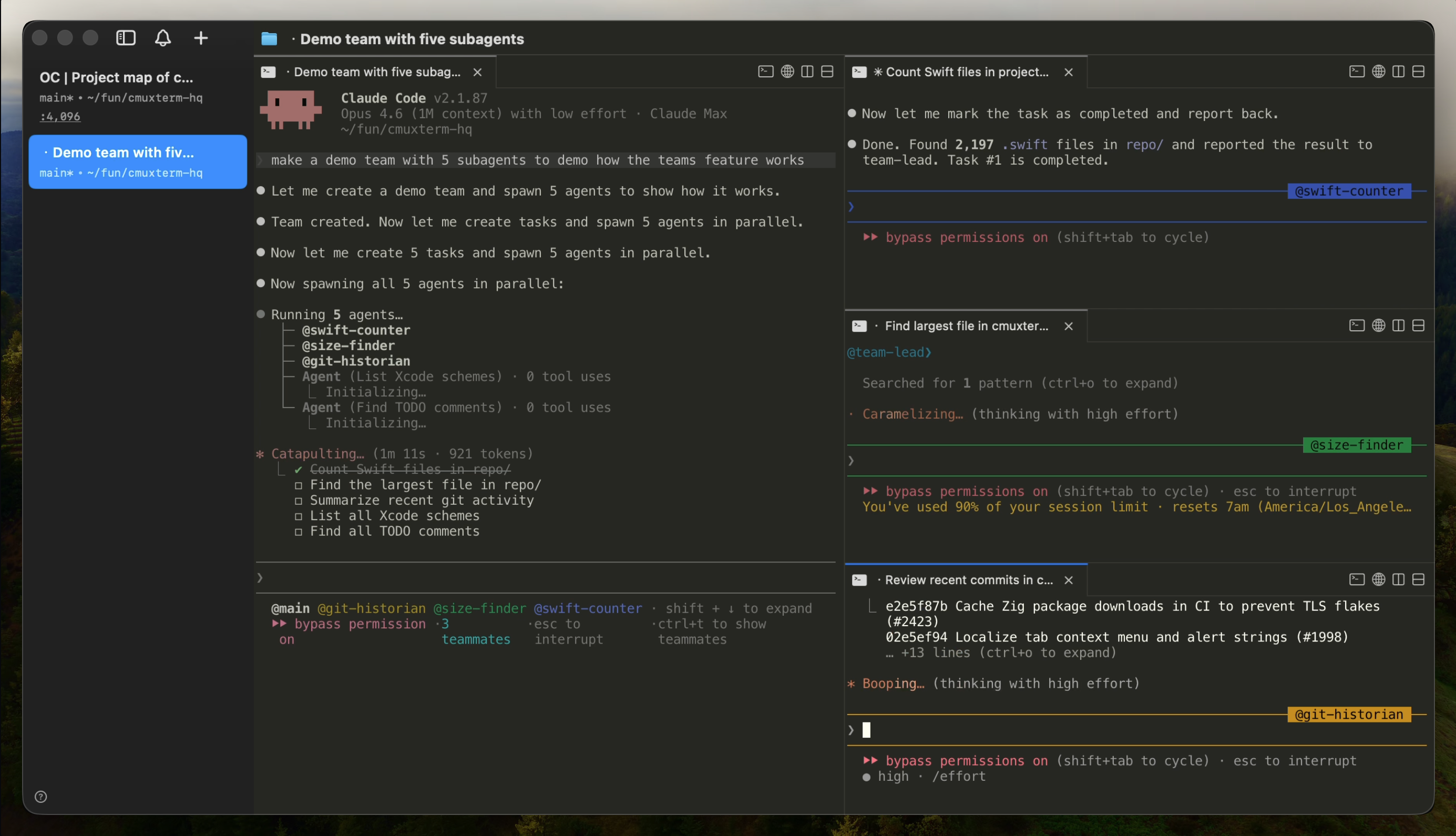
Claude Code Teams
cmux claude-teams runs Claude Code's teammate mode with one command. Teammates spawn as native splits with sidebar metadata and notifications. No tmux required.
|
|
- Browser import — Import cookies, history, and sessions from Chrome, Firefox, Arc, and 20+ browsers so browser panes start authenticated
- Custom commands — Define project-specific actions in
cmux.json that launch from the command palette
- Programmable — CLI and socket API to create workspaces, split panes, send keystrokes, and automate the browser
- Native macOS app — Built with Swift and AppKit, not Electron. Fast startup, low memory.
- Ghostty compatible — Reads your existing
~/.config/ghostty/config for themes, fonts, and colors
- GPU-accelerated — Powered by libghostty for smooth rendering
- Keyboard shortcuts — Extensive shortcuts for workspaces, splits, browser, and more
- Open source — Free and GPL-licensed
Install
DMG (recommended)
Open the .dmg and drag cmux to your Applications folder. cmux auto-updates via Sparkle, so you only need to download once.
Homebrew
brew tap manaflow-ai/cmux
brew install --cask cmux
To update later:
brew upgrade --cask cmux
On first launch, macOS may ask you to confirm opening an app from an identified developer. Click Open to proceed.
Why cmux?
I run a lot of Claude Code and Codex sessions in parallel. I was using Ghostty with a bunch of split panes, and relying on native macOS notifications to know when an agent needed me. But Claude Code's notification body is always just "Claude is waiting for your input" with no context, and with enough tabs open I couldn't even read the titles anymore.
I tried a few coding orchestrators but most of them were Electron/Tauri apps and the performance bugged me. I also just prefer the terminal since GUI orchestrators lock you into their workflow. So I built cmux as a native macOS app in Swift/AppKit. It uses libghostty for terminal rendering and reads your existing Ghostty config for themes, fonts, and colors.
The main additions are the sidebar and notification system. The sidebar has vertical tabs that show git branch, linked PR status/number, working directory, listening ports, and the latest notification text for each workspace. The notification system picks up terminal sequences (OSC 9/99/777) and has a CLI (cmux notify) you can wire into agent hooks for Claude Code, OpenCode, etc. When an agent is waiting, its pane gets a blue ring and the tab lights up in the sidebar, so I can tell which one needs me across splits and tabs. Cmd+Shift+U jumps to the most recent unread.
The in-app browser has a scriptable API ported from agent-browser. Agents can snapshot the accessibility tree, get element refs, click, fill forms, and evaluate JS. You can split a browser pane next to your terminal and have Claude Code interact with your dev server directly.
Everything is scriptable through the CLI and socket API — create workspaces/tabs, split panes, send keystrokes, open URLs in the browser.
The Zen of cmux
cmux is not prescriptive about how developers hold their tools. It's a terminal and browser with a CLI, and the rest is up to you.
cmux is a primitive, not a solution. It gives you a terminal, a browser, notifications, workspaces, splits, tabs, and a CLI to control all of it. cmux doesn't force you into an opinionated way to use coding agents. What you build with the primitives is yours.
The best developers have always built their own tools. Nobody has figured out the best way to work with agents yet, and the teams building closed products definitely haven't either. The developers closest to their own codebases will figure it out first.
Give a million developers composable primitives and they'll collectively find the most efficient workflows faster than any product team could design top-down.
Documentation
For more info on how to configure cmux, head over to our docs.
Keyboard Shortcuts
Workspaces
| Shortcut |
Action |
| ⌘ N |
New workspace |
| ⌘ 1–8 |
Jump to workspace 1–8 |
| ⌘ 9 |
Jump to last workspace |
| ⌃ ⌘ ] |
Next workspace |
| ⌃ ⌘ [ |
Previous workspace |
| ⌘ ⇧ W |
Close workspace |
| ⌘ ⇧ R |
Rename workspace |
| ⌥ ⌘ E |
Edit workspace description |
| ⌘ B |
Toggle sidebar |
| ⌥ ⌘ B |
Toggle right sidebar |
| ⌘ ⇧ E |
Toggle right sidebar focus |
Surfaces
| Shortcut |
Action |
| ⌘ T |
New surface |
| ⌘ ⇧ ] |
Next surface |
| ⌘ ⇧ [ |
Previous surface |
| ⌃ Tab |
Next surface |
| ⌃ ⇧ Tab |
Previous surface |
| ⌃ 1–8 |
Jump to surface 1–8 |
| ⌃ 9 |
Jump to last surface |
| ⌘ W |
Close surface |
Split Panes
| Shortcut |
Action |
| ⌘ D |
Split right |
| ⌘ ⇧ D |
Split down |
| ⌥ ⌘ ← → ↑ ↓ |
Focus pane directionally |
| ⌘ ⇧ H |
Flash focused panel |
Browser
Browser developer-tool shortcuts follow Safari defaults and are customizable in Settings → Keyboard Shortcuts.
Command palette navigation shortcuts, including ⌃ P, are also customizable and can be cleared so the keypress reaches the active terminal.
| Shortcut |
Action |
| ⌘ ⇧ L |
Open browser in split |
| ⌘ L |
Focus address bar |
| ⌘ [ |
Back |
| ⌘ ] |
Forward |
| ⌘ R |
Reload page |
| ⌥ ⌘ I |
Toggle Developer Tools (Safari default) |
| ⌥ ⌘ C |
Show JavaScript Console (Safari default) |
Notifications
| Shortcut |
Action |
| ⌘ I |
Show notifications panel |
| ⌘ ⇧ U |
Jump to latest unread |
| ⌥ ⌘ U |
Toggle current item unread state |
| ⌃ ⌘ U |
Mark current item as oldest unread and jump to next latest unread |
| — |
Mark all notifications read (unbound by default; configure in Settings or cmux.json) |
| — |
Clear all notifications (unbound by default; configure in Settings or cmux.json) |
Find
| Shortcut |
Action |
| ⌘ F |
Find |
| ⌘ ⇧ F |
Find in directory |
| ⌘ G / ⌥ ⌘ G |
Find next / previous |
| ⌥ ⌘ ⇧ F |
Hide find bar |
| ⌘ E |
Use selection for find |
Terminal
| Shortcut |
Action |
| ⌘ K |
Clear scrollback |
| ⌘ C |
Copy (with selection) |
| ⌘ V |
Paste |
| ⌘ + / ⌘ - |
Increase / decrease font size |
| ⌘ 0 |
Reset font size |
Window
| Shortcut |
Action |
| ⌘ ⇧ N |
New window |
| ⌘ ⇧ O |
Reopen previous session |
| ⌘ , |
Settings |
| ⌘ ⇧ , |
Reload configuration |
| ⌘ Q |
Quit |
Nightly Builds
Download cmux NIGHTLY (universal; updates then switch to your Mac's architecture automatically)
cmux NIGHTLY is a separate app with its own bundle ID, so it runs alongside the stable version. Built automatically from the latest main commit and auto-updates via its own Sparkle feed.
Report nightly bugs on GitHub Issues or in #nightly-bugs on Discord.
Session restore
Quitting cmux saves the current session. On relaunch, cmux restores app-owned
state:
- Window/workspace/pane layout
- Working directories
- Terminal scrollback (best effort)
- Browser URL and navigation history
cmux does not checkpoint arbitrary live process state. Ordinary terminals,
tmux, vim, shells, and unsupported terminal apps reopen as normal terminals.
For live detach/reattach across cmux quit, crashes, and updates, opt in to the
local tmux owner with cmux local-tmux; see docs/local-tmux.md
for its lifecycle and machine-sleep limits.
Supported agent sessions can resume when hooks have saved a native session ID.
Install hooks after installing the agent CLI so its binary is on PATH:
cmux hooks setup
cmux hooks setup codex
cmux hooks setup --agent opencode
cmux hooks setup installs supported agents it can find and prints a summary
for skipped agents. Supported resume integrations include Claude Code, Codex,
Grok, OpenCode, Pi, Amp, Cursor CLI, Gemini, Rovo Dev, Copilot, CodeBuddy,
Factory, and Qoder. Claude Code is handled by the cmux Claude wrapper when Claude
integration is enabled in Settings.
Advanced users and integrations can attach a custom resume command to the
current terminal surface. This is useful for tools with their own durable state,
such as tmux sessions or custom agent CLIs:
cmux surface resume set --kind tmux --checkpoint work --shell "tmux attach -t work"
cmux surface resume show --json
cmux surface resume clear --checkpoint work
The binding stays attached to the cmux surface. Public CLI or socket-created
bindings are stored for inspection and manual restore unless you approve a
signed command prefix for automatic restore. Approved prefixes are also bound to
the working directory and exact environment values, when present. Review or edit
approvals in Settings > Terminal > Resume Commands. cmux only auto-runs
resume bindings it marks trusted, such as live process-detected tmux bindings or
user-approved prefixes. Sensitive environment keys such as tokens, passwords,
secrets, and API keys are dropped before a resume binding is stored.
To keep restored agent terminals idle instead of automatically running their resume commands,
turn off Settings > Terminal > Resume Agent Sessions on Reopen or set this in
~/.config/cmux/cmux.json:
{
  "terminal": {
    "autoResumeAgentSessions": false
  }
}
This only disables automatic agent resume commands. cmux still restores the saved layout,
working directories, scrollback, and browser history.
If you need to reapply the last saved snapshot manually, use:
File > Reopen Previous Session⌘ ⇧ Ocmux restore-session
Under the hood, cmux writes a versioned snapshot under
~/Library/Application Support/cmux/ and agent hooks write session mappings
under ~/.cmuxterm/. On restore, cmux rebuilds the layout first, then runs the
supported agent's native resume command when automatic agent resume is enabled.
Read the full guide at https://cmux.com/docs/session-restore.
FAQ
How does cmux relate to Ghostty?
cmux is not a fork of Ghostty. It uses libghostty as a library for terminal rendering, the same way apps use WebKit for web views. Ghostty is a standalone terminal; cmux is a different app built on top of its rendering engine.
macOS only, for now. cmux is a native Swift + AppKit app.
Is there an iOS app?
Yes, in beta. Pair your iPhone with your Mac from the Mobile Connect window and attach to your terminals from your phone, with optional forwarding of terminal notifications. It ships on TestFlight as cmux BETA. Early access is included with cmux Founders Edition. See the iOS docs.
What coding agents does cmux work with?
All of them. cmux is a terminal, so any agent that runs in a terminal works out of the box: Claude Code, Codex, OpenCode, Gemini CLI, Kiro, Aider, Goose, Amp, Cline, Cursor Agent, and anything else you can launch from the command line.
Can cmux orchestrate multiple agents and subagents?
Yes. When an agent spawns subagents or teammates, cmux turns them into native panes and splits instead of hidden background processes. It supports Claude Code teams and oh-my-opencode multi-model orchestration, so every agent in a run is visible and controllable.
Can I use cmux with remote machines?
Yes. Open workspaces over SSH and attach to remote tmux sessions, so agents can run on a remote host while you drive them from cmux. See SSH and remote.
How do notifications work?
When a process needs attention, cmux shows notification rings around panes, unread badges in the sidebar, a notification popover, and a macOS desktop notification. These fire automatically via standard terminal escape sequences (OSC 9/99/777), or you can trigger them with the cmux CLI and agent hooks. Any agent that supports hooks or OSC works, including Claude Code, Codex, OpenCode, and pi.
Is cmux programmable?
Yes. Every action is available through the cmux CLI and a Unix socket: create workspaces, open split panes, send input, read screen contents, take screenshots, and drive the in-app browser. See the CLI reference and browser automation docs.
What can the built-in browser do?
cmux can split a real browser pane next to your terminal, and it is fully programmable: navigate, snapshot the DOM, click, type, evaluate JavaScript, and read console and network activity over the same socket API. Agents use it to verify their own web changes without leaving cmux. See browser automation.
Does cmux have skills?
Yes. Skills are reusable workflows you can give any agent running in cmux, for things like CLI control, workspace automation, settings, and browser surfaces. Browse the open collection at cmux-skills, or read the skills docs.
Can I customize keyboard shortcuts?
Terminal keybindings are read from your Ghostty config file (~/.config/ghostty/config). cmux-specific shortcuts (workspaces, splits, browser, notifications) can be customized in Settings. See the default shortcuts for a full list.
Can I customize cmux?
Yes. Terminal rendering uses your Ghostty config, so themes, fonts, colors, and cursor carry over directly. cmux's own settings in ~/.config/cmux/cmux.json control the sidebar, tab bar, split panes, and behavior, and every keyboard shortcut is editable. See configuration.
Are my sessions saved?
cmux restores windows, workspaces, panes, working directories, and best-effort
scrollback when you relaunch. Supported agent integrations can resume from
their saved session IDs. Those are reconstructed app state and resume commands;
they do not keep arbitrary live processes running. Use cmux local-tmux for
live local detach/reattach across cmux quit, crashes, and updates. A local tmux
server cannot survive logout, restart, shutdown, or power loss; use
cmux ssh-tmux, cmux mosh-tmux, or a persistent cloud VM when the owner must
remain online while this Mac is offline. See session restore
and docs/local-tmux.md.
How does it compare to tmux?
tmux is a terminal multiplexer that runs inside any terminal. cmux is a native macOS app with a GUI: vertical tabs, split panes, an embedded browser, and a socket API, all built in, no config files or prefix keys needed. That said, lots of people happily run cmux with SSH and tmux together, and cmux can attach to your remote tmux sessions natively (beta).
Is cmux free?
Yes, cmux is free to use. The source code is available on GitHub.
How can I support cmux?
cmux is free and open source, and always will be. If you want to back development and get

 cmux is a free, open-source macOS terminal built for running AI coding agents in parallel: vertical tabs with git branch and PR status, plus notifications that flag which agent needs you.