





hyperswitch README

The project's README from github.com/juspay/hyperswitch. As one markdown file: README.md.

Hyperswitch-Logo Hyperswitch-Logo

Composable Open-Source Payments Infrastructure

Quickstart demo


📁 Table of Contents

What Can I Do with Hyperswitch?

Hyperswitch offers a modular, open-source payments infrastructure designed for flexibility and control. Apart from our Payment Suite offering, this solution allows businesses to pick and integrate only the modules they need on top of their existing payment stack — without unnecessary complexity or vendor lock-in.

Each module is independent and purpose-built to optimize different aspects of payment processing.

Learn More About The Payment Modules

  • Cost Observability
    Advanced observability tools to audit, monitor, and optimize your payment costs. Detect hidden fees, downgrades, and penalties with self-serve dashboards and actionable insights.
    Read more

  • Revenue Recovery
    Combat passive churn with intelligent retry strategies tuned by card bin, region, method, and more. Offers fine-grained control over retry algorithms, penalty budgets, and recovery transparency.
    Read more

  • Vault
    A PCI-compliant vault service to store cards, tokens, wallets, and bank credentials. Provides a unified, secure, and reusable store of customer-linked payment methods. Also supports bring-your-own-vault to connect existing providers including VGS and TokenEx without re-tokenizing or migrating stored cards.
    Read more

  • Intelligent Routing
    Route each transaction across Stripe, Adyen, Braintree, Worldpay, Checkout.com, and 120+ others to the PSP with the highest predicted auth rate. Reduce retries, avoid downtime, and minimize latency while maximizing first attempt success. Read more

  • Reconciliation
    Automate 2-way and 3-way reconciliation with backdated support, staggered scheduling, and customizable outputs. Reduces manual ops effort and increases audit confidence.
    Read more

  • Alternate Payment Methods
    Drop-in widgets for PayPal, Apple Pay, Google Pay, Samsung Pay, Pay by Bank, and BNPL providers like Klarna. Maximizes conversions with seamless one-click checkout.
    Read more

Quickstart

Local Setup via Docker

# One-click local setup

git clone --depth 1 --branch latest https://github.com/juspay/hyperswitch

cd hyperswitch

scripts/setup.sh
This script:
  • Detects Docker/Podman
  • Offers multiple deployment profiles:
    • Standard: App server + Control Center
    • Full: Includes monitoring + schedulers
    • Minimal: Standalone App server
  • Provides access links when done

If you need further help, check out our video tutorial.

👉 After setup, configure a connector and test a payment.

Hosted Sandbox (No Setup Required)

Hyperswitch offers a fully hosted sandbox environment that requires no setup. You can explore the Control Center, configure payment connectors, and test payments directly from the UI.

What you can do in the Hosted Sandbox
  • Access the full Control Center
  • Configure payment connectors
  • View logs, routing rules, and retry strategies
  • Try payments directly from the UI

Cloud Deployment

You can deploy to AWS, GCP, or Azure using Helm Charts.

Cloud Deployment Instructions.

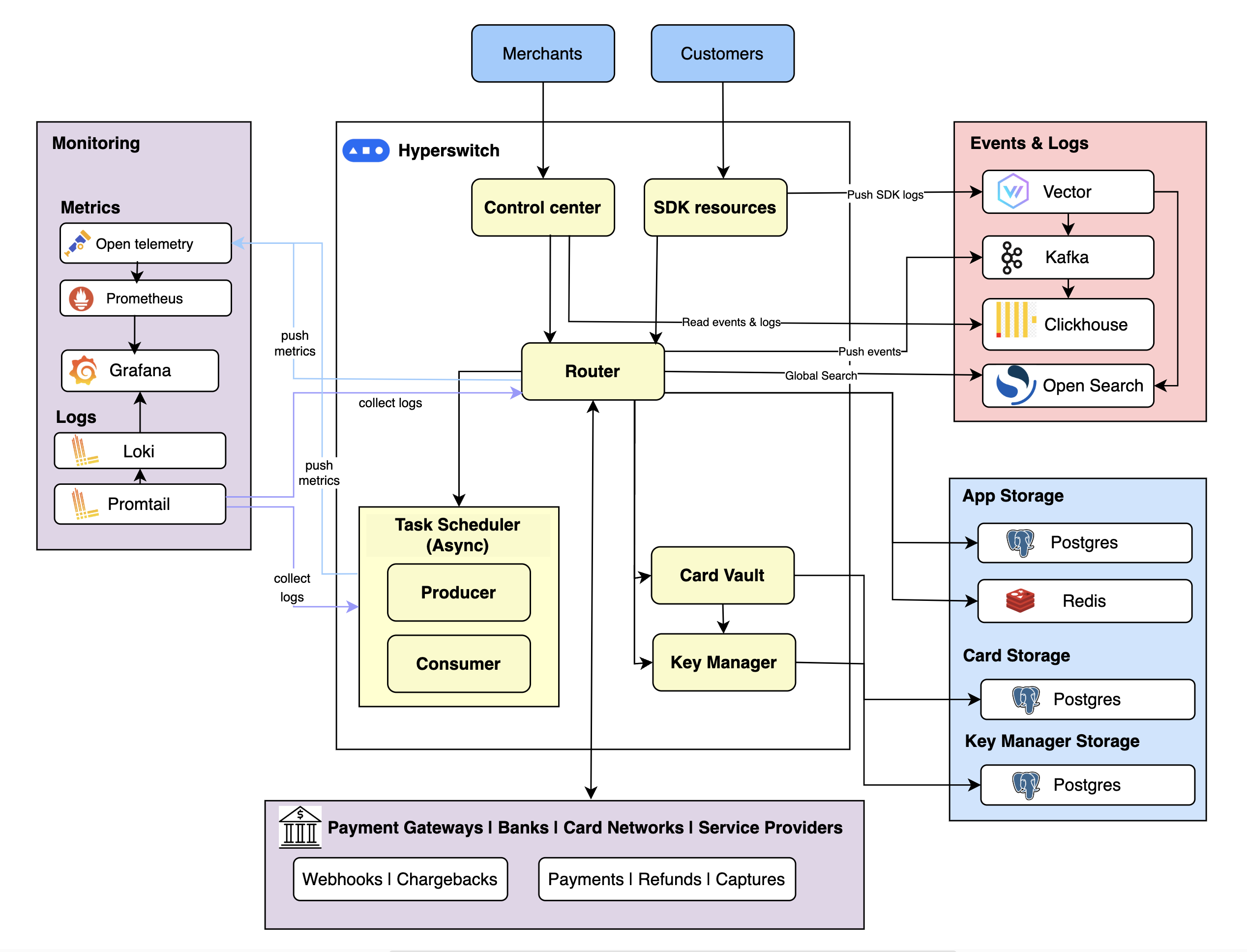
Architectural Overview

Why Hyperswitch?

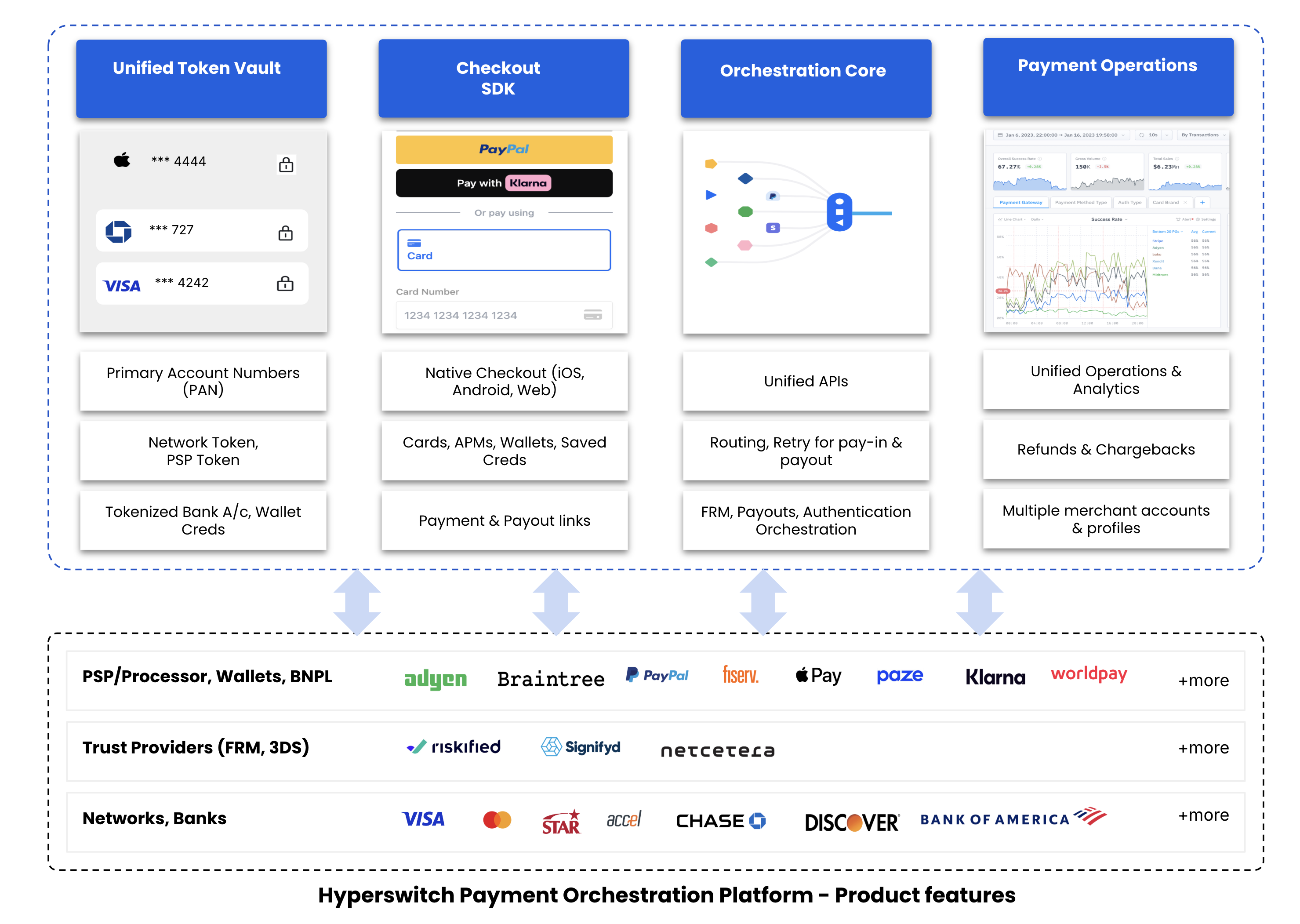
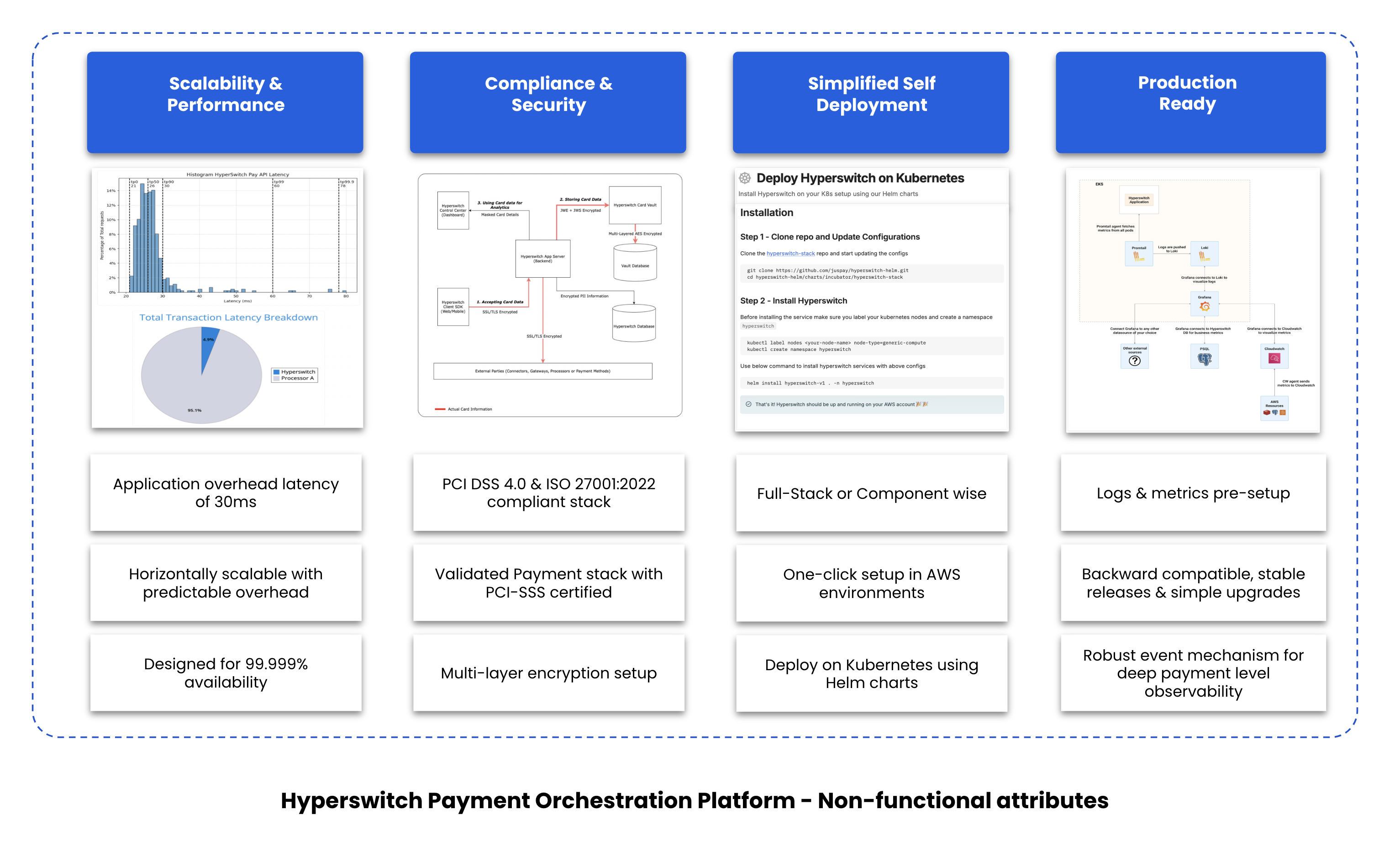
Hyperswitch is a commercial open-source payments stack purpose-built for scale, flexibility, and developer experience. Designed with a modular architecture, Hyperswitch lets you pick only the components you need—whether it’s routing, retries, vaulting, or observability—without vendor lock-in or bloated integrations.

Built in Rust for performance and reliability, Hyperswitch connects to Stripe, Adyen, Braintree, Worldpay, Checkout.com, Cybersource, and 120+ processors — exposing smart routing and retry logic, and provides a visual workflow builder in the Control Center. Whether you're integrating a full payment suite or augmenting an existing stack with a single module, Hyperswitch meets you where you are.

Common starting points: teams moving from a single Stripe/ Stripe connect or Braintree integration to multi-PSP routing, merchants replacing a payment gateway with direct acquirer connections to TSYS, JP Morgan Payments, or other acquirers, and merchants rearchitecting their payments platform through Hyperswitch while keeping their existing VGS, TokenEx or other existing vault intact.

“Linux for Payments” — Hyperswitch is a well-architected reference for teams who want to own their payments stack.

We believe in:

Supported Connectors

Hyperswitch integrates with 100+ payment processors out of the box. Each connector has a dedicated guide covering credentials setup, webhook configuration, supported payment methods, and common failure modes.

Processor Type Guide
Global Payments Payment Gateway View →
Stripe Payment Gateway View →
Paypal Payment Gateway View →
Adyen Payment Gateway View →
Bank of America Payment Gateway View →

👉 Browse all available connectors →

Hyperswitch Ecosystem Mapping

Hyperswitch is built as a set of modular services and SDKs that work together. The Rust app server in this repo is the core, and the repositories below extend it with dashboards, client SDKs, and deployment tooling.

1. Core backend services

The Rust services that process payments. The app server is the center of gravity; the vault and encryption service handle sensitive-data operations alongside it. hyperswitch-prism is a separate, lighter entry point: a unified connector library that can be used directly against payment processors without running the full switch. decision-engine is another standalone service: a routing control plane that selects the best gateway per transaction and can run independently of any orchestrator.

hyperswitch card-vault encryption-service prism decision-engine
Language Rust Rust Rust Rust Rust
Role App server. Routing, retries, vaulting, observability. PCI-compliant card storage. Encryption, decryption, KMS. Unified connector library, 100+ processors. Routing control plane. Rule-based and success-rate gateway selection. Standalone, works with any orchestrator.
Depends on card-vault, encryption-service encryption-service None None None

2. Dashboard

Merchant-facing UIs for configuring connectors, routing, and viewing transactions. Both require the hyperswitch backend to be running.

control-center control-center-embedded
Language ReScript TypeScript
Role Full merchant dashboard. Connectors, routing rules, analytics, API keys. Embeddable Hyperswitch components for partners and merchants surfacing Hyperswitch UI inside their own apps.
Depends on hyperswitch backend hyperswitch backend

3. Web checkout SDKs

How a browser talks to Hyperswitch. hyperswitch-client-core is the shared core, pulled in as a git submodule by every client SDK (web and mobile). hyperswitch-sdk-utils holds shared assets that merchants doing Headless Implementations consume directly.

hyperswitch-web client-core react-hyper-js sdk-utils
Language ReScript ReScript ReScript ReScript
Distribution npm git submodule npm git submodule
Role Primary web SDK. ReScript-built React library for unified checkout. Shared SDK core consumed transitively by every client SDK. Idiomatic React wrapper around the Hyper JS loader. Shared utilities and assets used across client-core and hyperswitch-web.
Depends on hyperswitch backend None hyperswitch-web None

4. Mobile SDKs

Native SDKs for embedding Hyperswitch checkout into mobile apps. All are built on top of hyperswitch-client-core, pulled in as a git submodule.

Android iOS React Native Flutter
Repository hyperswitch-sdk-android hyperswitch-sdk-ios react-native-hyperswitch flutter_hyperswitch
Language Kotlin Swift TypeScript Dart
Distribution Maven CocoaPods (SPM in progress) npm pub.dev
Status Officially supported Officially supported Officially supported Officially supported

[!IMPORTANT] An older repo, hyperswitch-sdk-react-native, is being deprecated and has already been removed from npm. Use react-native-hyperswitch instead.

5. Deployment & infrastructure

Tooling for running Hyperswitch, from local development through production.

hyperswitch-suite hyperswitch-helm
Tooling Terraform (HCL) Helm charts
Role Umbrella full-suite deployment that wires the core, vault, control-center, and web together. Recommended starting point for the full stack. Kubernetes deployments for GCP, Azure, or any K8s-compatible platform.

Contributing

We welcome contributors from around the world to help build Hyperswitch. Whether you're fixing bugs, improving documentation, or adding new features, your help is appreciated.

Please read our contributing guidelines to get started.

Join the conversation on Slack or explore open issues on GitHub.

Feature requests & Bugs

For new product features, enhancements, roadmap discussions, or to share queries and ideas, visit our GitHub Discussions

For reporting a bug, please read the issue guidelines and search for existing and closed issues. If your problem or idea is not addressed yet, please open a new issue.

Versioning

Check the CHANGELOG.md file for details.

This product is licensed under the Apache 2.0 License.

hyperswitch (juspay/hyperswitch)

Searching Database…

What is this?Hyperswitch is an open-source, composable payments platform that lets businesses route, retry, vault, and reconcile payments across 120+ payment processors like Stripe, Adyen, Braintree, and Worldpay, either self-hosted or as a SaaS.
Is Hyperswitch a single payment gateway or something broader?It's a modular ecosystem, not one gateway: a Rust app server is the core, backed by separate services for vaulting, encryption, routing, and reconciliation, plus web and mobile SDKs for checkout.
How do I get Hyperswitch running?For a no-setup trial, use the fully hosted sandbox from the Control Center. For local development, run the Docker/Podman quickstart script, which offers Standard, Full, or Minimal deployment profiles.
What do I need to self-host it, and can I deploy it to the cloud?Locally you need Docker or Podman to run the quickstart script. For production, Hyperswitch ships Helm charts so you can deploy to AWS, GCP, or Azure Kubernetes clusters.
Can I start processing payments right after setup?Not immediately — after the local or cloud setup finishes, you still need to configure a payment connector in the Control Center before you can test a transaction.
Who is Hyperswitch built for?It targets merchants and payment teams: those moving beyond a single Stripe/Braintree integration to multi-PSP routing, those replacing a gateway with direct acquirer connections, or those rearchitecting their stack while keeping an existing vault like VGS or TokenEx.
What payment processors does Hyperswitch connect to?It integrates with 100+ processors out of the box, including Stripe, Adyen, Braintree, Worldpay, Checkout.com, and Cybersource, each with a dedicated setup guide for credentials and webhooks.
What does the Cost Observability module do?It gives self-serve dashboards to audit and monitor payment costs, detecting hidden fees, downgrades, and penalties across your processors.
How does Hyperswitch's intelligent routing work?It routes each transaction to the processor with the highest predicted authorization rate across 120+ PSPs, reducing retries, downtime, and latency to maximize first-attempt success.
What does 'Linux for Payments' mean here?It's the project's framing of itself as a well-architected, open reference stack that teams can run and extend to own their payments infrastructure, instead of being locked into one vendor.
Creator
juspay
Size
464.8 MB
Stars
45.3K
Age
4y
Commits · 90 Days
