



Advanced AI explainability for PyTorch
pip install grad-cam
Documentation with advanced tutorials: https://jacobgil.github.io/pytorch-gradcam-book
This is a package with state of the art methods for Explainable AI for computer vision.
This can be used for diagnosing model predictions, either in production or while
developing models.
The aim is also to serve as a benchmark of algorithms and metrics for research of new explainability methods.
⭐ Comprehensive collection of Pixel Attribution methods for Computer Vision.
⭐ Tested on many Common CNN Networks and Vision Transformers.
⭐ Advanced use cases: Works with Classification, Object Detection, Semantic Segmentation, Embedding-similarity and more.
⭐ Includes smoothing methods to make the CAMs look nice.
⭐ High performance: full support for batches of images in all methods.
⭐ Includes metrics for checking if you can trust the explanations, and tuning them for best performance.
| Method |
What it does |
| GradCAM |
Weight the 2D activations by the average gradient |
| HiResCAM |
Like GradCAM but element-wise multiply the activations with the gradients; provably guaranteed faithfulness for certain models |
| GradCAMElementWise |
Like GradCAM but element-wise multiply the activations with the gradients then apply a ReLU operation before summing |
| GradCAM++ |
Like GradCAM but uses second order gradients |
| XGradCAM |
Like GradCAM but scale the gradients by the normalized activations |
| AblationCAM |
Zero out activations and measure how the output drops (this repository includes a fast batched implementation) |
| ScoreCAM |
Perbutate the image by the scaled activations and measure how the output drops |
| EigenCAM |
Takes the first principle component of the 2D Activations (no class discrimination, but seems to give great results) |
| EigenGradCAM |
Like EigenCAM but with class discrimination: First principle component of Activations*Grad. Looks like GradCAM, but cleaner |
| LayerCAM |
Spatially weight the activations by positive gradients. Works better especially in lower layers |
| FullGrad |
Computes the gradients of the biases from all over the network, and then sums them |
| Deep Feature Factorizations |
Non Negative Matrix Factorization on the 2D activations |
| KPCA-CAM |
Like EigenCAM but with Kernel PCA instead of PCA |
| FEM |
A gradient free method that binarizes activations by an activation > mean + k * std rule. |
| ShapleyCAM |
Weight the activations using the gradient and Hessian-vector product. |
| FinerCAM |
Improves fine-grained classification by comparing similar classes, suppressing shared features and highlighting discriminative details. |
| SegEigenCAM |
Like EigenCAM but with gradient weighting (absolute gradients ⊙ activations) before SVD and sign correction to fix SVD sign ambiguity; designed for semantic segmentation |
| RefineCAM |
A meta-method that computes a CAM at multiple layers, and then it combines them to ubtain a higher resolution and better focused CAM. It can be used with any of the other CAM methods. |
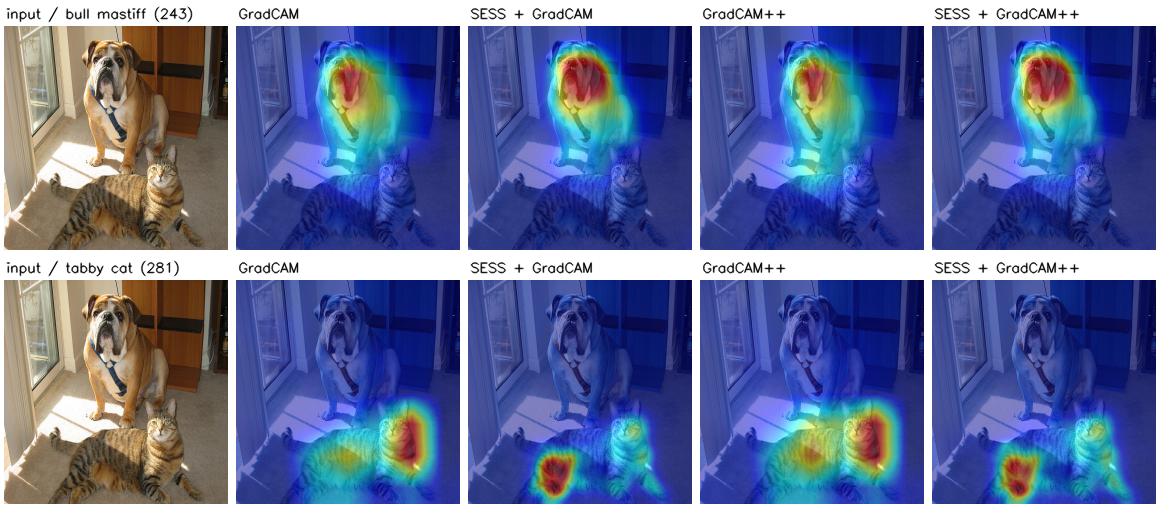
| SESS |
A meta-method that computes CAMs for sliding window patches taken at multiple scales, and fuses them with score based channel weights and a spatial weighted average. Makes the CAM robust to scale variance, multiple occurrences of the object and distractors. It can be used with any of the other CAM methods. |
Visual Examples
| What makes the network think the image label is 'pug, pug-dog' |
What makes the network think the image label is 'tabby, tabby cat' |
Combining Grad-CAM with Guided Backpropagation for the 'pug, pug-dog' class |
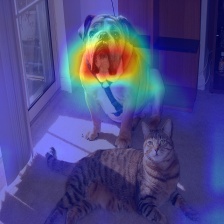 |
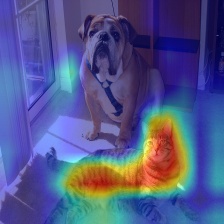 |
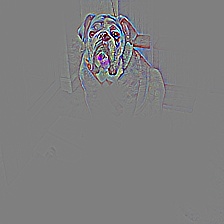 |
Object Detection and Semantic Segmentation
| Object Detection |
Semantic Segmentation |
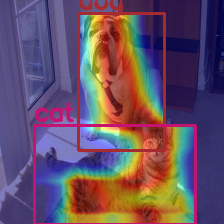 |
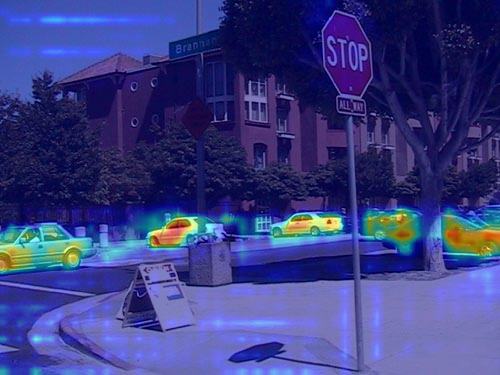 |
| 3D Medical Semantic Segmentation |
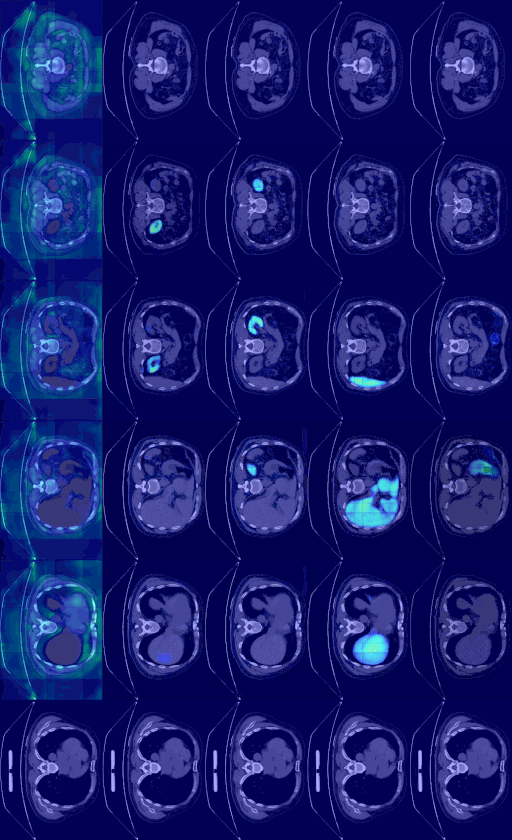 |
Explaining similarity to other images / embeddings
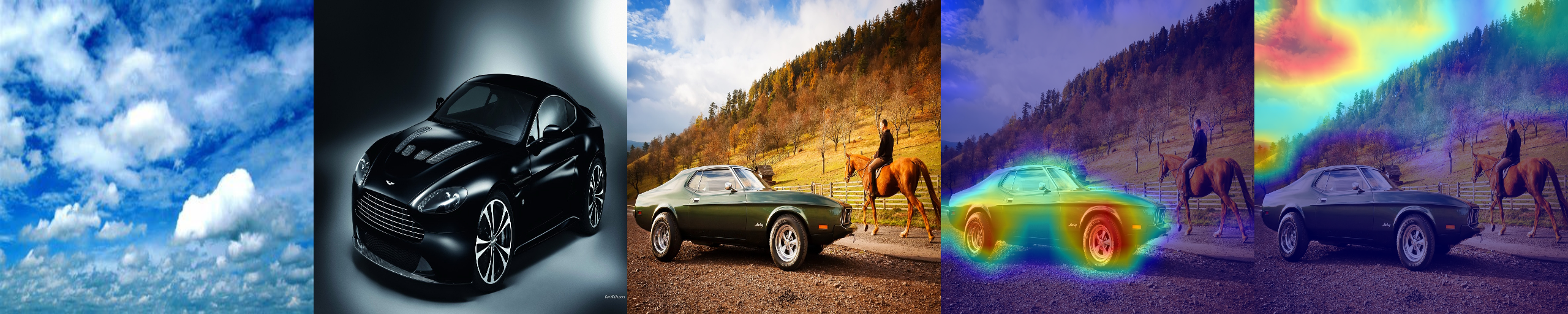
Deep Feature Factorization
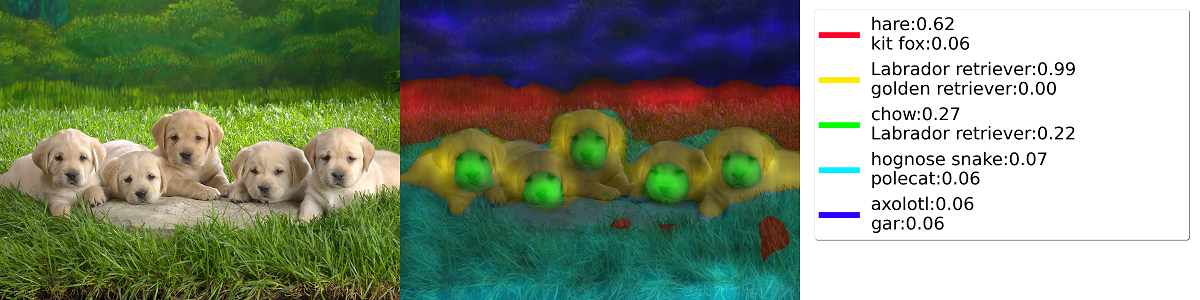
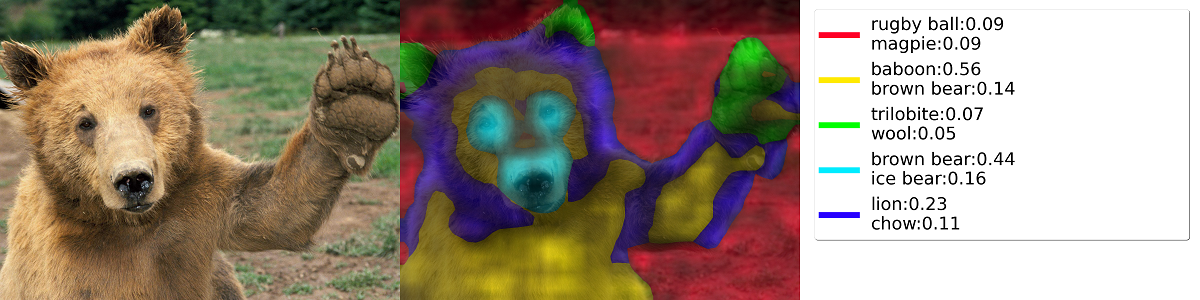
CLIP
| Explaining the text prompt "a dog" |
Explaining the text prompt "a cat" |
 |
 |
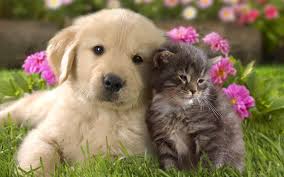
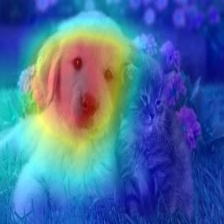
Classification
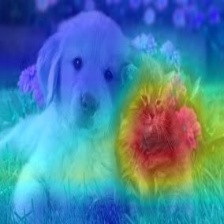
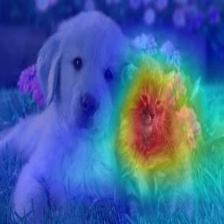
Resnet50:
| Category |
Image |
GradCAM |
AblationCAM |
ScoreCAM |
| Dog |
 |
 |
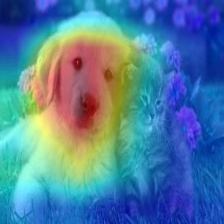 |
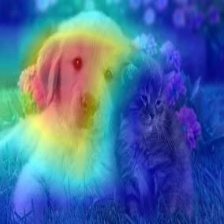 |
| Cat |
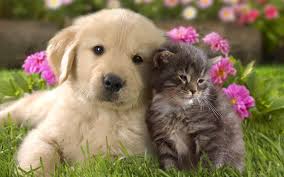 |
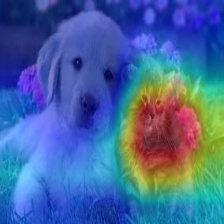 |
 |
 |
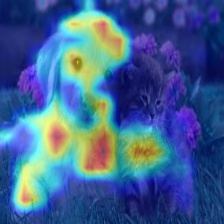
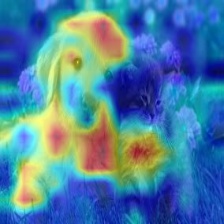
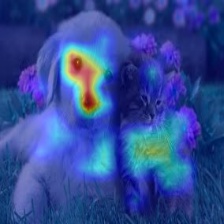
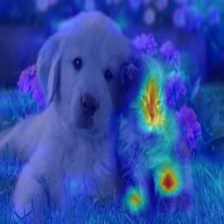
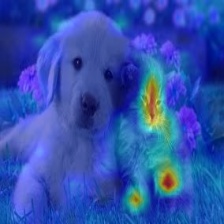
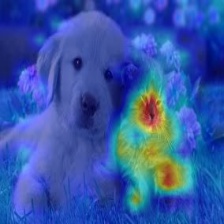
Vision Transfomer (Deit Tiny):
| Category |
Image |
GradCAM |
AblationCAM |
ScoreCAM |
| Dog |
|
 |
 |
 |
| Cat |
|
 |
 |
 |
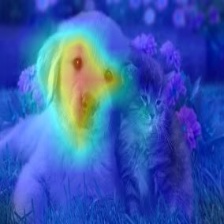
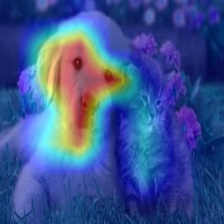
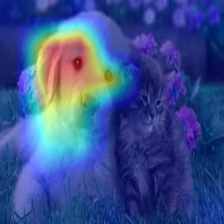
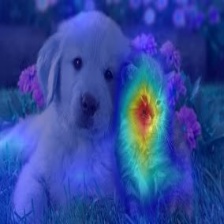
| Category |
Image |
GradCAM |
AblationCAM |
ScoreCAM |
| Dog |
|
 |
 |
 |
| Cat |
|
 |
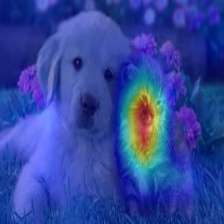 |
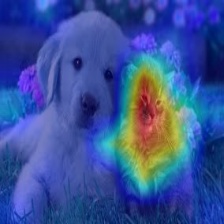 |
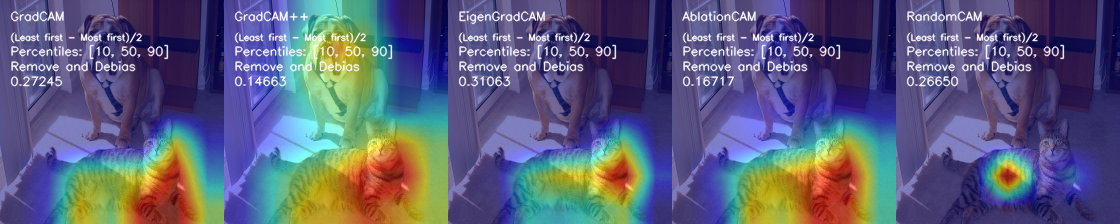
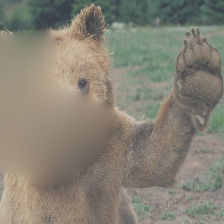
Metrics and Evaluation for XAI
Usage examples
from pytorch_grad_cam import GradCAM, HiResCAM, ScoreCAM, GradCAMPlusPlus, AblationCAM, XGradCAM, EigenCAM, FullGrad
from pytorch_grad_cam.utils.model_targets import ClassifierOutputTarget
from pytorch_grad_cam.utils.image import show_cam_on_image
from torchvision.models import resnet50, ResNet50_Weights

model = resnet50(weights=ResNet50_Weights.DEFAULT)
target_layers = [model.layer4[-1]]
input_tensor = # Create an input tensor image for your model..
# Note: input_tensor can be a batch tensor with several images!

# We have to specify the target we want to generate the CAM for.
targets = [ClassifierOutputTarget(281)]

# Construct the CAM object once, and then re-use it on many images.
with GradCAM(model=model, target_layers=target_layers) as cam:
  # You can also pass aug_smooth=True and eigen_smooth=True, to apply smoothing.
  grayscale_cam = cam(input_tensor=input_tensor, targets=targets)
  # In this example grayscale_cam has only one image in the batch:
  grayscale_cam = grayscale_cam[0, :]
  visualization = show_cam_on_image(rgb_img, grayscale_cam, use_rgb=True)
  # You can also get the model outputs without having to redo inference
  model_outputs = cam.outputs
cam.py has a more detailed usage example.
You need to choose the target layer to compute the CAM for.
Some common choices are:
- FasterRCNN: model.backbone
- Resnet18 and 50: model.layer4[-1]
- VGG, densenet161 and mobilenet: model.features[-1]
- mnasnet1_0: model.layers[-1]
- ViT: model.blocks[-1].norm1
- SwinT: model.layers[-1].blocks[-1].norm1
If you pass a list with several layers, the CAM will be averaged accross them.
This can be useful if you're not sure what layer will perform best.
Adapting for new architectures and tasks
Methods like GradCAM were designed for and were originally mostly applied on classification models,
and specifically CNN classification models.
However you can also use this package on new architectures like Vision Transformers, and on non classification tasks like Object Detection or Semantic Segmentation.
The be able to adapt to non standard cases, we have two concepts.
- The reshape transform - how do we convert activations to represent spatial images ?
- The model targets - What exactly should the explainability method try to explain ?
In a CNN the intermediate activations in the model are a mult-channel image that have the dimensions channel x rows x cols,
and the various explainabiltiy methods work with these to produce a new image.
In case of another architecture, like the Vision Transformer, the shape might be different, like (rows x cols + 1) x channels, or something else.
The reshape transform converts the activations back into a multi-channel image, for example by removing the class token in a vision transformer.
For examples, check here
The model_target argument
The model target is just a callable that is able to get the model output, and filter it out for the specific scalar output we want to explain.
For classification tasks, the model target will typically be the output from a specific category.
The targets parameter passed to the CAM method can then use ClassifierOutputTarget:
targets = [ClassifierOutputTarget(281)]
However for more advanced cases, you might want a different behaviour.
Check here for more examples.
Tutorials
Here you can find detailed examples of how to use this for various custom use cases like object detection:
These point to the new documentation jupter-book for fast rendering.
The jupyter notebooks themselves can be found under the tutorials folder in the git repository.
Guided backpropagation
from pytorch_grad_cam import GuidedBackpropReLUModel
from pytorch_grad_cam.utils.image import (
    show_cam_on_image, deprocess_image, preprocess_image
)
gb_model = GuidedBackpropReLUModel(model=model, device=model.device())
gb = gb_model(input_tensor, target_category=None)

cam_mask = cv2.merge([grayscale_cam, grayscale_cam, grayscale_cam])
cam_gb = deprocess_image(cam_mask * gb)
result = deprocess_image(gb)
Metrics and evaluating the explanations
from pytorch_grad_cam.utils.model_targets import ClassifierOutputSoftmaxTarget
from pytorch_grad_cam.metrics.cam_mult_image import CamMultImageConfidenceChange
# Create the metric target, often the confidence drop in a score of some category
metric_target = ClassifierOutputSoftmaxTarget(281)
scores, batch_visualizations = CamMultImageConfidenceChange()(input_tensor,
  inverse_cams, targets, model, return_visualization=True)
visualization = deprocess_image(batch_visualizations[0, :])

# State of the art metric: Remove and Debias
from pytorch_grad_cam.metrics.road import ROADMostRelevantFirst, ROADLeastRelevantFirst
cam_metric = ROADMostRelevantFirst(percentile=75)
scores, perturbation_visualizations = cam_metric(input_tensor,
  grayscale_cams, targets, model, return_visualization=True)

# You can also average across different percentiles, and combine
# (LeastRelevantFirst - MostRelevantFirst) / 2
from pytorch_grad_cam.metrics.road import ROADMostRelevantFirstAverage,
                                          ROADLeastRelevantFirstAverage,
                                          ROADCombined
cam_metric = ROADCombined(percentiles=[20, 40, 60, 80])
scores = cam_metric(input_tensor, grayscale_cams, targets, model)

# You can also use aggregate metrics such as ARCC
from pytorch_grad_cam.metrics.ARCC import ARCC

cam_metric = ARCC(base_method=cam)
arcc_score = cam_metric(input_tensor, grayscale_cams, targets, model)
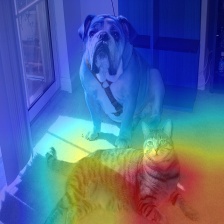
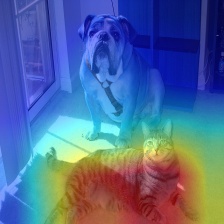
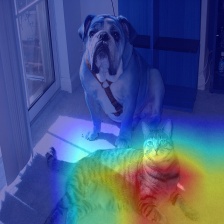
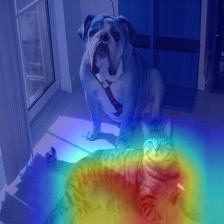
Smoothing to get nice looking CAMs
To reduce noise in the CAMs, and make it fit better on the objects,
two smoothing methods are supported:
aug_smooth=True
Test time augmentation: increases the run time by x6.
Applies a combination of horizontal flips, and mutiplying the image
by [1.0, 1.1, 0.9].
This has the effect of better centering the CAM around the objects.
eigen_smooth=True
First principle component of activations*weights
This has the effect of removing a lot of noise.
| AblationCAM |
aug smooth |
eigen smooth |
aug+eigen smooth |
 |
 |
 |
 |
Enhancing the CAM with scaling and sliding (SESS)
SESS is a method agnostic wrapper around any of the other CAM methods.
It resizes the image to several scales, slides a window over every scale, and fuses
the CAM of every patch back into the original image coordinates, weighted by the
score the model gives that patch.
This makes the CAM robust to scale variance, to multiple occurrences of the object
and to distractors, at the cost of running the base method once per patch.
from pytorch_grad_cam import SESS, GradCAM

with SESS(model=model,
          target_layers=target_layers,
          base_method=GradCAM) as cam:
    grayscale_cam = cam(input_tensor=input_tensor, targets=targets)
The run time is controlled by the number of scales and by the sliding window stride:
cam = SESS(model=model,
           target_layers=target_layers,
           base_method=GradCAM,
           num_scales=4,      # The image is resized to 4 scales instead of 12
           step_size=224,     # Non overlapping windows
           pre_filter_ratio=0.5,  # Skip the 50% lowest scoring patches
           batch_size=32)
Running the example script:
Usage: python cam.py --image-path <path_to_image> --method <method> --output-dir <output_dir_path>
To use with a specific device, like cpu, cuda, cuda:0, mps or hpu:
python cam.py --image-path <path_to_image> --device cuda --output-dir <output_dir_path>
You can choose between:
GradCAM , HiResCAM, ScoreCAM, GradCAMPlusPlus, AblationCAM, XGradCAM , LayerCAM, FullGrad, EigenCAM, ShapleyCAM, FinerCAM, SegEigenCAM and RefineCAM.
Some methods like ScoreCAM and AblationCAM require a large number of forward passes,
and have a batched implementation.
You can control the batch size with
cam.batch_size =
Citation
If you use this for research, please cite. Here is an example BibTeX entry:
@misc{jacobgilpytorchcam,
  title={PyTorch library for CAM methods},
  author={Jacob Gildenblat and contributors},
  year={2021},
  publisher={GitHub},
  howpublished={\url{https://github.com/jacobgil/pytorch-grad-cam}},
}
References
https://arxiv.org/abs/1610.02391
Grad-CAM: Visual Explanations from Deep Networks via Gradient-based Localization Ramprasaath R. Selvaraju, Michael Cogswell, Abhishek Das, Ramakrishna Vedantam, Devi Parikh, Dhruv Batra
https://arxiv.org/abs/2011.08891
Use HiResCAM instead of Grad-CAM for faithful explanations of convolutional neural networks Rachel L. Draelos, Lawrence Carin
https://arxiv.org/abs/1710.11063
Grad-CAM++: Improved Visual Explanations for Deep Convolutional Networks Aditya Chattopadhyay, Anirban Sarkar, Prantik Howlader, Vineeth N Balasubramanian
https://arxiv.org/abs/1910.01279
Score-CAM: Score-Weighted Visual Explanations for Convolutional Neural Networks Haofan Wang, Zifan Wang, Mengnan Du, Fan Yang, Zijian Zhang, Sirui Ding, Piotr Mardziel, Xia Hu
https://ieeexplore.ieee.org/abstract/document/9093360/
`Ablation-cam: Visual explanations for deep convolutional network via gradient-free localizati

 Это Python-пакет, который реализует множество современных методов объяснимого ИИ (Explainable AI), а именно пиксельной атрибуции и карт активации классов (Class Activation Map, CAM) для моделей компьютерного зрения. Он позволяет визуализировать, на каких частях изображения фокусируется модель.