








What is this?
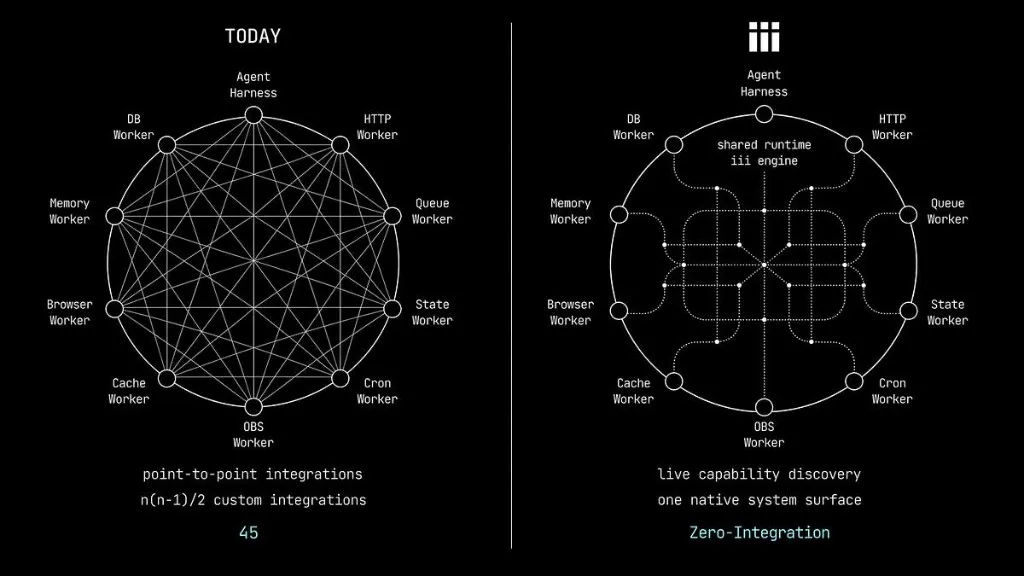
 iii is a real-time engine for your backend stack: queues, cron, HTTP, state, observability, agents, and sandboxes are collapsed into one live system surface where every service is composable and observable.
iii is a real-time engine for your backend stack: queues, cron, HTTP, state, observability, agents, and sandboxes are collapsed into one live system surface where every service is composable and observable.So is it a library I import, or something I run?It is a Rust engine you run. Your services connect as workers through SDKs, register with the engine, and immediately join a live catalog that every other worker can see and call.
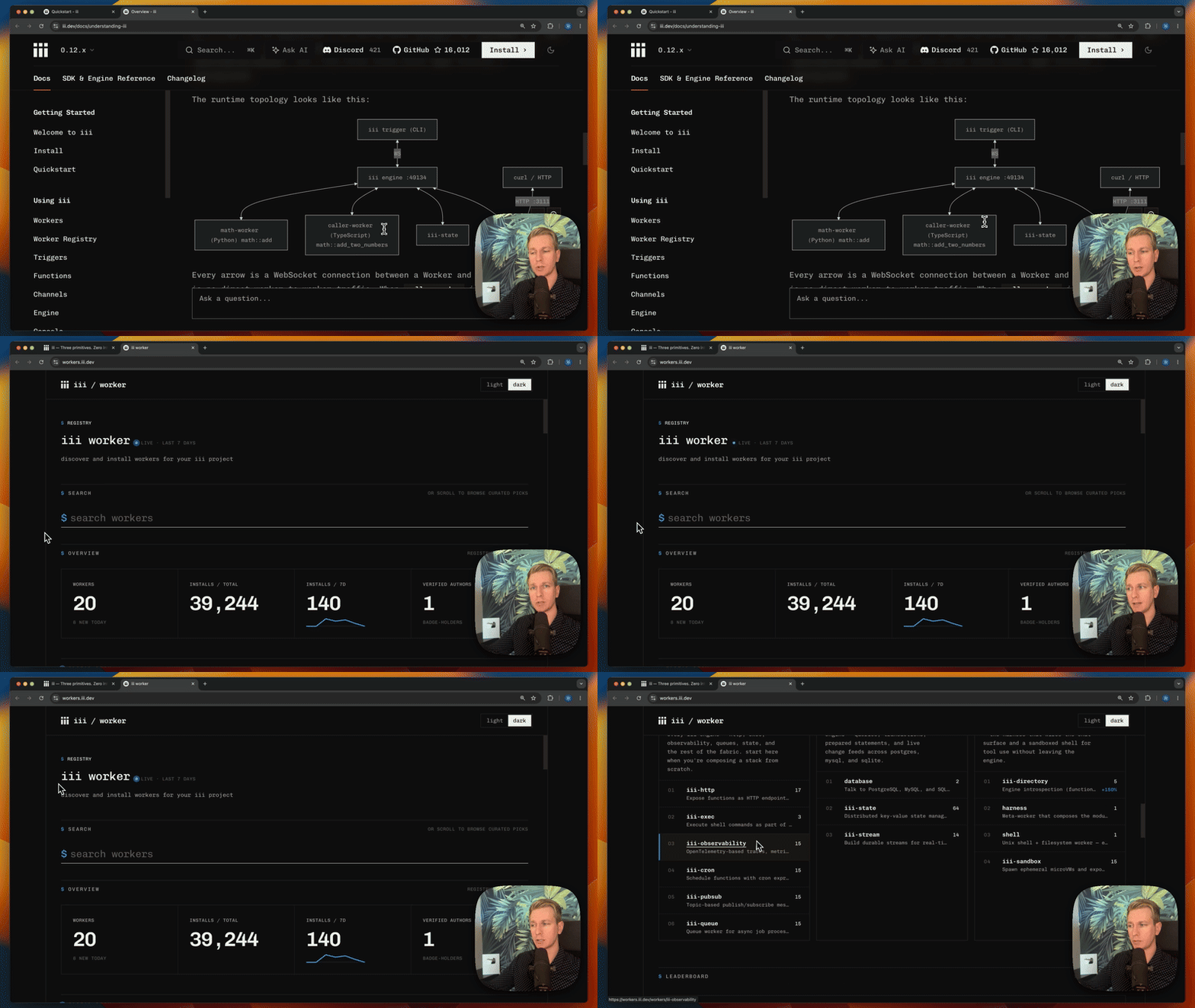
It is a Rust engine you run. Your services connect as workers through SDKs, register with the engine, and immediately join a live catalog that every other worker can see and call.How do I get it running?Install the iii CLI, declare your project workers in worker-compose.yaml, and start the whole stack with: iii compose --up. Ready-made workers can be browsed at workers.iii.dev.
Install the iii CLI, declare your project workers in worker-compose.yaml, and start the whole stack with: iii compose --up. Ready-made workers can be browsed at workers.iii.dev.Which languages can I write workers in?Official SDKs exist for Node.js (iii-sdk via npm/pnpm, requires Node >= 20), Python (pip install iii-sdk), Rust (add to Cargo.toml), and Go (go get github.com/iii-hq/iii).
Official SDKs exist for Node.js (iii-sdk via npm/pnpm, requires Node >= 20), Python (pip install iii-sdk), Rust (add to Cargo.toml), and Go (go get github.com/iii-hq/iii).Who works with it day to day?Platform teams publish workers, application teams register functions and declare triggers, and AI agents use the same catalog and the same function calls — one surface for all three.
Platform teams publish workers, application teams register functions and declare triggers, and AI agents use the same catalog and the same function calls — one surface for all three.Is it fully open source?Not entirely. The engine runtime is Elastic License 2.0 (source-available with restrictions), while all SDKs, the CLI, the console, docs, and the website are Apache 2.0.
Not entirely. The engine runtime is Elastic License 2.0 (source-available with restrictions), while all SDKs, the CLI, the console, docs, and the website are Apache 2.0.What is the core mental model?Three primitives: Worker, Function, Trigger. Workers register functions with stable ids like content::classify, and triggers are declarative — a direct call, HTTP endpoint, cron schedule, queue subscription, state change, or stream event — with iii handling routing, serialization, and delivery.
Three primitives: Worker, Function, Trigger. Workers register functions with stable ids like content::classify, and triggers are declarative — a direct call, HTTP endpoint, cron schedule, queue subscription, state change, or stream event — with iii handling routing, serialization, and delivery.How do AI agents fit in?Agents use the same catalog as developers: when a task needs a capability the system lacks, an agent can add a worker, discover its functions, call them, and trace what happened. Agent-readable skill docs install with npx skills add iii-hq/iii.
Agents use the same catalog as developers: when a task needs a capability the system lacks, an agent can add a worker, discover its functions, call them, and trace what happened. Agent-readable skill docs install with npx skills add iii-hq/iii.Can services be added while everything is running?Yes — Compose can add workers at runtime, so agents and applications can extend the live system without a restart. Workers can also be declared up front in worker-compose.yaml.
Yes — Compose can add workers at runtime, so agents and applications can extend the live system without a restart. Workers can also be declared up front in worker-compose.yaml.How do I see what the system is doing?The bundled iii-console lets developers and operators inspect workers, functions, triggers, queues, traces, logs, and real-time state. It is a React + Rust app that ships in this repo.
The bundled iii-console lets developers and operators inspect workers, functions, triggers, queues, traces, logs, and real-time state. It is a React + Rust app that ships in this repo.What are similar projects?encore, electric, flue, mem0, mcp-toolbox, evenfire, openclaw-enterprise, carno.js
encore, electric, flue, mem0, mcp-toolbox, evenfire, openclaw-enterprise, carno.jsWhich topics is it in?primitives, genai, engine, message-queue, cron, microservices, monorepo, sandbox, http, orchestration, observability, real-time
primitives, genai, engine, message-queue, cron, microservices, monorepo, sandbox, http, orchestration, observability, real-time