







What is this?
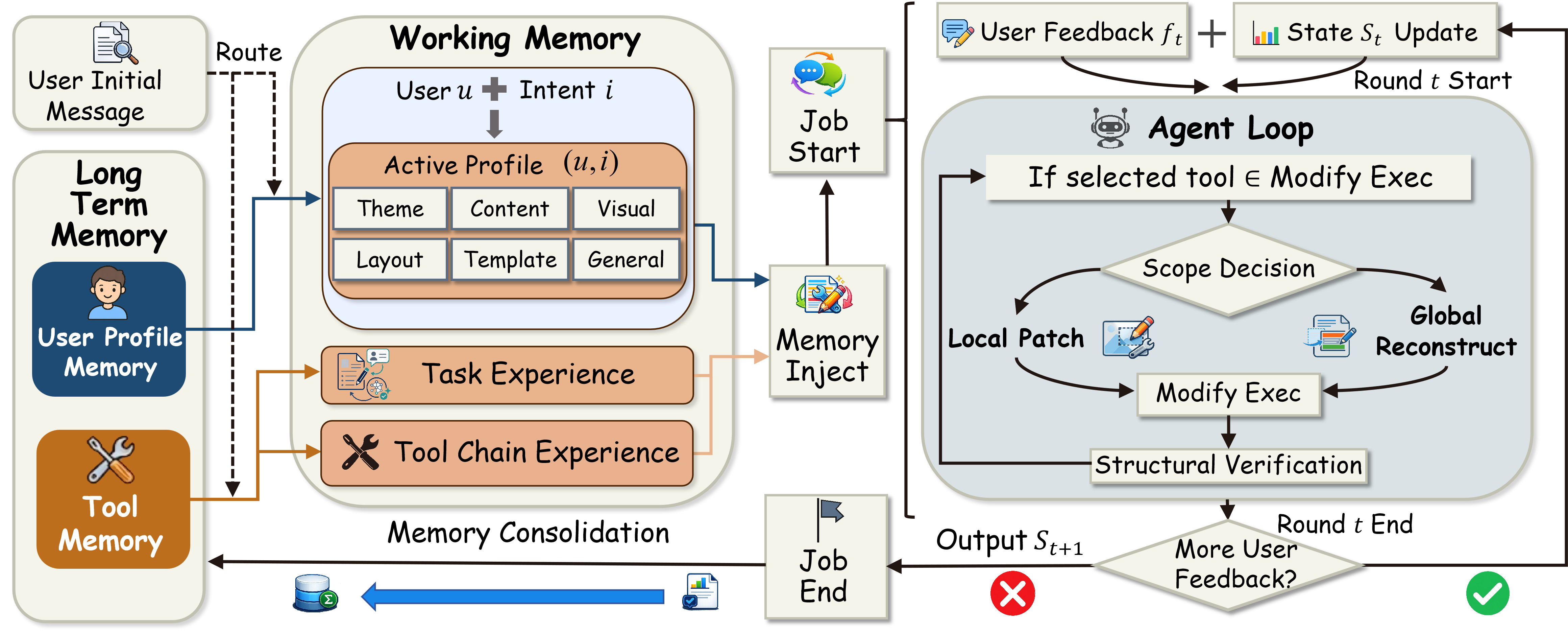
 MemSlides is a hierarchical memory-driven agent framework that treats slide generation as a stateful authoring process. It uses layered memory (user profile, working, tool) to personalize decks and apply scoped local revisions instead of regenerating the whole presentation.
MemSlides is a hierarchical memory-driven agent framework that treats slide generation as a stateful authoring process. It uses layered memory (user profile, working, tool) to personalize decks and apply scoped local revisions instead of regenerating the whole presentation.Is this a ready-made app or a framework I build on?It is a Python framework and CLI exposing public entry points (generate, revise, template induct) plus an experiment runner, not a hosted product; the hosted trial lives separately at memslides.com.
It is a Python framework and CLI exposing public entry points (generate, revise, template induct) plus an experiment runner, not a hosted product; the hosted trial lives separately at memslides.com.How do I get it running?Install from source, then run the built-in smoke suite to verify the install; the same experiment can also be run inside the project's Docker environment.
Install from source, then run the built-in smoke suite to verify the install; the same experiment can also be run inside the project's Docker environment.Do I need my own API keys to generate real slides?Yes — real generation experiments require user-provided model and service credentials, supplied via environment variables, a .env file, or a private YAML file selected with MEMSLIDESCONFIGFILE or --config.
Yes — real generation experiments require user-provided model and service credentials, supplied via environment variables, a .env file, or a private YAML file selected with MEMSLIDESCONFIGFILE or --config.Does the included smoke suite test real generation?No, smokeminimal is only a small verification suite; it doesn't exercise full real-model generation, though you can point the runner at your own suite YAML or a packaged suite name.
No, smokeminimal is only a small verification suite; it doesn't exercise full real-model generation, though you can point the runner at your own suite YAML or a packaged suite name.What happens to my credentials and generated files?Credentials must stay in environment variables, .env, or private YAML files, and generated workspaces, caches, and private config must never be committed; network access for search or model calls only happens if you supply those credentials.
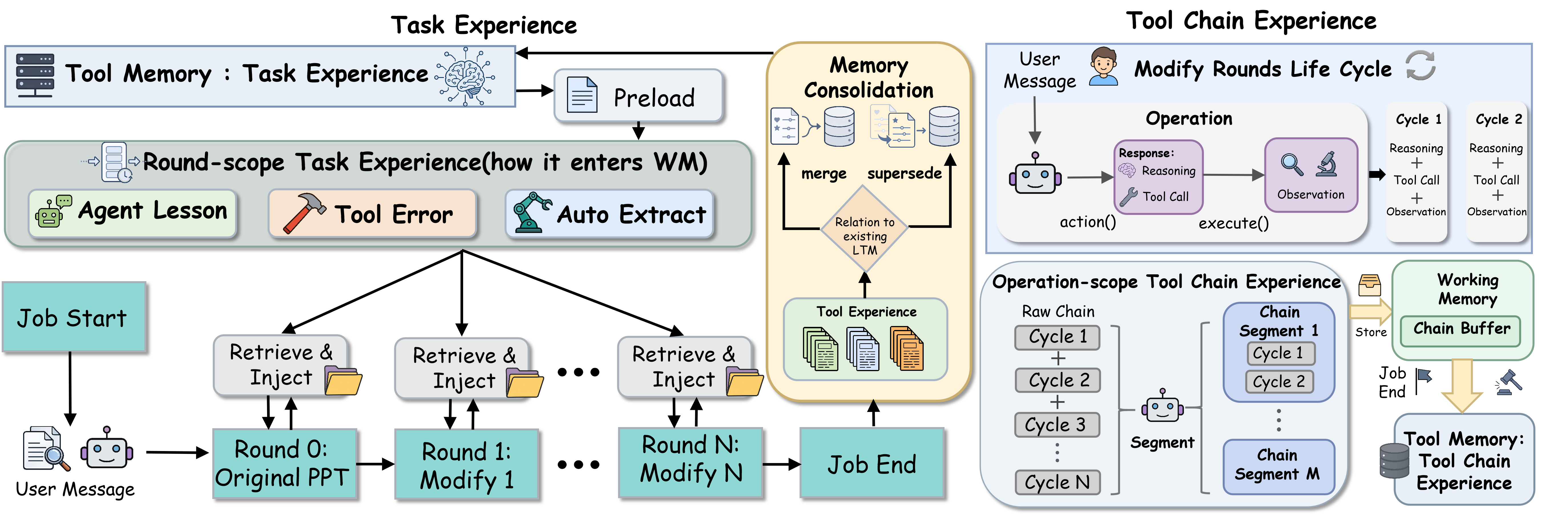
Credentials must stay in environment variables, .env, or private YAML files, and generated workspaces, caches, and private config must never be committed; network access for search or model calls only happens if you supply those credentials.What does tool memory actually store?Tool memory stores reusable execution experience from prior editing tasks, so future localized edits of a similar kind can avoid repeating the same execution failures.
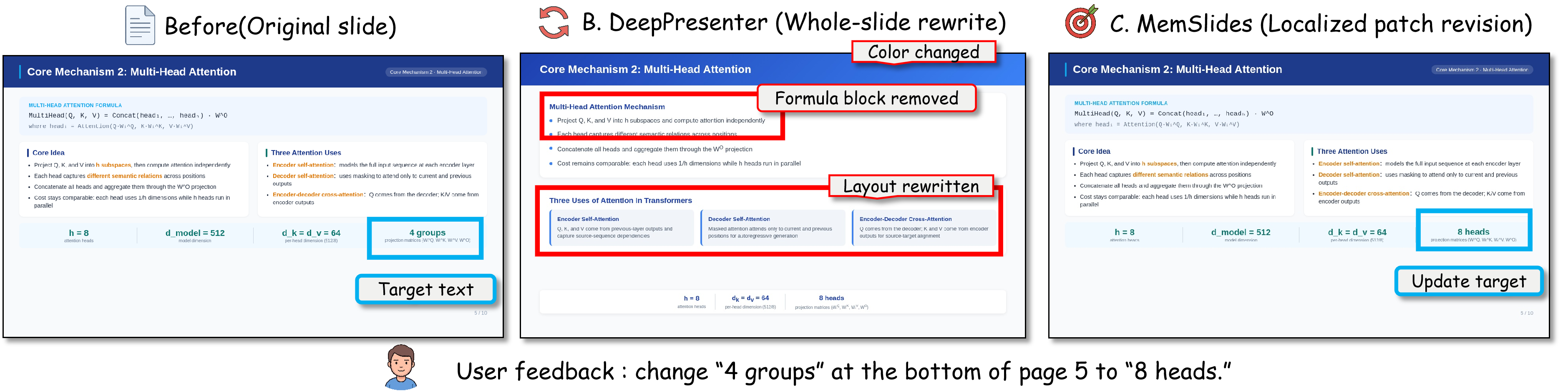
Tool memory stores reusable execution experience from prior editing tasks, so future localized edits of a similar kind can avoid repeating the same execution failures.Why patch only part of a slide instead of regenerating the whole deck?Revision feedback is projected onto the smallest affected slide region and applied as a scoped local patch, which keeps already-aligned content stable and reduces unintended drift from full-deck regeneration.
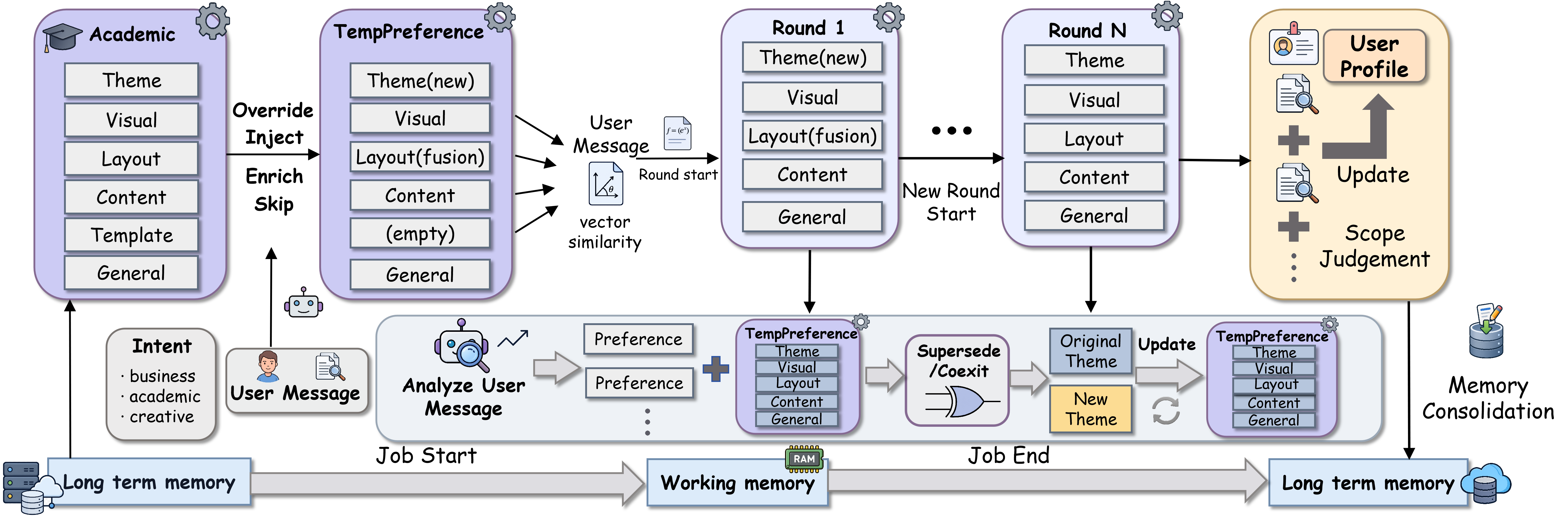
Revision feedback is projected onto the smallest affected slide region and applied as a scoped local patch, which keeps already-aligned content stable and reduces unintended drift from full-deck regeneration.How is user profile memory different from working memory?User profile memory is persistent and routes intent-matched personal preferences like theme and layout into new jobs, while working memory is session-scoped and tracks active constraints and edit-state across multi-turn revisions on the current deck.
User profile memory is persistent and routes intent-matched personal preferences like theme and layout into new jobs, while working memory is session-scoped and tracks active constraints and edit-state across multi-turn revisions on the current deck.Does MemSlides work with MCP?Yes — the README recommends using the MCP configuration together with the public CLI instead of importing the removed internal tool modules directly.
Yes — the README recommends using the MCP configuration together with the public CLI instead of importing the removed internal tool modules directly.What are similar projects?mem0, EverOS, memoket-kite, VoiceMem, evolver, Recuris, Raven, trae-agent
mem0, EverOS, memoket-kite, VoiceMem, evolver, Recuris, Raven, trae-agentWhich topics is it in?slide, presentations, memory-engine, memory-system, llm-tools, slides, long-term-memory, yaml, agent-memory, academic-research, model-context-protocol, ai-agent
slide, presentations, memory-engine, memory-system, llm-tools, slides, long-term-memory, yaml, agent-memory, academic-research, model-context-protocol, ai-agent