814 ·GitHub
What is this?
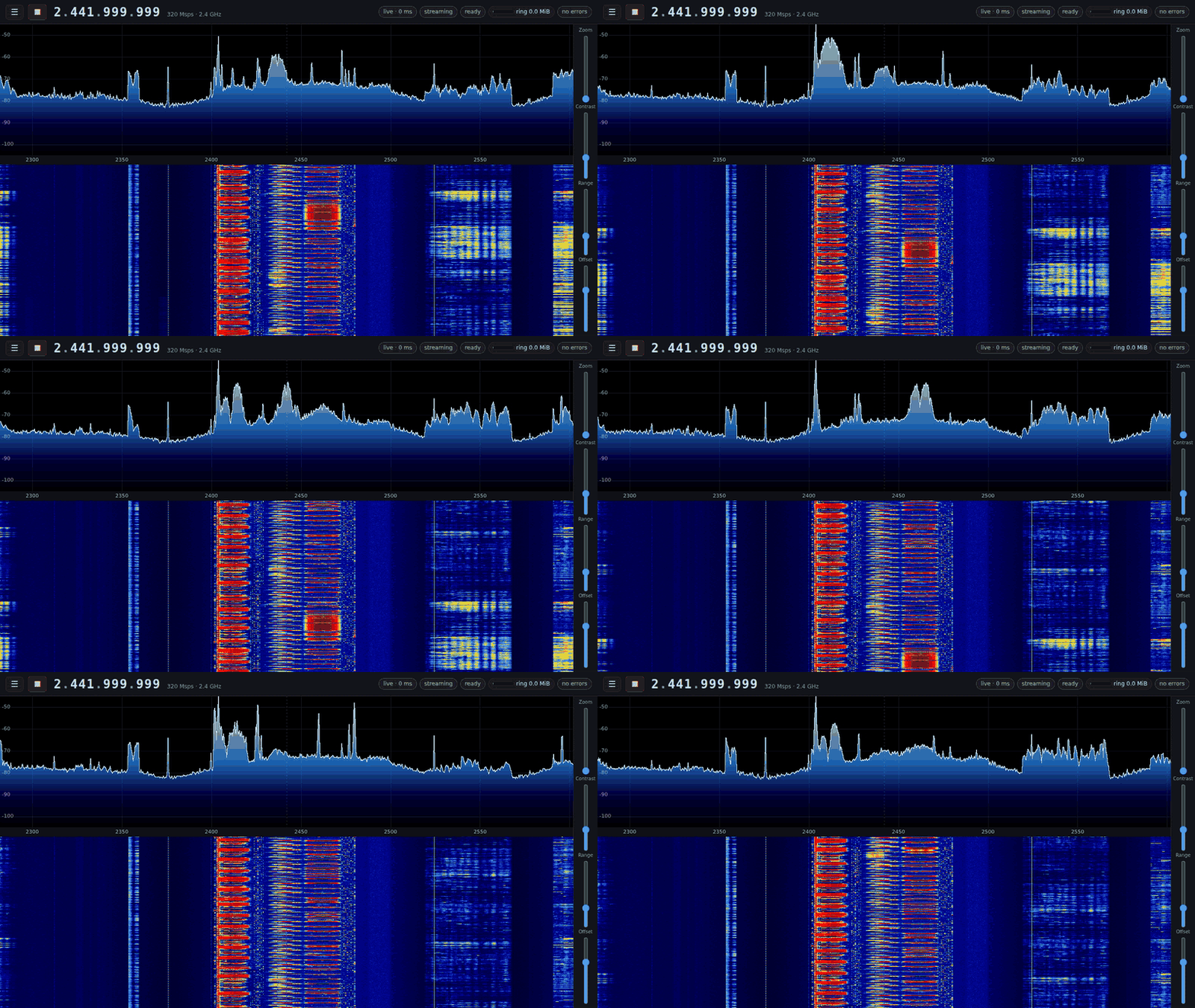
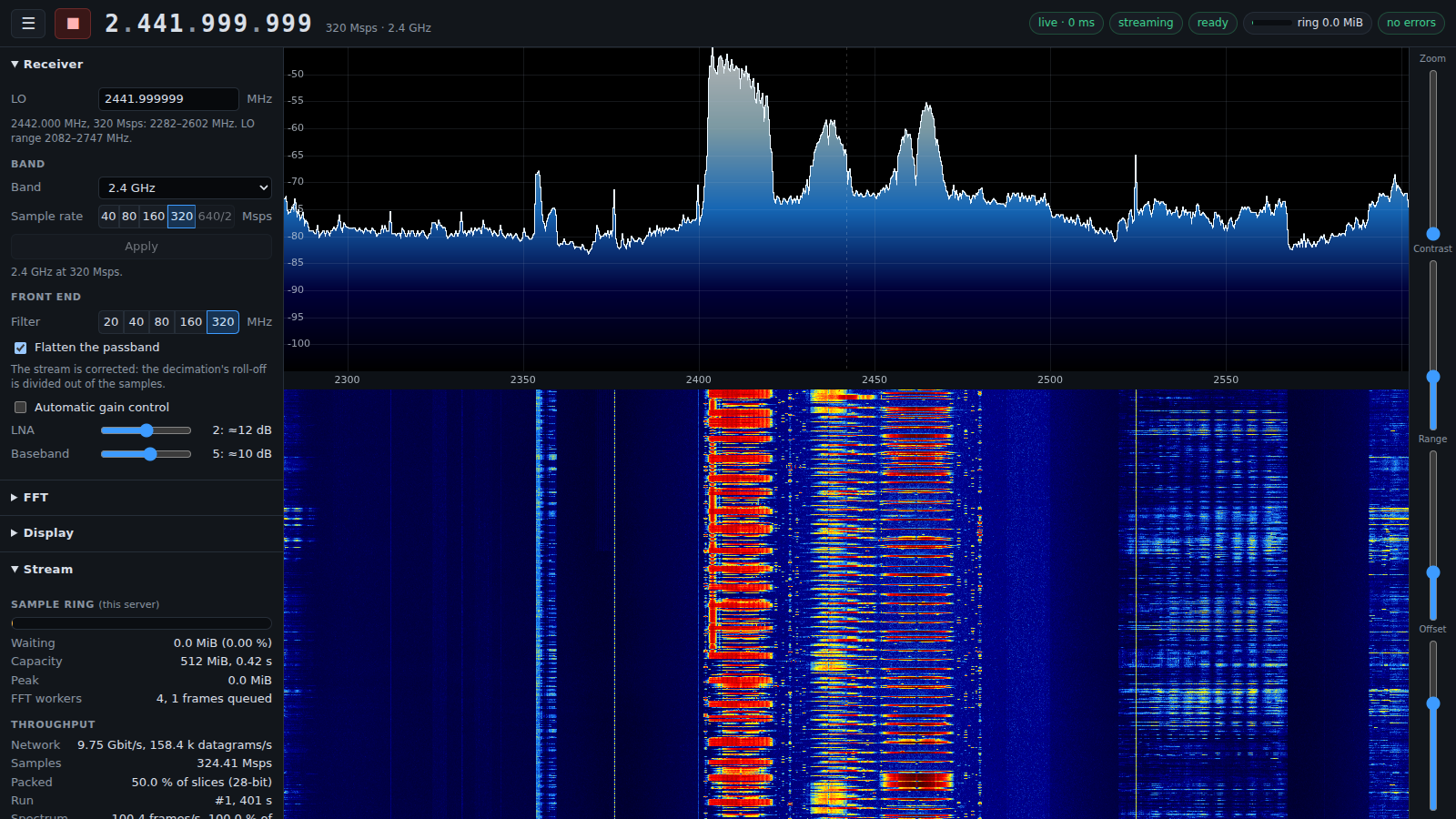
 W1700K SDR turns a Gemtek W1700K Wi-Fi 7 router into a wideband software-defined receiver: the router's MediaTek MT7996 radio captures raw 14-bit IQ at up to 320 Msps, its AN7581 SoC streams it over 10 GbE, and a Linux host shows it as a live spectrum and waterfall in the browser.
W1700K SDR turns a Gemtek W1700K Wi-Fi 7 router into a wideband software-defined receiver: the router's MediaTek MT7996 radio captures raw 14-bit IQ at up to 320 Msps, its AN7581 SoC streams it over 10 GbE, and a Linux host shows it as a live spectrum and waterfall in the browser.Do I install something on my computer, or is this firmware flashed onto the router?Both: custom firmware (a ROM patch plus the WM and WA programs, with no MediaTek code) replaces the router's stock radio/SoC firmware, and separate host software (w1700k-stream, w1700k-spectrum, sdr-recv) runs on a Linux PC to receive the IQ stream and show the browser UI.
Both: custom firmware (a ROM patch plus the WM and WA programs, with no MediaTek code) replaces the router's stock radio/SoC firmware, and separate host software (w1700k-stream, w1700k-spectrum, sdr-recv) runs on a Linux PC to receive the IQ stream and show the browser UI.How do I get it running?Wire a 3.3V USB serial adapter to the W1700K's console header, an Ethernet cable to its lan3 port for installation, and a 10 GbE NIC on the host to its wan port, then flash with init/install; afterward you just open the web UI and press play to load and start the radio firmware.
Wire a 3.3V USB serial adapter to the W1700K's console header, an Ethernet cable to its lan3 port for installation, and a 10 GbE NIC on the host to its wan port, then flash with init/install; afterward you just open the web UI and press play to load and start the radio firmware.What do I need on the build machine besides the router hardware?Building needs a C/C++ compiler, make, git, Python 3.10+, the usual Buildroot prerequisites, clang, ld.lld, llvm-objcopy and llvm-readobj for the RISC-V firmware, openssl for the firmware container, and libfftw3-dev plus zlib for the stream and spectrum servers.
Building needs a C/C++ compiler, make, git, Python 3.10+, the usual Buildroot prerequisites, clang, ld.lld, llvm-objcopy and llvm-readobj for the RISC-V firmware, openssl for the firmware container, and libfftw3-dev plus zlib for the stream and spectrum servers.Is it safe to flash, and can I undo it?The custom firmware is receive-only (the transmit path stays disabled) and never writes MediaTek's permanent eFuse bit, but installing it replaces the router's stock OS entirely; init/install first backs up the NAND so init/restore can return the unit to stock, and poking undocumented registers can hang the SoC until a power cycle.
The custom firmware is receive-only (the transmit path stays disabled) and never writes MediaTek's permanent eFuse bit, but installing it replaces the router's stock OS entirely; init/install first backs up the NAND so init/restore can return the unit to stock, and poking undocumented registers can hang the SoC until a power cycle.Why doesn't it just use MediaTek's vendor firmware?Everything that runs on the radio is written from scratch for this project (the ROM patch, WM and WA), with no MediaTek code included. The radio's cold-boot bring-up and calibration were decoded register by register from a trace of MediaTek's own firmware, so no vendor blobs are downloaded or needed at runtime.
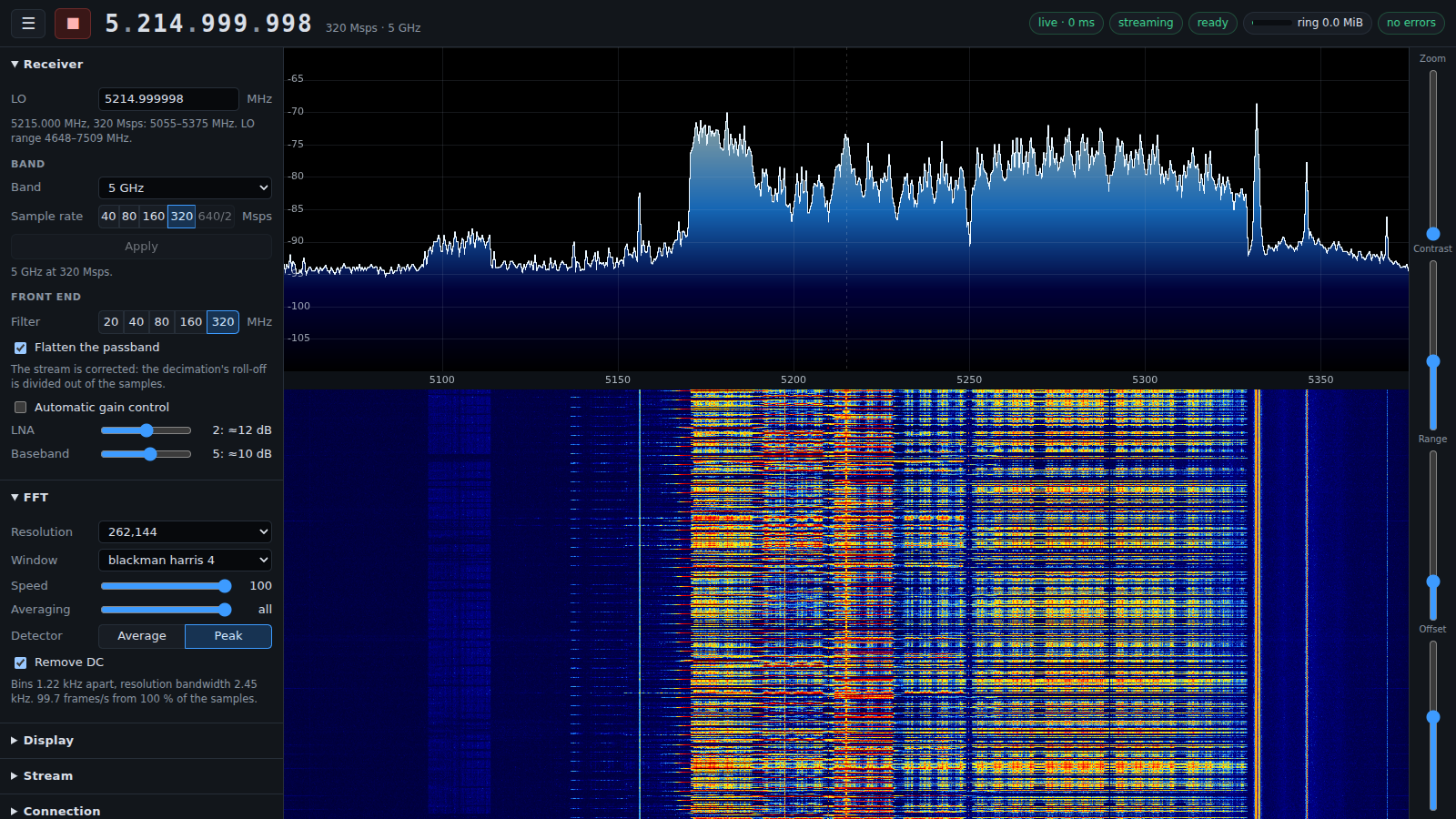
Everything that runs on the radio is written from scratch for this project (the ROM patch, WM and WA), with no MediaTek code included. The radio's cold-boot bring-up and calibration were decoded register by register from a trace of MediaTek's own firmware, so no vendor blobs are downloaded or needed at runtime.What sample rates and bands can it capture?It captures 14-bit complex IQ at 40, 80, 160 or 320 Msps across the 2.4, 5 and 6 GHz bands using the MT7976/MT7977 radios, plus an extra 640/2 Msps mode on band 2. The LO can tune to any frequency the band's synthesizer locks on, and it can be retuned mid-stream in about 1 ms.
It captures 14-bit complex IQ at 40, 80, 160 or 320 Msps across the 2.4, 5 and 6 GHz bands using the MT7976/MT7977 radios, plus an extra 640/2 Msps mode on band 2. The LO can tune to any frequency the band's synthesizer locks on, and it can be retuned mid-stream in about 1 ms.Can I go back to stock firmware if something breaks?Yes - init/install backs up the NAND's original data to the host before flashing, and init/restore writes that backup back to return the unit to its stock MediaTek firmware.
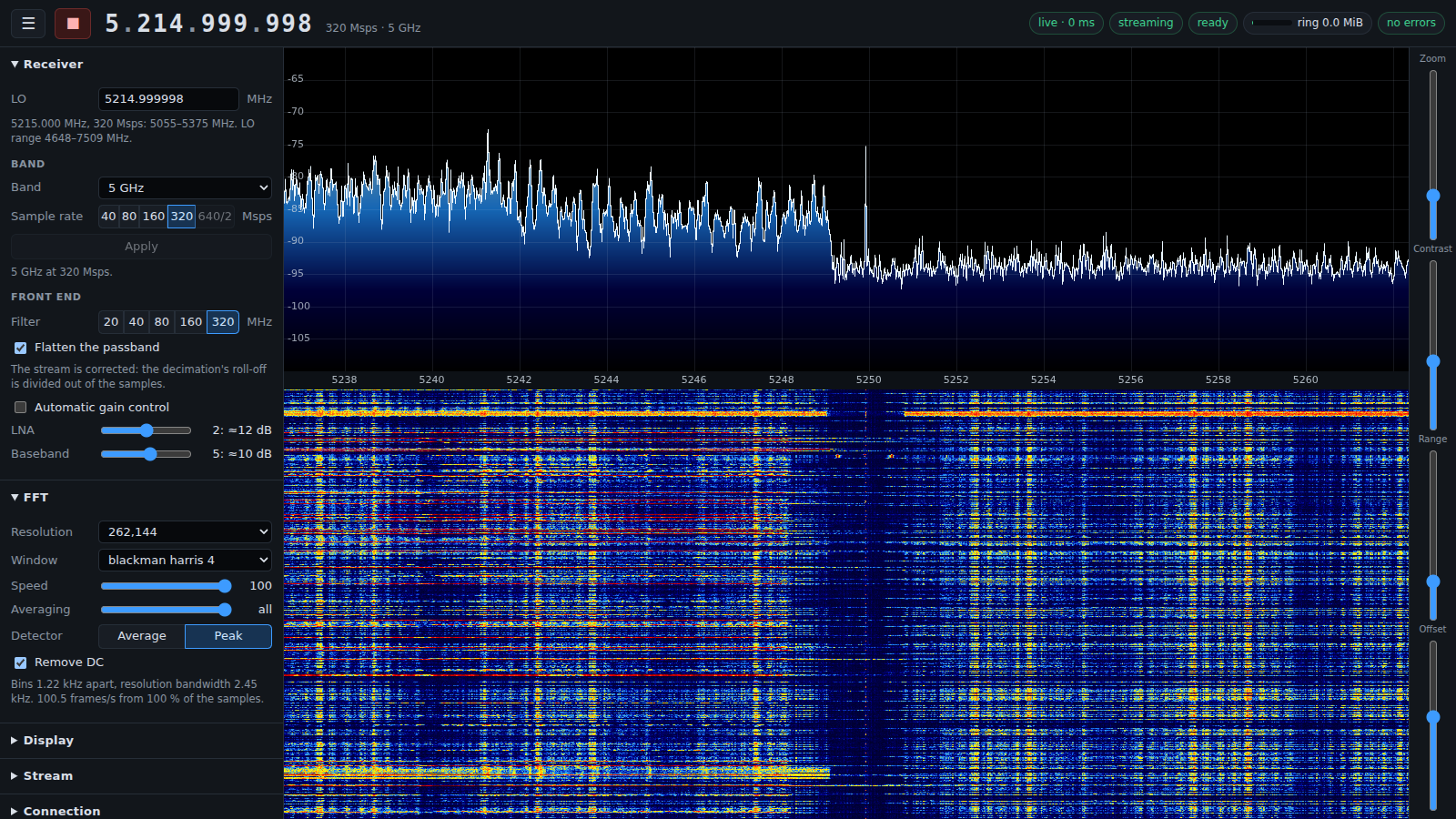
Yes - init/install backs up the NAND's original data to the host before flashing, and init/restore writes that backup back to return the unit to its stock MediaTek firmware.How fast is the live spectrum display?w1700k-spectrum runs a 262,144-point FFT over every sample at 100 spectra per second, with the decimation's roll-off corrected ('flattened') in the stream, rendered live in the browser next to the receiver controls.
w1700k-spectrum runs a 262,144-point FFT over every sample at 100 spectra per second, with the decimation's roll-off corrected ('flattened') in the stream, rendered live in the browser next to the receiver controls.What are similar projects?esp-sdr, ESP32-Bit-Pirate, mu300-linux, BLEhound, immortalwrt, unleashed-firmware, wifit3, xcertplay
esp-sdr, ESP32-Bit-Pirate, mu300-linux, BLEhound, immortalwrt, unleashed-firmware, wifit3, xcertplay