About
The gRPC-Gateway is a plugin of the Google protocol buffers compiler
protoc.
It reads protobuf service definitions and generates a reverse-proxy server which
translates a RESTful HTTP API into gRPC. This server is generated according to the
google.api.http
annotations in your service definitions.
This helps you provide your APIs in both gRPC and RESTful style at the same time.
Docs
You can read our docs at:
Testimonials
We use the gRPC-Gateway to serve millions of API requests per day,
and have been since 2018 and through all of that,
we have never had any issues with it.
- William Mill, Ad Hoc
Background
gRPC is great -- it generates API clients and server stubs in many programming
languages, it is fast, easy-to-use, bandwidth-efficient and its design is
combat-proven by Google. However, you might still want to provide a traditional
RESTful JSON API as well. Reasons can range from maintaining
backward-compatibility, supporting languages or clients that are not well supported by
gRPC, to simply maintaining the aesthetics and tooling involved with a RESTful
JSON architecture.
This project aims to provide that HTTP+JSON interface to your gRPC service.
A small amount of configuration in your service to attach HTTP semantics is all
that's needed to generate a reverse-proxy with this library.
Installation
Compile from source
The following instructions assume you are using
Go Modules for dependency
management. Use a
tool dependency
to track the versions of the following executable packages:
For Go 1.24 and later, prefer the tool directive in go.mod described in the "Tracking Tools in go.mod" section. The following blank-import pattern is mainly useful for projects that are not using Go 1.24 yet.
// +build tools

package tools

import (
    _ "github.com/grpc-ecosystem/grpc-gateway/v2/protoc-gen-grpc-gateway"
    _ "github.com/grpc-ecosystem/grpc-gateway/v2/protoc-gen-openapiv2"
    _ "google.golang.org/grpc/cmd/protoc-gen-go-grpc"
    _ "google.golang.org/protobuf/cmd/protoc-gen-go"
)
Run go mod tidy to resolve the versions. Install by running
go install \
    github.com/grpc-ecosystem/grpc-gateway/v2/protoc-gen-grpc-gateway \
    github.com/grpc-ecosystem/grpc-gateway/v2/protoc-gen-openapiv2 \
    google.golang.org/protobuf/cmd/protoc-gen-go \
    google.golang.org/grpc/cmd/protoc-gen-go-grpc
This will place four binaries in your $GOBIN;
protoc-gen-grpc-gatewayprotoc-gen-openapiv2protoc-gen-goprotoc-gen-go-grpc
Make sure that your $GOBIN is in your $PATH.
If you want to emit OpenAPI 3.1 instead of (or in addition to) Swagger 2.0,
install protoc-gen-openapiv3 as well:
go install github.com/grpc-ecosystem/grpc-gateway/v2/protoc-gen-openapiv3
⚠️ Alpha. protoc-gen-openapiv3 is new and its output is not yet
stable — the emitted JSON shape for oneofs, wrappers, enums, and similar
constructs may change in response to real-world feedback before the
plugin graduates. Don't rely on the exact spec bytes being stable across
minor releases; the proto-to-OpenAPI mapping rules are likely to
tighten, and tooling-compatibility compromises (documented in the
generator source) may be revisited as consumer OpenAPI 3.1 support
matures. protoc-gen-openapiv2 is the production-stable option.
See OpenAPI 3.1 Output
for what it supports and how it differs from protoc-gen-openapiv2.
Starting from Go 1.24, the tool directive in go.mod provides a structured way to track and manage executable dependencies. This replaces the previous workaround of using a separate tools.go file with blank imports.
Instead of manually importing tool dependencies in a Go source file, you can now use the tool directive in go.mod to declare the tools your project depends on. For example:
module tools

go 1.24

tool (
	github.com/grpc-ecosystem/grpc-gateway/v2/protoc-gen-grpc-gateway
	github.com/grpc-ecosystem/grpc-gateway/v2/protoc-gen-openapiv2
	google.golang.org/grpc/cmd/protoc-gen-go-grpc
	google.golang.org/protobuf/cmd/protoc-gen-go
)
To add tools to your module, use the -tool flag with go get:
go get -tool github.com/grpc-ecosystem/grpc-gateway/v2/protoc-gen-grpc-gateway
go get -tool github.com/grpc-ecosystem/grpc-gateway/v2/protoc-gen-openapiv2
go get -tool google.golang.org/protobuf/cmd/protoc-gen-go
go get -tool google.golang.org/grpc/cmd/protoc-gen-go-grpc
This automatically updates go.mod, adding the tools under the tool directive along with require statements to ensure version tracking.
Once the tool dependencies are properly recorded in the go.mod file, simply execute the following command in the root directory of your project:
go install tool
This will place four binaries in your $GOBIN;
protoc-gen-grpc-gatewayprotoc-gen-openapiv2protoc-gen-goprotoc-gen-go-grpc
Make sure that your $GOBIN is in your $PATH.
Download the binaries
You may alternatively download the binaries from the GitHub releases page.
We generate SLSA3 signatures using the OpenSSF's slsa-framework/slsa-github-generator during the release process. To verify a release binary:
- Install the verification tool from slsa-framework/slsa-verifier#installation.
- Download the provenance file
attestation.intoto.jsonl from the GitHub releases page.
- Run the verifier:
slsa-verifier -artifact-path <the-binary> -provenance attestation.intoto.jsonl -source github.com/grpc-ecosystem/grpc-gateway -tag <the-tag>
Alternatively, see the section on remotely managed plugin versions below.
Usage
1.Define your gRPC service using protocol buffers
your_service.proto:
 syntax = "proto3";
 package your.service.v1;
 option go_package = "github.com/yourorg/yourprotos/gen/go/your/service/v1";

 message StringMessage {
   string value = 1;
 }

 service YourService {
   rpc Echo(StringMessage) returns (StringMessage) {}
 }
2. Generate gRPC stubs
This step generates the gRPC stubs that you can use to implement the service and consume from clients:
Here's an example buf.gen.yaml you can use to generate the stubs with buf:
version: v2
plugins:
  - local: protoc-gen-go
    out: gen/go
    opt:
      - paths=source_relative
  - local: protoc-gen-go-grpc
    out: gen/go
    opt:
      - paths=source_relative
With this file in place, you can generate your files using buf generate.
For a complete example of using buf generate to generate protobuf stubs, see
the boilerplate repo.
For more information on generating the stubs with buf, see
the official documentation.
If you are using protoc to generate stubs, here's an example of what a command
might look like:
protoc -I . \
    --go_out ./gen/go/ --go_opt paths=source_relative \
    --go-grpc_out ./gen/go/ --go-grpc_opt paths=source_relative \
    your/service/v1/your_service.proto
3. Implement your service in gRPC as usual.
4. Generate reverse-proxy using protoc-gen-grpc-gateway
At this point, you have 3 options:
- no further modifications, use the default mapping to HTTP semantics (method, path, etc.)
- this will work on any
.proto file, but will not allow setting HTTP paths, request parameters or similar
- additional
.proto modifications to use a custom mapping
- relies on parameters in the
.proto file to set custom HTTP mappings
- no
.proto modifications, but use an external configuration file
- relies on an external configuration file to set custom HTTP mappings
- mostly useful when the source proto file isn't under your control
1. Using the default mapping
This requires no additional modification to the .proto file but does require enabling a specific option when executing the plugin.
The generate_unbound_methods should be enabled.
Here's what a buf.gen.yaml file might look like with this option enabled:
version: v2
plugins:
  - local: protoc-gen-go
    out: gen/go
    opt:
      - paths=source_relative
  - local: protoc-gen-go-grpc
    out: gen/go
    opt:
      - paths=source_relative
  - local: protoc-gen-grpc-gateway
    out: gen/go
    opt:
      - paths=source_relative
      - generate_unbound_methods=true
With protoc (just the grpc-gateway stubs):
protoc -I . --grpc-gateway_out ./gen/go \
    --grpc-gateway_opt paths=source_relative \
    --grpc-gateway_opt generate_unbound_methods=true \
    your/service/v1/your_service.proto
2. With custom annotations
Add a google.api.http
annotation to your .proto file
your_service.proto:
 syntax = "proto3";
 package your.service.v1;
 option go_package = "github.com/yourorg/yourprotos/gen/go/your/service/v1";
+
+import "google/api/annotations.proto";
+
 message StringMessage {
   string value = 1;
 }

 service YourService {
-  rpc Echo(StringMessage) returns (StringMessage) {}
+  rpc Echo(StringMessage) returns (StringMessage) {
+    option (google.api.http) = {
+      post: "/v1/example/echo"
+      body: "*"
+    };
+  }
 }
You will need to provide the required third party protobuf files to the protobuf compiler.
If you are using buf, this dependency can
be added to the deps array in your buf.yaml under the name
buf.build/googleapis/googleapis:
version: v2
name: buf.build/yourorg/myprotos
deps:
  - buf.build/googleapis/googleapis
Always run buf dep update after adding a dependency to your buf.yaml.
See a_bit_of_everything.proto
for examples of more annotations you can add to customize gateway behavior
and generated OpenAPI output.
Here's what a buf.gen.yaml file might look like:
version: v2
plugins:
  - local: protoc-gen-go
    out: gen/go
    opt:
      - paths=source_relative
  - local: protoc-gen-go-grpc
    out: gen/go
    opt:
      - paths=source_relative
  - local: protoc-gen-grpc-gateway
    out: gen/go
    opt:
      - paths=source_relative
If you are using protoc to generate stubs, you need to ensure the required
dependencies are available to the compiler at compile time. These can be found
by manually cloning and copying the relevant files from the
googleapis repository, and providing
them to protoc when running. The files you will need are:
google/api/annotations.proto
google/api/field_behavior.proto
google/api/http.proto
google/api/httpbody.proto
Here's what a protoc execution might look like:
protoc -I . --grpc-gateway_out ./gen/go \
    --grpc-gateway_opt paths=source_relative \
    your/service/v1/your_service.proto
3. External configuration
If you do not want to (or cannot) modify the proto file for use with gRPC-Gateway you can
alternatively use an external
gRPC Service Configuration file.
Check our documentation
for more information. This is best combined with the standalone=true option
to generate a file that can live in its own package, separate from the files
generated by the source protobuf file.
Here's what a buf.gen.yaml file might look like with this option enabled:
version: v2
plugins:
  - local: protoc-gen-go
    out: gen/go
    opt:
      - paths=source_relative
  - local: protoc-gen-go-grpc
    out: gen/go
    opt:
      - paths=source_relative
  - local: protoc-gen-grpc-gateway
    out: gen/go
    opt:
      - paths=source_relative
      - grpc_api_configuration=path/to/config.yaml
      - standalone=true
With protoc (just the grpc-gateway stubs):
protoc -I . --grpc-gateway_out ./gen/go \
    --grpc-gateway_opt paths=source_relative \
    --grpc-gateway_opt grpc_api_configuration=path/to/config.yaml \
    --grpc-gateway_opt standalone=true \
    your/service/v1/your_service.proto
5. Write an entrypoint for the HTTP reverse-proxy server
package main

import (
  "context"
  "flag"
  "net/http"

  "github.com/grpc-ecosystem/grpc-gateway/v2/runtime"
  "google.golang.org/grpc"
  "google.golang.org/grpc/credentials/insecure"
  "google.golang.org/grpc/grpclog"

  gw "github.com/yourorg/yourrepo/proto/gen/go/your/service/v1/your_service"  // Update
)

var (
  // command-line options:
  // gRPC server endpoint
  grpcServerEndpoint = flag.String("grpc-server-endpoint",  "localhost:9090", "gRPC server endpoint")
)

func run() error {
  ctx := context.Background()
  ctx, cancel := context.WithCancel(ctx)
  defer cancel()

  // Register gRPC server endpoint
  // Note: Make sure the gRPC server is running properly and accessible
  mux := runtime.NewServeMux()
  opts := []grpc.DialOption{grpc.WithTransportCredentials(insecure.NewCredentials())}
  err := gw.RegisterYourServiceHandlerFromEndpoint(ctx, mux,  *grpcServerEndpoint, opts)
  if err != nil {
    return err
  }

  // Start HTTP server (and proxy calls to gRPC server endpoint)
  return http.ListenAndServe(":8081", mux)
}

func main() {
  flag.Parse()

  if err := run(); err != nil {
    grpclog.Fatal(err)
  }
}
6. (Optional) Generate OpenAPI definitions using protoc-gen-openapiv2
Here's what a buf.gen.yaml file might look like:
version: v2
plugins:
  - local: protoc-gen-go
    out: gen/go
    opt:
      - paths=source_relative
  - local: protoc-gen-go-grpc
    out: gen/go
    opt:
      - paths=source_relative
  - local: protoc-gen-grpc-gateway
    out: gen/go
    opt:
      - paths=source_relative
      - generate_unbound_methods=true
  - local: protoc-gen-openapiv2
    out: gen/go
To use the custom protobuf annotations supported by protoc-gen-openapiv2, we need
another dependency added to our protobuf generation step. If you are using
buf, you can add the buf.build/grpc-ecosystem/grpc-gateway dependency
to your deps array:
version: v2
name: buf.build/yourorg/myprotos
deps:
  - buf.build/googleapis/googleapis
  - buf.build/grpc-ecosystem/grpc-gateway
With protoc (just the swagger file):
protoc -I . --openapiv2_out ./gen/openapiv2 \
    your/service/v1/your_service.proto
If you are using protoc to generate stubs, you will need to copy the protobuf
files from the protoc-gen-openapiv2/options directory of this repository,
and providing them to protoc when running.
Note that this plugin also supports generating OpenAPI definitions for unannotated methods;
use the generate_unbound_methods option to enable this.
It is possible with the HTTP mapping for a gRPC service method to create duplicate mappings
with the only difference being constraints on the path parameter.
/v1/{name=projects/*} and /v1/{name=organizations/*} both become /v1/{name}. When
this occurs the plugin will rename the path parameter with a "_1" (or "_2" etc) suffix
to differentiate the different operations. So in the above example, the 2nd path would become
/v1/{name_1=organizations/*}. This can also cause OpenAPI clients to URL encode the "/" that is
part of the path parameter as that is what OpenAPI defines in the specification. To allow gRPC gateway to
accept the URL encoded slash and still route the request, use the UnescapingModeAllCharacters or
UnescapingModeLegacy (which is the default currently though may change in future versions). See
Customizing Your Gateway
for more information.
Alternative: OpenAPI 3.1 with protoc-gen-openapiv3
⚠️ Alpha. protoc-gen-openapiv3 is new and its output is not yet
stable. Expect breaking changes to the emitted JSON shape (oneof
encodings, wrapper types, enum form, path-template expansion, etc.)
between minor releases while the mapping rules settle in response to
real-world feedback. Use it if you want to follow that evolution;
otherwise protoc-gen-openapiv2 remains the stable choice.
protoc-gen-openapiv3 is a separate generator that emits OpenAPI
3.1.0 JSON directly from google.api.http annotations. It's a good
choice when your downstream tooling requires 3.1, when you want the richer
JSON Schema 2020-12 constructs (proper oneOf encoding for proto oneofs,
spec-accurate literal expansion of constrained path templates like
{name=shelves/*/books/*}, etc.).
Add it to your buf.gen.yaml alongside (or instead of) protoc-gen-openapiv2:
version: v2
plugins:
  - local: protoc-gen-openapiv3
    out: gen/openapiv3
Or invoke it directly with protoc:
protoc -I. --openapiv3_out=./gen/openapiv3 your/service/v1/your_service.proto
A .openapi.json file appears next to each proto file that declares HTTP
bindings; files with no HTTP-bound services produce no output.
See OpenAPI 3.1 Output for
more information about the capabilities of protoc-gen-openapiv3.
Usage with remote plugins
As an alternative to all of the above, you can use buf with
remote plugins
to manage plugin versions and generation. An example buf.gen.yaml using remote
plugin generation looks like this:
version: v2
plugins:
  - remote: buf.build/protocolbuffers/go:v1.31.0
    out: gen/go
    opt:
      - paths=source_relative
  - remote: buf.build/grpc/go:v1.3.0
    out: gen/go
    opt:
      - paths=source_relative
  - remote: buf.build/grpc-ecosystem/gateway:v2.16.2
    out: gen/go
    opt:
      - paths=source_relative
  - remote: buf.build/grpc-ecosystem/openapiv2:v2.16.2
    out: gen/openapiv2
This requires no local installation of any plugins. Be careful to use the same
version of the generator as the runtime library, i.e. if using v2.16.2, run
$ go get github.com/grpc-ecosystem/grpc-gateway/[email protected]
To get the same version of the runtime in your go.mod.
Note that usage of remote plugins is incompatible with usage of external configuration files like grpc_api_configuration.
Video intro
This GopherCon UK 2019 presentation from our maintainer @JohanBrandhorst provides a good intro to using the gRPC-Gateway. It uses the following boilerplate repo as a base: https://github.com/johanbrandhorst/grpc-gateway-boilerplate.
Parameters and flags
When using buf to generate stubs, flags and parameters are passed through
the opt field in your buf.gen.yaml file, for example:
version: v2
plugins:
  - local: protoc-gen-grpc-gateway
    out: gen/go
    opt:
      - paths=source_relative
      - grpc_api_configuration=path/to/config.yaml
      - standalone=true
During code generation with protoc, flags to gRPC-Gateway tools must be passed
through protoc using one of 2 patterns:
- as part of the
--<tool_suffix>_out protoc parameter: --<tool_suffix>_out=<flags>:<path>
--grpc-gateway_out=repeated_path_param_separator=ssv:.
--openapiv2_out=repeated_path_param_separator=ssv:.
- using additional
--<tool_suffix>_opt parameters: --<tool_suffix>_opt=<flag>[,<flag>]*
--grpc-gateway_opt repeated_path_param_separator=ssv
--openapiv2_opt repeated_path_param_separator=ssv
More examples
More examples are available under the examples directory.
proto/examplepb/echo_service.proto, proto/examplepb/a_bit_of_everything.proto, proto/examplepb/unannotated_echo_service.proto: service definition
proto/examplepb/echo_service.pb.go, proto/examplepb/a_bit_of_everything.pb.go, proto/examplepb/unannotated_echo_service.pb.go: [generated] stub of the serviceproto/examplepb/echo_service.pb.gw.go, proto/examplepb/a_bit_of_everything.pb.gw.go, proto/examplepb/uannotated_echo_service.pb.gw.go: [generated] reverse proxy for the serviceproto/examplepb/unannotated_echo_service.yaml: gRPC API Configuration for unannotated_echo_service.proto
server/main.go: service implementationmain.go: entrypoint of the generated reverse proxy
To use the same port for custom HTTP handlers (e.g. serving swagger.json),
gRPC-Gateway, and a gRPC server, see
this example by CoreOS
(and its accompanying blog post).
This example by neiro.ai (and its accompanying blog post) shows how mediafiles using multipart/form-data can be integrated into rpc messages using a middleware.
Features
Supported
- Generating JSON API handlers.
- Method parameters in the request body.
- Method parameters in the request path.
- Method parameters in the query string.
- Enum fields in the path parameter (including repeated enum fields).
- Mapping streaming APIs to newline-delimited JSON streams.
- Mapping HTTP headers with
Grpc-Metadata- prefix to gRPC metadata (prefixed with grpcgateway-)
- Optionally emitting API definitions for
OpenAPI (Swagger) v2.
- Setting gRPC timeouts
through inbound HTTP
Grpc-Timeout header.
- Partial support for gRPC API Configuration
files as an alternative to annotation.
- Automatically translating PATCH requests into Field Mask gRPC requests. See
the docs
for more information.
- Protobuf Editions support (edition 2023).
- Go Opaque API support.
No plan to support
But patches are welcome.
- Method parameters in HTTP headers.
- Handling trailer metadata.
- Encoding request/response body in XML.
- True bi-directional streaming.
Mapping gRPC to HTTP
- How gRPC error codes map to HTTP status codes in the response.
- HTTP request source IP is added as
X-Forwarded-For gRPC request header.
- HTTP request host is added as
X-Forwarded-Host gRPC request header.
- HTTP
Authorization header is added as authorization gRPC request header.
- Remaining Permanent HTTP header keys (as specified by the IANA
here)
are prefixed with
grpcgateway- and added with their values to gRPC request
header.
- HTTP headers that start with 'Grpc-Metadata-' are mapped to gRPC metadata
(prefixed with
grpcgateway-).
- While configurable, the default {un,}marshaling uses
protojson.
- The path template used to map gRPC service methods to HTTP endpoints supports the google.api.http
path template syntax. For example,
/api/v1/{name=projects/*/topics/*} or /prefix/{path=organizations/**}.
Contribution
See CONTRIBUTING.md.
License
gRPC-Gateway is licensed under the BSD 3-Clause License.
See LICENSE for more details.







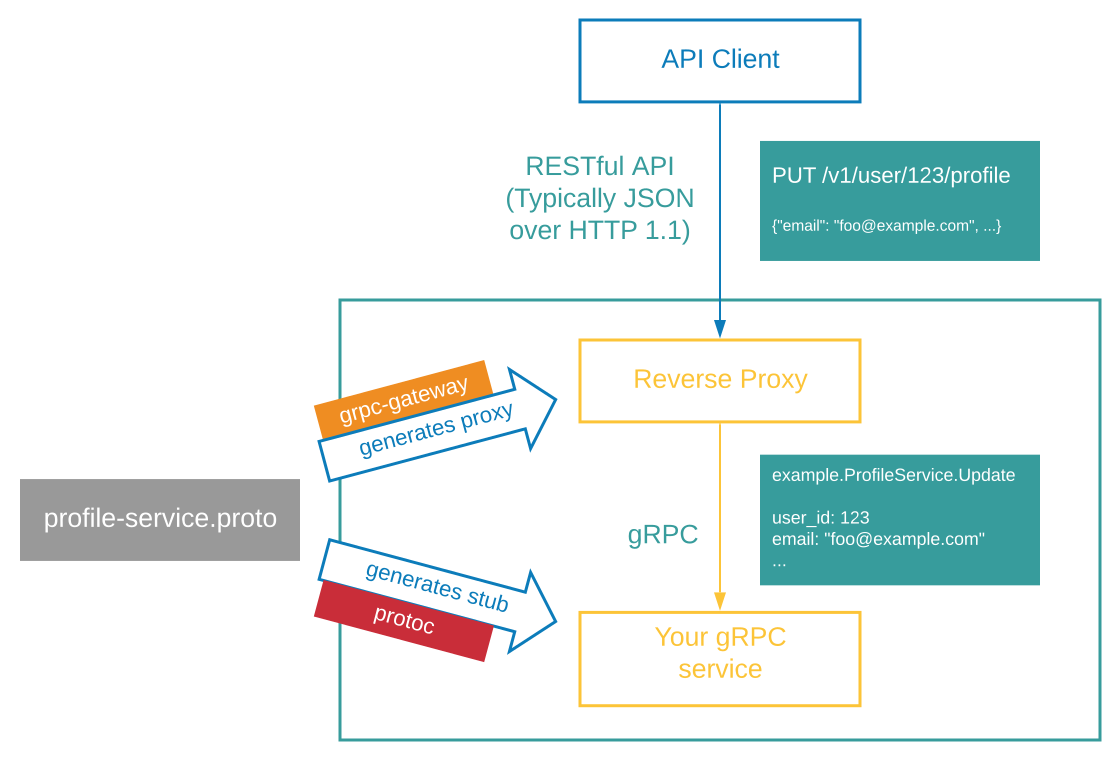


 gRPC-Gateway 是一个 protoc 插件,它会读取你的 protobuf 服务定义,生成一个反向代理服务器,把 RESTful HTTP API 转换成 gRPC,这样一个服务就能同时为 gRPC 客户端和 RESTful JSON 客户端提供服务。