Fiber is an Express inspired web framework built on top of Fasthttp, the fastest HTTP engine for Go. Designed to ease things up for fast development with zero memory allocation and performance in mind.
Tool Sponsors - supporting Fiber with free IDE licenses and AI credits
⚙️ Installation
Fiber requires Go version 1.26 or higher to run. If you need to install or upgrade Go, visit the official Go download page. To start setting up your project, create a new directory for your project and navigate into it. Then, initialize your project with Go modules by executing the following command in your terminal:
go mod init github.com/your/repo
To learn more about Go modules and how they work, you can check out the Using Go Modules blog post.
After setting up your project, you can install Fiber with the go get command:
go get -u github.com/gofiber/fiber/v3
This command fetches the Fiber package and adds it to your project's dependencies, allowing you to start building your web applications with Fiber.
⚡️ Quickstart
Getting started with Fiber is easy. Here's a basic example to create a simple web server that responds with "Hello, World 👋!" on the root path. This example demonstrates initializing a new Fiber app, setting up a route, and starting the server.
package main

import (
    "log"

    "github.com/gofiber/fiber/v3"
)

func main() {
    // Initialize a new Fiber app
    app := fiber.New()

    // Define a route for the GET method on the root path '/'
    app.Get("/", func(c fiber.Ctx) error {
        // Send a string response to the client
        return c.SendString("Hello, World 👋!")
    })

    // Start the server on port 3000
    log.Fatal(app.Listen(":3000"))
}
This simple server is easy to set up and run. It introduces the core concepts of Fiber: app initialization, route definition, and starting the server. Just run this Go program, and visit http://localhost:3000 in your browser to see the message.
Zero Allocation
Fiber is optimized for high-performance, meaning values returned from fiber.Ctx are not immutable by default and will be reused across requests. As a rule of thumb, you must only use context values within the handler and must not keep any references. Once you return from the handler, any values obtained from the context will be reused in future requests. Visit our documentation to learn more.
🤖 Benchmarks
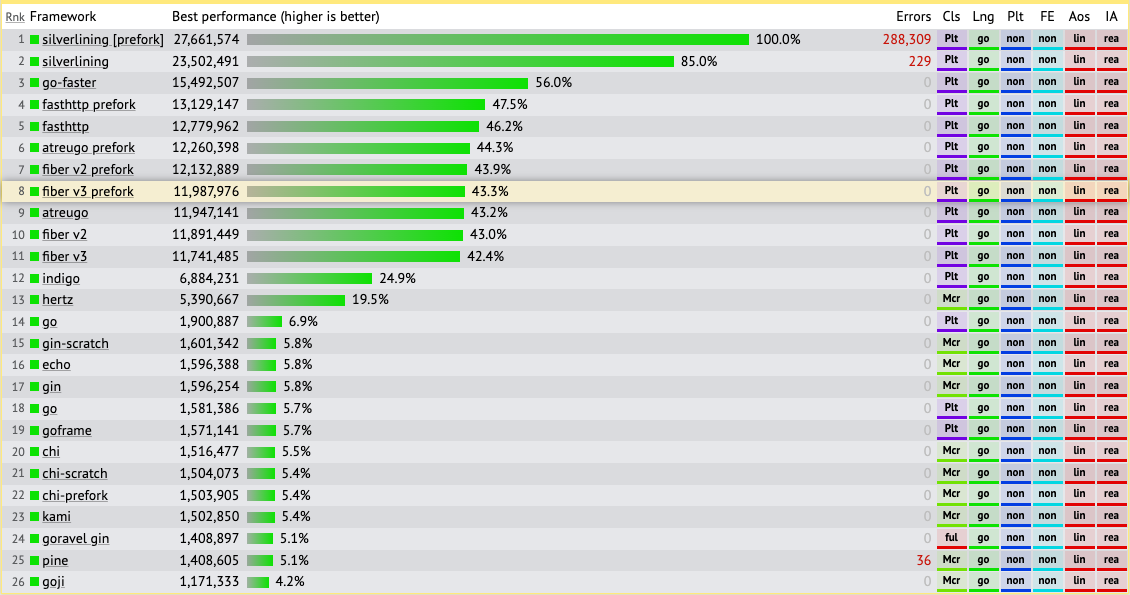
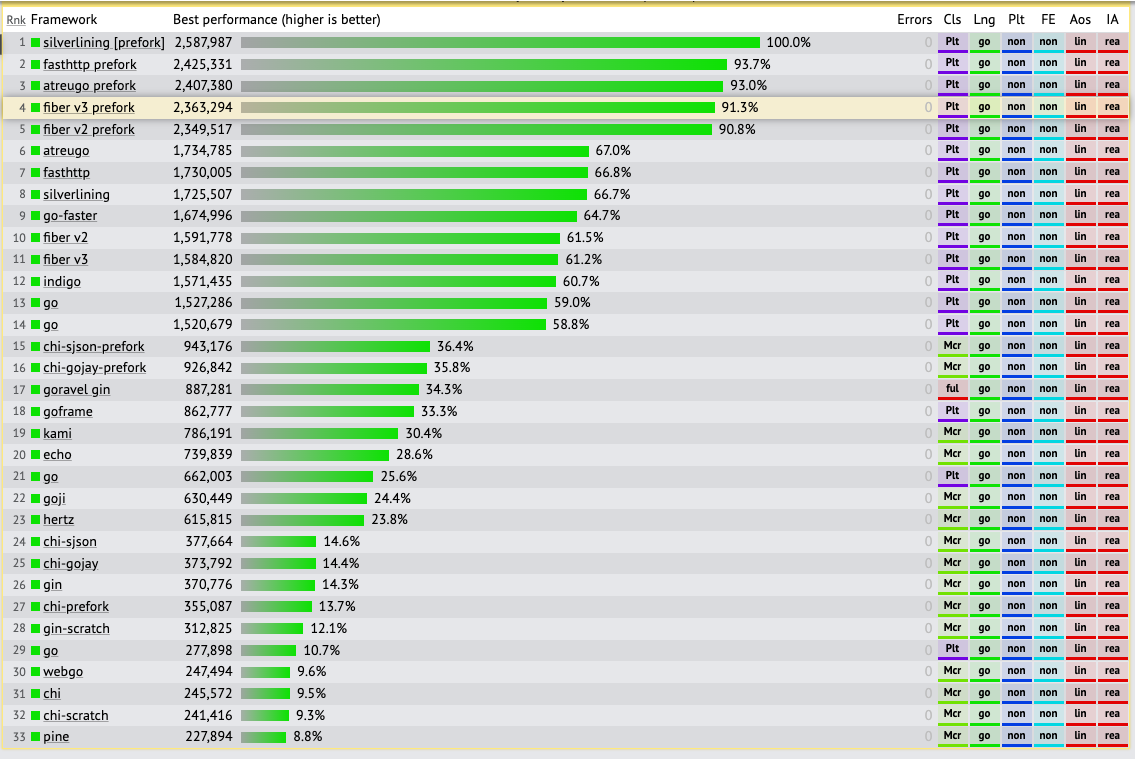
These tests are performed by TechEmpower. If you want to see all the results, please visit our Wiki.
New gophers that make the switch from Node.js to Go are dealing with a learning curve before they can start building their web applications or microservices. Fiber, as a web framework, was created with the idea of minimalism and follows the UNIX way, so that new gophers can quickly enter the world of Go with a warm and trusted welcome.
Fiber is inspired by Express, the most popular web framework on the Internet. We combined the ease of Express and raw performance of Go. If you have ever implemented a web application in Node.js (using Express or similar), then many methods and principles will seem very common to you.
We listen to our users in issues, Discord channeland all over the Internet to create a fast, flexible and friendly Go web framework for any task, deadline and developer skill! Just like Express does in the JavaScript world.
⚠️ Limitations
Due to Fiber's usage of unsafe, the library may not always be compatible with the latest Go version. Fiber v3 has been tested with Go version 1.26 or higher.
Fiber automatically adapts common net/http handler shapes when you register them on the router, and you can still use the adaptor middleware when you need to bridge entire apps or net/http middleware.
net/http compatibility
Fiber can run side by side with the standard library. The router accepts existing net/http handlers directly and even works with native fasthttp.RequestHandler callbacks, so you can plug in legacy endpoints without wrapping them manually:
package main

import (
    "log"
    "net/http"

    "github.com/gofiber/fiber/v3"
)

func main() {
    httpHandler := http.HandlerFunc(func(w http.ResponseWriter, r *http.Request) {
        if _, err := w.Write([]byte("served by net/http")); err != nil {
            panic(err)
        }
    })

    app := fiber.New()
    app.Get("/", httpHandler)

    // Start the server on port 3000
    log.Fatal(app.Listen(":3000"))
}
When you need to convert entire applications or reuse net/http middleware chains, rely on the adaptor middleware. It converts handlers and middlewares in both directions and even lets you mount a Fiber app in a net/http server.
Express-style handlers
Fiber also adapts Express-style callbacks that operate on the lightweight fiber.Req and fiber.Res helper interfaces. This lets you port middleware and route handlers from Express-inspired codebases while keeping Fiber's router features:
// Request/response handlers (2-argument)
app.Get("/", func(req fiber.Req, res fiber.Res) error {
    return res.SendString("Hello from Express-style handlers!")
})

// Middleware with an error-returning next callback (3-argument)
app.Use(func(req fiber.Req, res fiber.Res, next func() error) error {
    if req.IP() == "192.168.1.254" {
        return res.SendStatus(fiber.StatusForbidden)
    }
    return next()
})

// Middleware with a no-arg next callback (3-argument)
app.Use(func(req fiber.Req, res fiber.Res, next func()) {
    if req.Get("X-Skip") == "true" {
        return // stop the chain without calling next
    }
    next()
})
Note: Adapted net/http handlers continue to operate with the standard-library semantics. They don't get access to fiber.Ctx features and incur the overhead of the compatibility layer, so native fiber.Handler callbacks still provide the best performance.
👀 Examples
Listed below are some of the common examples. If you want to see more code examples, please visit our Recipes repository or visit our hosted API documentation.
Fiber defaults to the html/template when no view engine is set.
If you want to execute partials or use a different engine like amber, handlebars, mustache, or pug, etc., check out our Template package that supports multiple view engines.
package main

import (
    "log"

    "github.com/gofiber/fiber/v3"
    "github.com/gofiber/template/pug"
)

func main() {
    // Initialize a new Fiber app with Pug template engine
    app := fiber.New(fiber.Config{
        Views: pug.New("./views", ".pug"),
    })

    // Define a route that renders the "home.pug" template
    app.Get("/", func(c fiber.Ctx) error {
        return c.Render("home", fiber.Map{
            "title": "Homepage",
            "year":  1999,
        })
    })

    log.Fatal(app.Listen(":3000"))
}
What is this?Fiber is an Express-inspired web framework for Go, built on top of the fasthttp engine, with fast development and high performance in mind.
How is it different from just using Go's standard net/http?It runs on fasthttp instead of the standard net/http and wraps it in an Express-style API - routing, middleware, template engines and WebSockets included - so you don't assemble those pieces yourself.
How do I add it to my project?Create a project directory, init it with go mod init, then run go get github.com/gofiber/fiber/v3. After that a Hello-World server is fiber.New(), one app.Get route and starting the server - then visit it in your browser.
Do I need anything besides Go installed?Just Go itself, version 1.26 or higher. The README mentions no other runtimes, databases or external services.
Are there any gotchas I should know about?fiber.Ctx values are reused across requests for zero allocations, so use them only inside the handler and never keep references after it returns. Fiber also uses unsafe, so it may lag the newest Go releases; v3 is tested with Go 1.26+.
What does it include out of the box?Robust routing, static file serving, middleware with Next support, template engines, WebSockets, Socket.io, Server-Sent Events and a rate limiter, among others.
Why did the author create Fiber?To welcome gophers switching from Node.js: Fiber combines the ease of Express with the raw performance of Go, following a minimalist, UNIX-way philosophy so newcomers can start building quickly.
Can I use my existing net/http handlers and middleware with Fiber?Yes. The router accepts existing net/http handlers and native fasthttp.RequestHandler callbacks directly, and the adaptor middleware converts whole apps and middleware chains in both directions - you can even mount a Fiber app inside a net/http server. Adapted handlers keep standard-library semantics, don't get fiber.Ctx and carry some overhead, so native fiber handlers stay fastest.
How fast is it, really?The README points to TechEmpower benchmarks, with full results published on the project's Wiki, and advertises extreme performance with a low memory footprint rather than citing a single number.













 Fiber is an Express-inspired web framework for Go, built on top of the fasthttp engine, with fast development and high performance in mind.