Experiential

Experiential is an open source gateway and router for agent workflows:
- Use hosted, BYOK, and local models through one OpenAI-compatible API.
- Control which users and agents can use which models, for which use cases, and how much they can spend.
- Turn production traffic into a custom router or model optimized for quality, speed, and cost.
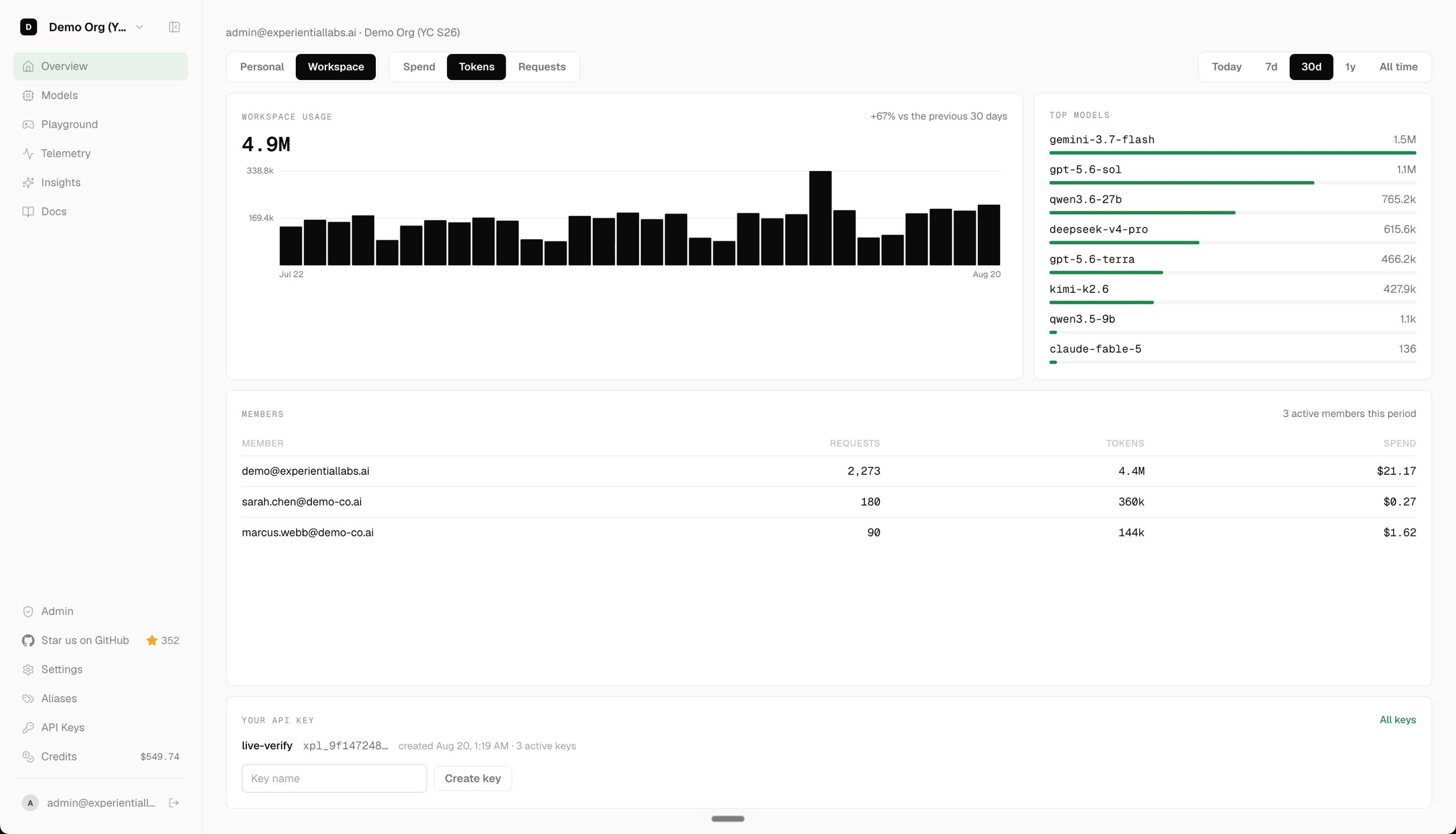
🌐 Platform |
📚 Docs |
 Discord
Getting Started
Start a local OpenAI-compatible gateway. On first run, the setup wizard uses the shared provider,
model, and reasoning-effort selectors, persists every selected provider connection, then shows
defaults for the public alias, identity, and $50.00 command budget before printing a one-time key:
pip install experiential
exp
Choose a public alias such as opus-5, capture the issued key, and send a request:
export EXP_GATEWAY_KEY=...
curl http://127.0.0.1:8000/v1/chat/completions \
  -H "Authorization: Bearer $EXP_GATEWAY_KEY" \
  -H 'Content-Type: application/json' \
  -d '{"model":"opus-5","messages":[{"role":"user","content":"Help me"}]}'
Setup / get started with the hosted gateway
Prefer a managed gateway to running one locally? The hosted platform at
platform.experientiallabs.ai serves the same
OpenAI-compatible (and Anthropic Messages) API at https://api.experientiallabs.ai/v1.
See SETUP.md for copy-paste prompts you hand to your coding agent
(Claude Code, Cursor, Codex, and similar); the agent runs the setup for you. It
collects four prompts:
- Upload your LLM traces as telemetry: create an account instantly from your email, then pull or upload your existing LLM traces onto the platform as telemetry.
- Connect your inference provider keys (BYOK): create an account, then connect your own OpenAI, Anthropic, Gemini, Azure, Bedrock, Fireworks, or OpenRouter keys for free pass-through.
- Start calling models on the gateway: make your first
/v1 call with the OpenAI and Anthropic SDKs using an xpl_ key, and optionally repoint your existing coding agents.
- Full onboarding: create an account instantly from your email, connect your keys, import your spend, then repoint every coding agent (Claude Code, Cursor, Codex, Aider, and similar) or Conductor at the gateway.
Using the API
Start the local gateway with exp (or exp run); the compiled native data plane
serves every route on loopback. From Python, load a fitted project router as an
official OpenAI client backed by its own private gateway:
import exp

with exp.load_router("my-project") as client:
    response = client.chat.completions.create(
        model="my-project",
        messages=[{"role": "user", "content": "hello"}],
    )
Coding Agent
exp code runs exp-code, Experiential's open-source coding and cowork
agent built on Pi. It needs Node.js 22.19 or newer and
uses your running local gateway, or the hosted gateway after exp login:
exp code                       # interactive terminal UI
exp code -p "Summarize sales.csv into report.docx"
Every argument goes to exp-code, so its print, JSON, and RPC modes work through exp code too.
Capture Traffic
Capture is designed to collect supported traces from the Codex and Claude Code desktop apps using
your existing ChatGPT or Claude subscription, while requests go directly to OpenAI or Anthropic.
It requires macOS, Python 3.13 or newer, and approval for its extension and certificate:
exp capture
Capture is experimental; macOS network reliability is still under investigation.
Use Experiential's gateway as middleware to control costs, enforce guardrails, and optimize quality,
costs, and speed. Leave the terminal open while you work. Press Ctrl+C to stop capture.
View your capture telemetry.
Optimize from Traffic
First, collect OpenTelemetry traces from your current agent. If you just want to try it out, grab
the public terminal-tasks OTLP dataset:
curl -L -o traces.otel.jsonl \
  https://huggingface.co/datasets/experiential-labs/wmo-terminal-tasks-traces/resolve/540883e451dc13d34fb50fdd36b143cb0f1fb0db/traces.otel.jsonl
Then build a project. The build command walks you through providers,
models, and budget, and asks for your trace file:
# Build simulation from your agent traces and optimize a router against it
exp build support-agent
After collecting traces from your router, fine-tune an open source model you own using
Tinker.
exp optimize model support-agent
Telemetry
Anonymous aggregate PostHog product telemetry is enabled by default. It never includes prompts,
traces, actions, observations, paths, model names, credentials, or raw customer content.
exp config telemetry status
exp config telemetry disable
exp config telemetry enable
The preference is stored locally in .exp/settings.toml.
Development
uv sync --extra dev
uv run ruff format --check .
uv run ruff check .
uv run ty check
uv run pytest -q
Repository and documentation conventions live in AGENTS.md.

 Experiential 是一个开源的网关和路由器,面向智能体工作流。你可以通过一个 OpenAI 兼容的 API 使用托管模型、自带密钥(BYOK)模型和本地模型,控制谁能在哪些模型上花多少钱,还能把生产环境的流量转化为定制的优化路由器,或你自己微调的模型。