






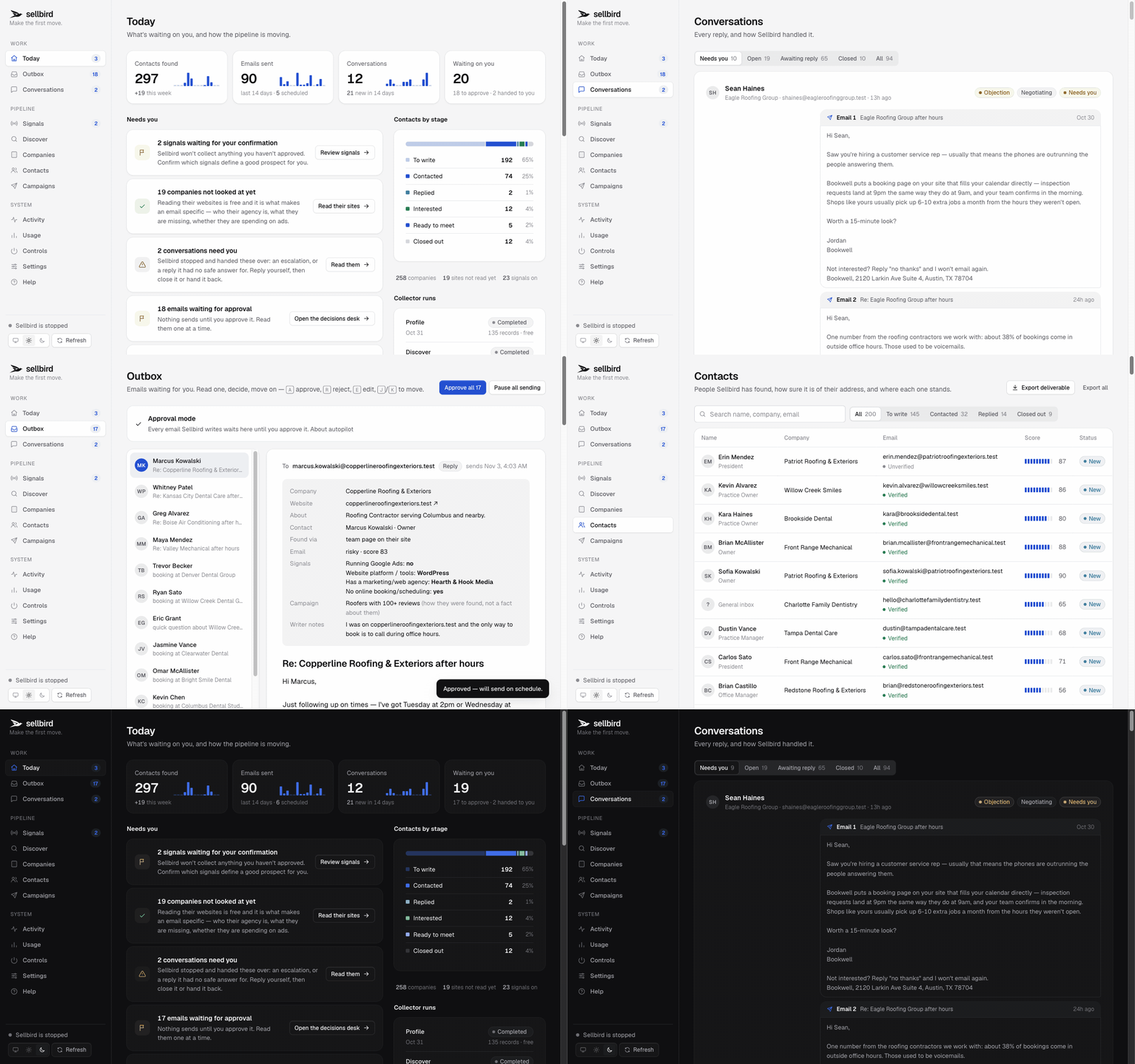
What is this?
 Harvey is an autonomous AI sales agent that finds businesses to sell to, learns something specific about each one, writes a personalized cold email, sends it, reads replies, and pushes the conversation toward a booked meeting — running in a loop on your own machine.
Is this a hosted SaaS or something I run myself?It is a self-hosted Python program: you run it on your own machine with your own login, and it exposes a local web dashboard at localhost:5555 rather than a cloud account.
It is a self-hosted Python program: you run it on your own machine with your own login, and it exposes a local web dashboard at localhost:5555 rather than a cloud account.How do I get it running?Install Python 3.11+, log in to the Claude Code CLI (or set up Codex), and tell Claude Code to 'set up Harvey for me' — the repo ships a CLAUDE.md that acts as a setup wizard, checking your state, installing what's missing, and training Harvey on your product.
Install Python 3.11+, log in to the Claude Code CLI (or set up Codex), and tell Claude Code to 'set up Harvey for me' — the repo ships a CLAUDE.md that acts as a setup wizard, checking your state, installing what's missing, and training Harvey on your product.Do I need a Claude or OpenAI API key to run it?No separate API key — Harvey uses your existing Claude Pro/Max subscription through the Claude Code CLI (default) or a ChatGPT plan through Codex (opt-in on macOS/Linux), plus a mailbox like Gmail/Google Workspace to actually send mail from.
No separate API key — Harvey uses your existing Claude Pro/Max subscription through the Claude Code CLI (default) or a ChatGPT plan through Codex (opt-in on macOS/Linux), plus a mailbox like Gmail/Google Workspace to actually send mail from.Does Harvey send cold emails on its own without me checking them?No — the project explicitly guarantees that nothing sends without you; drafted outreach is approved message-by-message from the dashboard or terminal before it goes out.
No — the project explicitly guarantees that nothing sends without you; drafted outreach is approved message-by-message from the dashboard or terminal before it goes out.Does Harvey only work on macOS, or Linux too?The Claude provider is the default on any machine with Python 3.11+ and the Claude Code CLI; the Codex (ChatGPT) provider is explicitly supported as an opt-in option on macOS and Linux.
The Claude provider is the default on any machine with Python 3.11+ and the Claude Code CLI; the Codex (ChatGPT) provider is explicitly supported as an opt-in option on macOS and Linux.How much does finding prospects actually cost?The default source, OpenStreetMap, is free with unlimited lookups but thin coverage for storefront-less trades; paid sources like DataForSEO or Serper cost roughly $0.0018–$1 per search or per 1,000 listings.
The default source, OpenStreetMap, is free with unlimited lookups but thin coverage for storefront-less trades; paid sources like DataForSEO or Serper cost roughly $0.0018–$1 per search or per 1,000 listings.What signals does Harvey check before deciding who to target?It can track 23 signals (no website, unclaimed Google listing, running ads, stale blog, missing schema markup, etc.) but collects none of them until you review and confirm the catalog yourself.
It can track 23 signals (no website, unclaimed Google listing, running ads, stale blog, missing schema markup, etc.) but collects none of them until you review and confirm the catalog yourself.How do I change the way Harvey writes its emails?Harvey's sales knowledge lives as plain Markdown files in skills/ (like emailframeworks.md or objectionhandling.md); editing a file changes behavior on the next 15-minute heartbeat with no retraining or restart needed.
Harvey's sales knowledge lives as plain Markdown files in skills/ (like emailframeworks.md or objectionhandling.md); editing a file changes behavior on the next 15-minute heartbeat with no retraining or restart needed.Why doesn't Harvey use tools like Apollo or Clearbit?It replaces paid prospecting databases entirely, building contact and company data itself from free sources and three plain HTTP requests per business (homepage, robots.txt, sitemap) instead of a subscription data provider.
It replaces paid prospecting databases entirely, building contact and company data itself from free sources and three plain HTTP requests per business (homepage, robots.txt, sitemap) instead of a subscription data provider.What are similar projects?franco, brigade, OpenDuet, autoresearch, hermes-agent, buscandomilhao, growth-engineer, CUAWright
franco, brigade, OpenDuet, autoresearch, hermes-agent, buscandomilhao, growth-engineer, CUAWrightWhich topics is it in?sales-automation, lead-generation, email-marketing, autonomous-agent, email, autonomous-agents, chatgpt, workflow-automation, agentic-ai, dashboard, claude, openai
sales-automation, lead-generation, email-marketing, autonomous-agent, email, autonomous-agents, chatgpt, workflow-automation, agentic-ai, dashboard, claude, openai