

reelbench-skills README

项目的 README,来自 github.com/eternityspring/reelbench-skills。合并为一个 markdown 文件:README.md。

reelbench-skills

Claude Code / Codex skills for working with video.

English | 中文 | Telegram @ahao_dev | X @eternityspring

Skills · Install · Example · What it looks like

❤️ Sponsor

Want to appear here?

Click to collapse
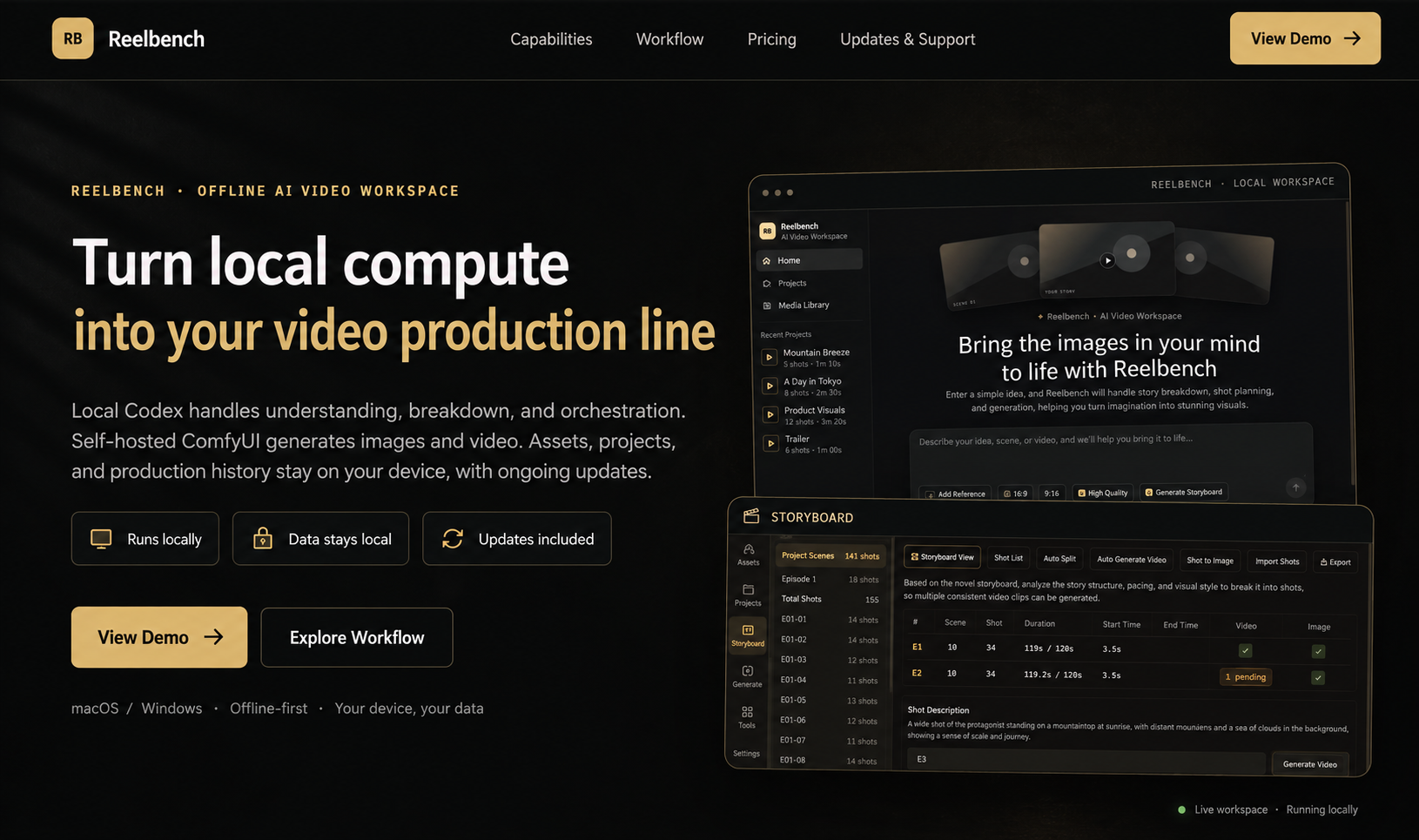
Reelbench Studio Reelbench Studio is a paid AI video workspace built by the author of these skills, delivered as source code that runs offline. Local Codex handles understanding, breakdown and orchestration, a self-hosted ComfyUI generates the images and video, and your assets and projects stay on your own machine.
赛博班底 mini program code 赛博班底 is a WeChat mini program built by the author of these skills: reference images for AI short video, covering characters, costumes, expressions and more, filterable by category and tag. Every image comes with a Chinese prompt you can copy in one tap, and you can long-press the full-size image to save it. Scan the code on the left in WeChat to open it.

Skills

skill what it does
video-shots Shot breakdown: turns a finished film into a shot-by-shot table — duration, shot size, category, camera move, frame description, rhythm role. Cuts and durations are measured by ffmpeg; the model only judges what it should; 15 quality gates check every call.
video-sync Composites a video with the shot data alongside it: footage on one side, the current shot's data on the other, switching at every cut with the list scrolling and highlighting itself. Landscape stacks, portrait sits side by side; the layout is one CSS file.
video-scrub Strips metadata: rebuilds the film as a clean file carrying only picture and sound — GPS, device, account IDs and telemetry tracks all left behind. The hard part is the three layers ffprobe cannot see: SEI, the AAC DSE, and compressorname. Byte-for-byte picture by default, verified by 12 byte-level gates.

AI video community

I run a paid group about AI video — workflows, tools, and how this stuff actually gets done.

Interested? Message me on Telegram @ahao_dev and mention github.

Install

git clone https://github.com/eternityspring/reelbench-skills.git
cd reelbench-skills
./scripts/install.sh

This symlinks the skills into ~/.claude/skills/ and/or ~/.codex/skills/ (whichever exists), so git pull takes effect immediately.

./scripts/install.sh --claude      # Claude Code only
./scripts/install.sh --codex       # codex only
./scripts/install.sh video-shots   # one skill only
./scripts/install.sh --uninstall   # remove the symlinks

Requirements: node >= 18 and ffmpeg / ffprobe (macOS: brew install node ffmpeg). No npm dependencies, no API keys — it runs on your current session.

Prefer a copy over a symlink? cp -r skills/video-shots ~/.claude/skills/ — each skill is self-contained.

Example

demo-report/ is the real output of running the skill on demo-video.mp4 (a 202.9-second AI-generated short film, 啥是AI): 53 shots, 3.83 s average shot length, 15.7 cuts per minute, all 15 gates green. demo-report-en/ is the same pipeline run on a 287.4-second English excerpt with --lang en — an entirely English report: 46 shots, 6.25 s average, and one 46.92 s take that scene detection never cut, because it genuinely never cuts.

Shot breakdown report

The report is a single interactive page: an embedded player (playback highlights the current shot, click a shot to jump), a pace strip, a shot list you can search, filter and sort (list or card view, first and last keyframe side by side, click a frame to enlarge), distributions, cast, and the quality gates. No external dependencies — double-click it offline.

the shot list on a narrow screen
demo-report/
├── shots-report.html   ← clone and double-click
├── shots.json          ← the breakdown data for all 53 shots
├── shots.md            ← Markdown shot list
├── track.json          ← frame-difference motion curve (the machine's evidence)
└── frames/             ← first and last keyframe of every shot, 106 files

demo-scrub/ is what video-scrub produces — four pieces of text and no video, because its output looks exactly like the source, which is the whole point. What is worth reading is the reconciliation, above all half.txt: the textbook recipe leaves ffprobe looking spotless while the bitstream still carries x264's encoder-settings SEI in 4 places and the AAC DSE in 8 — no ffprobe command shows either of them.

What video-sync produces is at the bottom of this page — as a video, not a screenshot.

What it looks like

A 287.4-second English excerpt with its 46-shot breakdown, 1280×1296 (the source is 640×360, blown up with --scale 2). The panel switches with every cut; the list scrolls up and the highlight rides along:

If the player does not load, grab the file: demo-sync/demo-en-sync.mp4

reelbench-skills (eternityspring/reelbench-skills)

正在搜索数据库…

这是什么?这是一组三个用于 Claude Code / Codex 的 skill,用来处理 AI 生成的视频:一个逐镜头分析工具、一个视频加数据的同步查看器,以及一个元数据清理工具。
这些是独立应用,还是我要加载到智能体里的 skill?它们是 skill 包,不是独立应用。你需要把它们符号链接到 Claude Code 和/或 Codex 的 skills 文件夹里,之后智能体会在会话中运行它们。
我该如何安装这些 skill?安装脚本会把三个 skill 文件夹符号链接到 ~/.claude/skills/ 和/或 ~/.codex/skills/(存在哪个就链接到哪个),因此之后执行 'git pull' 就能原地更新它们;如果你不想使用符号链接,每个 skill 都是独立的,可以直接复制,例如 'cp -r skills/video-shots ~/.claude/skills/'。
使用前需要先安装什么?Node.js 18+,以及在 PATH 中可用的 ffmpeg/ffprobe(macOS 下可执行 'brew install node ffmpeg')。不需要 npm 依赖,也不需要 API 密钥,一切都在你当前的智能体会话中运行。
video-scrub 的元数据清除真的彻底吗?默认情况下,它的目标是输出与原片逐字节一致的画面,并执行 12 项逐字节检查。但难点在于有三层信息 ffprobe 根本看不到:演示表明,常见的“清理”方法仍会在 4 处留下 x264 编码器设置的 SEI,在 8 处留下 AAC 的 DSE,而这些都无法通过任何 ffprobe 命令发现。
有任何视频数据会离开我的电脑吗?不会。分析和清理都通过 ffmpeg/ffprobe 在你当前的会话中本地运行;video-scrub 只会去除 GPS、设备信息、账户 ID 和遥测数据,而不会上传任何内容。
video-shots 为一部电影输出的内容具体是什么?一张逐镜头表格,包含时长、景别、类别、镜头运动、画面描述和节奏作用。切点和时长由 ffmpeg 测量,模型只负责判断定性字段,并通过 15 项质量检查。
运行 video-sync 时会是什么样子?它会把原始素材与一个滚动的数据面板合成在一起,面板会高亮当前镜头,并在每个切点处切换:横屏视频上下堆叠,竖屏视频左右并排。
我能否无需任何服务器设置就查看镜头分析报告?可以。输出是一个独立的交互式 HTML 页面,双击即可离线打开,包含可搜索、可排序的镜头列表、节奏条、关键帧和质量检查。
我为什么需要 video-scrub?在分享 AI 生成的视频片段之前,去除其中的个人元数据(GPS、设备信息、账户 ID、遥测数据),同时保证画面和声音逐字节不变。
大小
101.4 MB
星标
1.2K
更新
提交Nov 09
时长
2个月
提交 · 90 天