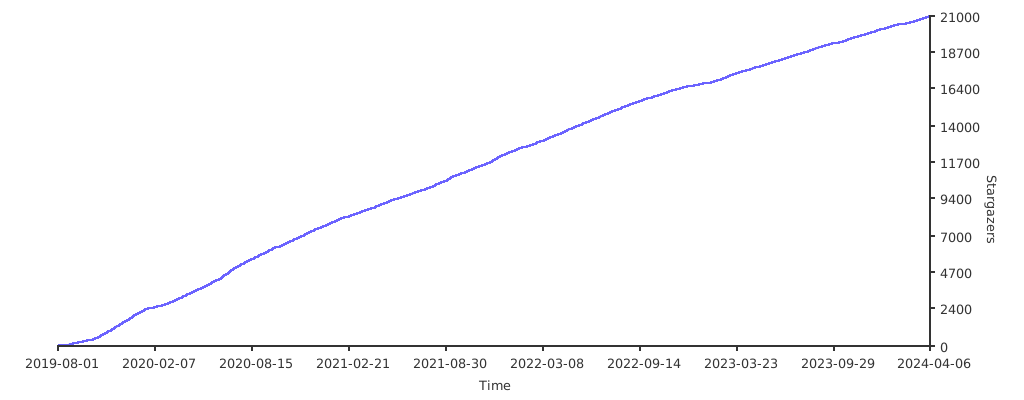


25.3K ·GitHub
What is this?
 Kuboard is a free management interface built for Kubernetes (compatible with K8s 1.13+) that turns cluster management into a visual web dashboard. This repo holds the source of its v4 documentation site.
Kuboard is a free management interface built for Kubernetes (compatible with K8s 1.13+) that turns cluster management into a visual web dashboard. This repo holds the source of its v4 documentation site.So is this repo the dashboard itself, or just its documentation?Just the documentation: it is the source of the Kuboard v4 docs site, a VuePress project published in both Chinese and English. The dashboard is a separate product that this site explains.
Just the documentation: it is the source of the Kuboard v4 docs site, a VuePress project published in both Chinese and English. The dashboard is a separate product that this site explains.How do I actually get Kuboard?The README links straight to the installation docs, and the site walks through install and upgrade for v4 alongside guides for cluster management, workloads, networking and storage.
The README links straight to the installation docs, and the site walks through install and upgrade for v4 alongside guides for cluster management, workloads, networking and storage.What do I need to have before installing it?A running Kubernetes cluster of version 1.13 or newer — Kuboard plugs into your existing cluster rather than replacing it.
A running Kubernetes cluster of version 1.13 or newer — Kuboard plugs into your existing cluster rather than replacing it.Can I get the full picture from the online demo?No — the demo account is read-only and only exposes part of Kuboard's features, so real usage means deploying it against your own cluster.
No — the demo account is read-only and only exposes part of Kuboard's features, so real usage means deploying it against your own cluster.Is Kuboard a hosted service, or do I run it myself?You host it yourself and drive it from a web browser. The browser experience goes as far as KuboardProxy, which provides kubectl-proxy-style access without a local terminal.
You host it yourself and drive it from a web browser. The browser experience goes as far as KuboardProxy, which provides kubectl-proxy-style access without a local terminal.How does Kuboard handle user logins?Three ways: a built-in user store with password policies and expiry, single sign-on via GitLab or GitHub, or an LDAP directory. This spares admins from handing ServiceAccount tokens to regular users.
Three ways: a built-in user store with password policies and expiry, single sign-on via GitLab or GitHub, or an LDAP directory. This spares admins from handing ServiceAccount tokens to regular users.What do the built-in suites add on top?A resource monitoring suite based on Prometheus and Grafana (CPU, memory, network, disk from cluster down to pod level) and log aggregation built on Grafana, Loki and Promtail, plus a storage volume browser.
A resource monitoring suite based on Prometheus and Grafana (CPU, memory, network, disk from cluster down to pod level) and log aggregation built on Grafana, Loki and Promtail, plus a storage volume browser.Can it do the things I'd normally reach for kubectl for?Much of it: Top Nodes and Top Pods, container logs and terminals, a file browser that uploads and downloads files to containers, and KuboardProxy for kubectl-proxy access right in the browser.
Much of it: Top Nodes and Top Pods, container logs and terminals, a file browser that uploads and downloads files to containers, and KuboardProxy for kubectl-proxy access right in the browser.Why choose it over the stock Kubernetes Dashboard?The README highlights multi-cluster management with per-cluster and per-namespace permissions, a microservice layered view per namespace, a graphical workload editor that avoids YAML, richer authentication, alerting via email or WeChat, and operation audit.
The README highlights multi-cluster management with per-cluster and per-namespace permissions, a microservice layered view per namespace, a graphical workload editor that avoids YAML, richer authentication, alerting via email or WeChat, and operation audit.What are similar projects?NodePilot, labtether, stalwart, skywalking, evenfire, JeecgBoot, netdata, emqx
NodePilot, labtether, stalwart, skywalking, evenfire, JeecgBoot, netdata, emqxWhich topics is it in?ldap, grafana, k8s, audit-log, prometheus, rbac, microservices, shell, kubernetes, dashboard, monitoring, documentation
ldap, grafana, k8s, audit-log, prometheus, rbac, microservices, shell, kubernetes, dashboard, monitoring, documentation