








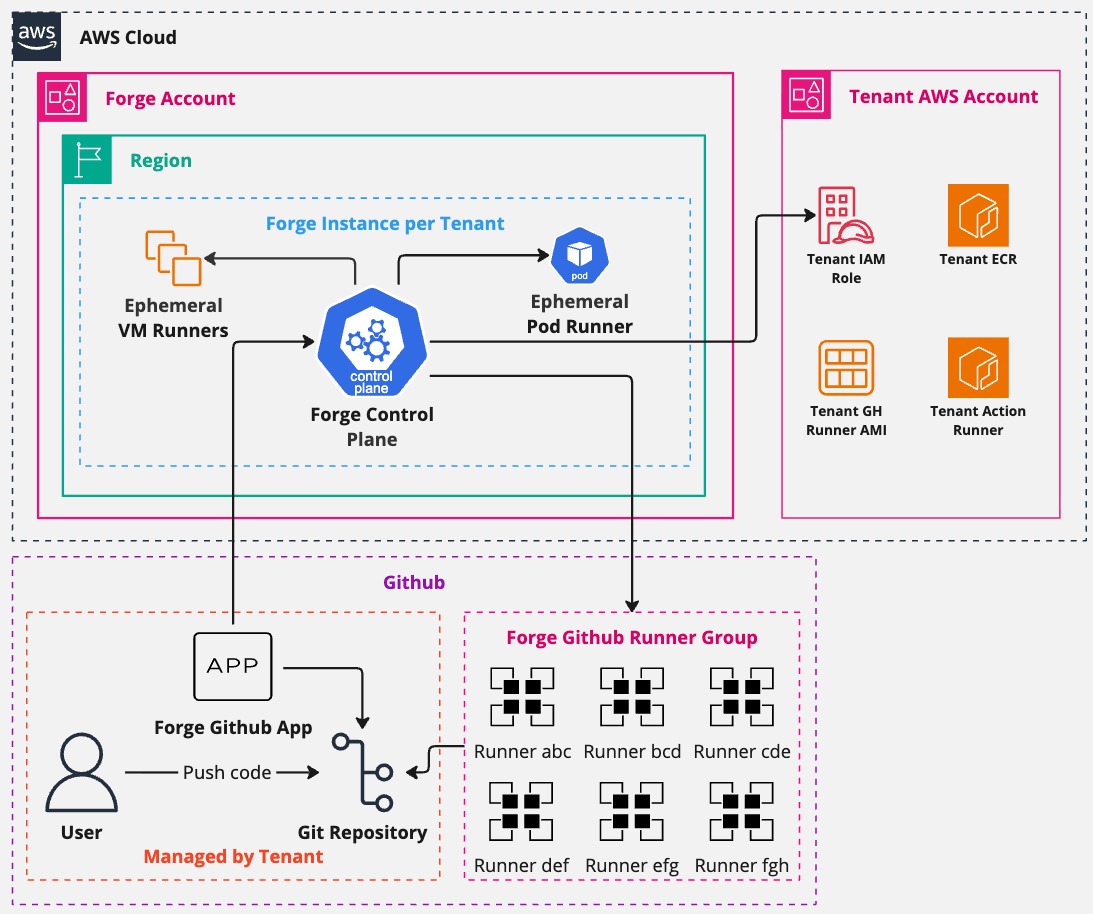
What is this?
 ForgeMT is an open-source platform from Cisco for running self-hosted GitHub Actions runners on your own AWS accounts — ephemeral EC2 runners and Kubernetes ARC runner scale sets, operated as code across many tenant repos.
ForgeMT is an open-source platform from Cisco for running self-hosted GitHub Actions runners on your own AWS accounts — ephemeral EC2 runners and Kubernetes ARC runner scale sets, operated as code across many tenant repos.So is it a hosted service, or Terraform code I deploy myself?You deploy it yourself from code: a set of Terraform modules plus copyable Terragrunt examples that form a runner control plane. There is no SaaS UI — tenant teams just consume runner labels in their workflow YAML.
You deploy it yourself from code: a set of Terraform modules plus copyable Terragrunt examples that form a runner control plane. There is no SaaS UI — tenant teams just consume runner labels in their workflow YAML.What does the smallest useful install look like?One GitHub.com org, one tenant, one runner lane and one smoke workflow. In practice: copy examples/deployments/platform into your IaC repo, replace the AWS, GitHub, VPC and tenant values, store the GitHub App key in SSM, then run terragrunt init, plan and apply.
One GitHub.com org, one tenant, one runner lane and one smoke workflow. In practice: copy examples/deployments/platform into your IaC repo, replace the AWS, GitHub, VPC and tenant values, store the GitHub App key in SSM, then run terragrunt init, plan and apply.What do I need to have in place before deploying?A GitHub.com or GHES org with a runner group and GitHub App scope, an AWS account with region, VPC and subnets, an S3 bucket plus DynamoDB lock table for state, and a runner AMI or container image for your first lane.
A GitHub.com or GHES org with a runner group and GitHub App scope, an AWS account with region, VPC and subnets, an S3 bucket plus DynamoDB lock table for state, and a runner AMI or container image for your first lane.Do I need to deploy all the modules to get value?No — the README says not to. Start with a single lane; skip EKS entirely for an EC2-only install, and leave Splunk, Teleport, OpenCost and OpenTelemetry modules out until your operating model needs them.
No — the README says not to. Start with a single lane; skip EKS entirely for an EC2-only install, and leave Splunk, Teleport, OpenCost and OpenTelemetry modules out until your operating model needs them.Is ForgeMT built from scratch or on top of existing projects?On existing ones: EC2 lanes build on terraform-aws-github-runner, and Kubernetes lanes on actions-runner-controller (ARC). ForgeMT adds the multi-tenant operating model, tenant boundaries and Terragrunt examples on top of them.
On existing ones: EC2 lanes build on terraform-aws-github-runner, and Kubernetes lanes on actions-runner-controller (ARC). ForgeMT adds the multi-tenant operating model, tenant boundaries and Terragrunt examples on top of them.Why does setup require creating a GitHub App?The runner fleet integrates with GitHub through a GitHub App owned by the platform team; its private key is stored in SSM, and each tenant boundary also defines the App's installation scope.
The runner fleet integrates with GitHub through a GitHub App owned by the platform team; its private key is stored in SSM, and each tenant boundary also defines the App's installation scope.Does it work with GitHub Enterprise Server, or only GitHub.com?Both. The pre-deployment checklist starts from your GitHub target: a GitHub.com or GHES URL, organization, runner group and GitHub App installation scope.
Both. The pre-deployment checklist starts from your GitHub target: a GitHub.com or GHES URL, organization, runner group and GitHub App installation scope.What are similar projects?floci, encore, neckbeard, semaphore, terraformer, full-stack-data-engineering, yq, vcluster
floci, encore, neckbeard, semaphore, terraformer, full-stack-data-engineering, yq, vclusterWhich topics is it in?ec2, platform-engineering, multi-tenancy, iam, devops-tools, multi-tenant, terraform, devsecops, infrastructure-as-code, oidc, ci-cd, aws
ec2, platform-engineering, multi-tenancy, iam, devops-tools, multi-tenant, terraform, devsecops, infrastructure-as-code, oidc, ci-cd, aws