271 ·GitHub
What is this?
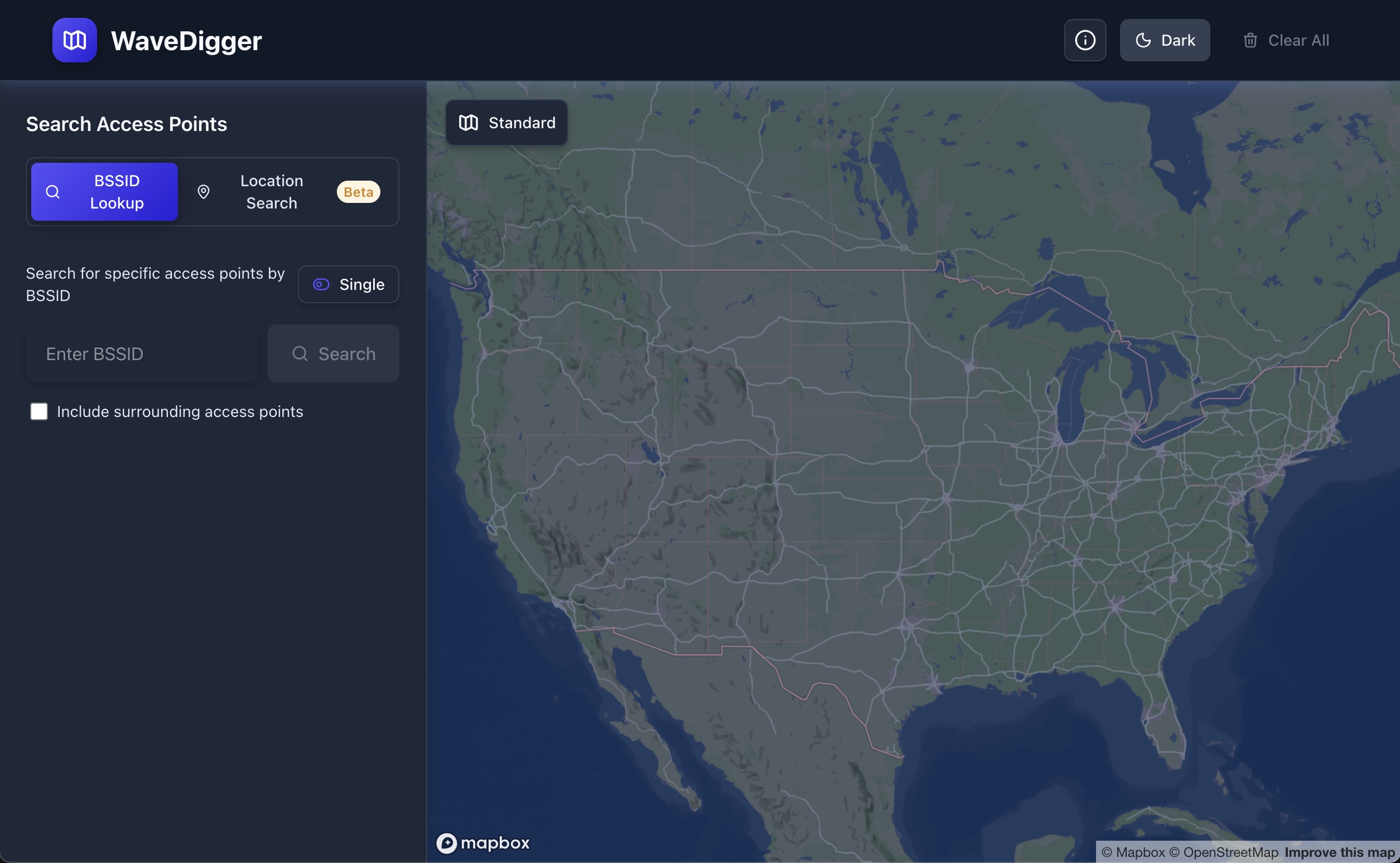
 WaveDigger is a web tool that looks up the physical location of Wi-Fi access points by their BSSID (MAC address), and LTE/5G NR cell towers by their network parameters, using Apple's location services API.
Is this a standalone app or does it tap into Apple's own database?It's a self-hosted Next.js web app that queries Apple's real WLOC API behind the scenes, reusing reverse-engineered protobuf definitions to send valid requests and decode the responses.
It's a self-hosted Next.js web app that queries Apple's real WLOC API behind the scenes, reusing reverse-engineered protobuf definitions to send valid requests and decode the responses.How do I get it running?Install Node.js dependencies with npm, optionally add a Mapbox token to .env.local for better map tiles, then start the Next.js dev server.
Install Node.js dependencies with npm, optionally add a Mapbox token to .env.local for better map tiles, then start the Next.js dev server.Do I need Node.js and a Mapbox account first?You need Node.js 24+ and npm; a Mapbox token is optional and only improves the map tile rendering.
You need Node.js 24+ and npm; a Mapbox token is optional and only improves the map tile rendering.Will every BSSID I enter actually return a location?No — Apple's database doesn't cover every access point, so newly deployed or private routers often return no result.
No — Apple's database doesn't cover every access point, so newly deployed or private routers often return no result.Is there a hosted version I can use without running it myself?Yes, the README mentions a hosted version exists, though self-hosting is the documented path with full setup steps.
Yes, the README mentions a hosted version exists, though self-hosting is the documented path with full setup steps.Any catch with the AGPL license if I deploy my own modified copy?Yes — AGPL-3.0 requires that if you run a modified version as a network service, you must publish your modified source code to its users.
Yes — AGPL-3.0 requires that if you run a modified version as a network service, you must publish your modified source code to its users.What kind of lookups beyond BSSID does it support?It also supports LTE tower lookups via MCC/MNC/TAC/Cell ID and 5G NR tower lookups via MCC/MNC/TAC/NCI, with NR searches also returning nearby cells in the same cluster.
It also supports LTE tower lookups via MCC/MNC/TAC/Cell ID and 5G NR tower lookups via MCC/MNC/TAC/NCI, with NR searches also returning nearby cells in the same cluster.How are results shown?Results are plotted on an interactive deck.gl-powered map, and the app keeps a search history for quick re-access to recent lookups.
Results are plotted on an interactive deck.gl-powered map, and the app keeps a search history for quick re-access to recent lookups.Whose research does this build on?It's built on the reverse-engineering work of the apple-corelocation-experiments project, which documented Apple's undocumented WLOC API, protobuf formats, and coordinate encoding.
It's built on the reverse-engineering work of the apple-corelocation-experiments project, which documented Apple's undocumented WLOC API, protobuf formats, and coordinate encoding.What formats can I enter a BSSID in?The input accepts AA:BB:CC:DD:EE:FF, AA-BB-CC-DD-EE-FF, or AABBCCDDEEFF, with automatic formatting and validation.
The input accepts AA:BB:CC:DD:EE:FF, AA-BB-CC-DD-EE-FF, or AABBCCDDEEFF, with automatic formatting and validation.What are similar projects?kepler.gl, osiris, cesium, city-roads, dawarich, Shadowbroker, Leaflet, gods-eye-view
kepler.gl, osiris, cesium, city-roads, dawarich, Shadowbroker, Leaflet, gods-eye-viewWhich topics is it in?protobuf, gis, geospatial, wifi, maps, osint, agplv3, tailwindcss, data-visualization, reverse-engineering, nextjs, web-app
protobuf, gis, geospatial, wifi, maps, osint, agplv3, tailwindcss, data-visualization, reverse-engineering, nextjs, web-app