







10.9K ·GitHub
What is this?
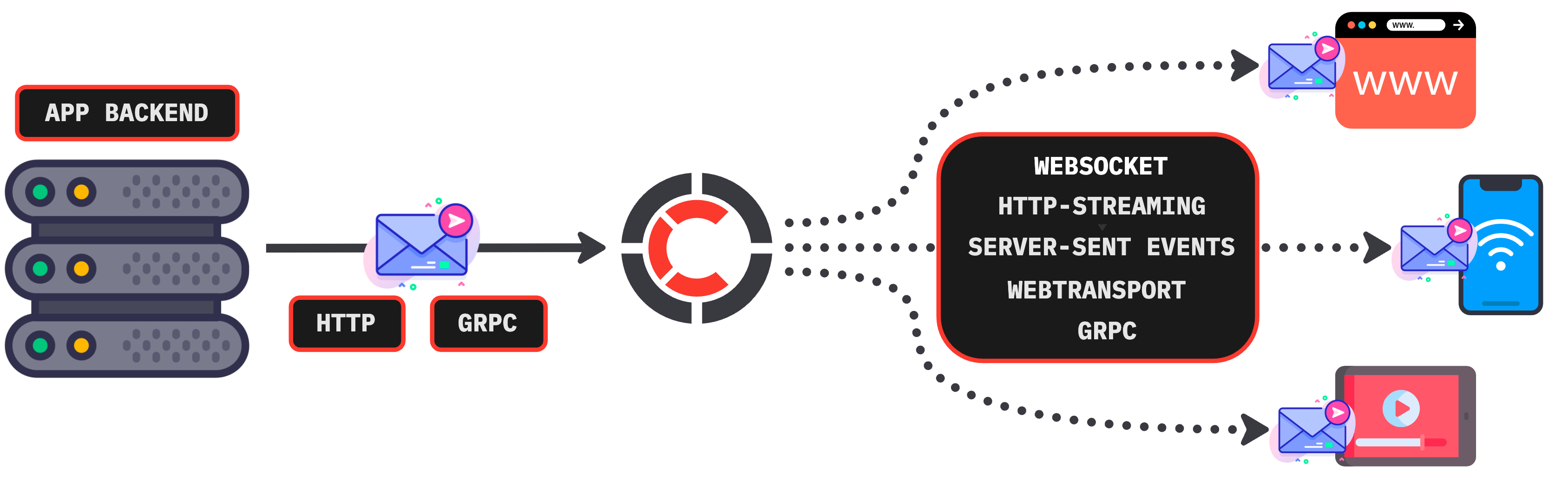
 Centrifugo is an open-source, language-agnostic real-time messaging server that lets any backend push messages to connected clients over WebSocket, HTTP-streaming, SSE, GRPC or WebTransport. It acts as a self-hosted alternative to Pubnub, Pusher, Ably, Socket.IO, Phoenix.PubSub and SignalR.
Centrifugo is an open-source, language-agnostic real-time messaging server that lets any backend push messages to connected clients over WebSocket, HTTP-streaming, SSE, GRPC or WebTransport. It acts as a self-hosted alternative to Pubnub, Pusher, Ably, Socket.IO, Phoenix.PubSub and SignalR.Is it a library I import or a standalone server?It is a standalone server you run yourself (via Docker, native binary, or Homebrew). Your backend talks to it over a simple HTTP or GRPC API to publish messages, while clients subscribe to channels using official SDKs.
It is a standalone server you run yourself (via Docker, native binary, or Homebrew). Your backend talks to it over a simple HTTP or GRPC API to publish messages, while clients subscribe to channels using official SDKs.How do I get it running?Spin it up with the embedded admin UI using Docker to try it locally, then open the admin UI in the browser to watch connections and publish test messages. For production, use native binaries, Homebrew, or packages with real configuration, following the quickstart tutorial.
Spin it up with the embedded admin UI using Docker to try it locally, then open the admin UI in the browser to watch connections and publish test messages. For production, use native binaries, Homebrew, or packages with real configuration, following the quickstart tutorial.Do I need Redis or anything else to run it?A single node can run standalone, but scaling across multiple nodes requires a broker: Redis (or Redis Cluster/compatible stores like Elasticache, Valkey, KeyDB, DragonflyDB), PostgreSQL, or Nats.
A single node can run standalone, but scaling across multiple nodes requires a broker: Redis (or Redis Cluster/compatible stores like Elasticache, Valkey, KeyDB, DragonflyDB), PostgreSQL, or Nats.Any gotcha when trying the Docker quick start?The quick-start flags shown in the README disable client and admin authentication entirely for a frictionless local demo — you must never run with those insecure flags in production.
The quick-start flags shown in the README disable client and admin authentication entirely for a frictionless local demo — you must never run with those insecure flags in production.Do I need to write my backend in Go to use it?No. Centrifugo is language-agnostic — any backend stack can talk to it through its HTTP or GRPC API, and it's used to build chat apps, live comments, multiplayer games, real-time dashboards and AI streaming responses.
No. Centrifugo is language-agnostic — any backend stack can talk to it through its HTTP or GRPC API, and it's used to build chat apps, live comments, multiplayer games, real-time dashboards and AI streaming responses.What transports do client SDKs support?WebSocket, HTTP-streaming, Server-Sent Events (EventSource), GRPC, and an experimental WebTransport transport.
WebSocket, HTTP-streaming, Server-Sent Events (EventSource), GRPC, and an experimental WebTransport transport.Can I connect without installing an SDK?Yes, Centrifugo supports a unidirectional approach over WebSocket, SSE, HTTP-streaming or GRPC that needs no SDK — any standard client for that transport works.
Yes, Centrifugo supports a unidirectional approach over WebSocket, SSE, HTTP-streaming or GRPC that needs no SDK — any standard client for that transport works.How does Centrifugo authenticate connections?It supports JWT-based authentication or a proxy-like mode where Centrifugo makes a request to your backend to validate each connection.
It supports JWT-based authentication or a proxy-like mode where Centrifugo makes a request to your backend to validate each connection.What monitoring tools does it integrate with?It exposes a large set of Prometheus metrics and ships an official Grafana dashboard, plus a built-in admin web UI for watching live connections and publishing messages.
It exposes a large set of Prometheus metrics and ships an official Grafana dashboard, plus a built-in admin web UI for watching live connections and publishing messages.What are similar projects?emqx, socket.io, financial-intelligence-system, NodeBB, chat, nakama, serve, apisix
emqx, socket.io, financial-intelligence-system, NodeBB, chat, nakama, serve, apisixWhich topics is it in?http3, protocol-buffers, socket-io, alternative, pubsub, websockets, sse, grafana, kafka, scalability, jwt, prometheus
http3, protocol-buffers, socket-io, alternative, pubsub, websockets, sse, grafana, kafka, scalability, jwt, prometheus