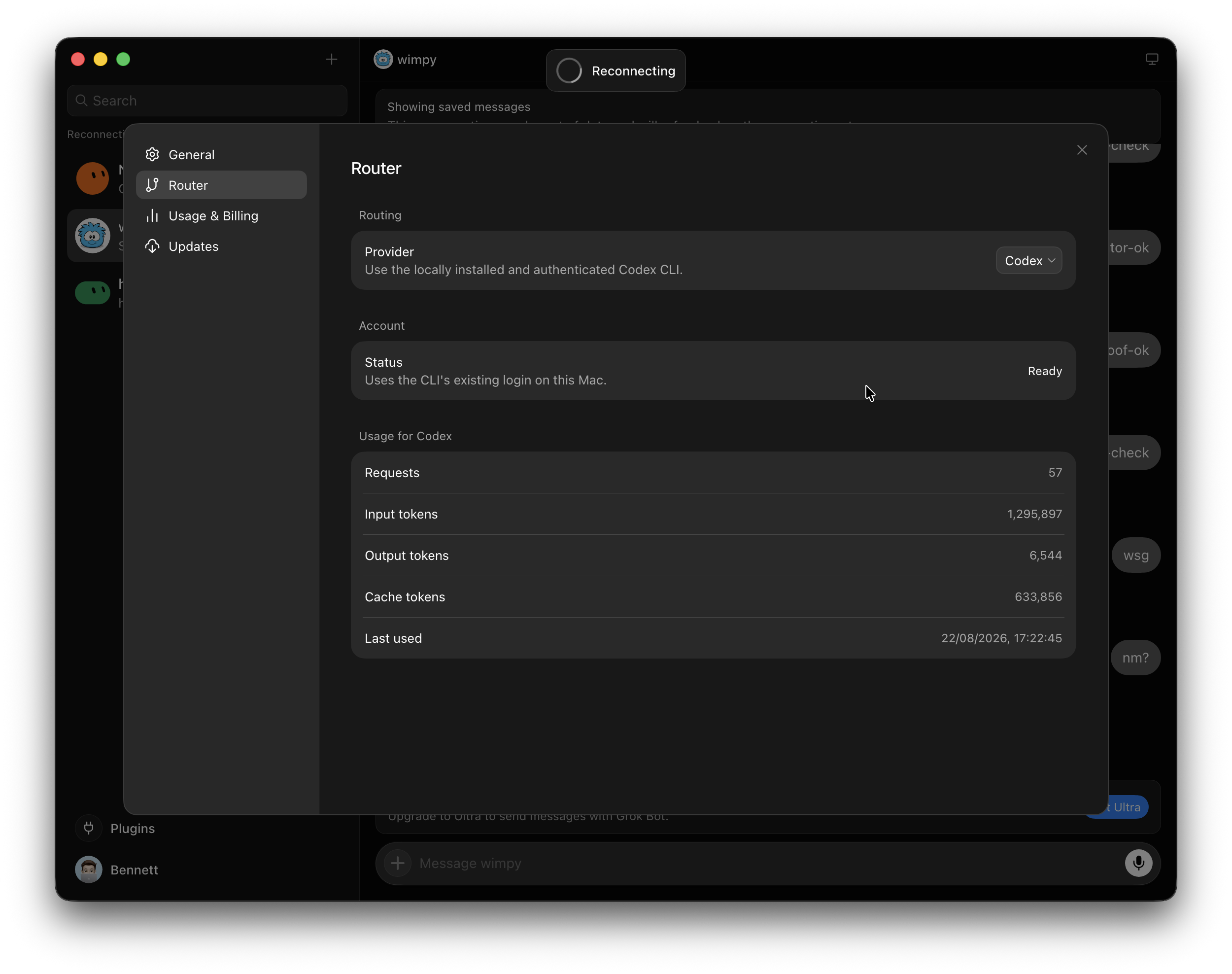
What is this?
 It's an unofficial, source-oriented reconstruction of the publicly shipped Grok Bot 0.18.0 macOS app, rebuilt into readable TypeScript sources and extended with an inference router, MCP tools, local usage tracking, and an optional local Docker sandbox.
It's an unofficial, source-oriented reconstruction of the publicly shipped Grok Bot 0.18.0 macOS app, rebuilt into readable TypeScript sources and extended with an inference router, MCP tools, local usage tracking, and an optional local Docker sandbox.Is this an official Grok Bot release or a reverse-engineered build?It is a hacking/research reconstruction, not Anysphere's original source or an official release; it hybridizes reconstructed runtime code from source/ with the original minified shipped renderer as the UI baseline.
It is a hacking/research reconstruction, not Anysphere's original source or an official release; it hybridizes reconstructed runtime code from source/ with the original minified shipped renderer as the UI baseline.How do I build and run the reconstructed app?Run 'npm run bootstrap' to download and SHA-256-verify the pinned 0.18.0 DMG (or point GROKBOT018APP at an existing copy), then run 'npm run package' to compile the runtimes, patch the renderer, and produce an ad-hoc signed app bundle.
Run 'npm run bootstrap' to download and SHA-256-verify the pinned 0.18.0 DMG (or point GROKBOT018APP at an existing copy), then run 'npm run package' to compile the runtimes, patch the renderer, and produce an ad-hoc signed app bundle.What do I need installed before building it?You need macOS on Apple Silicon, Node.js 26.5.x, Xcode Command Line Tools, and Git LFS; Docker Desktop is only required if you want the local sandbox, and Claude Code/Codex router modes need those apps already logged in locally.
You need macOS on Apple Silicon, Node.js 26.5.x, Xcode Command Line Tools, and Git LFS; Docker Desktop is only required if you want the local sandbox, and Claude Code/Codex router modes need those apps already logged in locally.Is this safe to rely on long-term, or a one-off experiment?It's explicitly experimental: it targets only one pinned macOS/arm64 release, depends on external provider sessions staying valid, and makes no promise of working with future Grok Bot versions.
It's explicitly experimental: it targets only one pinned macOS/arm64 release, depends on external provider sessions staying valid, and makes no promise of working with future Grok Bot versions.Can I build and run this on Windows too?No — building and running the reconstruction requires macOS on Apple Silicon; a Windows 0.18.0 installer is only preserved as a checksummed research artifact in research-archives/, not a supported build target.
No — building and running the reconstruction requires macOS on Apple Silicon; a Windows 0.18.0 installer is only preserved as a checksummed research artifact in research-archives/, not a supported build target.Which AI providers can I route inference through?The Router supports Cursor (default, via your existing session), Claude Code and Codex (reusing local authenticated logins, no extra API key needed), and OpenRouter via a saved API key.
The Router supports Cursor (default, via your existing session), Claude Code and Codex (reusing local authenticated logins, no extra API key needed), and OpenRouter via a saved API key.Is this project actively maintained?No — the repository is archived, so it's frozen as an experimental research snapshot rather than an actively developed project.
No — the repository is archived, so it's frozen as an experimental research snapshot rather than an actively developed project.What does the local Docker sandbox replace?It swaps the remote execution box for a loopback-only local container running the same box host and execution daemon, mounting content-addressed artifacts read-only.
It swaps the remote execution box for a loopback-only local container running the same box host and execution daemon, mounting content-addressed artifacts read-only.Why wasn't the whole UI rebuilt from scratch?The shipped app only contained minified, source-mapless production JS/CSS, so recreating the full original React frontend was out of scope; instead the team kept the checksum-verified shipped renderer and made a narrow patch for the new Router settings UI.
The shipped app only contained minified, source-mapless production JS/CSS, so recreating the full original React frontend was out of scope; instead the team kept the checksum-verified shipped renderer and made a narrow patch for the new Router settings UI.What are similar projects?claudecodeui, overmind, opensquilla, 1code, opencodex, deer-flow, claude-task-master, CanvasTTY
claudecodeui, overmind, opensquilla, 1code, opencodex, deer-flow, claude-task-master, CanvasTTYWhich topics is it in?llm-router, openrouter, hacking, sandbox, reverse-engineering, electron, cursor, anthropic, codex, research, claude-code, mcp
llm-router, openrouter, hacking, sandbox, reverse-engineering, electron, cursor, anthropic, codex, research, claude-code, mcp