



What is this?
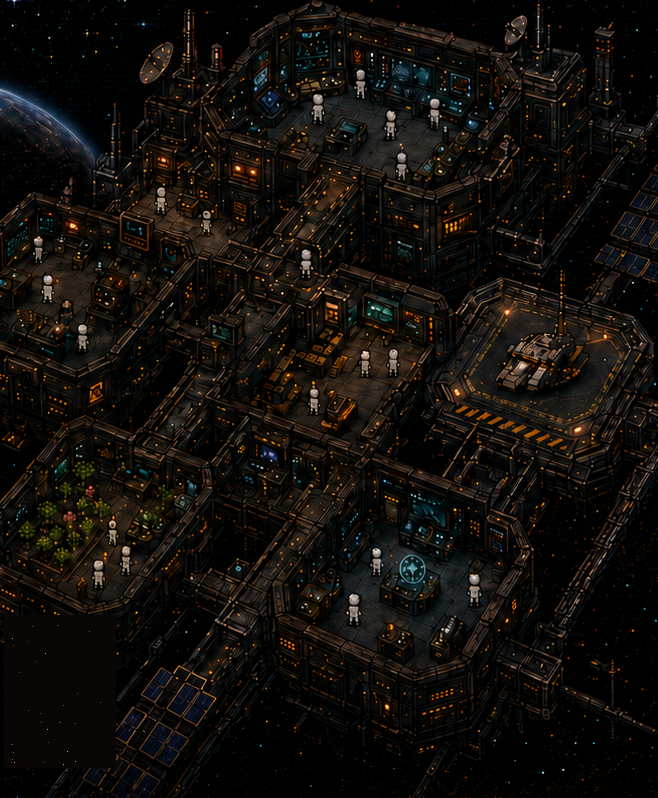
 StarNet is a local-first desktop harness where you create AI agents, arrange them into a pixel-art space station, and watch them actually perform work with real models and tools — the layout is a live projection of the harness's real runtime state, not decoration.
StarNet is a local-first desktop harness where you create AI agents, arrange them into a pixel-art space station, and watch them actually perform work with real models and tools — the layout is a live projection of the harness's real runtime state, not decoration.Is the station just a decorative UI, or does it mean something?The map is the actual permission model: a room is a capability-scoped team, a hallway is an authorized handoff lane, and any placed object is a real capability grant — the layout you draw is literally the workflow the agents execute.
The map is the actual permission model: a room is a capability-scoped team, a hallway is an authorized handoff lane, and any placed object is a real capability grant — the layout you draw is literally the workflow the agents execute.How do I get it running?Download a prebuilt desktop installer from the releases page (Windows x64-setup.exe, macOS aarch64.dmg for Apple Silicon, or macOS x64.dmg for Intel), or run from source with Node.js 18+ and Git (Rust and Tauri prerequisites are only needed to build the desktop shell).
Download a prebuilt desktop installer from the releases page (Windows x64-setup.exe, macOS aarch64.dmg for Apple Silicon, or macOS x64.dmg for Intel), or run from source with Node.js 18+ and Git (Rust and Tauri prerequisites are only needed to build the desktop shell).Do I need an API key to use it?Not necessarily — you can bring your own OpenRouter key or sign in with Anthropic, OpenAI, or Google, but you can also run entirely free by installing Ollama, pulling a local model, and picking OLLAMA as the provider.
Not necessarily — you can bring your own OpenRouter key or sign in with Anthropic, OpenAI, or Google, but you can also run entirely free by installing Ollama, pulling a local model, and picking OLLAMA as the provider.Is this ready to run on Linux, or just Windows and macOS?Only Windows and macOS get supported public releases; Linux builds are internal artifacts only, not a shipped target. It's also an early release — Windows is the most-tested desktop target, while macOS has less real-world coverage.
Only Windows and macOS get supported public releases; Linux builds are internal artifacts only, not a shipped target. It's also an early release — Windows is the most-tested desktop target, while macOS has less real-world coverage.Can I reach my agents when I'm away from the desktop?Yes — you can wire agents to Telegram, Discord, Slack, Signal, or Matrix to message your station remotely, and a Night Shift mode lets agents keep working unattended within an adjustable, logged leash.
Yes — you can wire agents to Telegram, Discord, Slack, Signal, or Matrix to message your station remotely, and a Night Shift mode lets agents keep working unattended within an adjustable, logged leash.Where do my API keys and agent data actually go?Provider requests leave your machine when an agent runs, but secrets live in the OS keychain/sidecar and never touch the frontend, and station state, transcripts, memory, and ledgers stay in your local workspace unless you use a network tool or connector.
Provider requests leave your machine when an agent runs, but secrets live in the OS keychain/sidecar and never touch the frontend, and station state, transcripts, memory, and ledgers stay in your local workspace unless you use a network tool or connector.Can I fork this and ship my own branded version?The code is MIT and can be forked, modified, and redistributed (including commercially), but the StarNet name, logo, station artwork, and brand identity are not covered by the license, so forks must use their own name and art and not present themselves as StarNet.
The code is MIT and can be forked, modified, and redistributed (including commercially), but the StarNet name, logo, station artwork, and brand identity are not covered by the license, so forks must use their own name and art and not present themselves as StarNet.What happens when an agent is unsure what to do?Instead of guessing silently, StarNet's Task Briefs turn ambiguity into one concrete question with options, sent over any connected channel, so you make the call before work proceeds.
Instead of guessing silently, StarNet's Task Briefs turn ambiguity into one concrete question with options, sent over any connected channel, so you make the call before work proceeds.Where do finished agent outputs end up?Completed deliverables land in an OUTBOX as real files you open directly, instead of being buried in chat scrollback you have to dig through.
Completed deliverables land in an OUTBOX as real files you open directly, instead of being buried in chat scrollback you have to dig through.Can I migrate agents from OpenClaw or Hermes?Yes — point StarNet at your existing OpenClaw or Hermes home directory and it will mint a new StarNet agent from the found persona, instructions, memory, and model, though API keys are never transferred and must be re-entered.
Yes — point StarNet at your existing OpenClaw or Hermes home directory and it will mint a new StarNet agent from the found persona, instructions, memory, and model, though API keys are never transferred and must be re-entered.How can I extend what an agent is allowed to touch?You can attach Model Context Protocol (MCP) servers and paste-a-key/OAuth connectors to grant agents access to additional tools and services beyond the built-in capabilities.
You can attach Model Context Protocol (MCP) servers and paste-a-key/OAuth connectors to grant agents access to additional tools and services beyond the built-in capabilities.Which topics is it in?pixel-art, vanilla-javascript, scheduler, byok, voice, local-ai, openrouter, agent-harness, slack, discord, tauri, telegram
pixel-art, vanilla-javascript, scheduler, byok, voice, local-ai, openrouter, agent-harness, slack, discord, tauri, telegram