


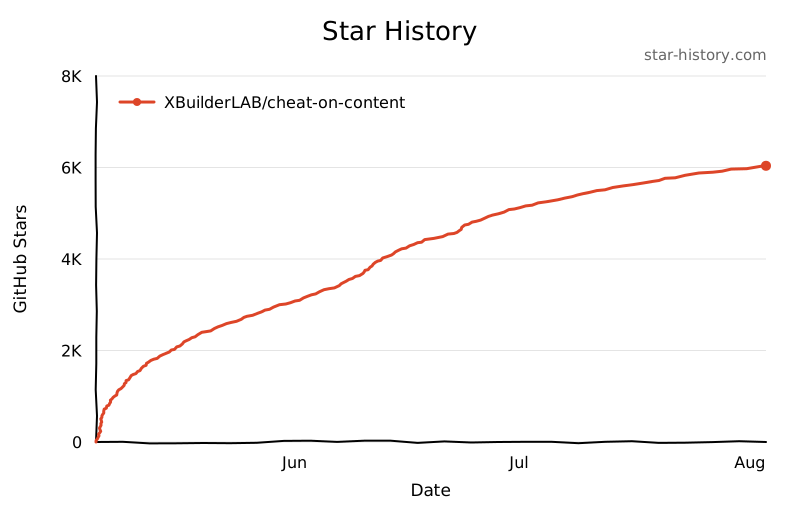
7.3K ·GitHub
What is this?
 A skill for AI coding agents aimed at content creators: every post becomes a calibrated experiment — score it, blind-predict its performance, publish, retro the numbers at T+3 days, and evolve your scoring rubric. The author credits it with going from 0 to 1M followers in a month.
A skill for AI coding agents aimed at content creators: every post becomes a calibrated experiment — score it, blind-predict its performance, publish, retro the numbers at T+3 days, and evolve your scoring rubric. The author credits it with going from 0 to 1M followers in a month.So is it a standalone app, or something that lives inside my AI agent?It lives inside your AI agent, not as a separate app: the installer symlinks 14 sub-skills into the agent's skill directory, and one install covers every content project you run.
It lives inside your AI agent, not as a separate app: the installer symlinks 14 sub-skills into the agent's skill directory, and one install covers every content project you run.How do I set it up and start using it?Run bash install.sh from the repo, then open a skill-compatible agent inside your content project and say 'init cheat-on-content' — five yes/no questions finish onboarding.
Run bash install.sh from the repo, then open a skill-compatible agent inside your content project and say 'init cheat-on-content' — five yes/no questions finish onboarding.Which coding agents can run it?Claude Code works by default, Codex via bash install.sh --codex, or both via --all. Hook-aware agents auto-report buffer and pending retros at each session start; with other agents you just say 'status'.
Claude Code works by default, Codex via bash install.sh --codex, or both via --all. Hook-aware agents auto-report buffer and pending retros at each session start; with other agents you just say 'status'.Will its predictions be any good when I'm just starting out?Cold start is the catch: without an imported benchmark account (5–10 samples) your first 5 predictions land at ±50% precision. Also, the 1.3 to 1.4 upgrade is a breaking migration — run /cheat-migrate after git pull or blind scoring keeps flagging nonblindwarning.
Cold start is the catch: without an imported benchmark account (5–10 samples) your first 5 predictions land at ±50% precision. Also, the 1.3 to 1.4 upgrade is a breaking migration — run /cheat-migrate after git pull or blind scoring keeps flagging nonblindwarning.Who is this for, and do I need to be a developer to use it?Content creators who publish regularly and want their intuition made measurable rather than motivated. You do need a coding agent like Claude Code or Codex and a terminal for the bash install, so some comfort with developer tooling helps.
Content creators who publish regularly and want their intuition made measurable rather than motivated. You do need a coding agent like Claude Code or Codex and a terminal for the bash install, so some comfort with developer tooling helps.Does my operating system matter for this?Only in that your coding agent must run there — the project targets Linux, macOS and Windows.
Only in that your coding agent must run there — the project targets Linux, macOS and Windows.Is it free to use, even commercially?Yes — MIT license, and commercial use, modification and closed-source integration are all explicitly allowed.
Yes — MIT license, and commercial use, modification and closed-source integration are all explicitly allowed.How is this different from just asking ChatGPT if my post will go viral?General assistants answer from the global average and forget you after the reply. This builds a scoring formula reverse-engineered from your channel's own history, updates it with every post, and remembers your benchmark account, cadence and last three flops.
General assistants answer from the global average and forget you after the reply. This builds a scoring formula reverse-engineered from your channel's own history, updates it with every post, and remembers your benchmark account, cadence and last three flops.What does one full cycle of using it look like?You score the piece and log a blind prediction before publishing, then settle the books against real numbers three days later. The loop is score → blind-predict → publish → T+3d retro → evolve, and three same-direction misses in a row prompt you to upgrade your formula.
You score the piece and log a blind prediction before publishing, then settle the books against real numbers three days later. The loop is score → blind-predict → publish → T+3d retro → evolve, and three same-direction misses in a row prompt you to upgrade your formula.How does it stop me from fooling myself with wishful scoring?Formula switches force a re-score of all historical samples and only ship if the new rubric ranks more accurately than the old one, plus a cross-model independent audit. Observations refuted by data get deleted, so the rubric only keeps what works right now.
Formula switches force a re-score of all historical samples and only ship if the new rubric ranks more accurately than the old one, plus a cross-model independent audit. Observations refuted by data get deleted, so the rubric only keeps what works right now.If I uninstall it, do I lose my logged predictions?No — bash uninstall.sh (or bash uninstall.sh --codex) removes the skill from your agent, and your content data is not touched.
No — bash uninstall.sh (or bash uninstall.sh --codex) removes the skill from your agent, and your content data is not touched.What are similar projects?cy-carousel-skill, marketing-agi, linkedin-agent-skill, dbskill, youtube-agent-skill, linkedin-skills, no-ai-slop, codex-ppt-skill
cy-carousel-skill, marketing-agi, linkedin-agent-skill, dbskill, youtube-agent-skill, linkedin-skills, no-ai-slop, codex-ppt-skillWhich topics is it in?forecasting, decision-making, social-media, content-creation, analytics, agent-skill, evaluation, workflow, skill, productivity, codex, claude-code
forecasting, decision-making, social-media, content-creation, analytics, agent-skill, evaluation, workflow, skill, productivity, codex, claude-code