
Hy Memory
Production-grade dual-system cognitive memory for LLM agents.










English | 中文
Hy Memory (Official Website) is a production-grade dual-system cognitive memory engine and Python SDK (hy-memory) for self-evolving LLM agents, providing specialized memory pipelines across three task scenes: hierarchical long-term cognitive memory for Chat, two-layer fact and reusable-experience memory for Working, and version-evolution diff-chain tracking for Coding. Built on top of Hy Memory, MemHub is a local-first desktop and CLI product that unifies conversation history and coding traces from user-authorized AI applications (such as Claude Code, Cursor, Codex, OpenCode, and Qwen Code) into a single managed runtime and local data directory, enabling governed cross-application memory recall.
Latest News
- [new] 🔥🔥🔥 [2026-10]: 🚀 Open-sourced quantized FP8 (Hy-Memory-30B-A3B-FP8) and GGUF (Hy-Memory-30B-A3B-GGUF) versions of Hy-Memory-30B-A3B on Hugging Face!
- [new] 🔥🔥🔥 [2026-11]: 📦 Released MemHub v1.0.7 with Ultra no longer freezing on a damaged knowledge graph, graph and vector backends (Neo4j / Memgraph / Qdrant) configurable from the CLI, backups that include your memories, a per-model output token setting, and OpenCode V2 support, on
hy-memory==2.0.16. See the release notes for details.
- [new] 🔥🔥🔥 [2026-11]: 📦 Released MemHub v1.0.6 with interfaces in 11 languages, memory modes (lite / pro / ultra with nightly evolve), safe embedding-model switching, multi-user support for the CLI and API, memory writes that retry themselves and pause while the model provider is down, and more reliable upgrades, on
hy-memory==2.0.14. See the release notes for details.
- [new] 🔥🔥🔥 [2026-10]: 📦 Released MemHub v1.0.5 with Chinese, English and Spanish interfaces, one-time pairing codes for more custom Harnesses, and smoother browsing, search, startup and recovery, on
hy-memory==2.0.8. See the release notes for details.
- [new] 🔥🔥🔥 [2026-10]: 📦 Released MemHub v1.0.4 and memhub-cli 1.0.5, with a signed macOS desktop app and verified macOS/Linux Runtimes!
- [new] 🔥🔥🔥 [2026-10]: 🚀 Released Hy Memory 2.0 (
hy-memory==2.0.4) on PyPI and open-sourced the Hy-Memory monorepo together with MemHub!
- [new] 🔥🔥🔥 [2026-10]: 🚀 Open-sourced Hy-Memory-30B-A3B on Hugging Face along with its technical report on attributed reinforcement learning for long-term memory writing!
- [new] 🔥🔥 [2026-09]: 📊 Released CMB: A Coding Memory Benchmark for Long-Horizon and Interleaved Coding Agents (submitted to ICLR 2027).
- [new] 🔥🔥 [2026-08]: 🎉 Accepted at EMNLP 2026: Memory Beyond Recall: A Dual-Process Cognitive Memory System for Self-Evolving LLM Agents!
- 🔥 [2026-05]: 🌟 Initial Release Released Hy Memory 1.0, our first-generation dual-system cognitive memory framework for self-evolving LLM agents.
Papers
Welcome to the Hy Memory Research Family, covering cognitive chat memory, long-horizon coding memory, and RL-trained memory writing models:
Memory Beyond Recall: A Dual-Process Cognitive Memory System for Self-Evolving LLM Agents (Accepted at EMNLP 2026)
TL;DR: Proposes the dual-process (System 1 + System 2) cognitive memory architecture for Chat, organizing personal memory into an 8-layer hierarchy (raw dialogues, atomic facts, summaries, schemas, and prospective intentions) with conflict reconciliation and cross-domain schema induction.
📄 Paper: https://arxiv.org/abs/2606.09483
CMB: A Coding Memory Benchmark for Long-Horizon and Interleaved Coding Agents (Submitted to ICLR 2027)
TL;DR: Introduces a benchmark and two-layer + version-evolution diff-chain memory method for long-horizon Coding agents, preserving both reusable engineering experiences and exact code revision trajectories across interleaved tasks.
📄 Paper: docs/papers/CMB_A_Coding_Memory_Benchmark_for_Long_Horizon_and_Interleaved_Coding_Agents.pdf
Hy-Memory-30B-A3B: Attributed Reinforcement Learning for Long-Term Memory Writing (Open Model Technical Report)
TL;DR: Trains a 30B-A3B MoE model via attributed reinforcement learning specifically for high-precision long-term memory extraction and conflict reconciliation.
📄 Paper: https://arxiv.org/abs/2610.22196 · Model: https://huggingface.co/tencent/Hy-Memory-30B-A3B
Quick Start
1. Installation
pip install hy-memory==2.0.4              # core (includes ChromaDB and Kuzu)
pip install "hy-memory[qdrant]==2.0.4"    # + Qdrant
pip install "hy-memory[faiss]==2.0.4"     # + FAISS
pip install "hy-memory[graph]==2.0.4"     # + Neo4j
pip install "hy-memory[mysql]==2.0.4"     # + MySQL cache
pip install "hy-memory[rerank]==2.0.4"    # + local multilingual cross-encoder rerank
pip install "hy-memory[all]==2.0.4"       # everything
2. Configuration
Only an LLM and an embedding endpoint are needed; any OpenAI-compatible service works:
export MEMORY_LLM_API_KEY="sk-your-key"
export MEMORY_LLM_BASE_URL="https://api.deepseek.com"
export MEMORY_LLM_MODEL="deepseek-chat"

export MEMORY_EMBEDDER_API_KEY="sk-your-key"
export MEMORY_EMBEDDER_BASE_URL="https://dashscope.aliyuncs.com/compatible-mode/v1"
export MEMORY_EMBEDDER_MODEL="text-embedding-v3"
export MEMORY_EMBEDDING_DIMS=1024
Or use the OpenAI defaults with a single key:
export OPENAI_API_KEY="sk-your-key"
See the Environment Variable Reference for the full list.
Prompts ship in 11 languages (en, zh-Hans, zh-Hant, ja, es, de, pt,
fr, ko, ru, id). By default the SDK picks Chinese or English from the
input. Set MEMORY_LANGUAGE (or language= on add()) to choose one
explicitly; memories are then written in that language. See
Prompt language.
3. Chat Memory
from hy_memory import HyMemoryClient

client = HyMemoryClient(mode="pro")

# Write: plain text or OpenAI-format messages
client.add("I love sci-fi movies, especially Interstellar", user_id="user_1")
client.add([
    {"role": "user", "content": "Recommend a movie"},
    {"role": "assistant", "content": "Try Interstellar — a sci-fi masterpiece by Nolan"},
], user_id="user_1")

# Search: returns the profile / normal / proactive channels
results = client.search("What movies does the user like?", user_ids=["user_1"], limit=10)
for mem in results["memories"]["normal"]:
    print(f"  [{mem['score']:.2f}] {mem['content']}")

client.close()
4. Working & Coding Memory
Writes must include a tool-call trace (tool_calls or role="tool" messages) and take effect in pro / ultra mode only (lite ignores scene and stores everything as raw memory):
messages = [
    {"role": "user", "content": "Fix the timeout in the search client."},
    {"role": "assistant", "content": "", "tool_calls": [{
        "id": "call_1", "type": "function",
        "function": {"name": "apply_patch", "arguments": '{"path":"src/search.py"}'},
    }]},
    {"role": "tool", "tool_call_id": "call_1", "name": "apply_patch",
     "content": "Patch applied successfully"},
]

client.add(
    messages,
    scene="coding",                              # or "working"
    user_id="user_123",
    workspace_id="github.com/example/service",   # optional: isolate by repository / project
    branch="fix/search-timeout",                 # optional: requires workspace_id
)

result = client.search(
    "Which timeout implementation was finally kept?",
    scene="coding",
    user_ids=["user_123"],
    workspace_id="github.com/example/service",
    branch="fix/search-timeout",
    limit=5,
)

result["facts"]          # fact layer
result["experiences"]    # experience layer
result["chain_block"]    # coding only: version-evolution context (empty unless MEMORY_CODING_CHAIN_BLOCK_ENABLED)
5. Routing, Source Isolation & Advanced APIs
- Automatic scene routing: When
scene is omitted, writes without tool calls go straight to chat (zero LLM calls), and writes with tool calls are classified once into chat / working / coding. For searches, search_mode="default" goes to chat with zero LLM calls, while search_mode="agentic" performs scene classification, query rewriting, and time-range parsing. See Working/Coding Scenes.
- Separate memories by source: Pass
source="openclaw" | "cursor" | "codex" on add() and filter with include_sources / exclude_sources on search() to isolate caller applications independently of agent_id.
- CRUD & System 2 evolution:
client.get(id), client.update(id, text), client.delete(id), client.list_memories(user_id=...), and client.evolve(user_id=...) (triggers System 2 in ultra mode).
- Per-call embedding endpoint override: Pass
embed_override={"base_url": ..., "api_key": ...} to add() / search() or use with embed_endpoint_override(...): for concurrency-safe endpoint switching.
For provider configuration, storage backends, scenes, and the complete API, see the Usage Guide.
System Architecture
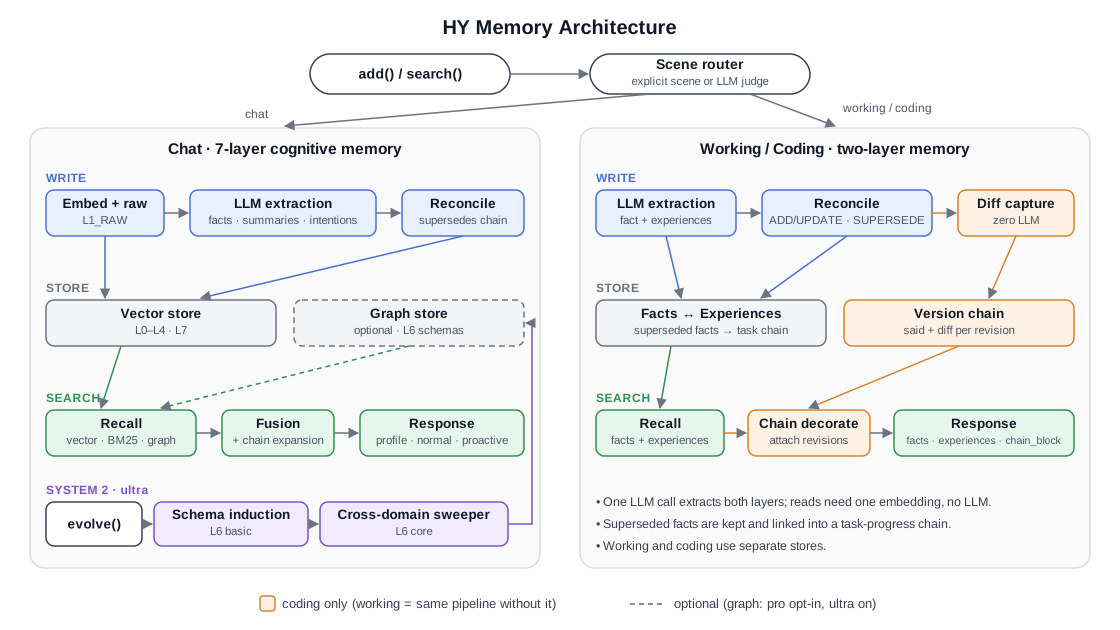
Hy Memory provides three memory scenes (scene), one per kind of task. add() / search() go through the scene router first, then into the Chat or the Working / Coding pipeline (orange parts in the diagram are coding-only; without them the pipeline is Working):
scene |
Tasks |
Memory shape |
chat |
Small talk, personal information, preferences, general Q&A |
Hierarchical memory (L0–L7) |
working |
Productivity work: documents, spreadsheets, research, financial analysis, content creation, computer operation |
Two-layer memory: session facts + reusable experiences |
coding |
Software engineering: coding, debugging, testing, builds, APIs/SDKs, scripts, SQL |
The same two-layer memory as working, plus a code version-evolution chain (diff chain) |
1. Chat: Memory Hierarchy
For long-term personal memory. Raw conversations are abstracted layer by layer into facts, summaries, a profile, and higher-level cognitive structures:
| Layer |
Name |
Content |
| L0 |
BASIC_INFO |
Basic information |
| L1 |
RAW |
Raw conversation (append-only) |
| L2 |
FACT |
Atomic facts (versioned, immutable records) |
| L3 |
SUMMARY |
Session summaries |
| L4 |
IDENTITY |
Reserved |
| L5 |
KNOWLEDGE |
Reserved |
| L6 |
SCHEMA |
Mental models (abstract narrative templates, graph layer) |
| L7 |
INTENTION |
Prospective intentions (with an expiry; demoted to ordinary facts once expired) |
Modes
| Mode |
What it does |
Graph DB |
Use case |
lite |
Raw-only embedding writes and searches, no LLM calls; scene and layers are ignored |
No |
Vanilla vector RAG, fast ingestion, zero LLM cost |
pro |
+ LLM extraction + reconcile |
Optional (MEMORY_ENABLE_GRAPH, off by default) |
Standard workloads |
ultra |
+ System 2 schema induction + cross-domain sweeper (triggered by evolve()) |
Yes (always on) |
Full cognitive architecture |
2. Working: Two-Layer Productivity Memory
For getting things done. One session with tool calls (a trace) produces both layers at once:
| Layer |
What it records |
Per session |
Structure |
Facts (WorkingFact) |
What this session did: the task, the approach, the result |
Exactly 1, no threshold |
statement, subject, files, details (verbatim source) |
| Experiences |
Approaches that can be reused next time a similar task comes up |
0–N, must pass a value threshold |
task, search_keys, solution, boundary_envs, confidence |
The fact layer guarantees that work which was done is remembered; the experience layer makes what was learned reusable. The two layers link to each other (fact.derived_experience_ids ↔ experience.source_fact_ids), and superseded facts stay traceable through a task-progress chain (fact_chain_summary).
3. Coding: Two-Layer Memory + Version-Evolution Chain
Coding reuses the same two-layer pipeline and data schema as Working. It differs in three ways:
|
Working |
Coding |
| Extraction spec |
Productivity-task spec |
Software-engineering spec: the subject must be code or a decision; record exact coordinates (file / function / branch) instead of pasting code |
| Storage |
coding_memory.db + *_coding_keys / *_working_facts collections |
coding_memory_cv.db + *_cv collections, fully isolated from working |
| Version-evolution chain |
None |
Yes: how many times the same code was changed, and what each change was |
Why a version-evolution chain: fact extraction deliberately avoids pasting code (the budget goes to more informative coordinates), so a version that was later reverted never appears in a fact.
That version is usually not in the working tree or at HEAD either, so it cannot be read back afterwards. The chain stores the real diff of every version with zero LLM calls, filling in exactly the information a summary inevitably drops.
Design highlights (hy_memory/coding/chain_store.py):
- A decorator, not a retriever: the vector layer decides which facts are returned; the chain only attaches, under each fact, every revision of the code it touches (the user's words for that revision + the real diff).
- Change sources: local Git diffs (set
MEMORY_CODING_CHAIN_REPO_ROOT), or deterministic replace actions with path / old / new in the tool trace.
- Chain granularity & isolation: one thread corresponds to one block of one function in one file on one branch, isolated by
user_id + workspace_id.
Support
Storage Backends
- Vector stores: ChromaDB (default), Qdrant, FAISS
- Graph stores (ultra mode): Kuzu (default), Neo4j
- Working / Coding business storage: SQLite (default), optional PostgreSQL; configuration
Documentation
- Usage guide — full configuration reference, API details, deployment modes
- Environment variables — settings and defaults
- Search and Reader guide — reader selection, schema quotas, rerank, and return channels
- Working/Coding Scenes — productivity-memory routing, response shapes, and coding chain behavior
- Graph memory design — graph projection, rerank, relation paths, and deployment limits
- Environment template — a copy-ready configuration template
- MemHub README — local-first desktop & CLI product overview, runtime commands, and privacy boundaries
- Hermes native memory provider — explicit owner/agent scope; separate HTTP service; automatic capture and recall opt-in.
- OpenClaw plugin — agent integrations live under
plugins/ (overview: plugins/README.md)
License
Hy-Memory is licensed under Apache-2.0. See LICENSE; third-party
components remain subject to their respective licenses and notices.

 Hy Memory 是一个面向生产环境的双系统认知记忆引擎,也是用于自我进化 LLM 智能体的 Python SDK(hy-memory),并为聊天、工作和编程任务分别提供独立的记忆流水线。它还附带 MemHub,这是一款本地优先的桌面和命令行工具,可将 Claude Code、Cursor、Codex 等应用的记忆统一到一个受管理的本地存储中。