Most database GUIs are Electron shells with megabytes of tax. GoNavi takes a different path — and “lightweight” only makes sense if you separate three numbers:
Number
What it means
GoNavi (v0.9.8)
Installer size
What you download
~20–26 MB class (Win / macOS / Linux release assets)
Steady-state RSS
What RAM the running UI holds
Linux WebKit build, idle empty workbench: main ≈ 429 MB; with WebKit helpers ≈ 765 MB (method below)
UI stack
Chromium tax or not
Go + system WebView (Wails) — not Electron
Typical Electron client
GoNavi
Runtime
Chromium + Node
Go + native WebView
Installer
Hundreds of MB common
~20–26 MB class
Startup
Heavy
Fast
Memory claim
Often mixed with installer size
Measure RSS separately (see note)
AI / Agents
Bolt-on or absent
First-class MCP + multi-provider AI (draft SQL; GUI still owns schema / edits / EXPLAIN)
Installer MB ≠ RAM. The RSS figures above are one Linux cloud run of the v0.9.8 WebKit41 build (empty workbench, no DB connections, remote display, ~30–40 s steady). Do not compare them to installer size, or to unverified “native ~80 MB” marketing. Windows / macOS laptop numbers may differ — treat them as a labeled sample, not a leaderboard score.
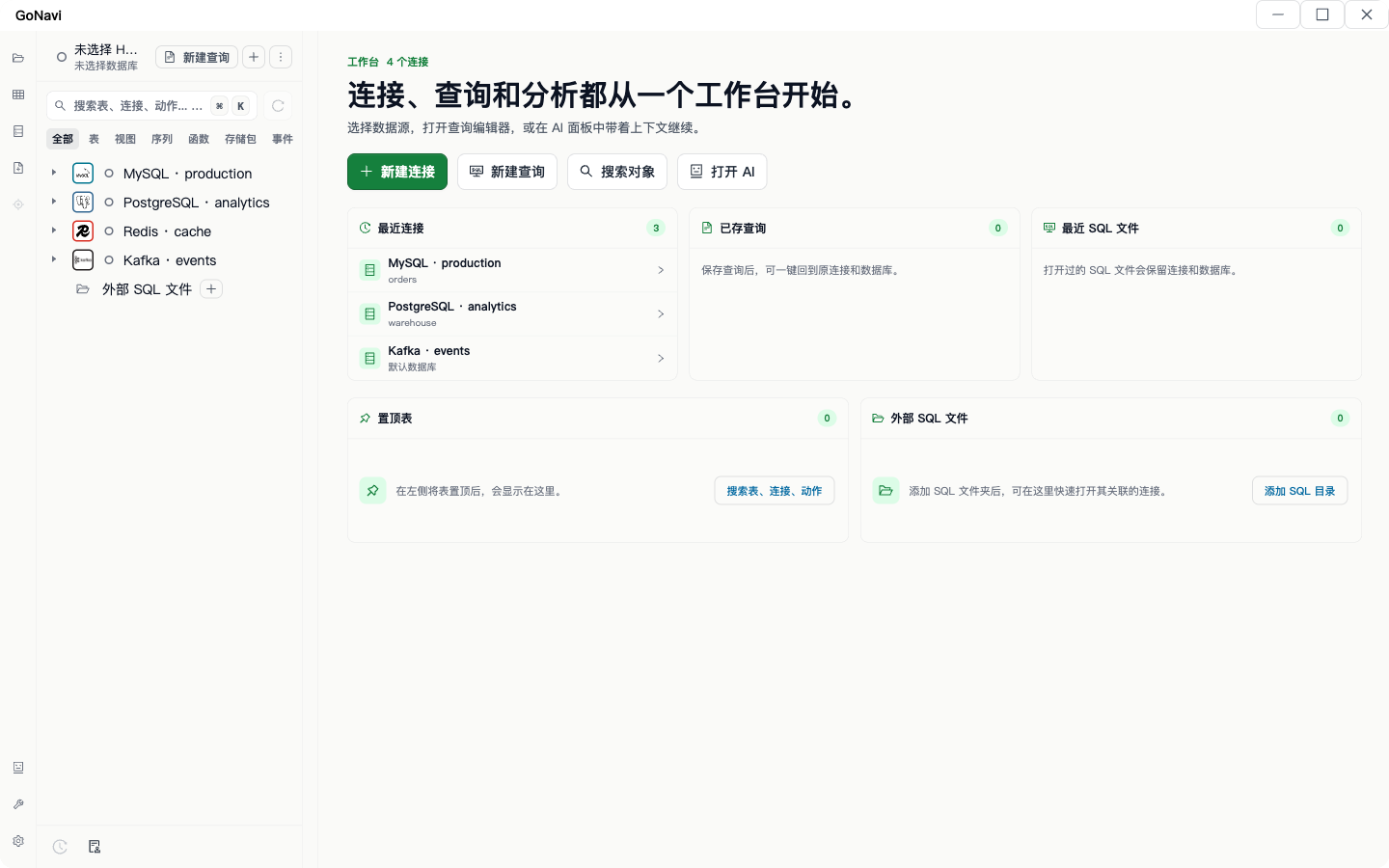
One cockpit for MySQL, Postgres, Redis, Kafka, Milvus, OceanBase, ClickHouse… Query, edit, audit, sync — and hand structured context to coding agents without leaking passwords off-host.
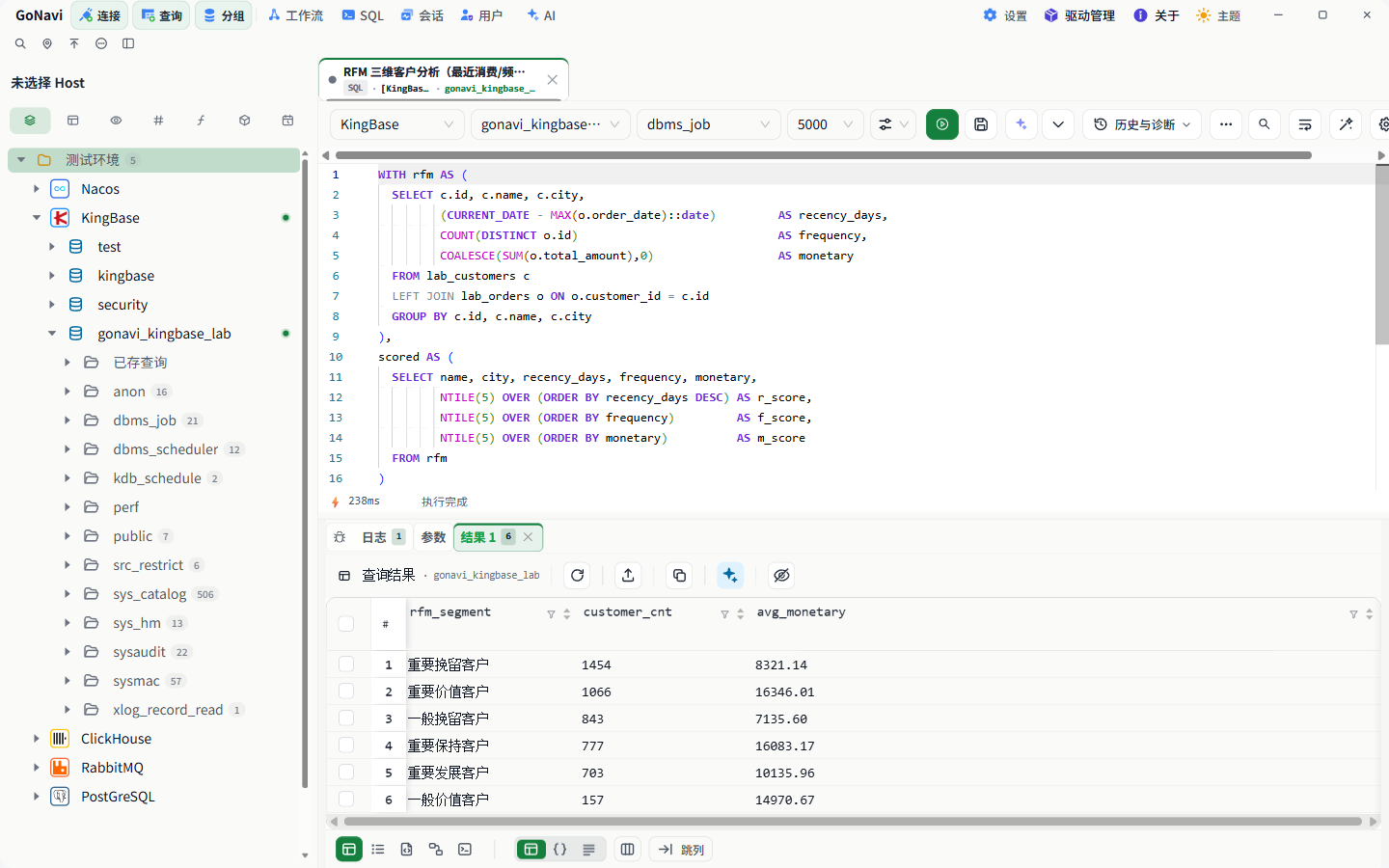
SQL editor — highlighting, result grid, object tree
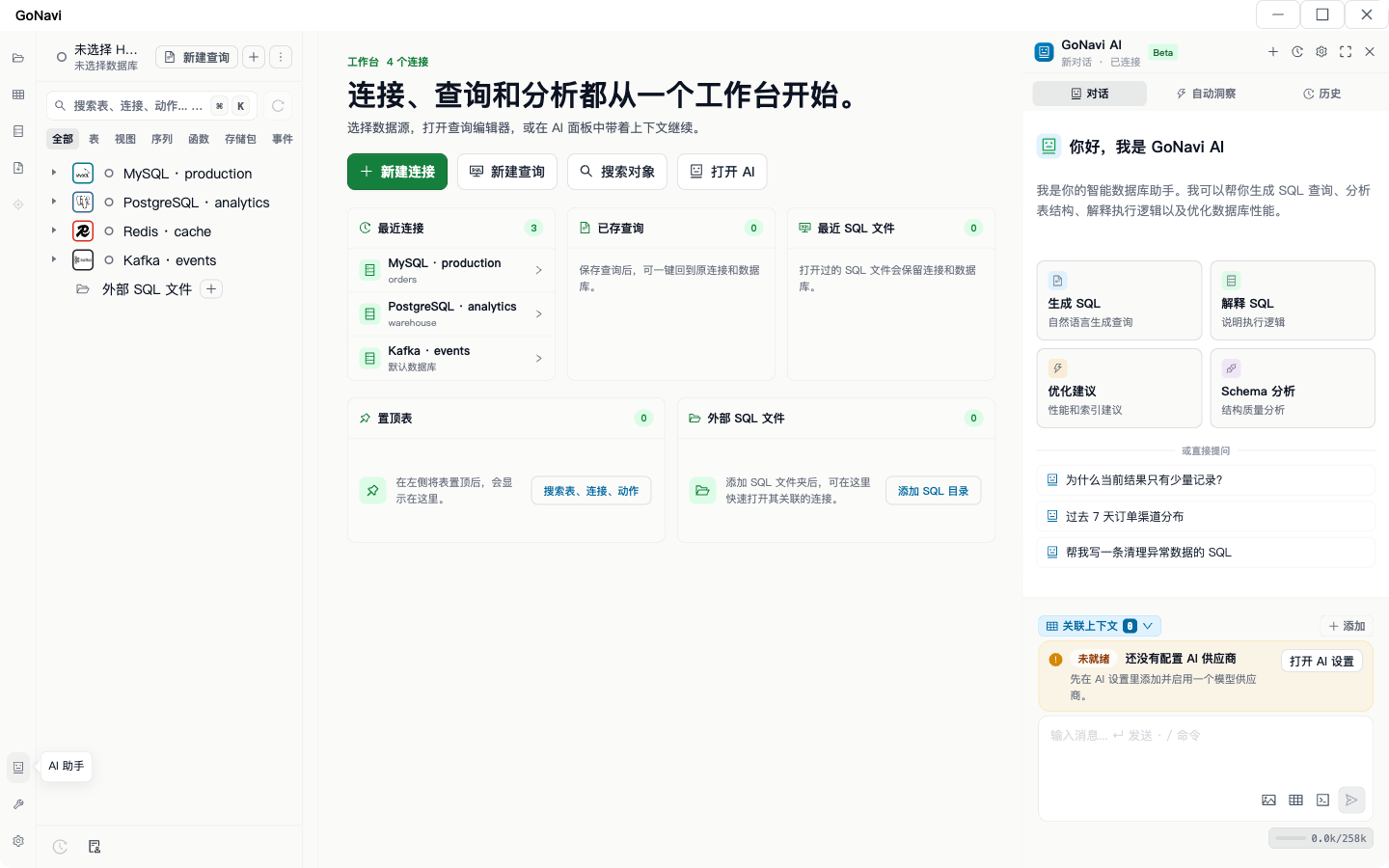
AI assistant — schema-aware chat, insert / run / preview generated SQL
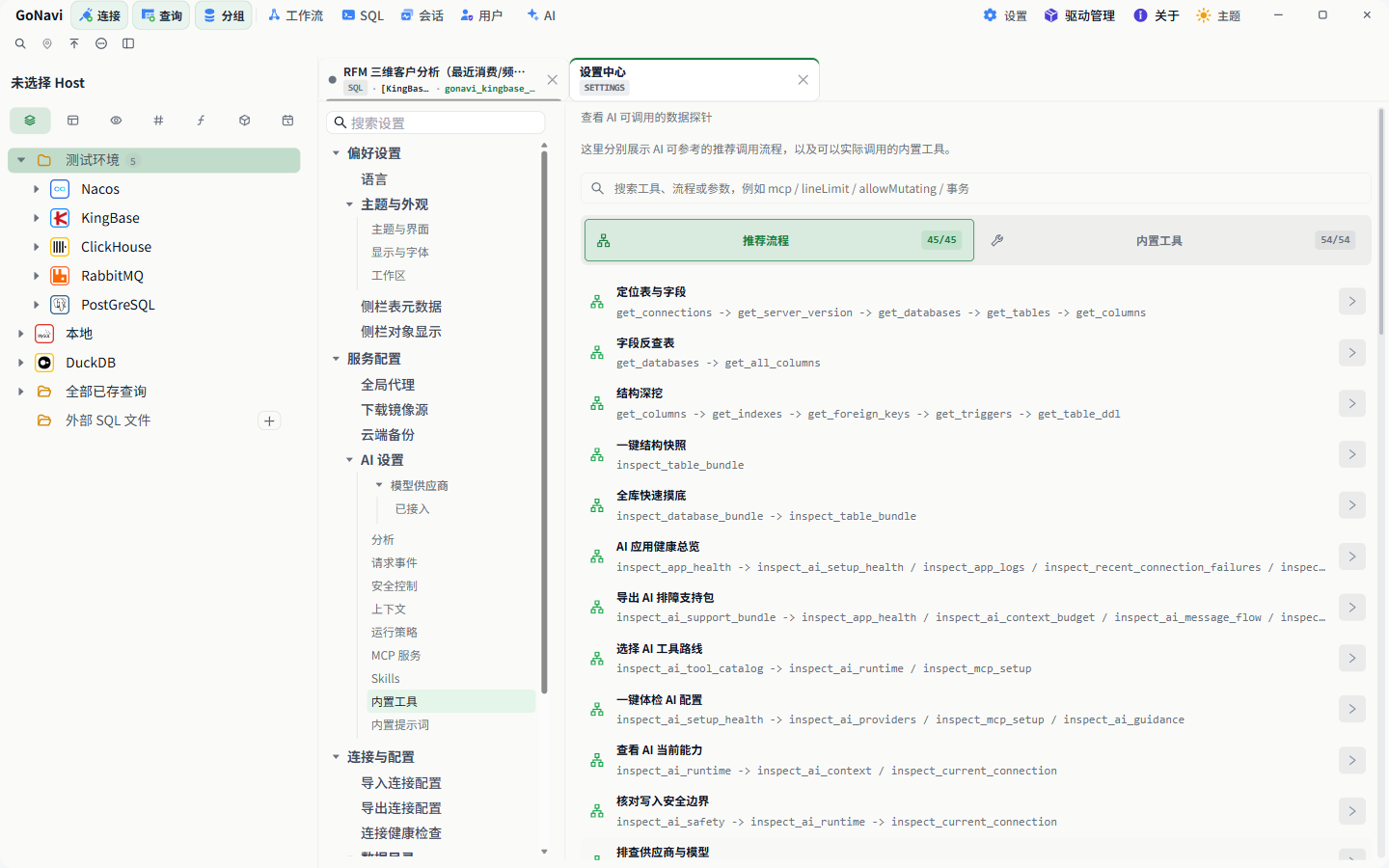
AI settings — built-in tools and recommended inspection flows
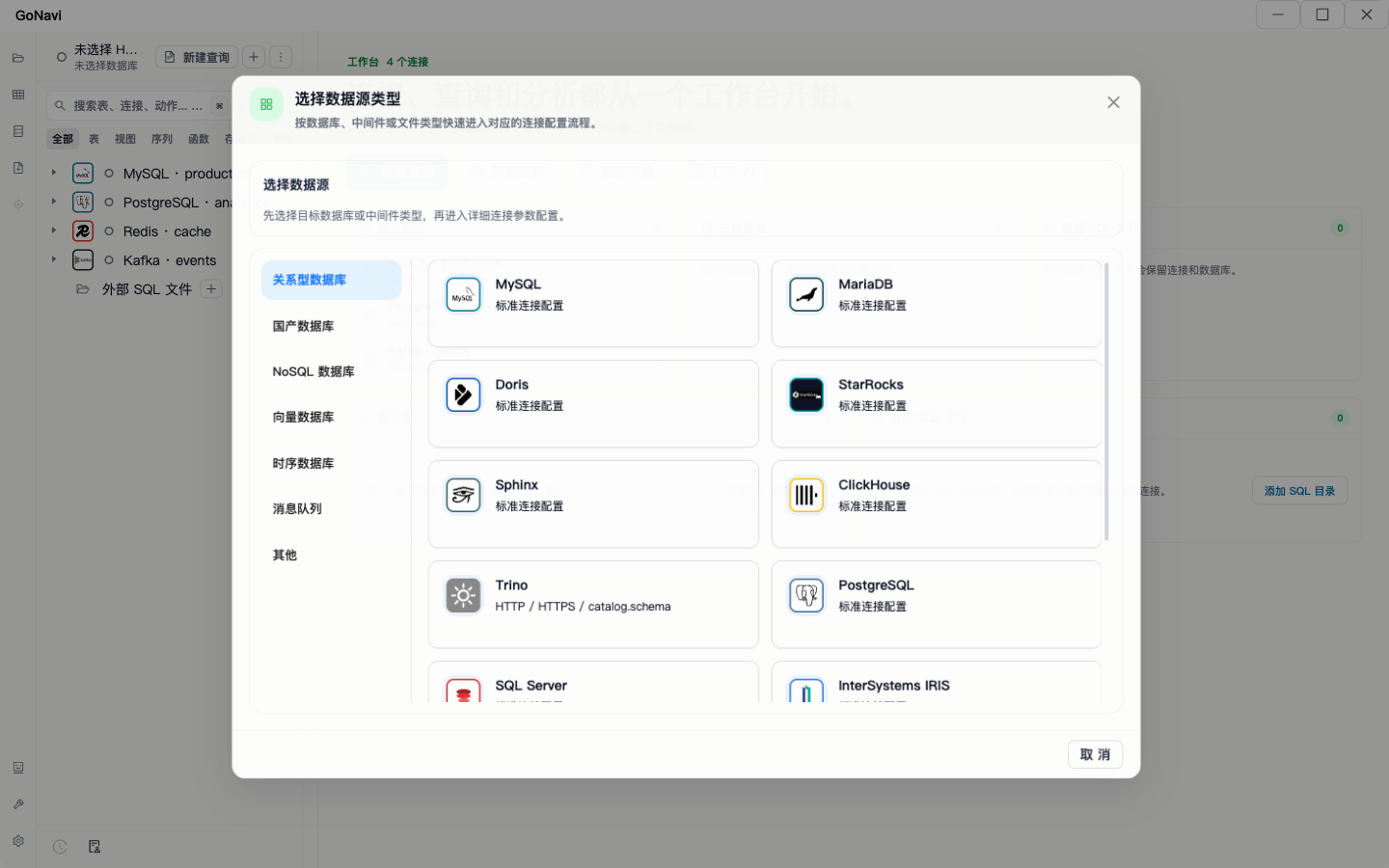
New connection — searchable, categorized data-source picker
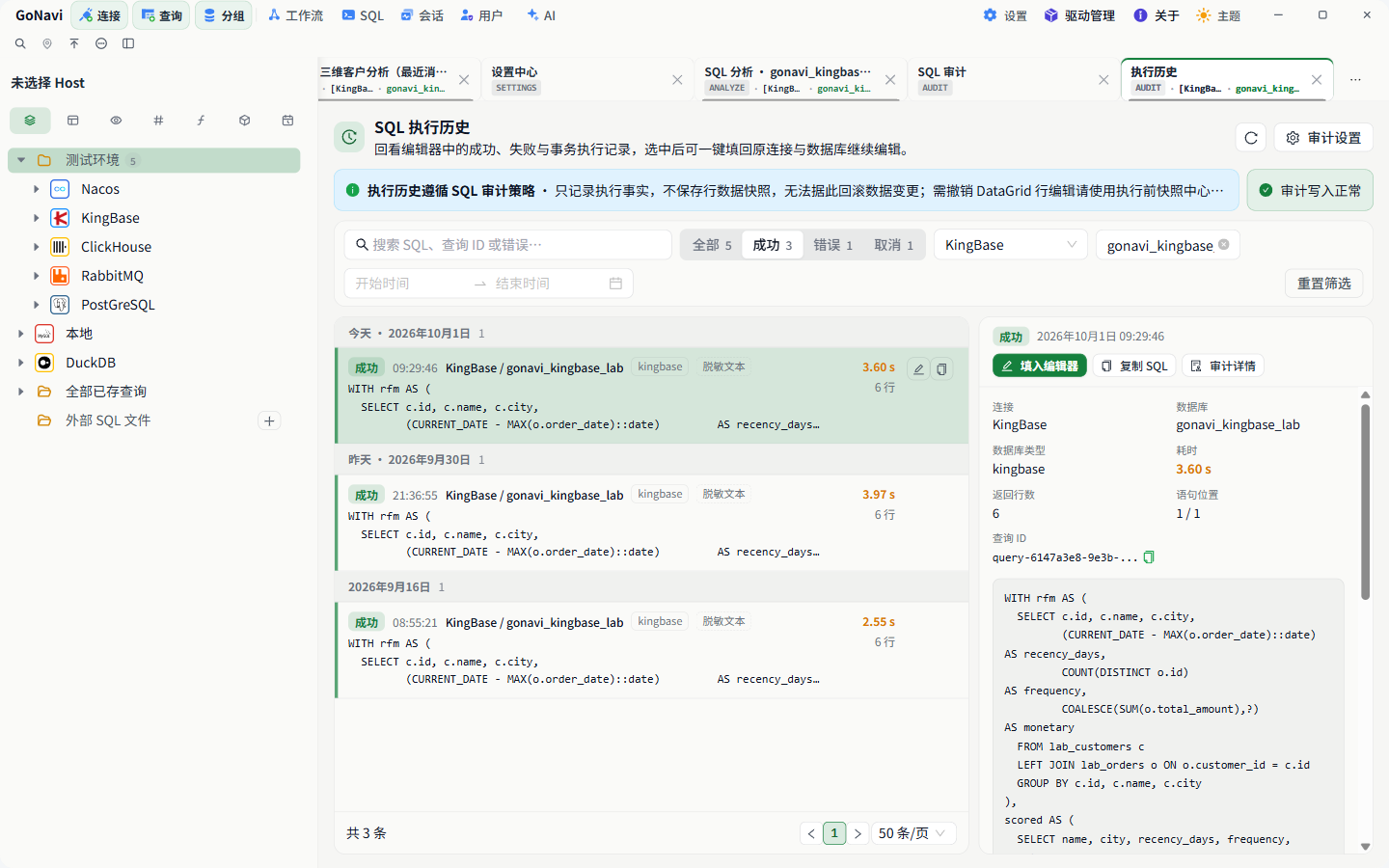
SQL execution history — filter, inspect, refill into the editor
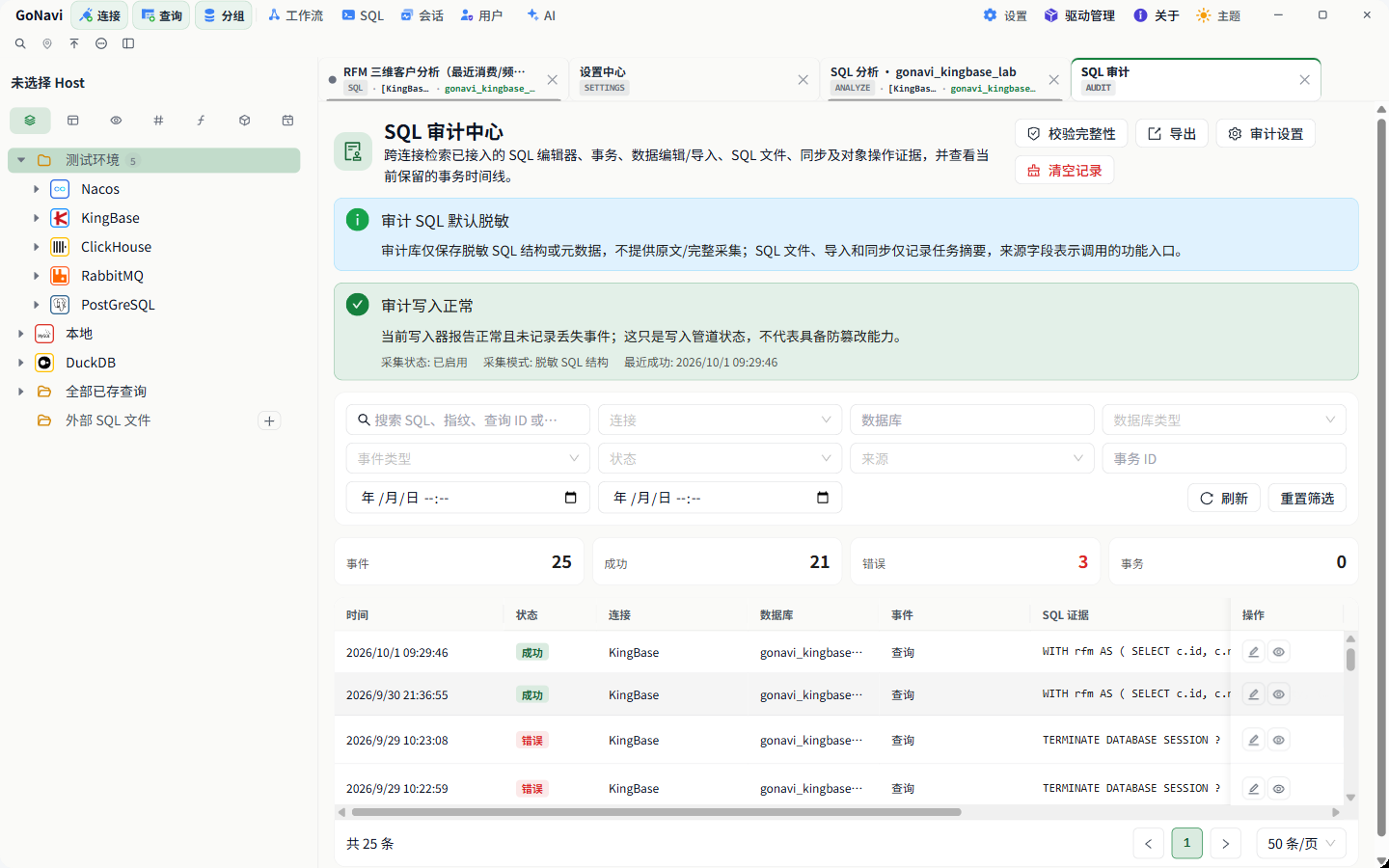
SQL audit center — desensitized SQL evidence across connections
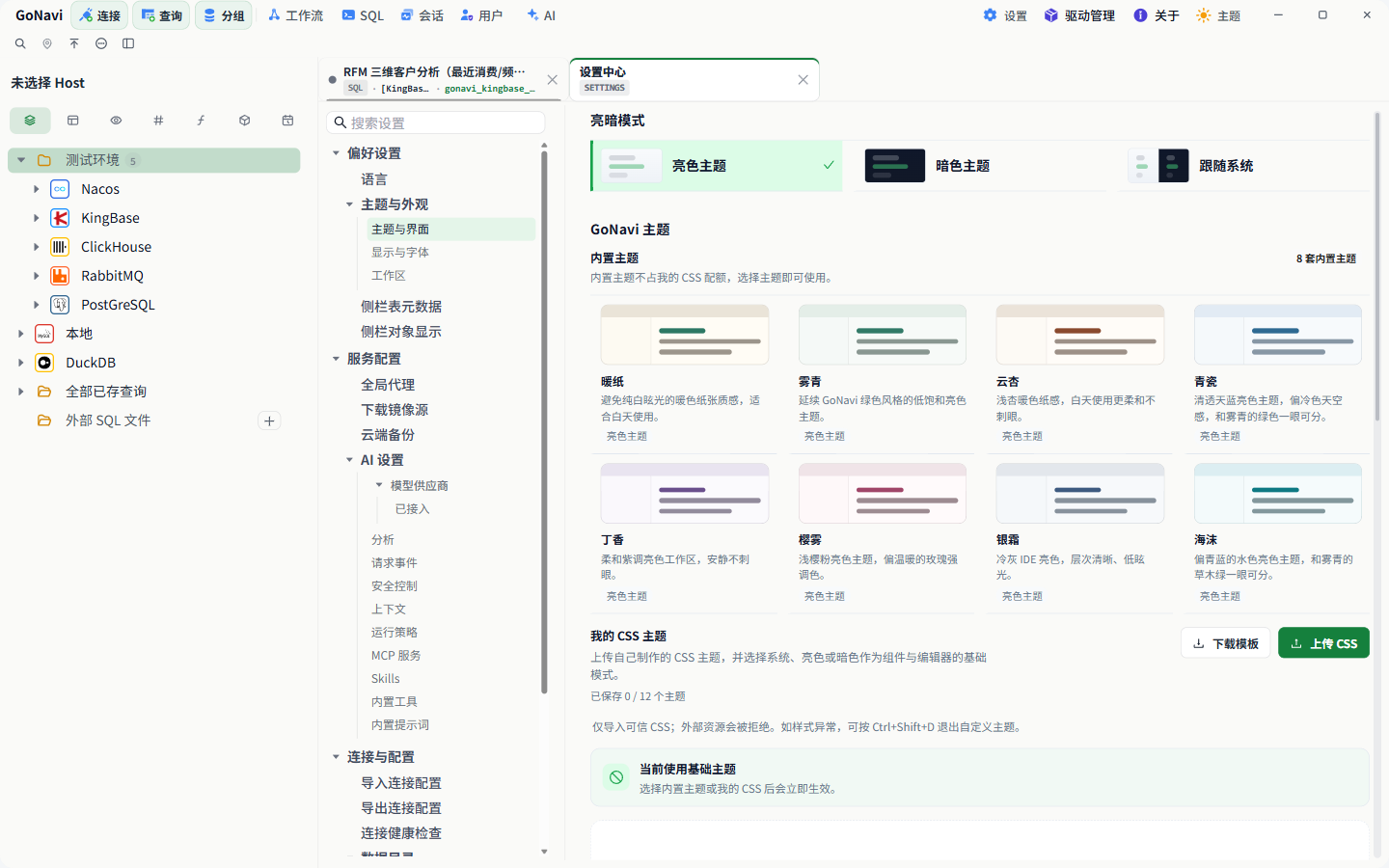
Settings — built-in themes, fonts, workspace, and more
Sample data from a local lab database · connection addresses, keys, and provider configuration are not shown
💖 Sponsors
Want to sponsor GoNavi? We welcome sponsorships and partnerships that help sustain its open-source development. Contact the maintainer on WeChat: ygf1140302783 (note “GoNavi”) to start a conversation.
APISmart provides unified access to leading AI models through a single API. Developers can connect to LLM, image, and video models using one API key and an OpenAI-compatible interface. This eliminates the need to manage multiple providers separately. Intelligent routing and automatic failover help improve reliability, while centralized billing makes usage easier to manage. With APISmart, developers can build and scale AI applications faster through one streamlined platform.
Lets developers and agent workflows use multiple AI capabilities without separately integrating each provider.
HuaLongAI is a premium model API relay provider for power AI developers, focused on official direct connectivity. It primarily offers Codex-series models supplied directly from official sources, with no substitutions or dilution, and invites verification. Billing is transparent, with token-level itemized records available for review. It supports enterprise-grade high concurrency and provides enterprise customers with a professional management platform, formal contracts, and invoices; visit the website for contact details. GPT-series models start at a 0.08 rate, with a stable Pro group at 0.15, two-way referral gifts, and uncapped referral rewards.
Stable model access is core infrastructure for GoNavi's schema-aware assistants, MCP, and day-to-day development.
MCP: after detecting a locally installed CLI, one-click connect Claude Code / Codex / OpenCode / ZCode / DeepSeek Harness / Kimi Code / Grok Build, or use Streamable HTTP for remote agents
Secrets stay on the GoNavi host — agents get tools, not raw passwords
Elasticsearch connections reuse the query workspace as a version-aware REST console:
Write Dev Tools-style METHOD /path requests with JSON bodies, or NDJSON for _bulk and _msearch; run the request at the cursor, the exact selection, or a batch in editor order.
Search hits can be viewed as a table while the complete HTTP response remains available as raw JSON or text.
A server-side allowlist accepts supported search, document, index, mapping, settings, alias, health, and limited CAT operations. Unknown and high-privilege endpoints are rejected by default.
Destructive operations require an expiring one-time confirmation. Connection protection still takes precedence and blocks writes as well as script-bearing reads.
Writes are limited to concrete indices and require Elasticsearch view_index_metadata (or manage) permission so GoNavi can verify the target before sending data; aliases and data streams are not accepted as write targets.
Request templates adapt document, mapping, and Bulk paths for Elasticsearch 6, 7, and 8.
This console targets Elasticsearch 6/7/8. It does not claim OpenSearch compatibility, and intentionally excludes reindex, security, snapshot, node, cluster-settings, template, pipeline, lifecycle, and other unrestricted administration APIs.
git clone https://github.com/Syngnat/GoNavi.git
cd GoNavi

wails dev                          # full hot reload
node tools/wails-fast-dev.mjs      # faster when Go exports unchanged
node tools/wails-fast-dev.mjs --refresh-bindings  # after Go export signature changes
Build
wails build
wails build -clean   # clean build before release
Artifacts → build/bin.
On Linux, install the build dependencies first (pick one):
The build detects whether WebKitGTK 4.1 or 4.0 is installed. The frontend build peaks at about 3 GB of memory.
Prefer a binary?
Grab the latest build from Releases (macOS AMD64/ARM64 · Windows AMD64 · Linux WebKitGTK 4.0/4.1).
Standalone CLI
Stable and dev builds carry headless gonavi archives under the
gonavi-cli_${VERSION}_${GOOS}_${GOARCH} namespace with a matching
gonavi-cli_${VERSION}_checksums.txt file. Download the matching archive from
the GitHub Release, verify its checksum, extract it, then run:
The project does not currently publish the CLI to npm. Install it directly from
the verified release archive instead.
The stable workflow also generates and retains a checksum-driven WinGet
manifest artifact for Syngnat.GoNavi.CLI; it must be accepted by the WinGet
community repository before the package is available there. The existing
desktop GoNavi package is separate. After acceptance, install with:
winget install --id Syngnat.GoNavi.CLI -e
The CLI shares the active data root with the desktop application:
GONAVI_DATA_ROOT first, then ~/.gonavi/storage_root.json, then ~/.gonavi.
Use a 0600 owner-only --connection-file for transient credentials; secrets
are never accepted as command-line flags. Query output defaults to JSONL, while
diagnostics go to stderr. Mutating SQL also requires the stored AI safety level,
connection protections, and --allow-write.
For Linux containers, copy docker.cli.env.example, set the host data root and
your host UID/GID, then run the CLI against the same mounted /data directory:
Open http://127.0.0.1:34116. Mount the active data root at /data (connections.json, daily_secrets.json, optional drivers/). Auth state → web_auth.json.
Do not expose an unhardened web entry to the public internet. Use reverse proxy + HTTPS in production.
Health: GET /__gonavi/healthz Local source build: add -f docker-compose.web-server.local.yml --build.
After changing env passwords:
docker compose --env-file docker.web-server.env -f docker-compose.web-server.yml up -d --force-recreate
(docker restart does not reload env files.)
🤖 MCP & Agents
Ship schema tools to agents without shipping your vault:
Image tags (all four images follow the same scheme):
Tag
Meaning
latest
Newest stable release
0.9.8 / v0.9.8
Exact release, e.g. ghcr.io/syngnat/gonavi-web-server:0.9.8
0.9 / v0.9
Newest patch of a minor line
dev-latest
Rolling dev branch build, moves on every push
Pin an exact release when a cluster should not drift; dev-latest is a moving
pointer and is not a stable anchor. Release tags are published both with and
without a v prefix (v0.9.8 and 0.9.8) pointing at the same digest, so use
whichever your tooling expects.
Safety defaults: remote schema-only omits execute_sql; when enabled it follows the same AI safety controls as the built-in assistant, and calling execute_sql is the confirmation. Details: cmd/gonavi-mcp-server/README.md.
Push a v* tag → GitHub Actions builds multi-arch releases. Notes auto-generated from merged PRs via .github/release.yaml.
🛠 Troubleshooting
Windows: missing Microsoft Edge WebView2 Runtime (common on intranet images)
The GoNavi desktop app on Windows depends on the Microsoft Edge WebView2 Runtime (a system component, not full Chrome). Some intranet / thin / Server / LTSC images ship without it. Symptoms:
Process exits immediately, blank/white window
Errors about missing WebView2 / WebView2 Runtime
Installer blocked by AV or group policy
1. Check whether Runtime is installed
In PowerShell:
# Common Evergreen install path (64-bit Windows)
Test-Path "${env:ProgramFiles(x86)}\Microsoft\EdgeWebView\Application"

# Registry (a `pv` version usually means installed)
Get-ItemProperty -Path "HKLM:\SOFTWARE\WOW6432Node\Microsoft\EdgeUpdate\Clients\{F3017226-FE2A-4295-8BDF-00C3A9A7E4C5}" `
  -ErrorAction SilentlyContinue |
  Select-Object pv, name
If the path is missing and registry has no pv, install the Runtime.
The next stable macOS release is gated on Developer ID signing and Apple notarization. Download the DMG from the matching GitHub Release, move GoNavi to Applications, and open it normally. Do not remove Gatekeeper quarantine metadata.
What is this?GoNavi is a high-performance, cross-platform database GUI client that connects to many different data sources (SQL, cache, vector, message queue, search, time-series, domestic DBs) and is built with AI assistants and MCP in mind.
Is this an Electron app like most other DB clients?No, it deliberately avoids Electron: it is built with Go and Wails v2 using the system's native WebView, paired with a React/TypeScript frontend, which keeps the installer around 20-26MB instead of the usual hundreds of MB.
How do I get it running?Clone the repo and build it with Wails: you need Go 1.25+, Node.js 18+, and the Wails CLI, then run the dev/build commands; built artifacts land in build/bin.
Do I need anything extra on Linux to build it?On Linux you additionally need a C compiler, pkg-config, and the GTK3/WebKitGTK development packages, and the build will detect whether WebKitGTK 4.1 or 4.0 is installed.
Is the lightweight claim really apples-to-apples with Electron apps?The README is careful to separate installer size (~20-26MB) from actual running memory (idle RSS around 429MB, or ~765MB with WebKit helpers on one Linux test), and warns not to compare these numbers to unverified marketing claims.
Who is this built for?Developers and teams working across many database and messaging systems who want one GUI plus AI/agent-assisted querying instead of juggling separate tools per data source.
Does the AI assistant get access to my database passwords?No, GoNavi keeps secrets on the host machine; coding agents receive structured tools and schema context, not raw credentials.
Which AI providers does the assistant support?It supports OpenAI, Gemini, Claude, and custom OpenAI-compatible APIs, with slash commands for generating, explaining, optimizing, and reviewing SQL.
What coding agents can connect via MCP?After detecting a locally installed CLI, GoNavi can one-click connect Claude Code, Codex, OpenCode, ZCode, DeepSeek Harness, Kimi Code, or Grok Build, or expose a Streamable HTTP endpoint for remote agents.
Which databases and systems work out of the box versus need extra setup?Built-in sources include MySQL, PostgreSQL, Oracle, Redis, Chroma, Qdrant, Milvus, RocketMQ, MQTT, Kafka, and RabbitMQ, while many others like MongoDB, ClickHouse, SQL Server, MariaDB, and TDengine are added as optional driver agents via the Driver Manager.
Can I run GoNavi as a server instead of a desktop app?Yes, besides the desktop build there is an experimental Web Server mode, and it ships with Docker, Kubernetes, Helm, and Podman packaging.









 GoNavi is a high-performance, cross-platform database GUI client that connects to many different data sources (SQL, cache, vector, message queue, search, time-series, domestic DBs) and is built with AI assistants and MCP in mind.