





rankme.fast README

The project's README from github.com/SelmiAbderrahim/rankme.fast. As one markdown file: README.md.

RankMeFast logo

RankMeFast

The self-hosted SEO platform. Plain-language audits for search and AI answers.

Site audits · rank tracking · keyword research · backlinks · Search Console · AI visibility, in one docker compose up.

CI License: AGPL v3 Version Status Docker Compose Node 20+ TypeScript Coverage 100% i18n: 7 locales

Quick start · Try it without keys · Features · Documentation · Self-hosting guide · Architecture · Contributing

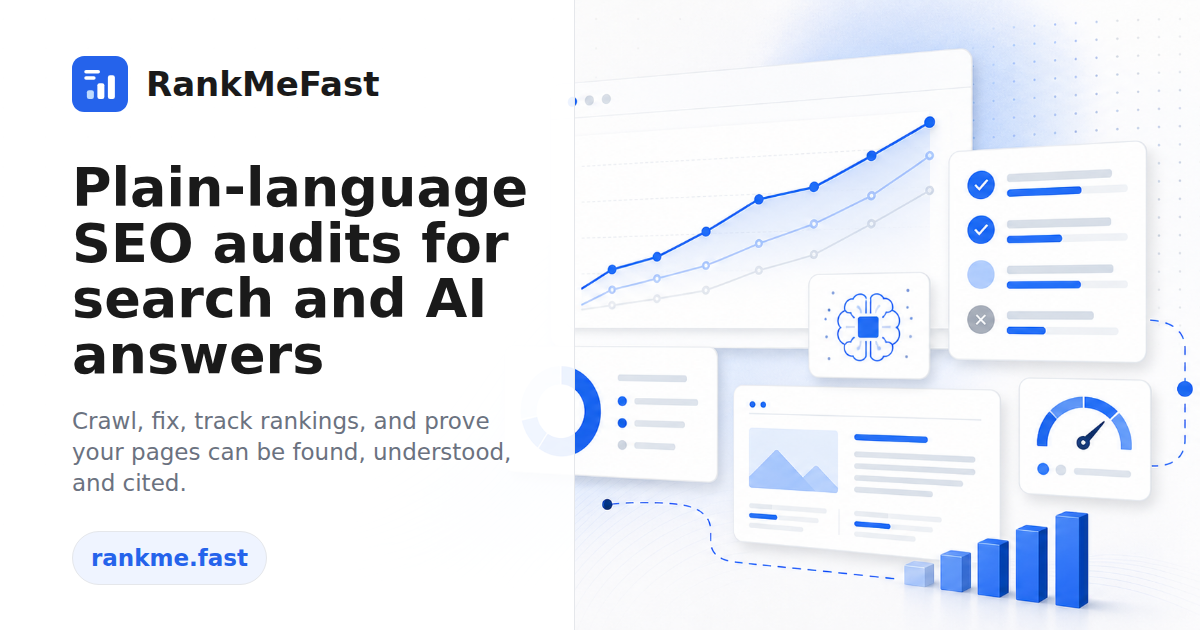
RankMeFast: plain-language SEO audits for search and AI answers

Why RankMeFast

Most SEO suites are closed SaaS with per-seat pricing, and your data stays on their servers. RankMeFast works differently:

[!NOTE] Public beta. Expect rough edges, and breaking changes between releases. Report bugs through GitHub issues.

Features

Area What you get
Site audits Crawl a site, run 26 automated checks, get a Fix now / Watch / Passed report with an optional AI summary.
Rank tracking Google organic positions over time, plus Bing, YouTube, and Amazon. SERP features, confirmed-drop alerts, and a local geogrid.
Keyword research Volume, difficulty, trends, SERP-overlap clustering, and cannibalization reports from Search Console data.
Links & competitors Backlink profiles, link-gap analysis, toxic-link review, competitor discovery, and content comparison.
Google integrations Search Console (performance, URL Inspection, sitemaps), GA4, PageSpeed Insights, and CrUX.
AI visibility Track prompts in AI Overviews and LLM answers, measure share of voice, get a weekly digest.
Content tools Content briefs, internal-linking suggestions, schema.org generation, and change monitoring for public pages.
Local & app SEO Business listings and reviews, local-pack ranks, and App Store / Google Play optimization.
Reporting PDF/CSV exports, scheduled white-label client reports, read-only share links, a Looker Studio connector, a read-only REST API, and an MCP server for AI assistants.
Teams & alerts Seats and invites, plus alert rules delivered by email, Slack, or signed webhook.
Seven languages English, Arabic (RTL), French, German, Spanish, Russian, and Chinese across the UI, emails, and docs.

Each vendor-backed feature has its own feature flag and provider setting, so you only turn on the ones you have keys for.

Quick start

Requirements: Docker with the Compose plugin.

git clone https://github.com/SelmiAbderrahim/rankme.fast.git
cd rankme.fast
cp .env.example .env

Edit .env. The minimum for a local install:

Variable Value
BETTER_AUTH_SECRET openssl rand -hex 32
MASTER_ENCRYPTION_KEY openssl rand -hex 32 (a different value)
POSTGRES_PASSWORD and DATABASE_URL the same random password in both
CLIENT_URL, APP_URL, VITE_SITE_URL http://localhost:3000
SERVER_URL http://localhost:8080

[!IMPORTANT] Back up MASTER_ENCRYPTION_KEY. Losing it makes every stored secret (OAuth tokens, channel credentials) unreadable.

Start the stack:

make build-up            # or: docker compose up -d --build
make ps                  # every service should be healthy

Open http://localhost:3000 and create an account.

Try it without vendor keys

Each provider has a fake backend, so you can explore the product without spending anything. With NODE_ENV=production the fakes are refused unless you opt in:

ALLOW_FAKE_PROVIDERS=true
EMAIL_TRANSPORT=fake

[!WARNING] Never enable this on a public deployment.

Connecting real data

Set the PROVIDER_* selectors and credentials in .env. Every variable is described in .env.example; these are the main ones:

Capability Setting Vendor
Audits, ranks, keywords, backlinks, competitors, reviews, app data PROVIDER_*=dataforseo + DATAFORSEO_LOGIN / DATAFORSEO_PASSWORD DataForSEO
PageSpeed / CrUX PROVIDER_PAGESPEED=google + GOOGLE_API_KEY (or dataforseo for lab data only) Google
Google sign-in, Search Console, GA4 GOOGLE_CLIENT_ID / GOOGLE_CLIENT_SECRET Google OAuth
Page content, change monitoring PROVIDER_CONTENT_SOURCE=firecrawl + FIRECRAWL_API_KEY Firecrawl
AI summaries, chat, clustering labels PROVIDER_AI=ai-sdk + one or more provider keys Anthropic, OpenAI, Google, DeepSeek, GLM, Kimi
Email EMAIL_TRANSPORT=resend + RESEND_API_KEY / RESEND_FROM Resend

If you select a provider but leave out its credentials, the app refuses to start and tells you which variable is missing. It never quietly falls back to the fake data.

Set SUPERADMIN_EMAIL and SUPERADMIN_PASSWORD to seed an operator account on first boot.

Day-to-day operations (make targets)
Command What it does
make build-up Build and start the stack, wait until healthy
make up / make down Start / stop the stack (volumes are kept)
make logs Follow logs from every service
make health Print each service's health state
make backup Dump Postgres, Mongo, and Redis into backup/
make restore Restore from backup/ (overwrites current data)
make test Run server and client test suites
make help List every target

The full operator guide is in docs/self-hosting.en.md.

Architecture

            ┌──────────┐   /api/*    ┌──────────┐   BullMQ   ┌──────────┐
 browser ──▶│   web    │────────────▶│   api    │───────────▶│  worker  │
            │ SSR + SPA│             │ Express  │   Redis    │  queues  │
            └──────────┘             └────┬─────┘            └────┬─────┘
                                          │                       │
                              MongoDB (documents)    PostgreSQL (time series,
                                                     usage, vendor cache)
                                          │                       │
                                          └──── vendor providers ─┘
                                     (DataForSEO, Google, Firecrawl, LLMs)
Service Role
web Node server for the React app. Marketing and docs pages are server-rendered; the dashboard is a client-side SPA. Proxies /api to api.
api Express 4 + TypeScript. Auth (Better Auth), REST routes, MCP endpoint.
worker Same image as api. Runs the BullMQ consumers: audits, rank checks, scheduled jobs.
mongo Sites, audit runs, reports, and other document-shaped data.
postgres Rank history, keywords, usage counters, and the vendor cache (Drizzle ORM; migrations apply on boot).
redis Job queues and rate limits.

Vendor calls all go through typed interfaces in server/src/shared/providers/, so switching vendors means changing config rather than feature code.

Tech stack

Layer Tools
Frontend React 18 · Redux Toolkit · React Router 6 · Vite 6 · Tailwind CSS v4 · shadcn/ui · i18next
Backend Express 4 · TypeScript 5 · Mongoose 8 · Drizzle ORM · Better Auth · BullMQ · pino · zod
Data MongoDB · PostgreSQL 17 · Redis 7
Quality Vitest (100% coverage) · Playwright · axe-core · ESLint

Documentation

User guides live in docs/, one file per page per locale, and are also served inside the app at /docs.

Start here Features Integrations
Getting started Audit report Google Search Console
Self-hosting Rank tracking Public API
Troubleshooting Keyword research MCP server
Changelog AI visibility Looker Studio

Development

The app runs through Docker Compose; the databases are only reachable on the internal compose network. Typechecking, linting, and tests run on the host with Node.js 20+:

npm --prefix server install
npm --prefix client install

Run the same checks as CI:

npm --prefix server run typecheck && npm --prefix client run typecheck
npm --prefix server run lint      && npm --prefix client run lint
npm --prefix server exec -- vitest run --coverage
npm --prefix client exec -- vitest run --coverage

Server tests use in-process MongoDB (mongodb-memory-server) and PGlite, so they don't need Docker. Coverage is enforced at 100% for owned code.

After editing a Drizzle schema under server/src/db/schema/, run npm --prefix server run db:generate and commit the generated SQL.

Repository layout
client/            React app + SSR server (client/server.js)
  src/features/    one folder per product area
  src/shared/      API client, UI primitives, i18n, theme
  e2e/             Playwright specs
server/
  src/modules/     one folder per API module (routes, service, model, tests)
  src/shared/      providers, queue, middleware, crypto, i18n
  src/worker.ts    worker entrypoint
  drizzle/         generated SQL migrations
docs/              user guides, one file per page per locale
ops/               operator runbooks
tools/             Looker Studio connector

Contributing

Issues and pull requests are welcome. For anything bigger than a bug fix, open an issue first so we can agree on the approach.

Before opening a PR, check that:

The conventions are written down in CLAUDE.md and .claude/rules/.

Security

Please don't report vulnerabilities in public issues. Use GitHub's private vulnerability reporting on this repository instead.

License

RankMeFast is licensed under the GNU Affero General Public License v3.0. If you run a modified version as a network service, you must offer its source to the users of that service.

rankme.fast (SelmiAbderrahim/rankme.fast)

Searching Database…

Что это?RankMeFast — self-hosted SEO-платформа, объединяющая аудиты сайтов, отслеживание позиций, подбор ключевых слов, анализ обратных ссылок, интеграцию с Search Console и отслеживание AI-видимости в одном стеке Docker Compose; позиционируется как открытая альтернатива закрытым SaaS-инструментам вроде Semrush.
Это SaaS, где я регистрируюсь, или то, что я запускаю сам?Вы запускаете его сами через Docker Compose; всё оседает в вашей собственной MongoDB и PostgreSQL, а не на серверах вендора, а для провайдеров данных подключаются ваши собственные API-ключи.
Как его запустить?Отредактируйте .env, внеся обязательные секреты (BETTER_AUTH_SECRET, MASTER_ENCRYPTION_KEY, пароль Postgres, URL), и запустите стек Docker Compose командой make build-up, затем откройте приложение и создайте аккаунт.
Нужны ли ключи API от DataForSEO, Google и т.д., чтобы им пользоваться?Для реальных данных да — аудиты, позиции, ключевые слова и обратные ссылки идут через DataForSEO, Google APIs, Firecrawl и опционально LLM-провайдера с вашими ключами. У каждого провайдера есть ещё и фейковый бэкенд с демо-данными, так что весь продукт можно попробовать без всяких ключей.
Достаточно ли это стабильно для продакшена?Проект помечен как публичная бета, так что ждите шероховатостей и ломающих изменений между релизами; баги отслеживаются через GitHub issues.
Где на самом деле живут мои SEO-данные?Все просканированные и вендорские данные хранятся в вашей собственной self-hosted MongoDB и PostgreSQL, а экспортировать данные или запланировать удаление аккаунта можно самостоятельно.
В чём подвох лицензии AGPL?Проект лицензирован под AGPL-3.0, поэтому если вы запускаете изменённую версию как сетевой сервис, вы обязаны сделать исходники этой изменённой версии доступными пользователям вашего сервиса.
Что считается отслеживанием AI-видимости?Оно отслеживает ваши промпты в AI Overviews и ответах LLM-чатов, измеряя долю голоса (share of voice) и присылая еженедельную сводку о том, как представлен ваш бренд.
Зачем нужен MCP-сервер?Он открывает интерфейс только для чтения, чтобы AI-ассистенты могли напрямую запрашивать ваши аудиты, позиции и данные по ключевым словам через Model Context Protocol.
Какие языки поддерживает интерфейс?Семь: английский, арабский (RTL), французский, немецкий, испанский, русский и китайский — в интерфейсе, письмах и документации.
Как он снижает расходы на API вендоров?Ответы вендоров кэшируются и разделяются между пользователями, поэтому один и тот же запрос по ключевому слову или URL не оплачивается дважды, пока кэшированная копия свежа.
Size
12 MB
Stars
750
Updated
CommitOct 09
Age
25d
Commits · 90 Days
